Tag: instability

  • Colorful Spirals

    Colorful Spirals

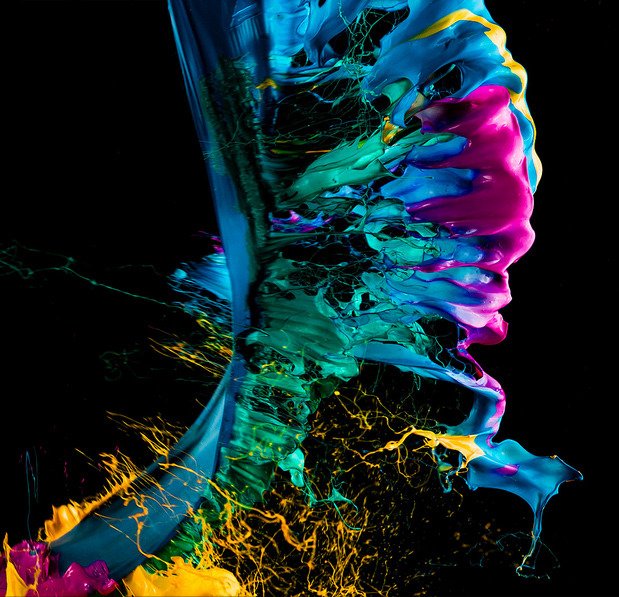
    Artist Fabian Oefner captures these colorful portraits of fluid instability by dripping acrylic paints onto a metal rod, which is connected to a drill. When the drill is switched on, paint is flung away from the rod, creating these snapshots of centripetal force and surface tension. Note how droplets gather at the ends of the spiral arms like in a Plateau-Rayleigh or a rimming instability. For more, check out Oefner’s webpage, which includes a video showing how the images are made, or his previously featured work, “Millefiori”. (Photo credit: F. Oefner; submitted by Stephen D.)

  • The Boundary Layer Visualized

    The Boundary Layer Visualized

    Any time there is relative motion between a solid and a fluid, a small region near the surface will see a large change in velocity. This region, shown with smoke in the image above, is called the boundary layer. Here air flows from right to left over a spinning spheroid. At first, the boundary layer is laminar, its flow smooth and orderly. But tiny disturbances get into the boundary layer and one of them begins to grow. This disturbance ultimately causes the evenly spaced vortices we see wrapping around the mid-section of the model. These vortices themselves become unstable a short distance later, growing wavy before breaking down into complete turbulence. (Photo credit: Y. Kohama)

  • Featured Video Play Icon

    Tuning Fork Fluids

    This high-speed video shows a liquid crystal fluid vibrating on a tuning fork. As the surface moves, tiny jets shoot upward, sometimes with sufficient energy that the fluid column is stretched beyond surface tension’s ability to keep it intact, resulting in droplet ejection. The jets and surface waves create a mesmerizing pattern of fluid motion. (Video credit: J. Savage) 

  • Featured Video Play Icon

    Flapping Flags

    Sometimes structural forces and aerodynamic forces combine to produce instabilities. One of the most common and familiar examples of this, a flag flapping in the breeze, remains extremely complex to analyze and describe. The flexibility of the flag, and its small but finite resistance to bending, combine with the variability of air flow around the flag to create a fascinating dance of effects. This same aeroelastic flutter can create disastrous results for structures and aircraft. For more on the flapping flag, see Argentina and Mahadevan (2004). (Video credit: S. Morris)

  • The Red Crown

    The Red Crown

    A drop of red dye falls into a thin layer of milk, forming a crown splash. Notice the pale edges of the droplets at the rim of the crown; this is milk that has been entrained by the original drop. The rim and satellite droplets surrounding the splash are formed due to surface tension effects, chiefly the Plateau-Rayleigh instability–the same effect responsible for breaking a falling column of liquid into droplets like in a leaking faucet. The instability will have a most unstable wavelength that determines the number of satellite droplets formed. (Photo credit: W. van Hoeve et al., University of Twente)

  • Dye Flow

    Dye Flow

    Fluid flow near a surface–inside the boundary layer–can often be unstable. This image shows one possible instability, formed when a cylinder is rotated back and forth about its longitudinal axis. This oscillation and the curvature of the cylinder destabilize flow in the boundary layer, forming vortices that line the cylinder. This particular behavior is called a Görtler instability. To visualize it, threads soaked in fluorescing dye have been embedded into slits in the cylinder. The cylinder is oscillated in a water tank and ultraviolet light is used to fluoresce the dye for the image. (Photo credit: Miguel Canals/University of Hawaii)

  • Fishbones

    Fishbones

    When two liquid jets collide, they can form an array of shapes ranging from a chain-like stream or a liquid sheet to a fishbone-type structure of periodic droplets. This series of images show the collision of two viscoelastic jets–in which polymer additives give the fluids elasticity properties unlike those of familiar Newtonian fluids like water. The jet velocities increase with each image, changing the behavior from a fluid chain (a and b); to a fishbone structure (c and d); to a smooth liquid sheet (e); to a fluttering sheet (f and g); to a disintegrating ruffled sheet (h), and finally a violently flapping sheet (i and j). The behavior of such jets is of particular interest in problems of atomization, where it can be desirable to break an incoming stream of liquid up into droplets as quickly as possible. (Photo credit: S. Jung et al.)

  • Liquid Sculptures

    Liquid Sculptures

    Artist Corrie White uses dyes and droplets to capture fantastical liquid sculptures at high-speed. The mushroom-like upper half of this photo is formed when the rebounding jet from one droplet’s impact on the water is hit by a well-timed second droplet, creating the splash’s umbrella. In the lower half of the picture, we see the remains of previous droplets, mixing and diffusing into the water via the Rayleigh-Taylor instability caused by their slight difference in density relative to the water. There’s also a hint of a vortex ring, likely from the droplet that caused the rebounding jet. (Photo credit: Corrie White)

  • Spiraling Ferrofluid

    Spiraling Ferrofluid

    Here a ferrofluid climbs a spiral steel structure sitting on an electromagnet. Magnetic field lines emanating from the sculpture’s edges tend to push the ferrofluid out into long spikes–part of the normal field instability–but surface tension resists. The short, somewhat squat spikes we see are the balance struck between these opposing forces. Though known for their wild appearance, ferrofluids appear many in common applications, including hard drives, speakers, and MRI contrast agents. Researchers have also recently suggested they might help understand the behavior of the multiverse. (Photo credit: P. Davis et al.)

  • Featured Video Play Icon

    Ink Drops

    This super high resolution video (check the original on YouTube) by filmmaker Jacob Schwarz features slow motion diffusion of ink into water. The subtle differences in density between the ink and the water promote instabilities such as the Rayleigh-Taylor instability and its distinctive cascade of mushroom- or umbrella-like shapes. The mixing of two fluids seems like a simple concept, but the reality is beautiful, complex, and always fascinating. (Video credit: J. Schwarz; submitted by Rebecca S.)