Here a ferrofluid climbs a spiral steel structure sitting on an electromagnet. Magnetic field lines emanating from the sculpture’s edges tend to push the ferrofluid out into long spikes–part of the normal field instability–but surface tension resists. The short, somewhat squat spikes we see are the balance struck between these opposing forces. Though known for their wild appearance, ferrofluids appear many in common applications, including hard drives, speakers, and MRI contrast agents. Researchers have also recently suggested they might help understand the behavior of the multiverse. (Photo credit: P. Davis et al.)
Tag: instability

Ink Drops
This super high resolution video (check the original on YouTube) by filmmaker Jacob Schwarz features slow motion diffusion of ink into water. The subtle differences in density between the ink and the water promote instabilities such as the Rayleigh-Taylor instability and its distinctive cascade of mushroom- or umbrella-like shapes. The mixing of two fluids seems like a simple concept, but the reality is beautiful, complex, and always fascinating. (Video credit: J. Schwarz; submitted by Rebecca S.)
Dropping Through Strata
When a droplet falls through an air/water interface, a vortex ring can form and fall through the liquid. In this video, the researchers investigate the effects of a stratified fluid interface on this falling vortex ring. In this case, a less dense fluid sits atop a denser one. Depending on the density of the initial falling droplet and the distance it travels through the first fluid, the behavior and break-up of the vortex ring when it hits the denser fluid differs. Here four different behaviors are demonstrated, including bouncing and trapping of the vortex ring. (Video credit: R. Camassa et al.)

Mixing Physics
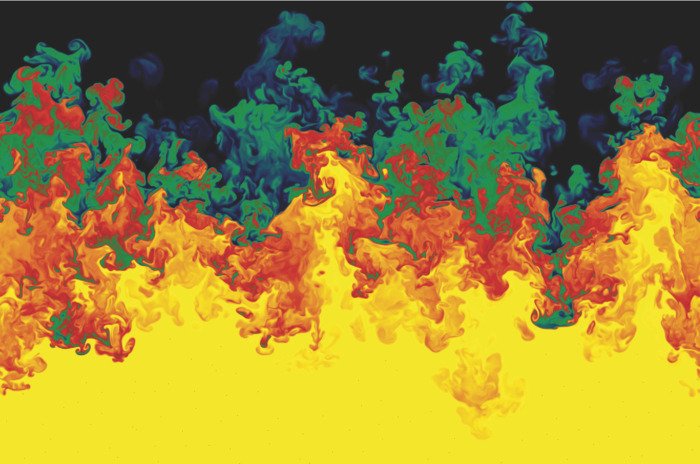
When a dense fluid sits above a lighter fluid in a gravitational field, the interface between the two fluids is unstable. It breaks down via a Rayleigh-Taylor instability, with mushroom-like protrusions of the lighter fluid into the heavier one. The image above comes from a numerical simulation of this effect well after the initial instability; the darker colors represent denser fluids and lighter colors are less dense fluids. The flow here has progressed to turbulence, and the authors of the simulation are exploring the statistical nature of this flow breakdown relative to the classical case of isotropic, homogeneous turbulence. (Photo credit: W. Cabot and Y. Zhou)
Spitting Droplets
Any phenomenon in fluid dynamics typically involves the interaction and competition of many different forces. Sometimes these forces are of very different magnitudes, and it can be difficult to determine their effects. This video focuses on capillary force, which is responsible for a liquid’s ability to climb up the walls of its container, creating a meniscus and allowing plants and trees to passively draw water up from their roots. Being intermolecular in nature, capillary forces can be quite slight in comparison to gravitational forces, and thus it’s beneficial to study them in the absence of gravity.
In the 1950s, drop tower experiments simulating microgravity studied the capillary-driven motion of fluids up a glass tube that was partially submerged in a pool of fluid. Without gravity acting against it, capillary action would draw the fluid up to the top of the glass tube, but no droplets would be ejected. In the current research, a nozzle has been added to the tubes, which accelerates the capillary flow. In this case, both in terrestrial labs and aboard the International Space Station, the momentum of the flow is sufficient to invert the meniscus from concave to convex, allowing a jet of fluid out of the tube. At this point, surface tension instabilities take over, breaking the fluid into droplets. (Video credit: A. Wollman et al.)

Slapping Sheets
Here fluid is ejected as two flat plates collide, creating a sheet of silicone oil. The initially smooth sheet forms a thicker ligament about the edge. Gravity causes the sheet to bend downward like a curtain, and growing instabilities along the ligament cause the development of a wavy edge. The points of the waves develop droplets that eject outward. Not long after this photograph, the entire liquid sheet will collapse into ligaments and flying droplets. (Photo credit: B. Chang, B. Slama, and S. Jung)

A Colorful Rinse
In this image a jet of water (clear/white) is rinsing a solution of polyacrylamide (PAM; blue) off a silicon surface. In the center, a hydraulic jump marks the interface where fast-moving laminar flow changes to a slower turbulent one. At the same time, the water, which is less viscous than the PAM, creates viscous finger-like protrusions into the blue liquid as it rinses the surface clean. (Photo credit: T. Walker, T. Hsu, and G. Fuller)
Mixing Physics
One of the most commonly observed fluid instabilities is the Rayleigh-Taylor instability, which occurs between fluids of differing densities. It’s most often seen when a denser fluid sits over a lower density fluid. In the video above, this is demonstrated experimentally: a lower density green fluid mixes in with the clear, higher density fluid. This is the classical case in which each initial region of fluid is uniform in density prior to the removal of the barrier. But what happens when each zone has its own variation in density? This is the second case. Before the barrier is removed, each region of the tank has a varying–or stratified–fluid density. In this case, the unmixed fluids are stably stratified, meaning that the fluid density increases with depth. At the barrier interface, the two separate fluids are still unstably stratified–with the denser fluid on top–so when the barrier is removed, the Rayleigh-Taylor instability still drives their mixing. Because of the stable stratification within the original unmixed fluids, the mixing region after the barrier’s removal is more limited. (Video credit: M. D. Wykes and S. B. Dalziel; via PhysicsCentral by APS)

Ocean Waves in the Sky
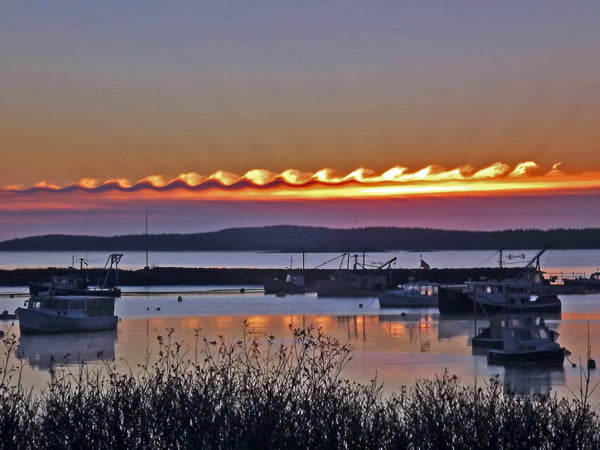
These wave-like Kelvin-Helmholtz clouds can form due to shear between different layers of air in the atmosphere. When one region of air has a higher velocity than the other, their interface forms a shear layer, which can break down in this wavy pattern. In this case, the lower layer of air was moist enough to form condensation and clouds, making the pattern visible to the naked eye. (Photo credit: Gene Hart; via Flow Visualization)
INK World v01
In this video, mixtures of inks (likely printer toners) and fluids move and swirl. Magnetic fields contort the ferrofluidic ink and make it dance, while less viscous fluids spread into their surroundings via finger-like protuberances. (Video credit and submission: Antoine Delach)