Tag: instability

  • Featured Video Play Icon

    Parametric Resonance

    At first glance, Steve Mould’s video on parametric resonance has nothing whatsoever to do with fluid dynamics. He uses a pendulum suspended on a spring to demonstrate how driving a system at a frequency that’s a multiple of the system’s natural frequency can add energy through resonance. Although his examples don’t use fluids, this phenomenon happens there, too, especially in vibrated fluid systems. Take, for example, this droplet bouncing on a vibrating pool. Depending on the amplitude of the vibrations driving the system, the droplet may bounce in time with the vibration, in time with the waves, or at a frequency twice that of the vibration. (Image and video credit: S. Mould)

    Animation depicted parametric resonance of a mass on a spring pendulum.
    By pulling on the string each time the mass swings through its lowest point (i.e., twice per swing cycle), Steve adds energy to the system, which is reflected in the increasing amplitude of the pendulum’s swing. This is an example of parametric resonance.
  • Featured Video Play Icon

    Eruption in a Box

    In layers of viscous fluids, lighter and less viscous fluids can displace heavier, more viscous liquids. Here, researchers demonstrate this using four fluids sandwiched between layers of glass and mounted in a rotating frame. (Think of those liquid-air-sand art frames found in museums but bigger!)

    In their first example, each layer of fluid is denser than the one beneath it, so buoyancy forces the lowest layer — air — to rise. The air pushes its way through the more viscous layer of olive oil, then slowly makes its way through the even more viscous glycerin before bursting through the last layer in an eruption. As the team varies the viscosity and miscibility of the layers, the movement of the buoyant fluids through the viscous layers changes dramatically. (Image and video credit: A. Albrahim et. al.)

  • Wild Patterns in Ionic Liquids

    Wild Patterns in Ionic Liquids

    Ionic liquids are essentially salts in a liquid form. In these images, a mixture of water and ionic liquid separates when heated. This phase separation causes the initial mixture to break into two regions: one low in ionic liquid and one rich in ionic liquid. Because the surface tensions of these two phases are different from one another, complex flow patterns form. (Image and research credit: M. Pascual et al.)

  • The Shapes of Melting Ice

    The Shapes of Melting Ice

    Water is an odd substance because it is densest at 4 degrees Celsius, well above its melting point at 0 degrees Celsius. This density anomaly means that melting ice takes on very different shapes, depending on the temperature of the water surrounding it. At low temperatures (under 4 degrees Celsius), the cold water melting off the ice is denser than the surroundings, so it sinks. The sinking fluid melts lower portions of the ice faster, leading to an inverted pinnacle (Image 1).

    In contrast, at higher temperatures (above 7 degrees Celsius), the meltwater is lighter than the surroundings and therefore rises, creating an upward-pointing pinnacle (Image 3). At intermediate temperatures, some areas of the ice see rising meltwater and some see sinking. This complicated flow pattern sets up vortices that result in a scalloped edge along the ice (Image 2). (Image and research credit: S. Weady et al.; via APS Physics)

  • Quantum Instability

    Quantum Instability

    In our everyday lives, two fluids moving past one another often form a wave-like pattern thanks to the Kelvin-Helmholtz instability. We see it in the curl of waves on the ocean, in clouds in the sky, and even in spirals of lava on Mars. Here researchers explore an analogous instability in the quantum world.

    By spinning a gas of ultracold atoms, the team observed a spontaneous transition from a needle-like configuration to a crystal made up of spirals. It’s a quantum Kelvin-Helmholtz instability! The authors found that wave’s phase is random; it arises purely from quantum interactions between the atoms. (Image, research, and submission credit: B. Mukherjee et al.; see also MIT News)

    The spinning cloud of ultracold atoms breaks up into a series of spirals.
  • Featured Video Play Icon

    Acrylic Paint Fractals

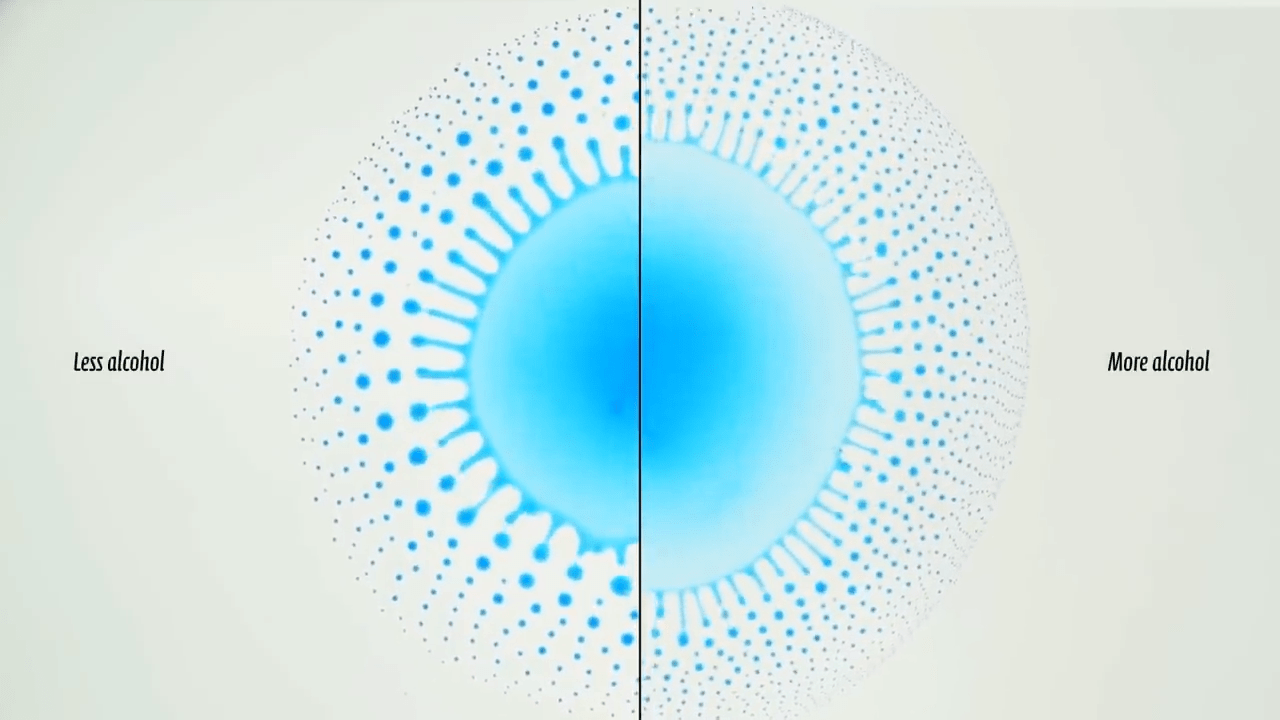
    Here’s a simple fluids experiment you can try at home using acrylic paints, ink, isopropyl alcohol and a few other ingredients. When dropped onto diluted acrylic paint, a mixture of black ink and alcohol spreads in a fractal fingering pattern. The radial (outward) flow is driven by the alcohol’s evaporation, which increases the local surface tension and draws fluid outward. The shape and density of the fingers depends, at least in part, on the viscosity of the underlying paint layer; more viscous paint layers grow smaller and denser fractal patterns. (Image and video credit: S. Chan et al.)

  • Antarctic Meltwaters

    Antarctic Meltwaters

    Cerulean blue meltwater glints in this satellite image of the George VI Ice Shelf. Wedged between the Antarctic Peninsula on the right and Alexander Island on the left, the ice shelf itself floats on the ocean. When ice shelves collapse, they do not directly raise sea levels since their weight has already displaced water; but a collapsed ice shelf lets glaciers flow and break up faster, thereby raising water levels.

    In past ice shelf collapses, scientists have noted major buildup and sudden drainage of surface lakes like the ones seen here. Meltwater penetrating through snow and ice can destabilize the shelf and hasten collapse, but the exact mechanisms are hard to track. This Physics Today article summarizes our understanding of the process and some of the methods scientists use to study it. (Image credit: L. Dauphin/NASA Earth Observatory; see also Physics Today)

  • Elastic Turbulence

    Elastic Turbulence

    Decades ago, engineers pumping polymer-filled drilling liquids into porous rock noticed sudden and dramatic increases in the viscosity of the liquid. Within the tiny pores of the rock, conventional (i.e., inertial) turbulent flow should be impossible — the Reynolds number is simply too low. Now a new experiment points to the source of the high viscosity: elastic turbulence.

    To observe the phenomenon, researchers watched flow in the spaces between glass beads packed into a narrow channel. Videos of flow through one of these pores — roughly 250 microns across — are shown below. When flow rates are low (left), the fluid moves smoothly through the pore, but at higher flow rates (right), chaotic fluctuations emerge, creating the dramatic increase in apparent viscosity. In their analysis, the researchers found that the polymers’ motions generated the flow fluctuations, but most of the viscosity increase was inherent to the fluid’s movement, not to the polymers’ resistance to stretching. (Image credit: top – M. van den Bos, pore flow – Datta Lab; research credit: C. Browne and S. Datta; via Quanta Magazine; submitted by Kam-Yung Soh)

    Video of smooth flow through a pore (left) and flow with elastic turbulence (right).
    At low flow rates (left), the fluid moves smoothly through the tiny pores, but at higher flow rates (right), the polymers in the flow generate elastic turbulence that greater increases the fluid’s apparent viscosity.
  • Featured Video Play Icon

    The Yarning Droplet

    Marangoni bursting takes place in alcohol-water droplets; as the alcohol evaporates, surface tension changes across the liquid surface, generating a flow that tears the original drop into smaller droplets. Here researchers add a twist to the experiment using PMMA, an additive that dissolves well in alcohol but poorly in water. As the alcohol evaporates, the PMMA precipitates back out of the water-rich droplet, forming yarn-like strands. (Image and video credit: C. Seyfert and A. Marin)

  • Laser-Induced Jet Break-Up

    Laser-Induced Jet Break-Up

    A falling stream of water will naturally break up into droplets via the Plateau-Rayleigh instability. Those droplets are random, unless something like vibration of the nozzle sets their size. In this study, though, researchers found that shining a laser beam on the stream can trigger an orderly break-up with droplets that are consistent in size and spacing.

    The optofluidic phenomenon depends on a few different effects. The changing curvature of the liquid stream reflects the laser light, some of which undergoes total internal reflection and travels up the jet as if it were a fiber optic cable. Look closely in the right side of the second image, and you’ll see a periodic flicker of green light at the mouth of the nozzle. Those flashes of green reveal that the liquid jet is guiding the light upstream in bursts, each of which exerts an optical pressure that triggers the Plateau-Rayleigh instability.

    When the laser first turns on, there’s a transition period before the orderly break-up begins, and, likewise, turning the laser off triggers a transition from orderly to random (top image). (Image and research credit: H. Liu et al.; via APS Physics; submitted by Kam-Yung Soh)