Tag: instability

  • Breaking Up Is(n’t) Hard to Do
    Breaking Up Is(n’t) Hard to Do

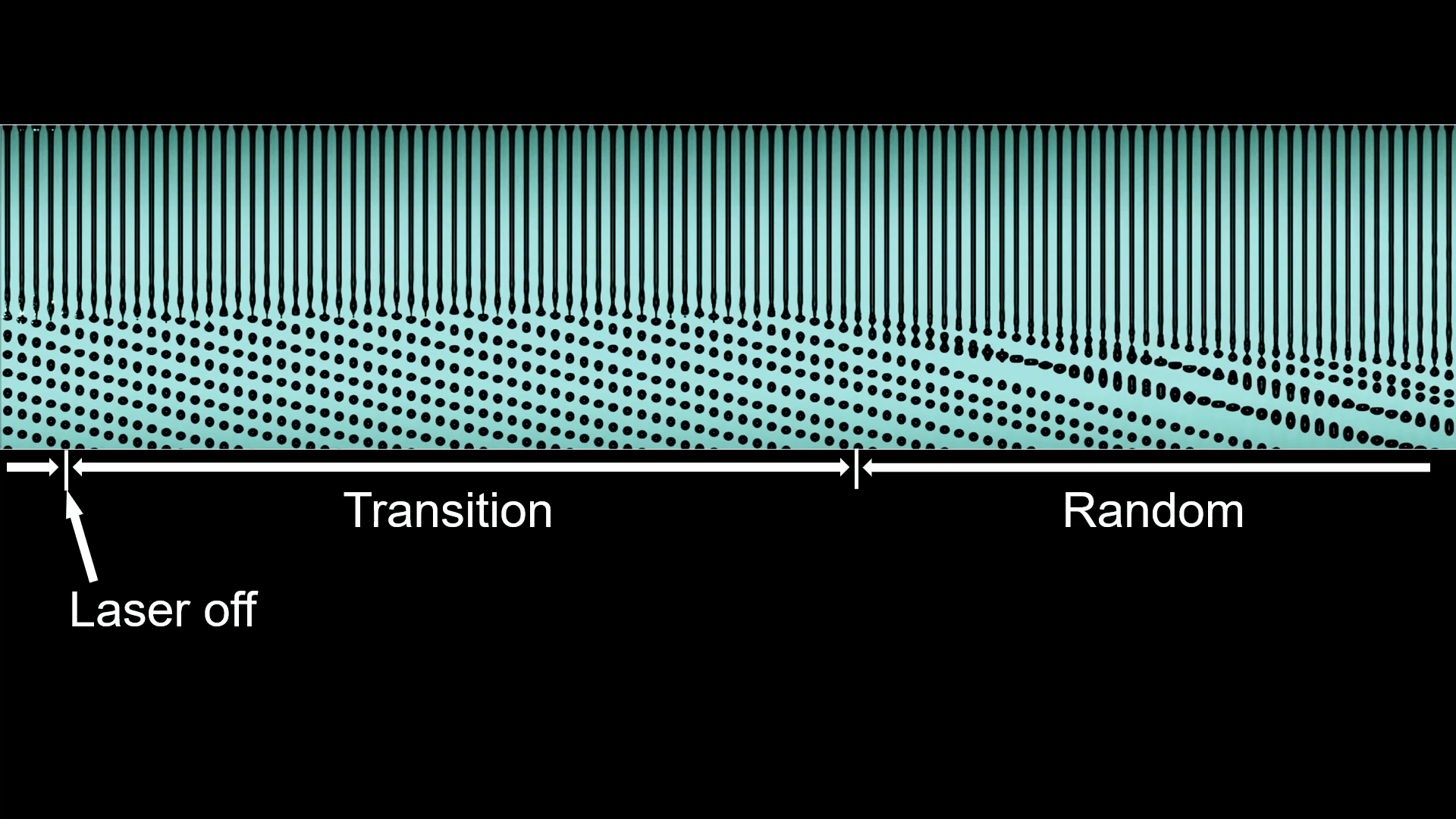
    Engineers often need to break a liquid jet up into droplets. To do so quickly, they surround the jet with a ring of fast-moving air in a set-up known as a coaxial jet. Shear between the gas and liquid creates instabilities that quickly distort the jet’s initial cylinder into sheets and ligaments. Those formations then undergo their own instabilities to break up into drops. The method is, as you can see in the high-speed images above, quite effective, though the breakup mechanism itself is tough to quantify. (Image credit: G. Ricard et al.)

  • Featured Video Play Icon

    Fluid Chains

    In this video, Steve Mould tackles a question many of us have likely wondered: just why does falling water make this chain-like shape? When pouring from a slit-like orifice, water jets take on this undulating pattern. While I have no issue with Steve’s explanation of surface tension oscillations driving the shape, I’ll quibble a little bit with the idea that this hasn’t been studied. Personally, I’d connect it to the fishbone instability, which classically occurs when two jets collide. At low flow rates, though, the colliding jets form a pattern very much like this one. And if you look just past the initial conditions at the container opening, all of these flows have thicker jet-like rims colliding. I think the flows in these videos are just a slightly messier version of the low-flow-rate fishbone. What do you think? (Video and image credit: S. Mould)

  • Featured Video Play Icon

    Dengue Dengue Dengue

    Musical duo Dengue Dengue Dengue create live audio/visual performances with fluid dynamics. Their visuals are created by adding various liquids and dyes atop an illuminated background. To add extra dynamism, they sometimes use a sheet of plastic to cover and pump the liquids, creating a pseudo-Hele-Shaw cell where they can trigger fluid instabilities in time to the music. The full performance in this video is nearly an hour long, but at least take some time to scrub through and see a few different sections. (Video credit: Dengue Dengue Dengue/Espacio Fundación Telefónica Lima; submitted by Tania S.)

  • Granular Fingers

    Granular Fingers

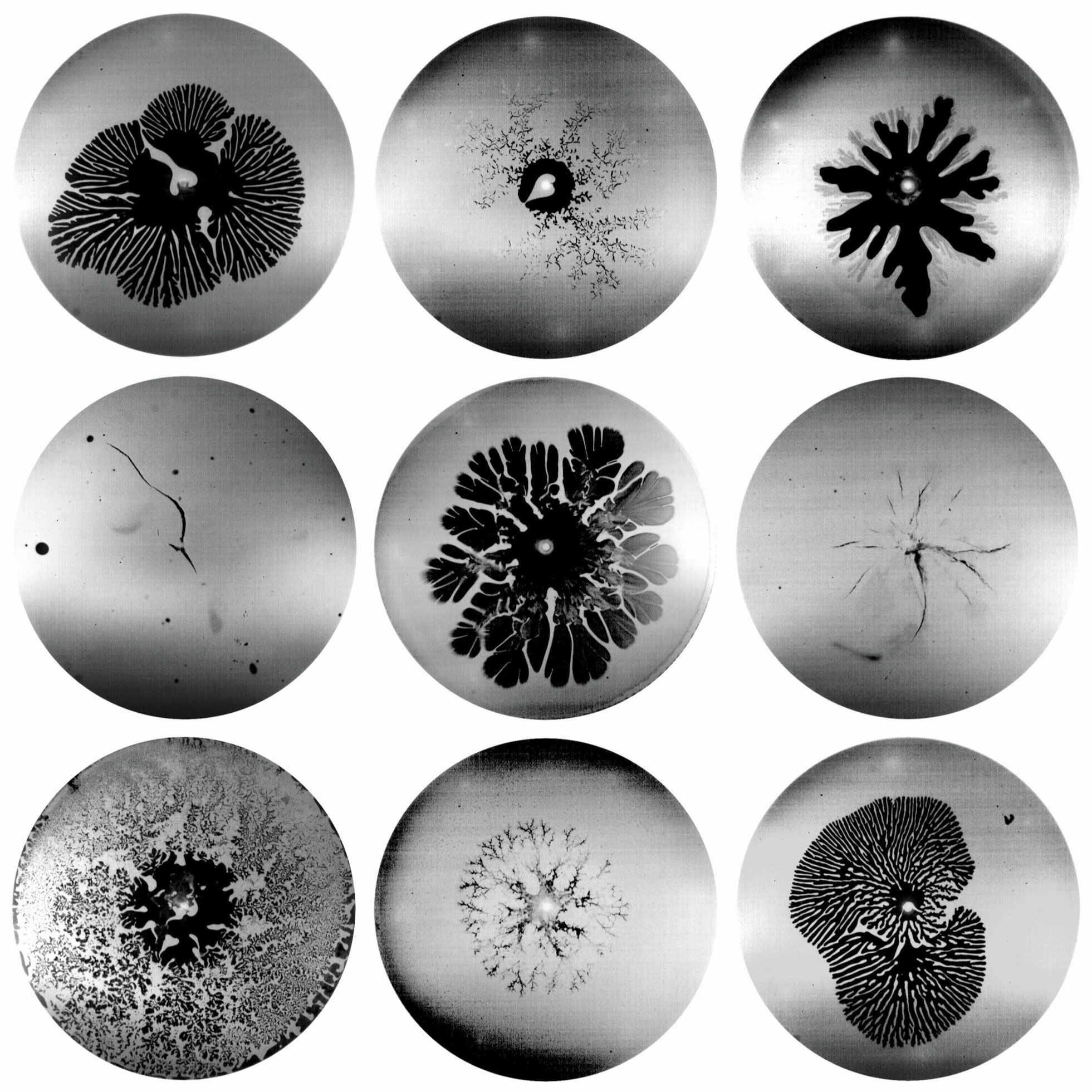
    Finger-like shapes often form on fluids injected between glass plates, but what happens when that injected fluid contains particles? That’s the situation in this recent study, where researchers sandwiched a fluid between two glass plates and then injected a second, similar fluid laced with particles.

    Despite the differences from the traditional Saffman-Taylor set-up, the granular-filled fluid still forms fingers as long as there’s even a slight density difference between the original and injected fluids. It doesn’t even matter which of the two fluids has the greater density! (Image and research credit: A. Kudrolli et al.)

  • Featured Video Play Icon

    Centrifugal Instability

    When it comes to geophysics, there are all kinds of phenomena that depend on rotation. In this short video, researchers demonstrate one such phenomena — the centrifugal instability — in a tank on a turn table. The experiment begins once the fluid in the tank is all rotating together, like a solid body would. Then, they reduce the rotation rate of the turn table. Almost immediately, we see rolls encircle the tank.

    The rolls form due to the difference in momentum between fluid in the interior and near the wall. Friction with the wall slows the fluid there down much faster than that in the middle of the tank. As the faster-moving fluid gets centrifuged outward, it forms rolls. As the video demonstrates, these rolls can be relatively uniform and laminar, or, with enough change in rotation rate, they can become turbulent. (Image and video credit: UCLA Spinlab)

  • Featured Video Play Icon

    Dendritic

    “What happens when two scientists, a composer, a cellist, and a planetarium animator make art?” The answer is “Dendritic,” a musical composition built directly on the tree-like branching patterns found when a less viscous fluid is injected into a more viscous one sandwiched between two plates.

    Normally this viscous fingering instability results in dense, branching fingers, but when there’s directional dependence in the fluid, the pattern transitions instead to one that’s dendritic. In this case, that directionality comes from liquid crystals, whose are rod-like shape makes it easier for liquid to flow in the direction aligned with the rods.

    For more on the science, math, and music behind the piece, check out this description from the scientists and composer. (Video, image, and submission credit: I. Bischofberger et al.)

  • Branching Gels

    Branching Gels

    If you sandwich a viscous fluid between two plates, then pull the plates apart, you’ll often get a complex branching pattern that forms as air pushes its way into the fluid. But the exact results depend strongly on what kind of viscous fluid you used. A new study looks specifically at what happens when that fluid is a yield-stress gel.

    Yield-stress fluids behave like a solid until a critical amount of force causes them to flow. Think about your toothpaste. When you take the cap off, the toothpaste stays put until you squeeze the tube enough to make it flow. The gels used in this experiment behave similarly.

    The researchers found that their gels required a critical energy input in order to branch and flow. If the energy applied in pulling the plates apart was too low, no branching occurred (Image 1). But beyond that critical energy, separating the plates created intricate branching patterns consistent with those seen in simpler, Newtonian fluids. (Image, research, and submission credit: T. Divoux et al.; via APS)

  • Featured Video Play Icon

    Traffic Flow and Phantom Jams

    We’ve all experienced the frustration of traffic jams that seem to come from nowhere — standstills that occur with no accident, construction, or obstacle in sight. Traffic shares a lot of similarities with fluid flows, including its waves and instabilities.

    These disturbances propagate and grow when traffic surpasses a critical density. Once that happens, any small speed adjustment made by a lead driver gets amplified by the larger and larger braking of each driver downstream. Effectively, this creates a wave of slower speed and higher density that travels downstream through the traffic.

    Each driver brakes more than the last largely because they can’t tell what the conditions upstream of them are. But that lack of knowledge may be less of an issue for driverless cars, which have the potential to communicate with cars and traffic sensors ahead of them. With enough automated vehicles on the highway, phantom traffic jams may become a thing of the past. (Video and image credit: TED-Ed)

  • Featured Video Play Icon

    Mimicking Supernovas

    The Hubble archives are full of incredible swirls of cosmic gas and dust, many of which were born in supernovas. Predicting the forms these massive explosions will generate is extremely difficult, thanks in large part to the complicated fluid dynamics generated by their blast waves. But new lab-scale experiments may help shed light on those underlying processes.

    Researchers mimic supernovas in the lab by launching blast waves through an interface between a dense gas (shown in white) and a lighter one (which appears black). As the blast wave passes, it drives the dense fluid into the lighter one, triggering a series of instabilities. Notice how any initial perturbations in the interface quickly grow into mushroom-like spikes that rapidly become turbulent. This behavior is exactly what’s seen in supernovas (and in inertial confinement fusion)! (Video credit: Georgia Tech; research credit: B. Musci et al.; submitted by D. Ranjan)

  • Dissolving Caramel

    Dissolving Caramel

    In nature, erosion patterns are driven by the interactions of flow and topography. Here, researchers study that process in the lab by placing an inclined block of caramel in quiescent syrup and watching as it dissolves. Initially, the bottom surface of the block develops regularly-spaced plumes — the dark lines seen in the first image. But because the caramel-laden plumes are heavier than the surrounding fluid, the flow quickly becomes unstable. The plumes cross one another and begin to carve chevrons into the caramel.

    The chevrons appear to march their way upward in the video. They slowly grow and change into a distinctly scalloped pattern. Scallops like these are often seen by geologists in caves and icebergs, and the authors argue that their results and modeling indicate the importance of buoyant flow effects on such natural formations. (Image and research credit: C. Cohen et al.)