Inside a combustion chamber, temperature fluctuations can cause sound waves that also disrupt the flow, in turn. This is called a thermoacoustic instability. In this video, researchers explore this process by watching how flames move down a tube. The flame fronts begin in an even curve that flattens out and then develops waves like those on a vibrating pool. Those waves grow bigger and bigger until the flame goes completely turbulent. Visually, it’s mesmerizing. Mathematically, it’s a lovely example of parametric resonance, where the flame’s instability is fed by system’s natural harmonics. (Video and image credit: J. Delfin et al.; research credit: J. Delfin et al. 1, 2)
Tag: parametric resonance

Parametric Resonance
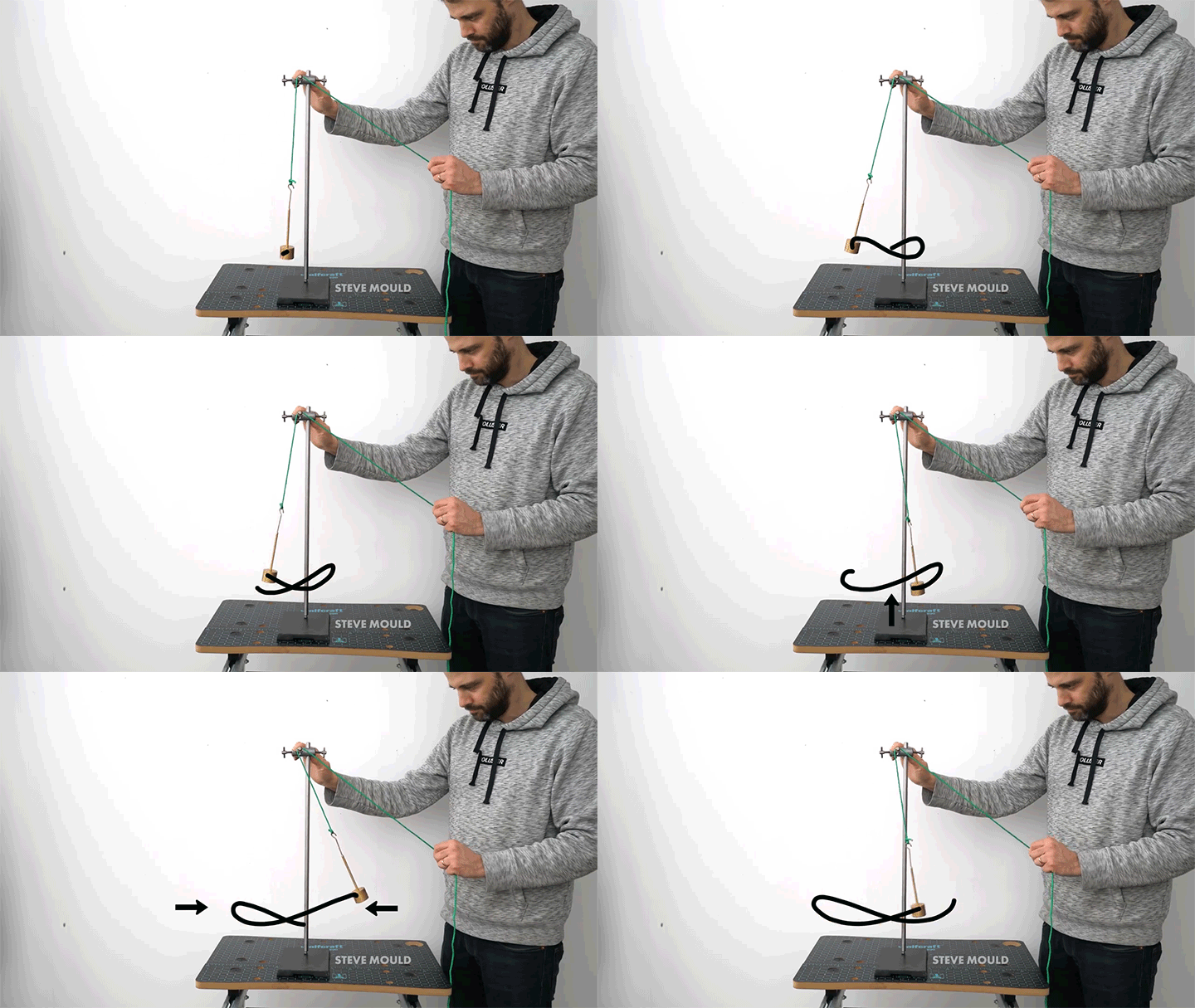
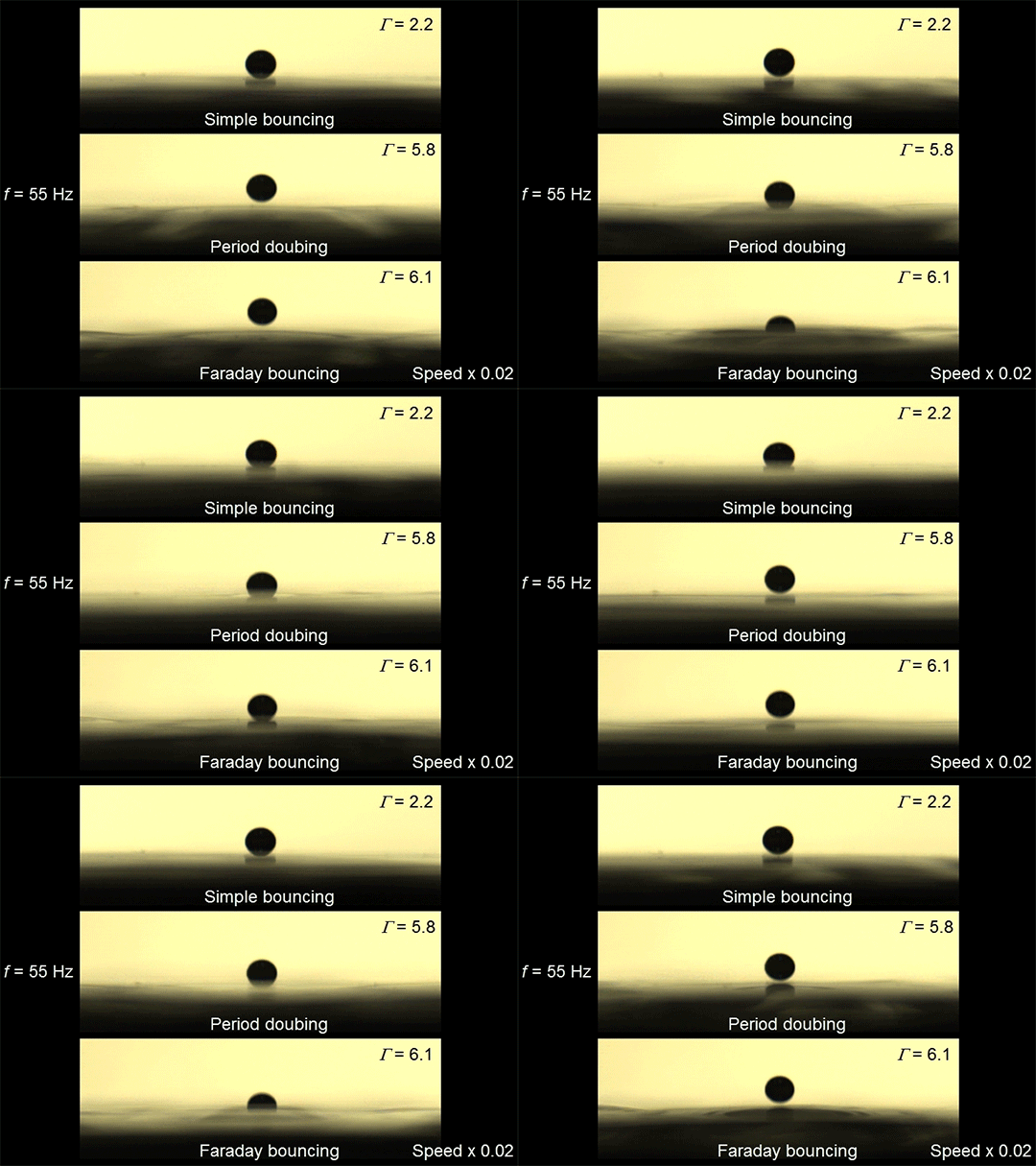
At first glance, Steve Mould’s video on parametric resonance has nothing whatsoever to do with fluid dynamics. He uses a pendulum suspended on a spring to demonstrate how driving a system at a frequency that’s a multiple of the system’s natural frequency can add energy through resonance. Although his examples don’t use fluids, this phenomenon happens there, too, especially in vibrated fluid systems. Take, for example, this droplet bouncing on a vibrating pool. Depending on the amplitude of the vibrations driving the system, the droplet may bounce in time with the vibration, in time with the waves, or at a frequency twice that of the vibration. (Image and video credit: S. Mould)

By pulling on the string each time the mass swings through its lowest point (i.e., twice per swing cycle), Steve adds energy to the system, which is reflected in the increasing amplitude of the pendulum’s swing. This is an example of parametric resonance. 
Resonating on a Bounce
When we think of resonance, we often think of it in simple terms: hit the one right note, and the wine glass will shatter. But resonance isn’t always about a one-to-one ratio between a driving frequency and the resonating system. Especially in fluid dynamics, we often see responses that occur at other, related frequencies.
One of the simplest places to see this is with a droplet bouncing on a bath of fluid. Above you see a liquid metal droplet bouncing on a bath of the same metal. At low amplitude, the pool surface moves at the driving frequency and a droplet bounces simply upon that surface, with one bounce per oscillation. Increase the amplitude, though, and the droplet’s bounce changes. It bounces twice – one large bounce and one small bounce – in the time it takes for the pool surface to go through one cycle. This is called period doubling because the bouncing occurs at twice the driving frequency.
Turn the amplitude up further, and the system undergoes another change. Faraday waves form on the surface. They resonate at half the driving frequency, and a droplet’s bouncing will sync up with the waves. That means the droplet returns to a one-to-one bounce with the waves, but the waves themselves are no longer reacting at the driving frequency. It’s this kind of complexity that makes fluid systems fertile grounds for studying paths toward chaos. (Image and research credit: X. Zhao et al.)

Psychedelic Faraday Waves
Vibrate a pool of water and above a critical frequency, a pattern of standing waves will form on the surface. These are known as Faraday waves after Michael Faraday, who studied the phenomenon in the early half of the nineteenth century. The kaleidoscopic view of them you see here comes from photographer Linden Gledhill, who used a high-speed camera and an LED ring light reflecting off the water to capture the changing motions of the waves. The wave patterns oscillate at half the frequency of the driving vibration, and, as the driving frequency changes, the wave patterns shift dramatically. Higher frequencies create more complicated patterns. (Image and video credit: L. Gledhill)