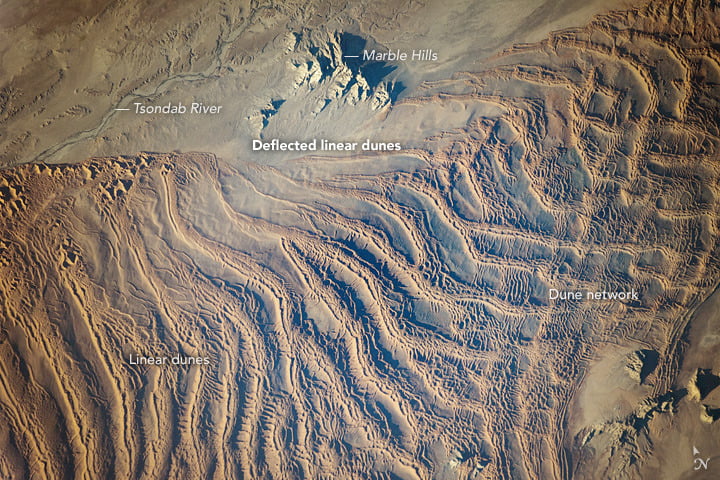
The Namib desert of southern Africa is home to some of the most stunning dunes on Earth. They are primarily linear dunes, which form parallel to the winds that form them. On the left side of the image, the dunes are aligned north-to-south along the direction of the southerly winds that blow through this area. Toward the center of the image, however, the dunes are deflected by strong seasonal winds blowing from the east. On the far right, the dunes break from a linear pattern to one with rectangular criss-crossings. This is a mixture of old and new dunes, evidence that the dominant direction of the wind has shifted over time. (Image credit: NASA Earth Observatory)
Tag: granular material

A Particle-Filled Splash


A drop of water that impacts a flat post will form a liquid sheet that eventually breaks apart into droplets when surface tension can no longer hold the water together against the power of momentum flinging the water outward. But what happens if that initial drop of water is filled with particles? Initially, the particle-laden drop’s impact is similar to the water’s – it strikes the post and expands radially in a sheet that is uniformly filled with particles. But then the particles begin to cluster due to capillary attraction, which causes particles at a fluid interface to clump up. You’ve seen the same effect in a bowl of Cheerios, when the floating O’s start to group up in little rafts. The clumping creates holes in the sheet which rapidly expand until the liquid breaks apart into many particle-filled droplets. To see more great high-speed footage and comparisons, check out the full video. (Image credit and submission: A. Sauret et al., source)

Clogging, In Hourglasses and Crowds
Hourglasses are pretty common, but you’ve probably never given much thought to the way they flow. An hourglass designer has to carefully select the sizing of the neck and the grains. Choosing a neck that’s too small relative to the grain size will result in frequent clogs but choosing too large a neck will make setting the timing difficult. Interestingly, it doesn’t matter whether the hourglass is filled with air or with water–the same principle holds.
Where this knowledge becomes especially useful, though, is when dealing with crowds. We’ve all experienced the frustration of being in a large crowd trying to fit through a small exit. Paradoxically, the fastest way to get a large number of particles (or sheep or people) through a narrow opening is to slow each individual down. This can either be done by instructing everyone to slow down or by forcing that same result by placing an obstacle immediately before the exit. The reduction in speed reduces clogging, which means everyone gets through faster! (Video credit: A. Marin et al.)

Floating on a Granular Raft

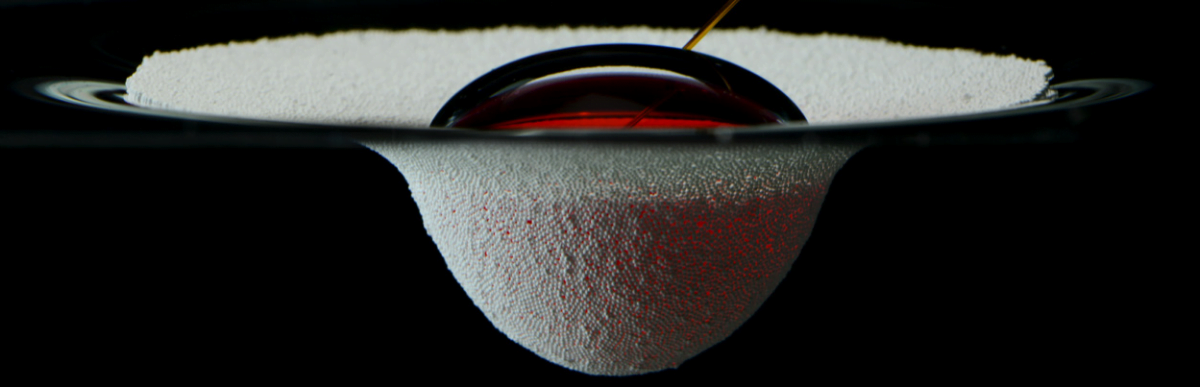
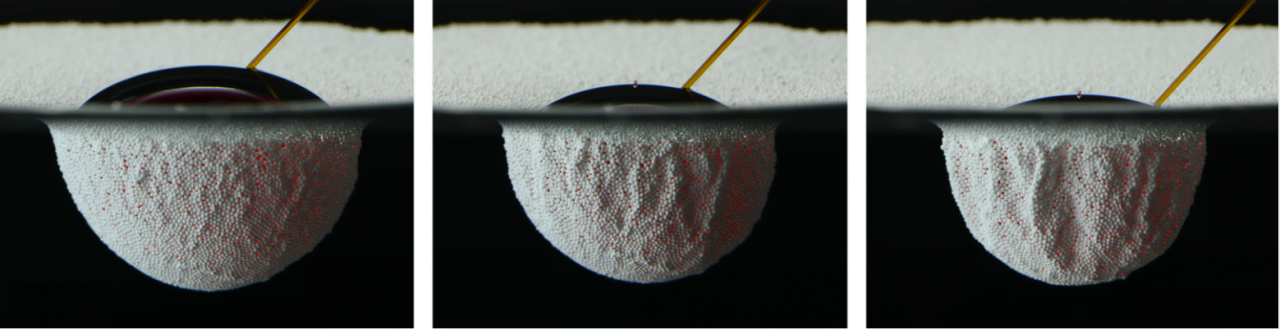
A thin layer of hydrophobic particles dispersed at an oil-water interface is strong enough to prevent a water droplet from coalescing. The researchers refer to this set-up as their granular raft. As the red-dyed water droplet gets larger (top row), it deforms the raft more and more, but the grains continue to keep the drop separate from the fluid beneath (middle row). When water is removed from the droplet, wrinkles form on the raft as the drop’s volume shrinks. This is because the contact line – where the droplet, grains, and air meet – is pinned. The grains already touching the drop are held there by adhesion. But since the drop is shrinking, the area on the raft has to shrink, too – thus wrinkles! (Photo credits: E. Jambon-Puillet and S. Protiere, original)

Martian Ripples
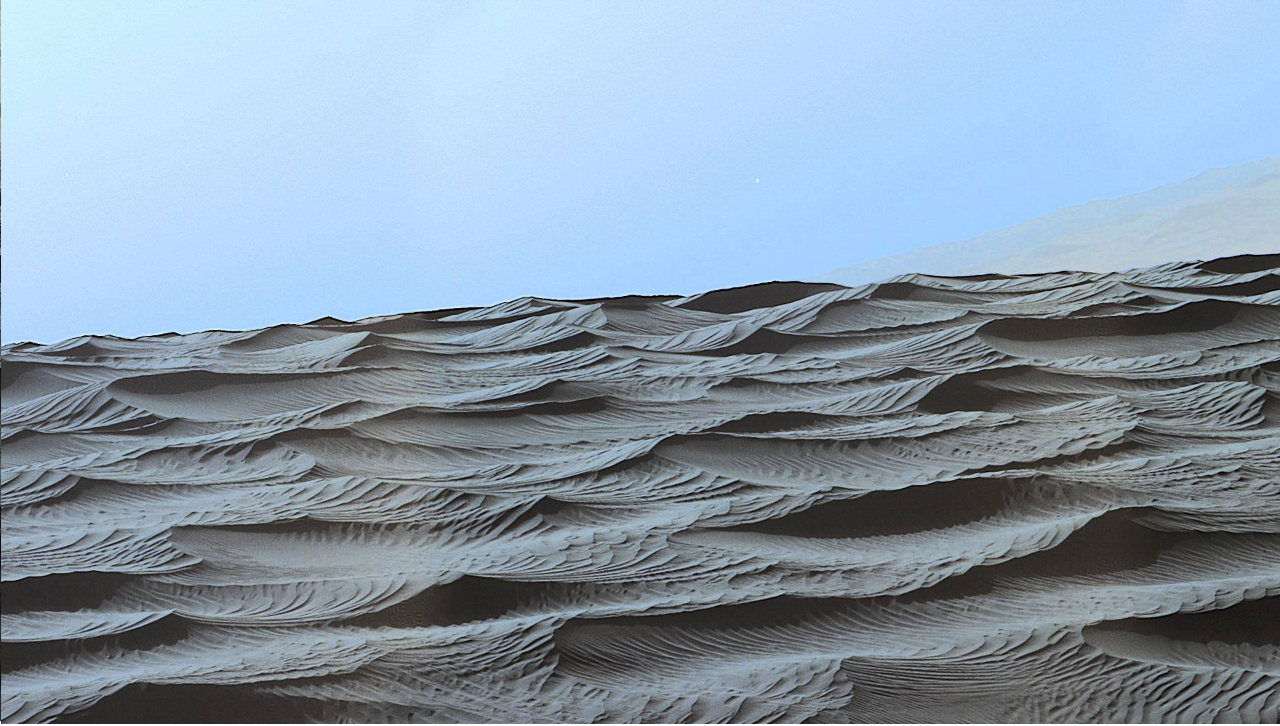
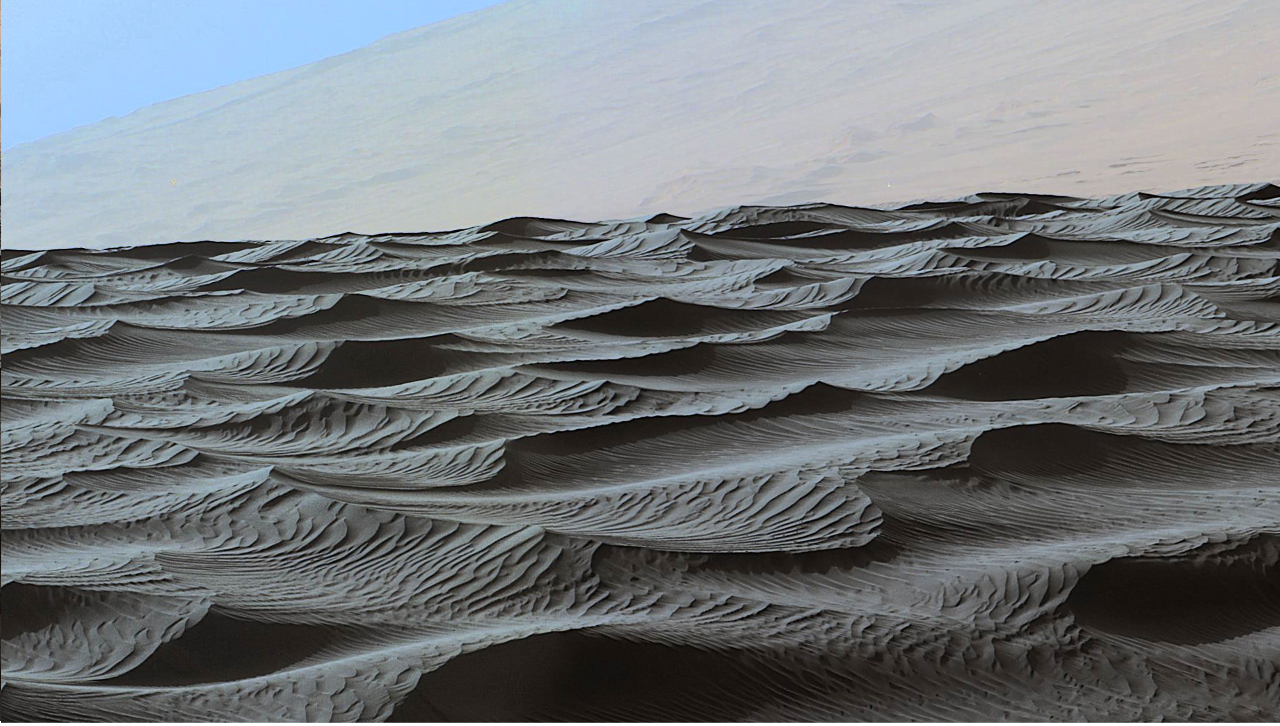
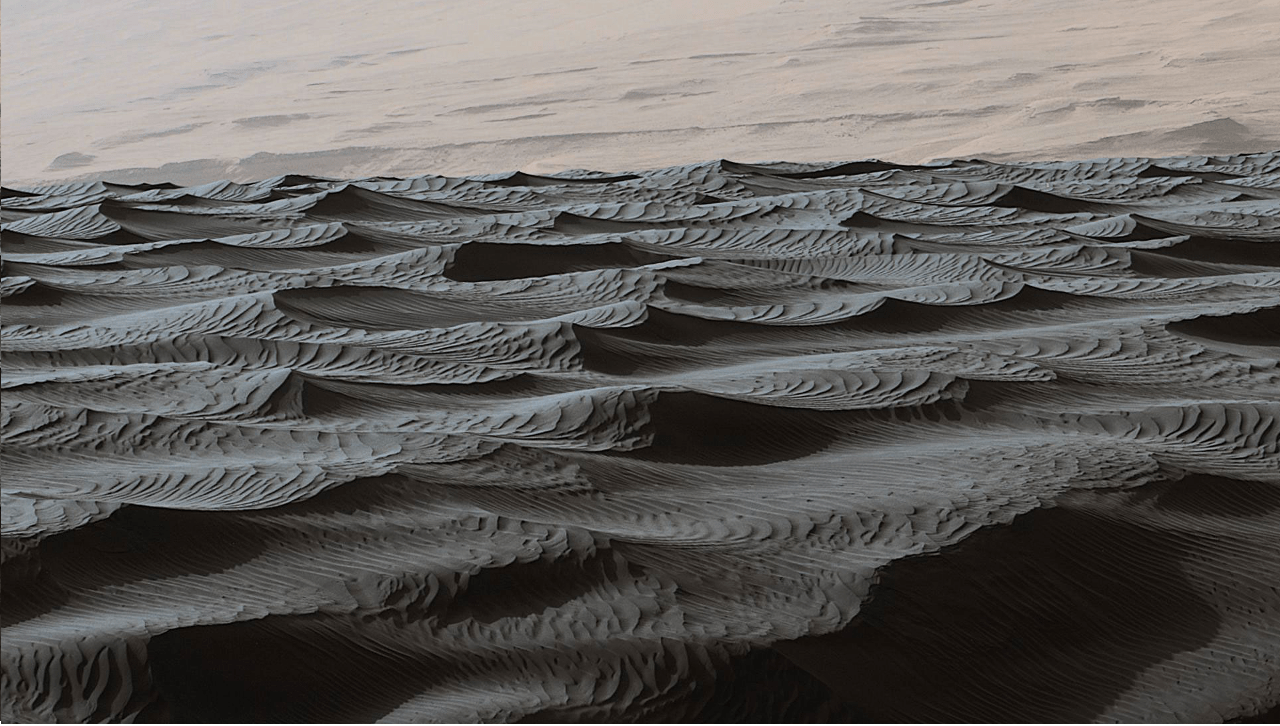

Earth and Mars both feature fields of giant sand dunes. The huge dunes are shaped by the wind and miniature avalanches of sand, and their surface is marked by small ripples less than 30 centimeters apart. These little ripples are formed when sand carried by the wind impacts the dunes. But Martian dunes have a second, larger kind of ripple, too. These sinuous, curvy ripples lie about 3 meters apart and cast the dark shadows seen in the images above. On Earth we see ripples like these underwater, where water drags sand along the surface. On Mars, the same process is thought to play out with the wind, and so scientists have named these wind-drag ripples. (Image credit: NASA/JPL/MSSS; via APOD, full-res; submitted by jshoer)

Granular Plugs
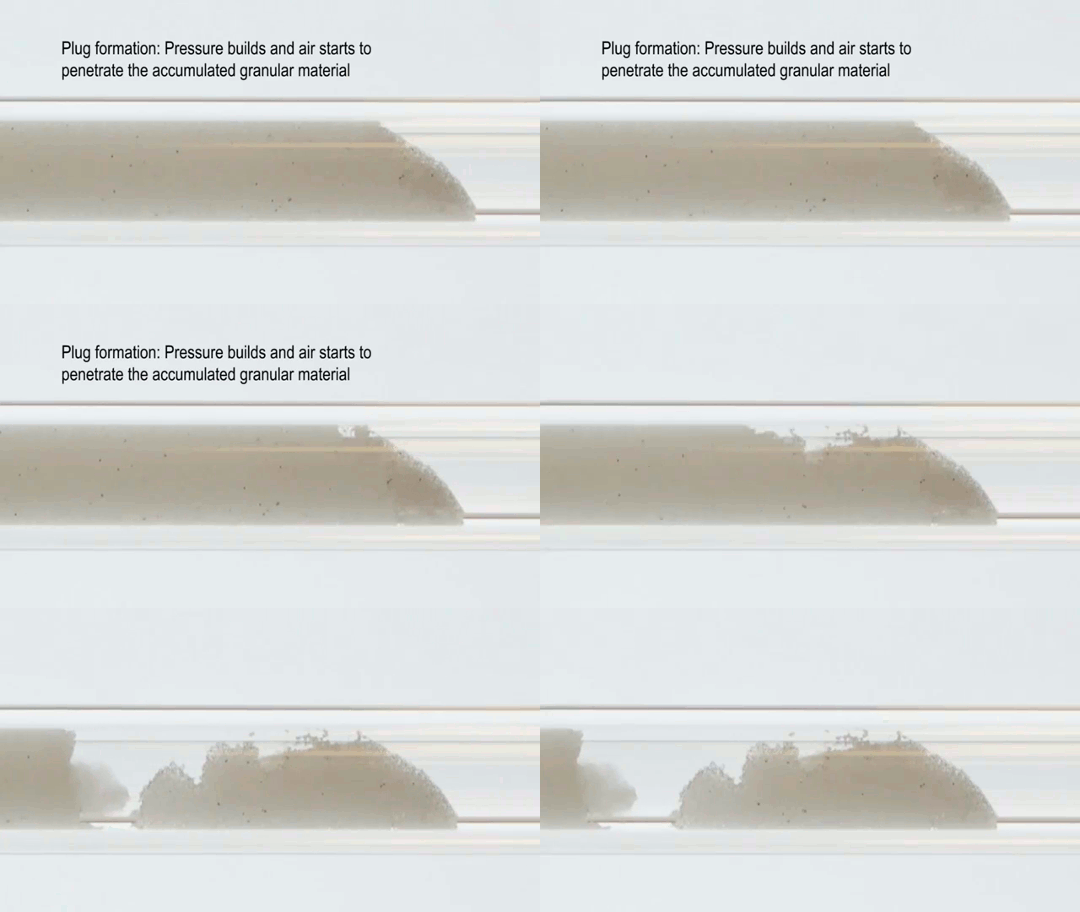
Imagine filling a narrow tube with a mixture of water and tiny glass beads. Then take a syringe and very slowly start drawing out the water. As the water gets sucked out of the tube, air will be pulled into the opposite end. The meniscus where the air and water meet sweeps up the glass beads like a liquid bulldozer. As the experiment continues, pressure builds up and air starts filtering through the beads, changing the viscous and frictional forces the system experiences. Eventually, the grains break off, leaving a chunk of glass beads – known as a plug – behind. Keep draining the tube and more plugs form. Check out the video below to see it in action! (Image/video credit: G. Dumazer et al., source; research paper; open synopsis; submitted by B. Sandnes)
Fluids Round-up
Time for another look at some of the best fluids content out there. It’s the fluids round-up – with a special focus this week on oceans!
– Ryan Pernofski spent two years filming the ocean in slow motion with his iPhone to make the short film “Slowmocean” seen above. It’s a gorgeous ode to the beauty of breaking waves.
– Oceans with higher salinity than Earth’s could drive global circulation that would make exoplanets more hospitable to life.
– Speaking of alien oceans that could harbor signs of life, there’s discussion afoot of how future missions to icy moons like Europa or Enceladus could collect samples from plumes ejected from beneath the ice.
– Wind and waves make harsh, erosive environments. This photo essay from SFGate shows how greatly the sands of Pacifica shift over time. (submitted by Richard)
Bonuses:
– New research explores how Martian mountains may have been carved out by the wind.
– Ever listened to an orchestra made from ice? You should! Learn about Tim Linhart, who builds and maintains ice instruments. (submitted by ashketchumm)
– MIT has demonstrated a new 3D-printing technique that allows for printing liquid and solid parts simultaneously, allowing would-be creators to rapid-prototype hydraulically-driven robotics.
Even more bonus bonus!
– ICYMI, the new FYFD video made Gizmodo!
If you’re a fan of FYFD, please consider becoming a patron. As a bonus, you’ll get access to this weekend’s planetary science webcast!

(Video credit: R. Pernofski; via Flow Visualization; Pluto image credit: NASA/APL)

The Brazil Nut Effect
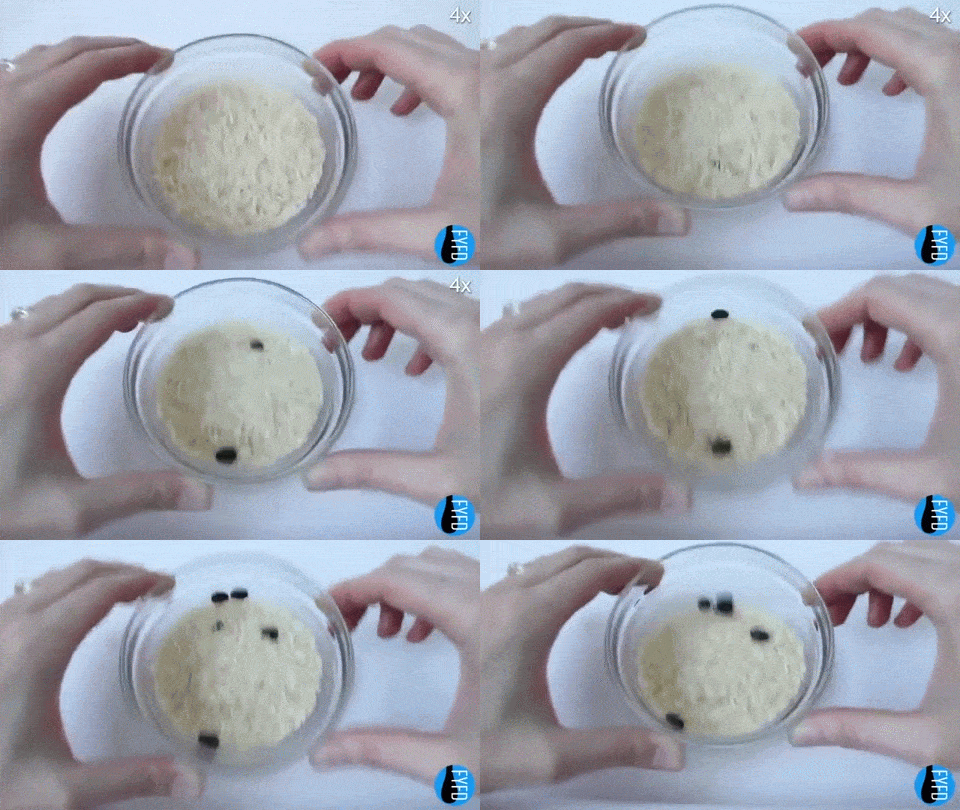
The Brazil nut effect is a common name for the phenomenon where large particles tend to rise to the top of a mixture when it’s shaken. It’s also the subject of the latest FYFD video, which you can see above.
I’ve seen other mentions of the topic previously, but when I started researching the literature, I discovered that the Brazil nut effect was much more complicated than I’d thought! Hopefully, you’ll find the results as interesting as I did. And if you want to dig further, there are links to the papers I used over on YouTube.
Filming was also interesting this time around. I tried out stop-motion animation for the first time. It takes so much patience! But I think the results are so cute. (Image and video credit: N. Sharp/FYFD)
Singing Sand Dunes
Reports of singing sand dunes date at least as far back as 800 C.E. Strange as it sounds, about forty sites around the world have been associated with this phenomenon, in which avalanches of sand grains on the outer surface of the dune cause a deep, booming hum for up to several minutes. As you can hear in the video above, the sound of the dune is somewhat like a propeller-driven airplane. A leading explanation for this behavior is that it results not from the size or shape of the sand grains but from the structure of the underlying dune.
Measurements show that the booming sand dunes contain a hard packed layer of sand 1-2 meters below the surface. When sand at the surface is disturbed by the wind or sliding researchers, it creates vibrations. Those disturbances have trouble crossing into the air or into the harder layers below. Instead they resonate in the upper surface of the sand, which acts as a waveguide, reflecting and enhancing the sound, just as the body of a violin resonates to enhance the vibration of its strings. For more, check out this video from Caltech or the research paper linked below. (Video credit: N. Vriend; research credit: M. Hunt and N. Vriend, pdf)
Sandscapes
Many of us have played with sand art–the rotating frames filled with water, sand, and air. In this video, Shanks FX demonstrates some of the realistic and surrealistic landscapes you can create using this toy. It also makes for a neat fluid dynamics demonstration. The buoyancy of the trapped air bubbles lets the sand sift slowly down instead of falling immediately. And the sand descends in a variety of ways–sometimes laminar columns and other times wilder turbulent plumes. (Video credit and submission: Shanks FX/PBS Digital Studios)