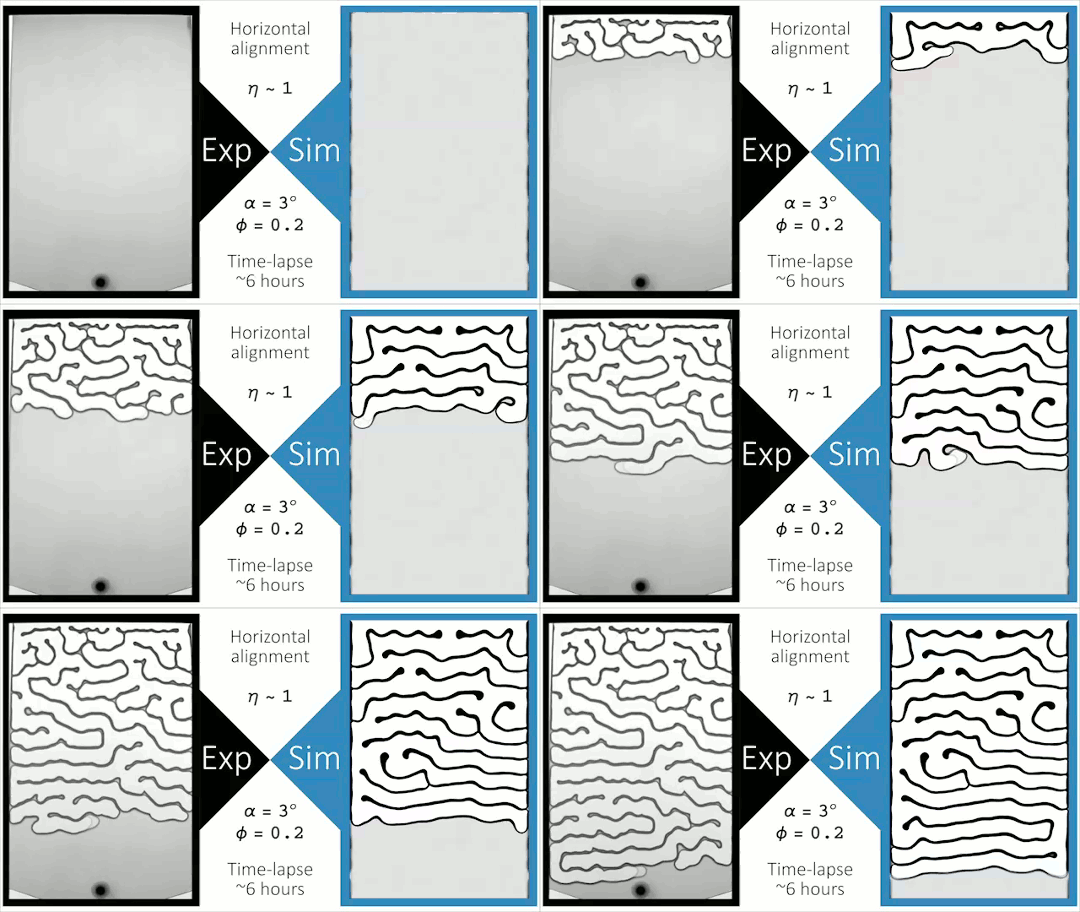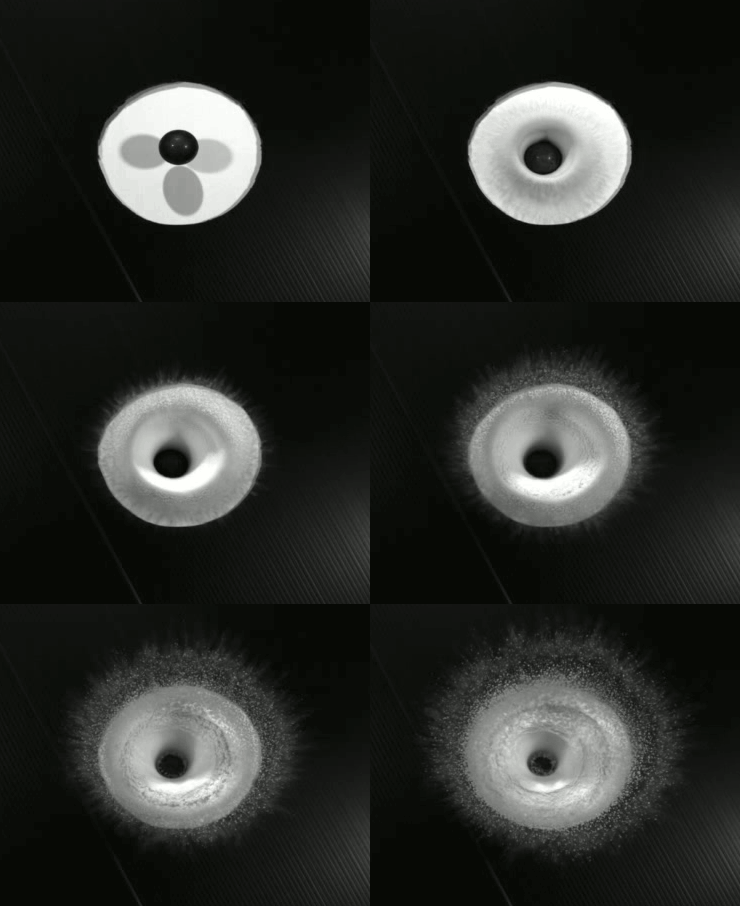
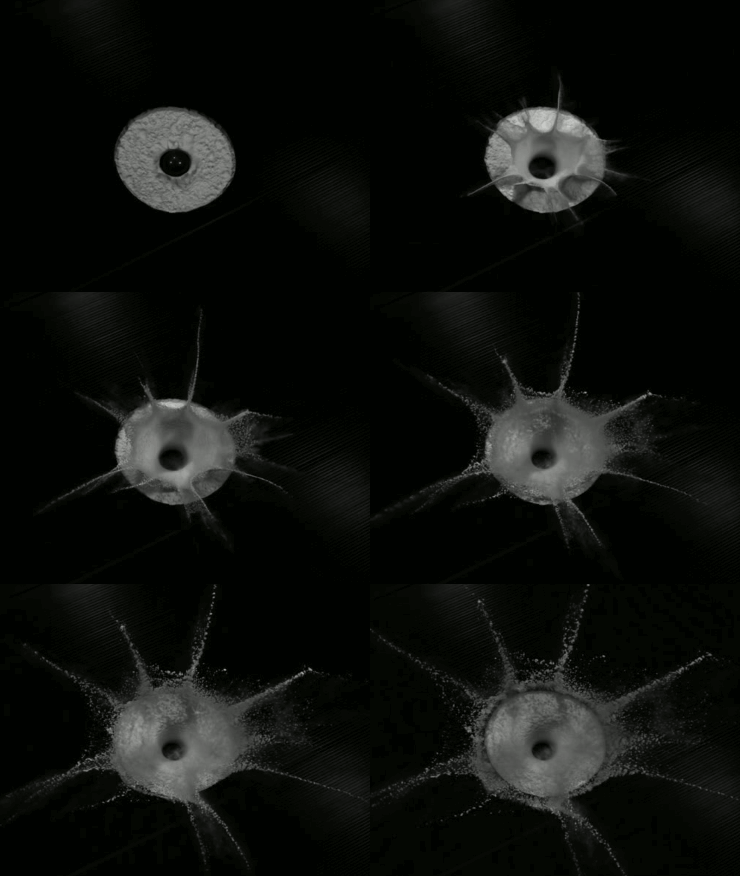
Pushing a fluid into a porous granular material can fracture it into branching, lightning-like patterns. Here, air is injected into wet grains as a laboratory analog to hydrocarbon extraction or fracturing to treat contaminated soil. The injection of air compacts grains along the branch boundaries, keeping individual branches separated from one another. The patterns that form change with grain shape and ultimately result from the interactions of pressure, surface tension, friction and viscous forces. Studies like these help optimize fluid flow, decontaminate polluted soil faster, and determine risk in gas-driven fracturing of hydrocarbon reservoirs. (Image and video credit: J. Campbell et al.; submitted by B. Sandnes)
Tag: granular material

When Friction Isn’t Enough
If you try to build a pyramid of dry glass beads, you’ll have a hard time of it. The frictional forces simply aren’t enough to hold the beads together against the force of gravity. If you add a little water, though, the story is different. The intermolecular forces inside water give it a lot of cohesion, which helps it fill the narrow gaps between beads. That added capillary force gives just enough additional sticking power to hold a pyramid of beads together. (Image and video credit: amàco et al.)

Skiing, Avalanches, and Freezing Bubbles
To wrap up our look at Olympic physics, we bring you a wintry mix of interviews with researchers, courtesy of JFM and FYFD. Learn about the research that helped French biathlete Martin Fourcade leave PyeongChang with 3 gold medals, the physics of avalanches, and how bubbles freeze.
If you missed any of our previous Olympic coverage, you can find our previous entries on the themed series page, and for more great interviews with fluids researchers, check out our previous collab video. (Video credit: T. Crawford and N. Sharp; image credits: GettyImages, T. Crawford and N. Sharp)

Flowing Through Tight Spaces
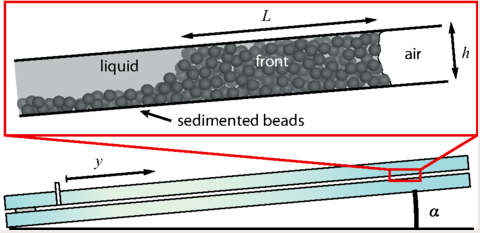
Fluid flow through porous media inside confined spaces can be tough to predict but is key to many geological and industrial processes. Here researchers examine a mixture of glass beads and water-glycerol trapped between two slightly tilted plates. As liquid is drained from the bottom of the cell, air intrudes. Loose grains pile up along the meniscus and get slowly bulldozed as the air continues forcing its way in. The result is a labyrinthine maze formed by air fingers of a characteristic width. The final pattern depends on a competition between hydrostatic pressure and the frictional forces between grains. Despite the visual similarity to phenomena like the Saffman-Taylor instability, the authors found that viscosity does not play a major role. For more, check out the video abstract here. (Image and research credit: J. Erikson et al., source)

An Armored Bed
A river’s flow constantly changes its underlying bed. The rocks and particulates beneath a flowing river can typically be divided into two zones: an upper layer called the bed-load zone where the flow moves particles with it and a lower layer where particles are mostly trapped but may creep over long periods. In gravelly river-beds this upper bed-load zone tends to accumulate more large particles, a phenomenon known as armoring. Experiments show that, in this region, large particles have a net vertical velocity moving upward, while smaller particles tend to move downward. Exactly why large particles are more prevalent in the bed-load zone in unknown; several theories have been offered. One suggests that the size segregation is similar to the Brazil nut effect and that smaller particles have a tendency to fall into gaps and sink more easily than larger ones. (Image and research credit: B. Ferdowsi et al., source)

A Hot Tub, Turned Fluidized Bed
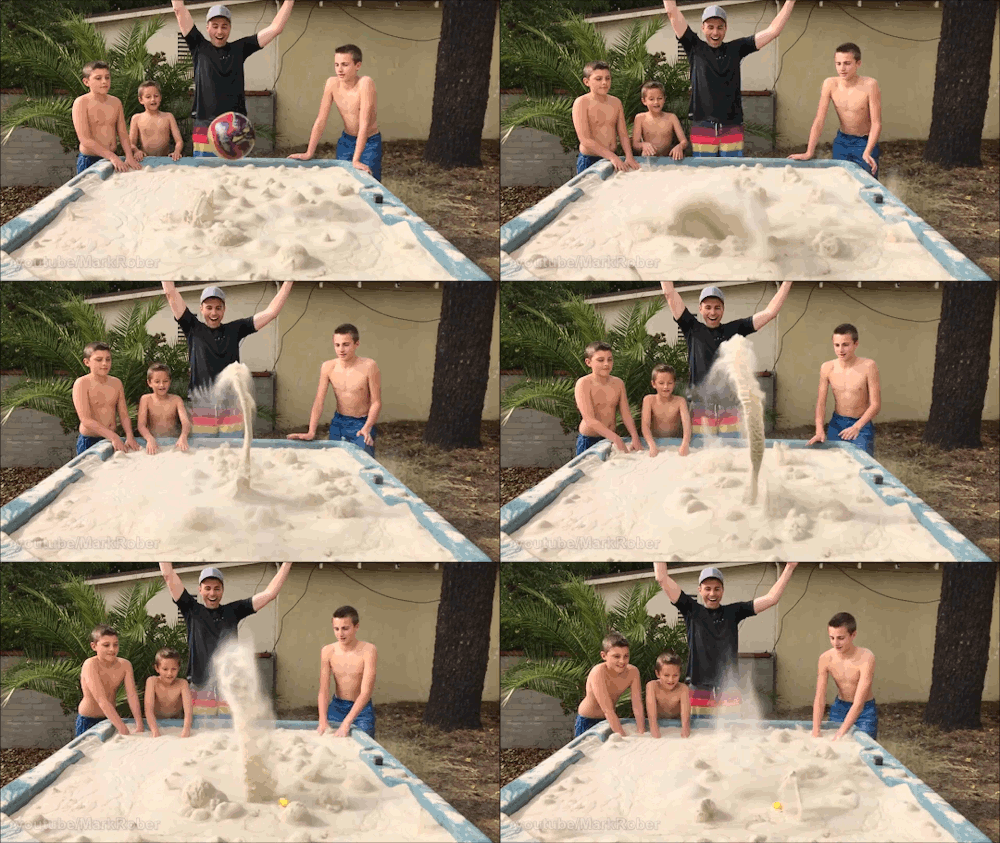
Fluidized beds continue to be all the rage among science YouTubers, but Mark Rober supersizes his by turning a broken hot tub into a massive bath of bubbling sand. His video includes a nice explanation of how a granular material like sand gets fluidized as well as how to make your own miniature bed. One of my favorite moments is shown in the animation below. When Mark drops a bowling ball into the fluidized bed, it creates a remarkably liquid-like splash. The ball sprays a splash curtain of sand up on impact and sinks into its own cavity. When the cavity seals behind the ball, it shoots up a tall jet of sand, just like a Worthington jet in water. Even with air fluidizing it, the sand doesn’t have surface tension, though, so the jet breaks up quite differently than water! (Video and image credit: M. Rober; submitted by clogwog)


Building with Sand
Sand and water make a remarkable team when it comes to building. But the substrate – the surface you build on – makes a big difference as well. Take a syringe of wet sand and drip it onto a waterproof surface (bottom right), and you’ll get a wet heap that flows like a viscous liquid. Drop the same wet sand onto a surface covered in dry sand (bottom left), and the drops pile up into a tower. Watch the sand drop tower closely, and you’ll see how new drops first glisten with moisture and then lose their shine. The excess water in each drop is being drawn downward and into the surrounding sand through capillary action. This lets the sand grains settle against one another instead of sliding past, giving the sand pile the strength to hold its weight upright. (Video and image credit: amàco et al.)


Stopping a Bounce
One way to damp a bouncing ball is to partially fill it with a fluid (a) or granular material (b). For the fluid, the initial impact sloshes the liquid. That doesn’t change the trajectory of the initial bounce noticeably, but it interferes with the second impact, drastically damping the rest of the ball’s bounces until it comes to a stop. A grain-filled ball is similar, at least to begin with. The initial bounce sends the grains flying, forming a granular gas inside the ball. This doesn’t affect the trajectory of the first bounce, but the second impact collapses the granular gas. All the impacts of the grains with one another dissipate the energy of the bounce, and the ball comes to a complete stop. This suggests that a partially-grain-filled container can make a good damper in sport or industrial applications. It also suggests that it might be even better for water-bottle flipping than water is. (Image and research credit: F. Pacheco-Vázquez & S. Dorbolo)

Revealing Stress
What goes on inside of a granular material like sand when an object moves through it? Individual grains will shift and may impact one another or simply slide past. Researchers use special photoelastic materials to see these forces in action. A photoelastic material responds to changes in stress by polarizing light, revealing areas of stress concentration. For an entire network of photoelastic beads, forces between the grains appear like a web of lightning. Individual strands are known as force chains. Bright lines indicate areas where grains are jammed against one another in opposition to the object’s movement. As the intruder is pulled against the force chain network, grains shift and new force chains form. (Image credit: Y. Zhang and R. Behringer, source)

Build Your Own Fluidized Bed
Previously, we featured some GIFs of bubbling, fluidized sand (below). Inspired by the same video, Dianna from Physics Girl decided to build her own set-up, discovering along the way that it’s a little tougher than you might think. To work well, you’ll need very fine, dry particles and a good way to uniformly distribute the air so it doesn’t simply bubble up in one spot. And if you accidentally apply too much air pressure, you may get a face full of sand. The final results are very fun, though, and hopefully Dianna’s lessons learned will help any other DIYers interested in trying this experiment at home. For a little more on the physics here and in related topics, check out some of our previous posts on fluidization, soil liquefaction, quicksand, and dam failures. (Video credit: Physics Girl; image credit: R. Cheng, source)