One way to damp a bouncing ball is to partially fill it with a fluid (a) or granular material (b). For the fluid, the initial impact sloshes the liquid. That doesn’t change the trajectory of the initial bounce noticeably, but it interferes with the second impact, drastically damping the rest of the ball’s bounces until it comes to a stop. A grain-filled ball is similar, at least to begin with. The initial bounce sends the grains flying, forming a granular gas inside the ball. This doesn’t affect the trajectory of the first bounce, but the second impact collapses the granular gas. All the impacts of the grains with one another dissipate the energy of the bounce, and the ball comes to a complete stop. This suggests that a partially-grain-filled container can make a good damper in sport or industrial applications. It also suggests that it might be even better for water-bottle flipping than water is. (Image and research credit: F. Pacheco-Vázquez & S. Dorbolo)
Tag: granular material

Revealing Stress


What goes on inside of a granular material like sand when an object moves through it? Individual grains will shift and may impact one another or simply slide past. Researchers use special photoelastic materials to see these forces in action. A photoelastic material responds to changes in stress by polarizing light, revealing areas of stress concentration. For an entire network of photoelastic beads, forces between the grains appear like a web of lightning. Individual strands are known as force chains. Bright lines indicate areas where grains are jammed against one another in opposition to the object’s movement. As the intruder is pulled against the force chain network, grains shift and new force chains form. (Image credit: Y. Zhang and R. Behringer, source)

Build Your Own Fluidized Bed
Previously, we featured some GIFs of bubbling, fluidized sand (below). Inspired by the same video, Dianna from Physics Girl decided to build her own set-up, discovering along the way that it’s a little tougher than you might think. To work well, you’ll need very fine, dry particles and a good way to uniformly distribute the air so it doesn’t simply bubble up in one spot. And if you accidentally apply too much air pressure, you may get a face full of sand. The final results are very fun, though, and hopefully Dianna’s lessons learned will help any other DIYers interested in trying this experiment at home. For a little more on the physics here and in related topics, check out some of our previous posts on fluidization, soil liquefaction, quicksand, and dam failures. (Video credit: Physics Girl; image credit: R. Cheng, source)


Forming Craters


Asteroid impacts are a major force in shaping planetary bodies over the course of their geological history. As such, they receive a great deal of attention and study, often in the form of simulations like the one above. This simulation shows an impact in the Orientale basin of the moon, and if it looks somewhat fluid-like, there’s good reason for that. Impacts like these carry enormous energy, about 97% of which is dissipated as heat. That means temperatures in impact zones can reach 2000 degrees Celsius. The rest of the energy goes into deforming the impacted material. In simulations, those materials – be they rock or exotic ices – are usually modeled as Bingham fluids, a type of non-Newtonian fluid that only deforms after a certain amount of force is applied. An everyday example of such a fluid is toothpaste, which won’t extrude from its tube until you squeeze it.
The fluid dynamical similarities run more than skin-deep, though. For decades, researchers looked for ways to connect asteroid impacts with smaller scale ones, like solid impacts on granular materials or liquid-on-liquid impacts. Recently, though, a group found that liquid-on-granular impacts scale exactly the way that asteroid impacts do. Even the morphology of the craters mirror one another. The reason this works has to do with that energy dissipation mentioned above. As with asteroid impacts, most of the energy from a liquid drop impacting a granular material goes into something other than deforming the crater region. Instead of heat, the mechanism for dissipation here is the drop’s deformation. The results, however, are strikingly alike.
For more on how asteroid impacts affect the moon and other bodies, check out Emily Lakdawalla’s write-up, which also includes lots of amazing sketches by James Tuttle Keane, who illustrates the talks he hears at conferences! (Image credits: J. Keane and B. Johnson; via the Planetary Society; additional research and video credit: R. Zhao et al., source; submitted by jpshoer)

Porous Fingers
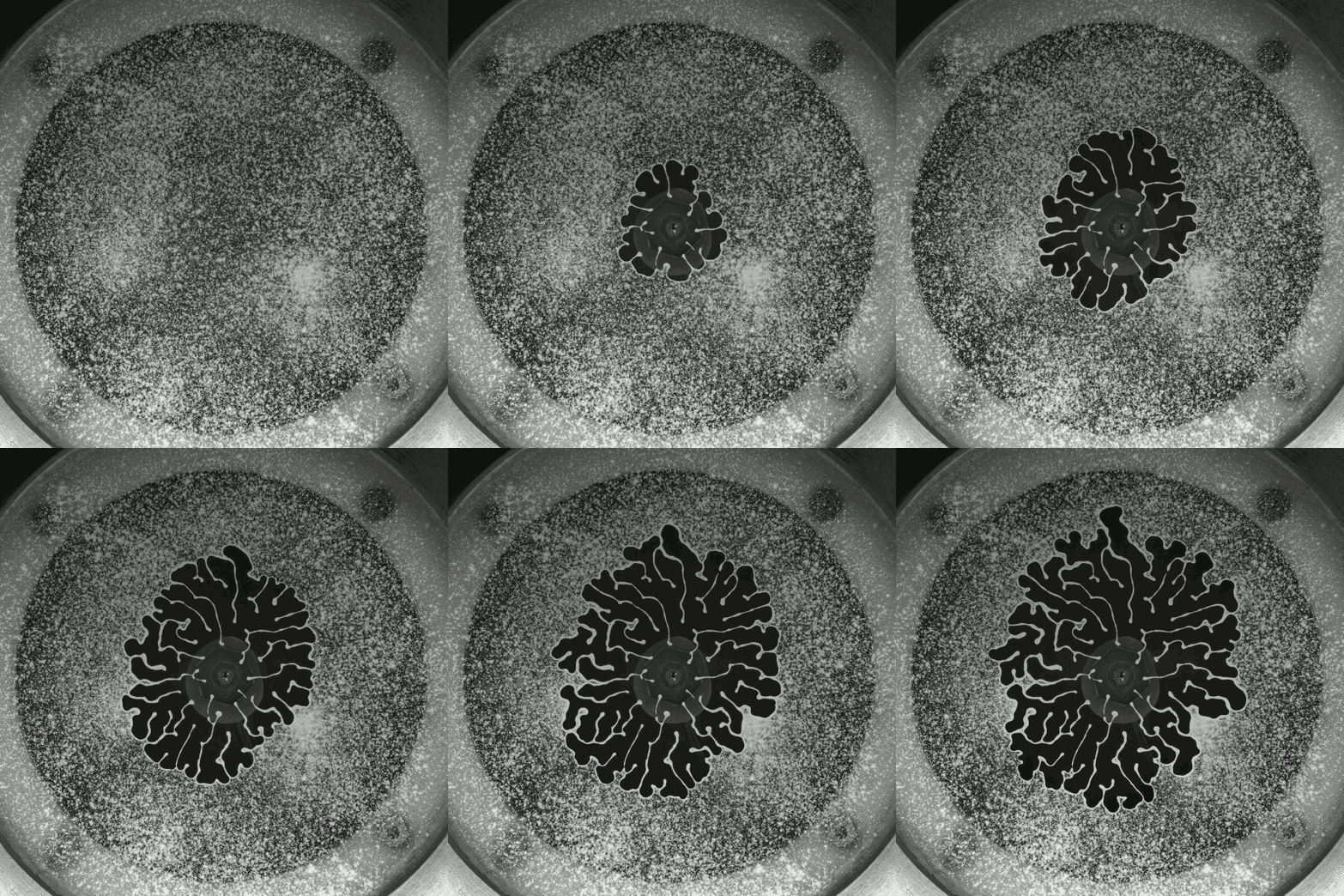
If you inject a less viscous fluid, like air, into a narrow gap between two glass plates filled with a more viscous fluid, you’ll get a finger-like instability known as the Saffman-Taylor instability. If you invert the situation – injecting something viscous like water into air – the water will simply expand radially; you’ll get no fingers. But that situation doesn’t hold if there are wettable particles in the air-filled gap. Inject water into a particle-strewn air gap and you get a pattern like the one above. In this case, as the water expands, it collects particles on the meniscus between it and the air. Once the concentration of particles on the meniscus is too high for more particles to fit there, the flow starts to branch into fingers. This creates a greater surface area for interface so that more particles can get swept up as the water expands. (Image and research credit: I. Bihi et al., source)
Dam Failure
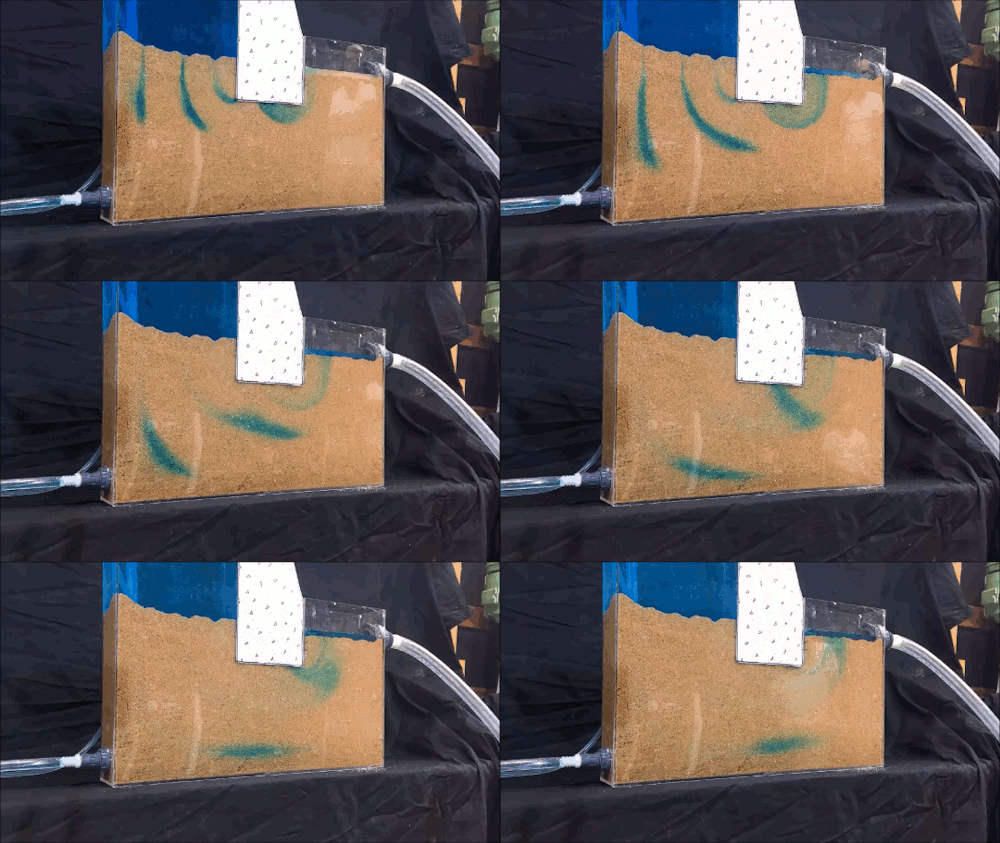
In a recent video, Practical Engineering tackles an important and often-overlooked challenge in civil engineering: dam failure. At its simplest, a levee or dam is a wall built to hold back water, and the higher that water is, the greater the pressure at its base. That pressure can drive water to seep between the grains of soil beneath the dam. As you can see in the demo below, seeping water can take a curving path through the soil beneath a dam in order to get to the other side. When too much water makes it into the soil, it pushes grains apart and makes them slip easily; this is known as liquefaction. As the name suggests, the sediment begins behaving like a fluid, quickly leading to a complete failure of the dam as its foundation flows away. With older infrastructure and increased flooding from extreme weather events, this is a serious problem facing many communities. (Video and image credit: Practical Engineering)

Turning Sand Into a Fluid


Pumping air through a bed of sand can make the grains behave just like a liquid. This process is called fluidization. Air introduced at the bottom of the bed forces its way upward through the sand grains. With a high flow rate, the space between sand grains gets larger, eventually reaching a point where the aerodynamic forces on a grain of sand equal gravitational forces. At this point the sand grains are essentially suspended in the air flow and behave like a fluid themselves. Light, buoyant objects – like the red ball above – can float in the fluidized sand; heavier, denser objects will sink. Fluidization has many useful properties – like good mixing and large surface contact between solid and fluid phases – that make it popular in industrial applications. For a similar (but potentially less playful) process, check out soil liquefaction. (Image credits: R. Cheng, source; via Gizmodo; submitted by Justin)

Surge Flows
Sandy beaches can be a great place to play with neat flows. In a recent video, Frank Howarth describes playing with beach rivers on the Oregon coast and observing a surge flow there. Under the right conditions, a current flowing over sand will build up sand ripples large enough that they form miniature dams in the flow. This traps additional water, which eventually collapses the sand ripples, releasing a surge of water. The surge tends to smooth out the sand and cause the ripple-making process to start over. It’s a fairly unusual phenomenon, but it’s one known to happen seasonally in a few specific places, like at Medano Creek in Colorado’s Great Sand Dunes National Park. There the snowmelt-fed creek surges during the late spring and early summer, releasing a fresh wave every 20 seconds or so. (Image credit: F. Howarth, source; h/t to Sebastian E.)

The Surge in the Hourglass

When we watch sands running through an hourglass, we think their flow rate is constant. In other words, the same number of grains falls through the neck at the beginning and the end. In many practical granular flows, like those through industrial hoppers (left), this is not the case. Instead, emptying those containers involves a surge near the end where the discharge rate is higher.
The surge is related to the interstitial fluid – the air, water, or other fluid in the space between the grains. On the right, you see an experiment in which brown grains submerged in green-dyed water are emptied. The dark layer is dyed water initially at the top of the grains. As the container drains, that dyed layer moves down more rapidly than the grains; this indicates that the interstitial fluid is actually being pumped by the draining of the grains. Researchers think this is an important factor affecting the final surge. (Image credits: hopper – T. Cizauskas; discharge graph – J. Koivisto and D. Durian, source; research credit: J. Koivisto and D. Durian; submitted by Marc A)

Self-Digging Seeds
Some plants in the Pelargonium family produce seeds with long helical tails. These appendages, formally known as awns, are humidity-sensitive. On humid nights or after rainfall, the awn begins to straighten. With its end anchored on the ground, this unfurling spins the seed and helps it burrow into the soil. A study looking at the physics of this system found that rotating reduces the drag a burrowing seed experiences in a granular material. Normally much of the force that opposes motion into a granular material is the result of intergranular contacts creating what are known as force chains. (Many science museums have great displays that visualize force chains.) The rotating seed drags grains near its surface along with it, helping to break up the force chains and reduce resistance. (Image and research credit: W. Jung et al., source)