Soil liquefaction is a rather unsettling process in which apparently solid ground begins moving in a fluid-like way after agitation. It occurs in loose sediments when the spaces between individual particles become nearly saturated with water. This can happen, for example, after heavy rains or in a place with inadequate drainage. Such cases are typically very localized, though, and require some significant agitation of the surface, like pressing with heavy machinery or jumping in a single spot. Soil liquefaction becomes a greater danger, however, in an earthquake. Even in a dry area, the earth’s shaking can force groundwater up into the surface sediment and vibrate the soil sufficiently to liquify it, causing whole buildings to sink or tip and wreaking havoc on manmade infrastructure. (Video credit: jokulhlaups)
Tag: granular flow

Sand Ripples
Wave motion in a bay or near a beach can cause significant sediment transport. Individual granular particles, like sand, can be lifted by the passage of a single wave, but, over time, complex patterns form as the granular bottom surface shifts due to the waves. This video shows time-lapse footage of the ripples that form and move in submerged sand during many hours of wave motion. A slight imperfection in the surface causes a network of sand ripples to grow and spread. Once formed, those ripples shift and reform depending on changes in the wave conditions. (Video credit: T. Parron et al.)
Impacts on Sand
Granular materials like sand are sometimes very fluid-like in their behaviors. The high-speed video above shows a ball bearing being dropped into packed sand. Many features of the splash are fluid-like; the initial impact creates a spreading crownlike splash, followed by a strong upward jet that eventually collapses back into the medium. At the same time, many of the impact characteristics are decidedly non-fluidic. Sand has no surface tension, so both the crown and the jet readily break up into small particles. The granular jet is very narrow and energetic, reaching heights greater than the impacter’s drop height. Interestingly, the column begins collapsing on its lower end before the jet even reaches its highest peak. This may be due to the lower energy of the sand particles that were ejected later in the crater formation process. (Video credit: J. Verschuur, B. van Capelleveen, R. Lammerink and T. Nguyen)
Particle-Tracking in Granular Flows
One of the challenges of experimental fluid dynamics is gathering sufficient data in environments that can be fast-changing, visually dense, and sometimes harsh. Ideally, researchers want to gather as much data–velocities, temperatures, pressures–at as many points as possible and do so without disturbing the flow with a probe. No technique can provide everything, and thus new diagnostics are always under development. This video shows a new particle tracking method developed for fluidized granular flows where the high concentration of particles makes other techniques unsuitable. Such flows are often seen in industrial applications in chemical processing, pharmaceuticals, and powder transport. Interestingly, the technique can also be used in particle-seeded fluid flows like those normally studied with particle image velocimetry (PIV). (Video credit: F. Shaffer and B. Gopalan; submitted by @ASoutolglesias)
Granular Gases
Vibrating particles or granular materials can produce many fluid-like behaviors. In this video, researchers demonstrate how a granular gas made up of particles of two sizes behaves at different conditions. By tweaking the amplitude of the vibration, they alter how the particles cluster in a divided container. At large vibrational amplitudes, the particles behave much like a gas–energetic and spread out. At lower amplitudes, though, the particle density and the number of particle collisions increases. Each collision dissipates some of a particle’s energy; more collisions means less energy available to escape. As a result, the particles cluster, forming an attractor that draws in additional particles over time. (Video credit: R. Mikkelson et al.)
Breaking Up Falling Beads
In a stream of falling liquid, surface tension instabilities cause the fluid to break up into droplets. This video shows a similar experiment with a stream of glass beads, a granular material. The whole system is housed under a vacuum to eliminate the effects of air drag on the stream, and a camera rides alongside the stream to track the evolution of the falling material in a Lagrangian fashion. As with a liquid stream, we see the granular flow develop undulations as it falls, ultimately breaking up into clusters of beads. The authors suggest that nanoscale surface roughness and van der Waals forces may be responsible for the clustering behavior in the absence of surface tension. (Video credit: J. Royer et al.)
Labyrinth
A labyrinthine pattern forms in this timelapse video of a multiphase flow in a Hele-Shaw cell. Initially glass beads are suspended in a glycerol-water solution between parallel glass plates with a central hole. Then the fluid is slowly drained over the course of 3 days at a rate so slow that viscous forces in the fluid are negligible. As the fluid drains, fingers of air invade the disk, pushing the beads together. The system is governed by competition between two main forces: surface tension and friction. Narrow fingers gather fewer grains and therefore encounter less friction, but the higher curvature at their tips produces larger capillary forces. The opposite is true of broader fingers. Also interesting to note is the similarity of the final pattern to those seen in confined ferrofluids. (Video credit and submission: B. Sandnes et al. For more, see B. Sandes et al.)
Dancing Sands
Here a collection of dry grains are vertically vibrated, creating a series of standing waves on the surface of the sand. The shapes of these Faraday waves are dependent upon the frequency of the vibration. Despite the solid nature of sand particles, this behavior is much the same as the behavior of a vibrated fluid.

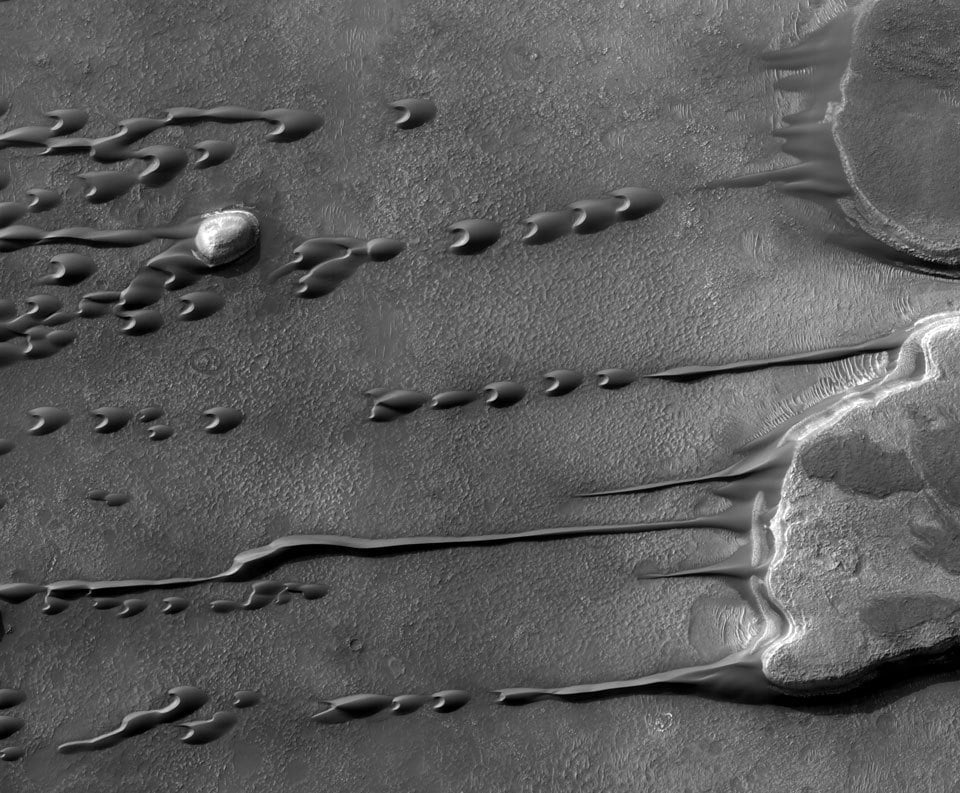
Barchan Dunes
The winds of Mars create sand dunes that seem to flow like a liquid across the planet’s surface. Here the wind blows from right to left around the flat top mesas on the right side of the image. The dark, arc-shaped dunes formed in the wake of the mesas are called barchans and can move downstream remarkably intact, even able to cross paths with other dunes. (Photo credit: MRO, NASA; via APOD)
Granular Eruptions
Granular flows, which are made up of loose particles like sand, often display remarkably fluid-like behavior. Here researchers explore the behavior of granular flows when a solid impacts them at high speed. The sand, unlike a fluid, does not have surface tension, yet we still observe many of the same behaviors. Like a fluid, the sand splashes and creates cavities and jets as it deforms around the fallen object. The sand even “erupts” as submerged pockets of air make their way back to the surface.