Tag: granular flow

  • Featured Video Play Icon

    Singing Sand Dunes

    Reports of singing sand dunes date at least as far back as 800 C.E. Strange as it sounds, about forty sites around the world have been associated with this phenomenon, in which avalanches of sand grains on the outer surface of the dune cause a deep, booming hum for up to several minutes. As you can hear in the video above, the sound of the dune is somewhat like a propeller-driven airplane. A leading explanation for this behavior is that it results not from the size or shape of the sand grains but from the structure of the underlying dune.

    Measurements show that the booming sand dunes contain a hard packed layer of sand 1-2 meters below the surface. When sand at the surface is disturbed by the wind or sliding researchers, it creates vibrations. Those disturbances have trouble crossing into the air or into the harder layers below. Instead they resonate in the upper surface of the sand, which acts as a waveguide, reflecting and enhancing the sound, just as the body of a violin resonates to enhance the vibration of its strings. For more, check out this video from Caltech or the research paper linked below. (Video credit: N. Vriend; research credit: M. Hunt and N. Vriend, pdf)

  • Pyroclastic Flow

    Pyroclastic Flow

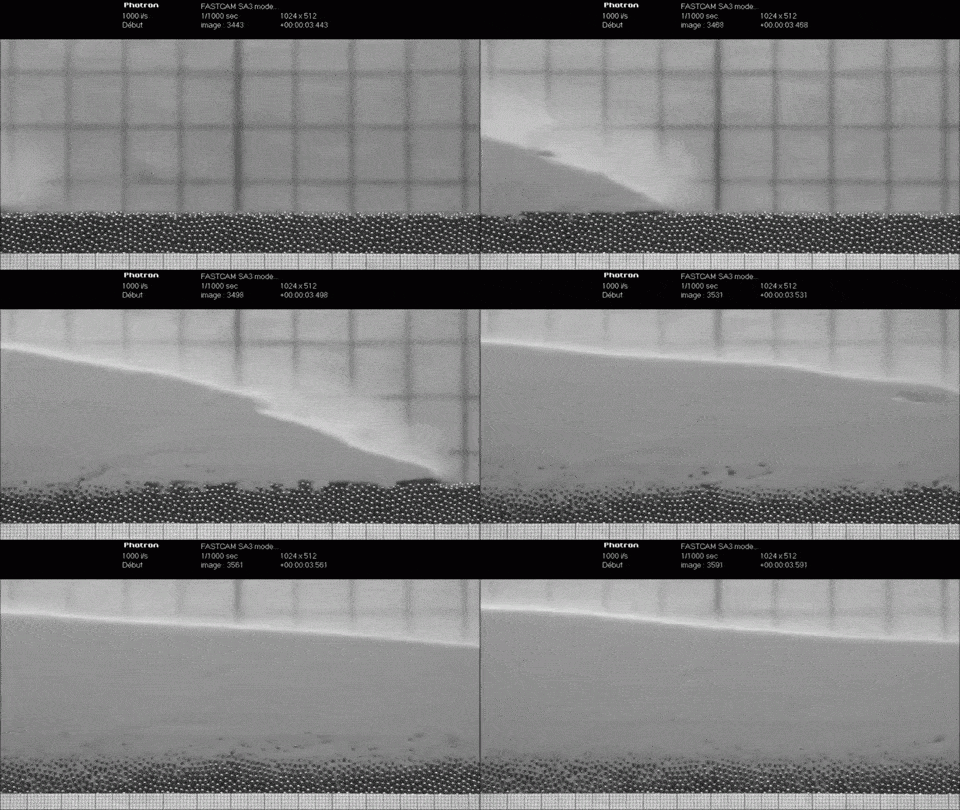
    Major volcanic eruptions can be accompanied by pyroclastic flows, a mixture of rock and hot gases capable of burying entire cities, as happened in Pompeii when Mt. Vesuvius erupted in 79 C.E. For even larger eruptions, such as the one at Peach Spring Caldera some 18.8 million years ago, the pyroclastic flow can be powerful enough to move half-meter-sized blocks of rock more than 150 km from the epicenter. Through observations of these deposits, experiments like the one above, and modeling, researchers were able to deduce that the Peach Spring pyroclastic flow must have been quite dense and flowed at speeds between 5 – 20 m/s for 2.5 – 10 hours! Dense, relatively slow-moving pyroclastic flows can pick up large rocks (simulated in the experiment with large metal beads) both through shear and because their speed generates low pressure that lifts the rocks so that they get swept along by the current. (Image credit: O. Roche et al., source)

  • The Angle of Repose

    [original media no longer available]

    Granular materials like sand tend to form heaps when poured. The steepness of the heap at rest is described by the angle of repose, which is determined by a balance between gravity, normal force, and friction on the grains. When a heap of grains is disturbed, it can trigger an avalanche. As can be seen in the video above, avalanches are a surface phenomenon, only moving the top few layers of grain while most of the heap remains stationary.  (Video credit: Peddie School Physics)

  • Featured Video Play Icon

    Sand Dunes

    Sand dunes form with a gentle incline facing the wind and a steeper slip face pointing away from the wind. Most slip faces are angled at about 30 to 34 degrees–called the angle of repose. The shape is determined by the dune’s ability to support its own weight; add more sand and it will cascade down the slip face in a miniature avalanche. Similarly, if you disturb sand on the slip face by digging a hole at the base, you get the cascading collapse seen in this video. By removing sand, the dune’s equilibrium is broken and it can no longer support its weight. This makes sand flow down the slip face until enough is shifted that the dune can support itself. Being a granular material, the sand itself appears to flow much like a fluid, with waves, ripples and all. (Video credit: M. Meier; submitted by Boris M.)

  • Barchan Dunes

    Barchan Dunes

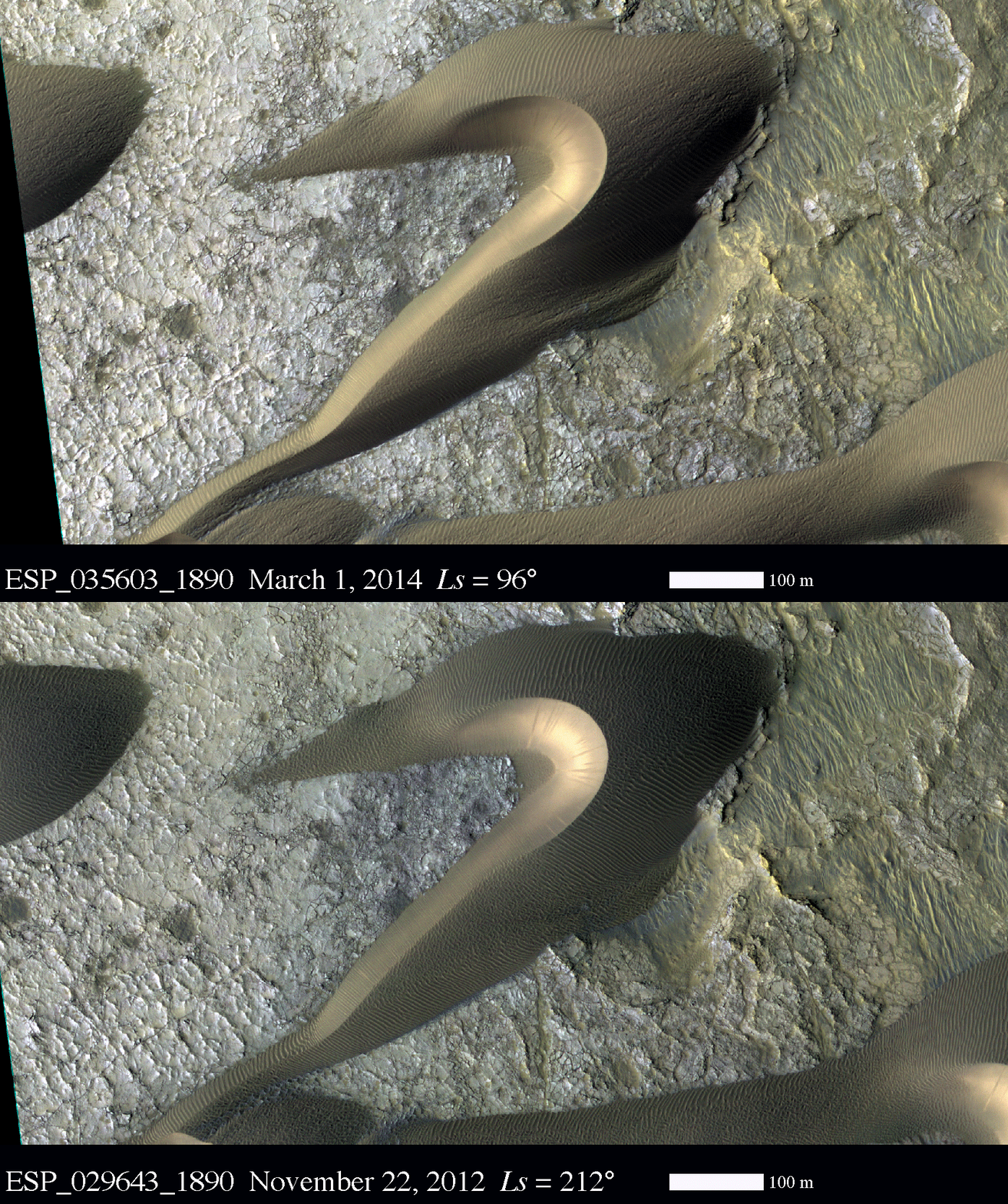
    Crescent-shaped barchan dunes are common on both Earth (top image) and Mars (bottom image). They form in areas where the wind comes predominantly from one direction. As the wind blows, it deposits sand on the gently sloping windward face of the dune. The leeward face of the dune is steeper; its shape is set by the sand’s angle of repose–essentially the steepest angle the sand can maintain without an avalanche. Barchan dunes are very mobile, moving between one and a hundred meters per year. They have also been seen moving through one another or moving along in formation. (Image credits: Google Earth, NASA/JPL/University of Arizona)

  • Featured Video Play Icon

    Bouncing with Liquids and Grains

    Bouncing a ball partially filled with a liquid can create chaotic results when the motion of the ball, fluid, and vibration plate couple. The behavior of a grain-filled ball is a bit different, though. Large grains will tend to bounce with the same frequency as the ball, even across a range of vibration conditions. A ball filled with smaller grains displays a variety of responses depending on the vibration conditions. Among these is a localized wave-like form called an oscillon which oscillates with a period different from but coupled to that of the vibration plate. All these different behaviors inside the bouncing sphere have noticeable effects on its outward motion, too. The chaotic activity of the fluid inside a bouncing ball makes it unstable, and, if not confined, it will bounce itself off the vibration platform. The grain-filled ball, on the other hand, remains bouncing on the platform even after being perturbed. This seems to be a result of the energy dissipation provided by the many inelastic collisions inside the ball as it bounces. (Video credit: F. Pacheco-Vazquez et al.)

  • Martian Barchans

    Martian Barchans

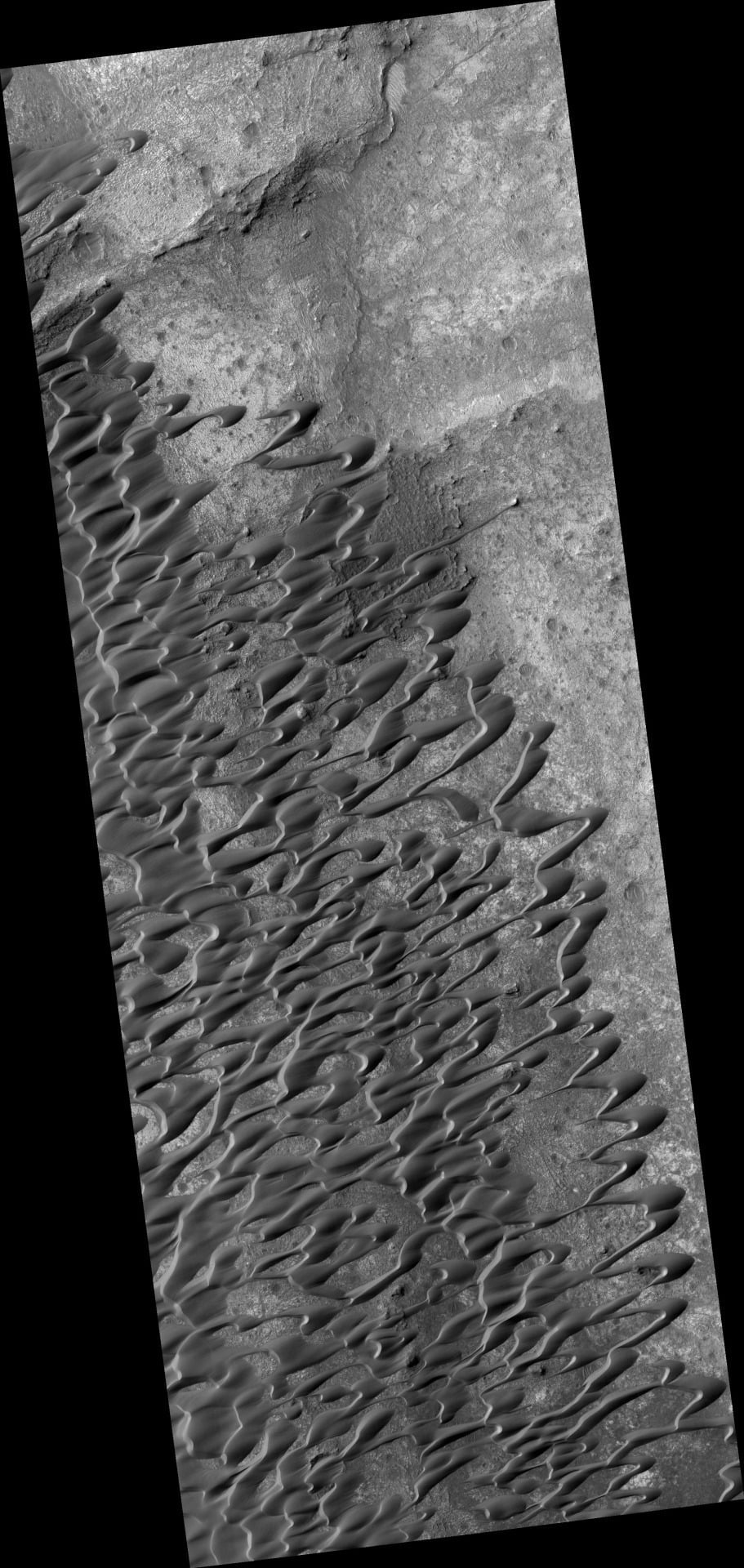
    Dunes are a fascinating interplay between fluid and granular flow. This satellite photo shows a dune field on Mars, Nili Patera. The dominant direction of wind flow is from the upper right, pushing the dunes themselves slowly toward the left. Many of the dunes along the edge are barchans, crescent-shaped dunes with a long, gradual slope facing the wind and a steeper leeward side. As the wind blows, it erodes the sand on the windward slope and deposits it on the leeward side. This is how the dune migrates. Check out this close-up of a barchan to see the changes in its ripples and shape over the past couple months. (Photo credit: NASA/JPL/Univ. of Arizona)

  • Featured Video Play Icon

    Granular Jet

    Sometimes the similarity between fluid flow and granular flows is quite striking. This video shows a stream of sand falling down a tube and impacting a rod. (Note: the view is rotated 90 degrees counter-clockwise, so down points to the right.) As the sand strikes the rod, it’s deflected into a conical sheet, very much like a water bell. There are even ripple-like instabilities that form in the granular sheet, though they move differently than in a liquid due to the sand’s lack of surface tension. (Video credit: S. Nagel et al.)

  • Featured Video Play Icon

    Soil Liquefaction

    Soil liquefaction is a rather unsettling process in which apparently solid ground begins moving in a fluid-like way after agitation. It occurs in loose sediments when the spaces between individual particles become nearly saturated with water. This can happen, for example, after heavy rains or in a place with inadequate drainage. Such cases are typically very localized, though, and require some significant agitation of the surface, like pressing with heavy machinery or jumping in a single spot. Soil liquefaction becomes a greater danger, however, in an earthquake. Even in a dry area, the earth’s shaking can force groundwater up into the surface sediment and vibrate the soil sufficiently to liquify it, causing whole buildings to sink or tip and wreaking havoc on manmade infrastructure. (Video credit: jokulhlaups)

  • Featured Video Play Icon

    Sand Ripples

    Wave motion in a bay or near a beach can cause significant sediment transport. Individual granular particles, like sand, can be lifted by the passage of a single wave, but, over time, complex patterns form as the granular bottom surface shifts due to the waves. This video shows time-lapse footage of the ripples that form and move in submerged sand during many hours of wave motion. A slight imperfection in the surface causes a network of sand ripples to grow and spread. Once formed, those ripples shift and reform depending on changes in the wave conditions. (Video credit: T. Parron et al.)