A river’s flow constantly changes its underlying bed. The rocks and particulates beneath a flowing river can typically be divided into two zones: an upper layer called the bed-load zone where the flow moves particles with it and a lower layer where particles are mostly trapped but may creep over long periods. In gravelly river-beds this upper bed-load zone tends to accumulate more large particles, a phenomenon known as armoring. Experiments show that, in this region, large particles have a net vertical velocity moving upward, while smaller particles tend to move downward. Exactly why large particles are more prevalent in the bed-load zone in unknown; several theories have been offered. One suggests that the size segregation is similar to the Brazil nut effect and that smaller particles have a tendency to fall into gaps and sink more easily than larger ones. (Image and research credit: B. Ferdowsi et al., source)
Tag: granular flow

Build Your Own Fluidized Bed
Previously, we featured some GIFs of bubbling, fluidized sand (below). Inspired by the same video, Dianna from Physics Girl decided to build her own set-up, discovering along the way that it’s a little tougher than you might think. To work well, you’ll need very fine, dry particles and a good way to uniformly distribute the air so it doesn’t simply bubble up in one spot. And if you accidentally apply too much air pressure, you may get a face full of sand. The final results are very fun, though, and hopefully Dianna’s lessons learned will help any other DIYers interested in trying this experiment at home. For a little more on the physics here and in related topics, check out some of our previous posts on fluidization, soil liquefaction, quicksand, and dam failures. (Video credit: Physics Girl; image credit: R. Cheng, source)

Dam Failure
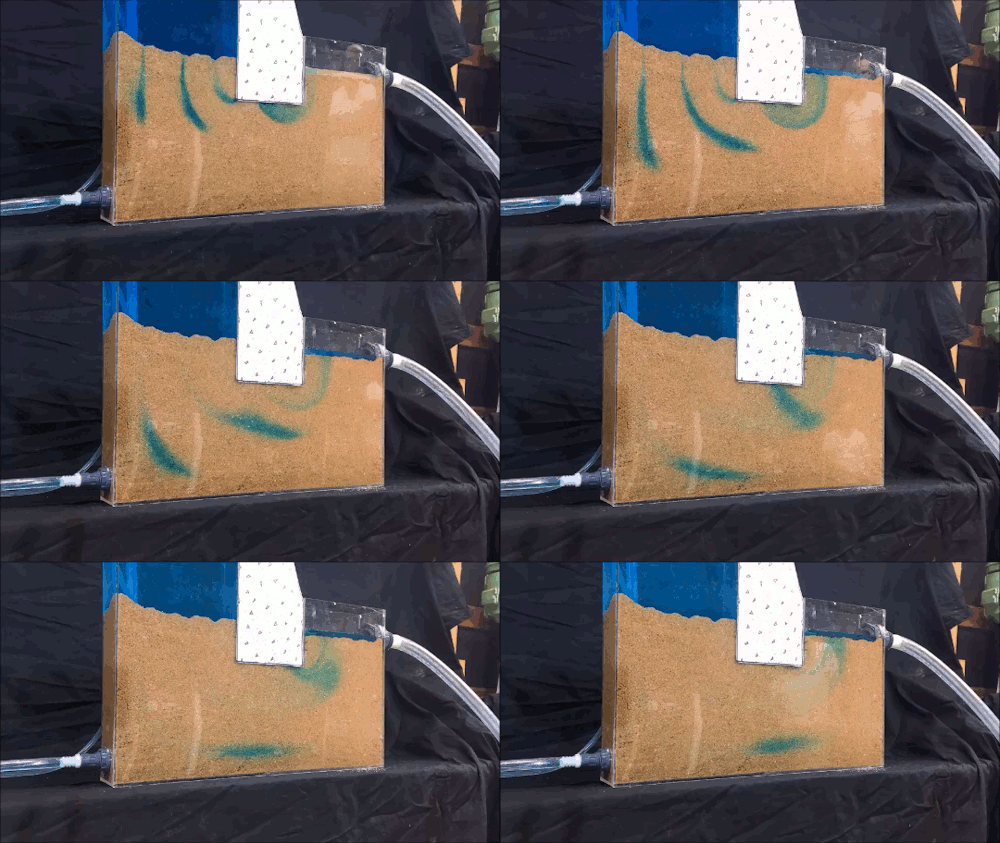
In a recent video, Practical Engineering tackles an important and often-overlooked challenge in civil engineering: dam failure. At its simplest, a levee or dam is a wall built to hold back water, and the higher that water is, the greater the pressure at its base. That pressure can drive water to seep between the grains of soil beneath the dam. As you can see in the demo below, seeping water can take a curving path through the soil beneath a dam in order to get to the other side. When too much water makes it into the soil, it pushes grains apart and makes them slip easily; this is known as liquefaction. As the name suggests, the sediment begins behaving like a fluid, quickly leading to a complete failure of the dam as its foundation flows away. With older infrastructure and increased flooding from extreme weather events, this is a serious problem facing many communities. (Video and image credit: Practical Engineering)

Turning Sand Into a Fluid


Pumping air through a bed of sand can make the grains behave just like a liquid. This process is called fluidization. Air introduced at the bottom of the bed forces its way upward through the sand grains. With a high flow rate, the space between sand grains gets larger, eventually reaching a point where the aerodynamic forces on a grain of sand equal gravitational forces. At this point the sand grains are essentially suspended in the air flow and behave like a fluid themselves. Light, buoyant objects – like the red ball above – can float in the fluidized sand; heavier, denser objects will sink. Fluidization has many useful properties – like good mixing and large surface contact between solid and fluid phases – that make it popular in industrial applications. For a similar (but potentially less playful) process, check out soil liquefaction. (Image credits: R. Cheng, source; via Gizmodo; submitted by Justin)

The Surge in the Hourglass

When we watch sands running through an hourglass, we think their flow rate is constant. In other words, the same number of grains falls through the neck at the beginning and the end. In many practical granular flows, like those through industrial hoppers (left), this is not the case. Instead, emptying those containers involves a surge near the end where the discharge rate is higher.
The surge is related to the interstitial fluid – the air, water, or other fluid in the space between the grains. On the right, you see an experiment in which brown grains submerged in green-dyed water are emptied. The dark layer is dyed water initially at the top of the grains. As the container drains, that dyed layer moves down more rapidly than the grains; this indicates that the interstitial fluid is actually being pumped by the draining of the grains. Researchers think this is an important factor affecting the final surge. (Image credits: hopper – T. Cizauskas; discharge graph – J. Koivisto and D. Durian, source; research credit: J. Koivisto and D. Durian; submitted by Marc A)

Boulder Sorting on Asteroid Itokawa
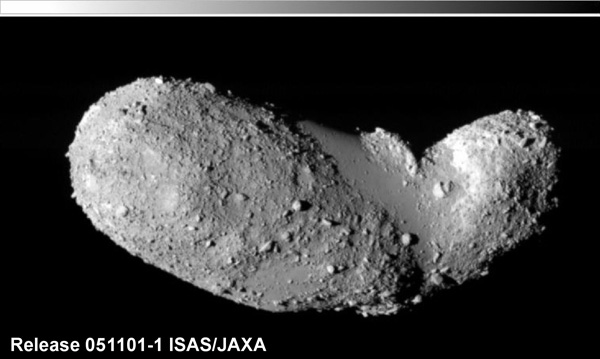
Itokawa is a small asteroid visited by the Japanese Hayabusa probe in 2005. Photographs of the asteroid revealed a surface covered in large boulders at high elevations and small pebbles in the valleys. The Brazil nut effect is often invoked to explain size separation in particle mixtures, but Itokawa is so small that any shaking sufficient to sort particles would likely exceed the asteroid’s meager escape velocity. Instead, researchers have suggested an alternative size sorting mechanism: ballistic sorting.
The idea of ballistic sorting is that pebbles that strike boulders will impact and bounce a long way, whereas pebbles that strike other pebbles are likely to rebound only a short way. In both experiments and simulations, the researchers found that this was the case and that mixtures of large and small particles tended to separate just as on the asteroid. The effect is possible on Earth as well, but Itokawa’s small gravitational acceleration makes for more effective size sorting. (Image credit: JAXA; research credit: T. Shinbrot et al.)
Living Fluid Dynamics
This short film for the 2016 Gallery of Fluid Motion features Montana State University students experiencing fluid dynamics in the classroom and in their daily lives. As in her previous film (which we deconstructed), Shanon Reckinger aims to illustrate some of our everyday interactions with fluids. This time identifying individual phenomena is left as an exercise for the viewer, but there are hints hidden in the classroom scenes. How many can you catch? I’ve labeled some of the ones I noticed in the tags. (Video credit: S. Reckinger et al.)
Clogging, In Hourglasses and Crowds
Hourglasses are pretty common, but you’ve probably never given much thought to the way they flow. An hourglass designer has to carefully select the sizing of the neck and the grains. Choosing a neck that’s too small relative to the grain size will result in frequent clogs but choosing too large a neck will make setting the timing difficult. Interestingly, it doesn’t matter whether the hourglass is filled with air or with water–the same principle holds.
Where this knowledge becomes especially useful, though, is when dealing with crowds. We’ve all experienced the frustration of being in a large crowd trying to fit through a small exit. Paradoxically, the fastest way to get a large number of particles (or sheep or people) through a narrow opening is to slow each individual down. This can either be done by instructing everyone to slow down or by forcing that same result by placing an obstacle immediately before the exit. The reduction in speed reduces clogging, which means everyone gets through faster! (Video credit: A. Marin et al.)

Martian Ripples
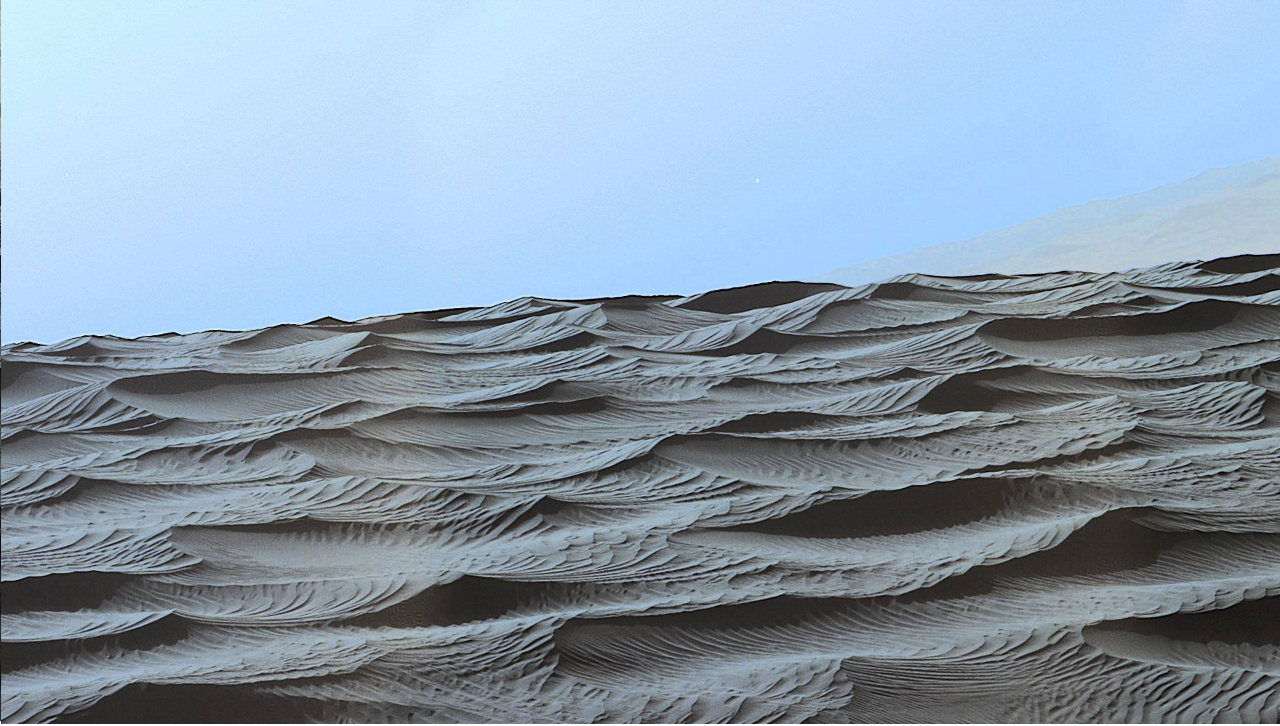
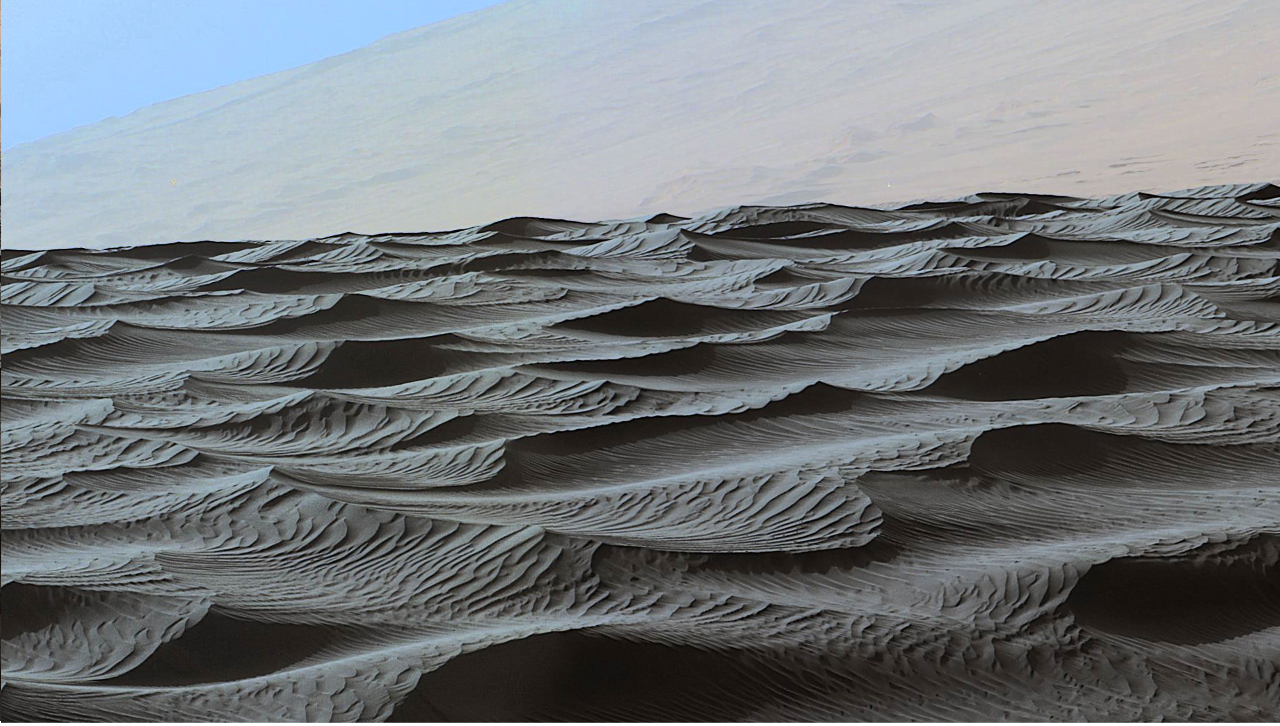
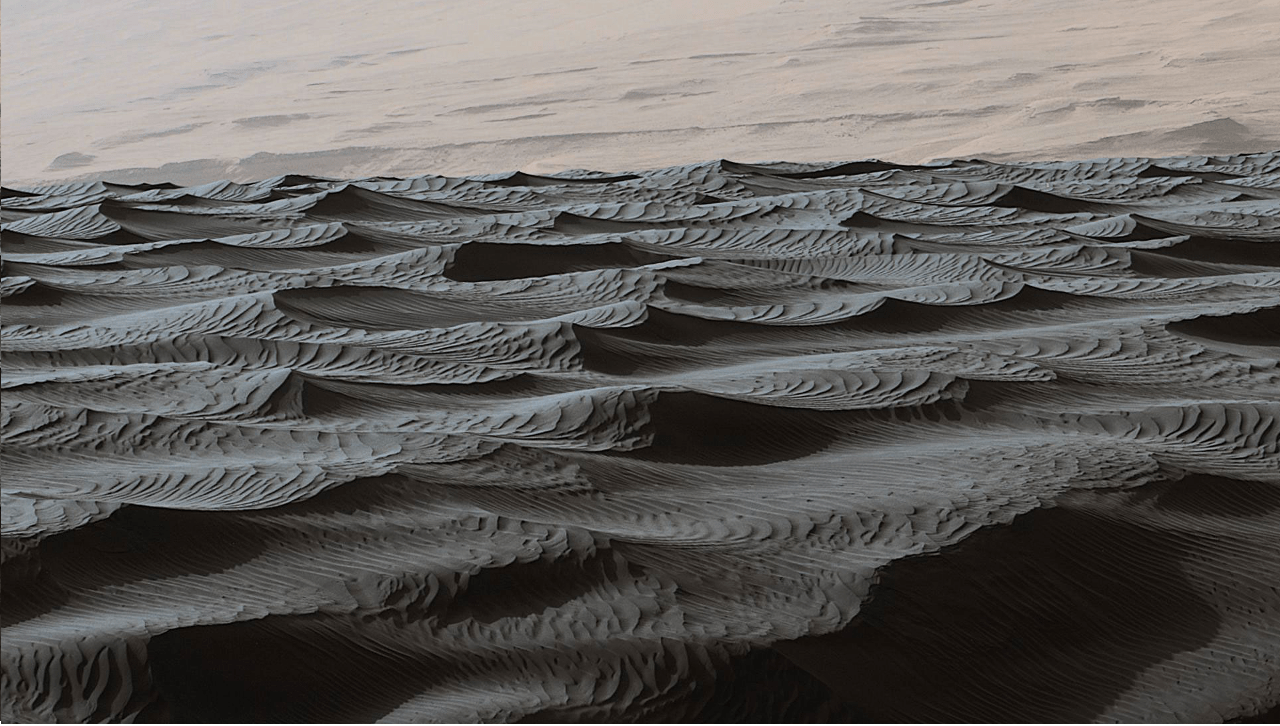

Earth and Mars both feature fields of giant sand dunes. The huge dunes are shaped by the wind and miniature avalanches of sand, and their surface is marked by small ripples less than 30 centimeters apart. These little ripples are formed when sand carried by the wind impacts the dunes. But Martian dunes have a second, larger kind of ripple, too. These sinuous, curvy ripples lie about 3 meters apart and cast the dark shadows seen in the images above. On Earth we see ripples like these underwater, where water drags sand along the surface. On Mars, the same process is thought to play out with the wind, and so scientists have named these wind-drag ripples. (Image credit: NASA/JPL/MSSS; via APOD, full-res; submitted by jshoer)

Quarry Smashing
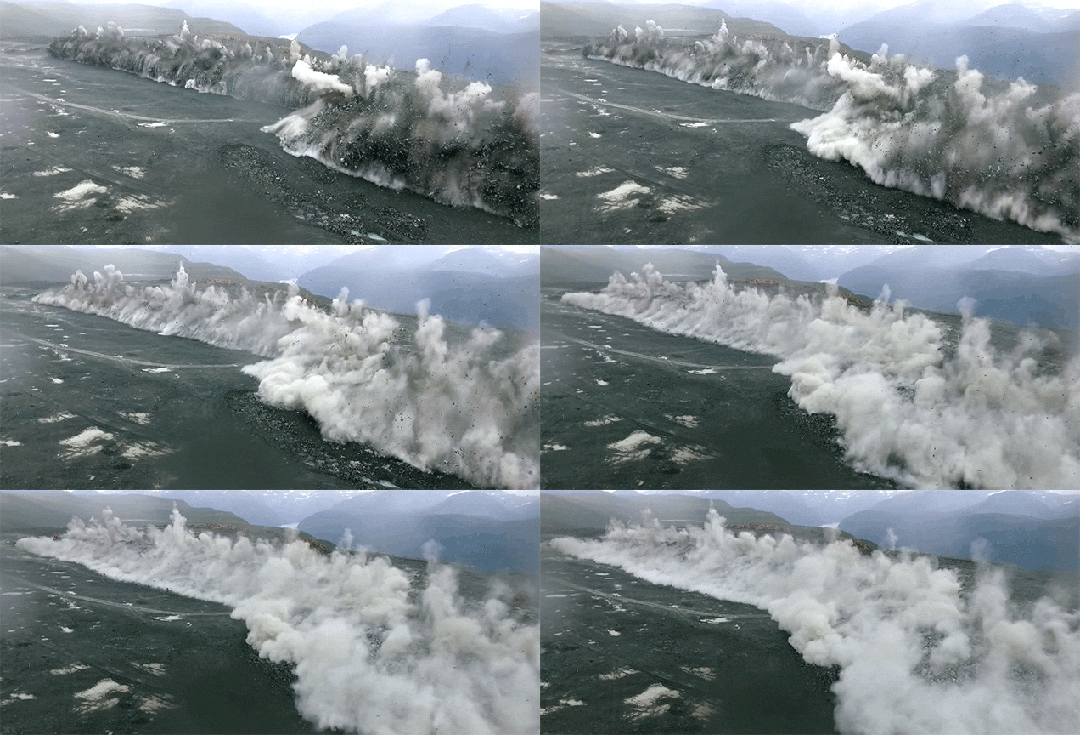
Despite appearances, this is not a crashing ocean wave. In fact, it’s a planned explosion at a quarry, and that wave is more than 360,000 tons of rock and 68 tons of explosive pouring down. The scale of this is hard to imagine, and the physics of a ocean breaker and a massive wave of rocks and gas are similar enough that it’s no wonder our brains interpret them as the same event. Visual effects artists have been using this trick for decades. Rather than simulate the motion of a true fluid, many CGI effects are created from digital particles that, much like the rocks above, are similar enough to fool our eyes and our brains. (Image credit: K. Venøy, source; via Gizmodo)