Tag: freezing

  • Featured Video Play Icon

    Supercooling Thermodynamics

    In the latest Gastrofiscia episode, Tippe Top Physics takes on thermodynamics and the complicated truth behind certain phase changes. Although we’re accustomed to thinking of water freezing at 0 degrees Celsius and boiling at 100 degrees Celsius, reality is more complex, and temperature is only one of the factors that goes into a change of phase. Pressure and purity also play an important role. 

    This is why it’s possible, for instance, to supercool purified water to below 0 degrees Celsius without freezing it. Liquid water needs a nucleus to serve as a seed for its freezing. Without dust or other impurities, it takes a lot of energy for water to spontaneously generate its own nucleus. Check out the full video to see how and why that’s so. (Image and video credit: Tippe Top Physics)

  • Avoiding Droplet Contact

    Avoiding Droplet Contact

    Cold rain splashing on airplane wings can freeze in instants. To prevent that, researchers look for ways to minimize the time and area of contact a drop has. Hydrophobic coatings and textures can do some of the work, but they are easily damaged and don’t always work well when it comes to freezing.

    The new technique shown here uses ring-shaped “waterbowls” to help deflect drops. As the drop impacts and spreads, the walls of the ring texture force the lamella up and off the surface. This reduces both the time and area of contact and, under the right circumstances, cuts the heat transfer between the fluid and surface in half. The technique is useful for more than just preventing freezing, though; it would also be helpful for waterproofing breathable fabrics, where shedding moisture quickly without clogging pores is key to keeping the wearer dry. (Image and research credit: H. Girard et al.; via MIT News and Gizmodo)

  • Featured Video Play Icon

    “-N- Uprising”

    Although Thomas Blanchard’s latest short film, “-N- Uprising”, is less overtly fluid dynamical, fluids underlie almost every aspect of it. The blossoming of flowers is often driven by osmosis and water pressure. Spiders rely on hydraulic pressure to move their limbs, and many insects first unfurl their wings by pumping hemolymph through the network of veins that lace them. Even when hidden beneath the surface, fluid dynamics is everywhere. (Video credit: T. Blanchard; via Colossal)

  • Ice Labyrinths

    Ice Labyrinths

    Pattern formation is extremely common in nature, from the dendritic growth of trees and snowflakes to the stripes of a tiger. A new paper describes how a thin layer of ice in a liquid can form labyrinthine patterns when illuminated with near-infrared light. Both the liquid and ice are maintained at a constant temperature below the melting point, but the ice absorbs the near-infrared light more effectively than the water. This means that parts of the ice that are far from the liquid warm and melt faster, creating holes that can then allow a pocket of liquid to seep in and reduce the absorption rate. The ice crystals themselves thin and expand across the surface at the expense of more holes, which eventually create larger channels that pock the ice. (Image and research credit: S. Preis et al.; via Nature; submitted by Kam-Yung Soh)

  • Freezing Stains

    Freezing Stains

    When they evaporate, drops of liquids like coffee and red wine leave behind stains with a darker ring along the edges, thanks to capillary action and surface tension pulling particles to that outer edge. In contrast, sublimating a frozen droplet leaves a stain pattern that concentrates at the center (top). When droplets freeze from the surface upward, particles within the droplet are driven toward the center as the freeze front pushes toward the drop apex. The final shape of the stain depends on the initial geometry of the droplet, and the concentration of particles toward the center occurs because of the way that the particle freezes, not how it sublimates (bottom). 

    Since many industrial processes rely on droplet evaporation to spread coatings, this work offers a new way to control the final outcome. (Image and research credit: E. Jambon-Puillet, source)

  • Phase-Switching to Avoid Icing

    Phase-Switching to Avoid Icing

    Preventing ice and frost from forming on surfaces – especially airplane wings – is a major engineering concern. The chemical de-icing cocktails currently used in aviation are a short-lived solution, and while superhydrophobic surfaces can be helpful, they tend to be easily damaged and therefore impractical. Another possible solution, shown here, are so-called phase-switching liquids – substances like cyclohexane that have freezing points higher than that of water. This means that they form a solid coating near the freezing temperature of water.

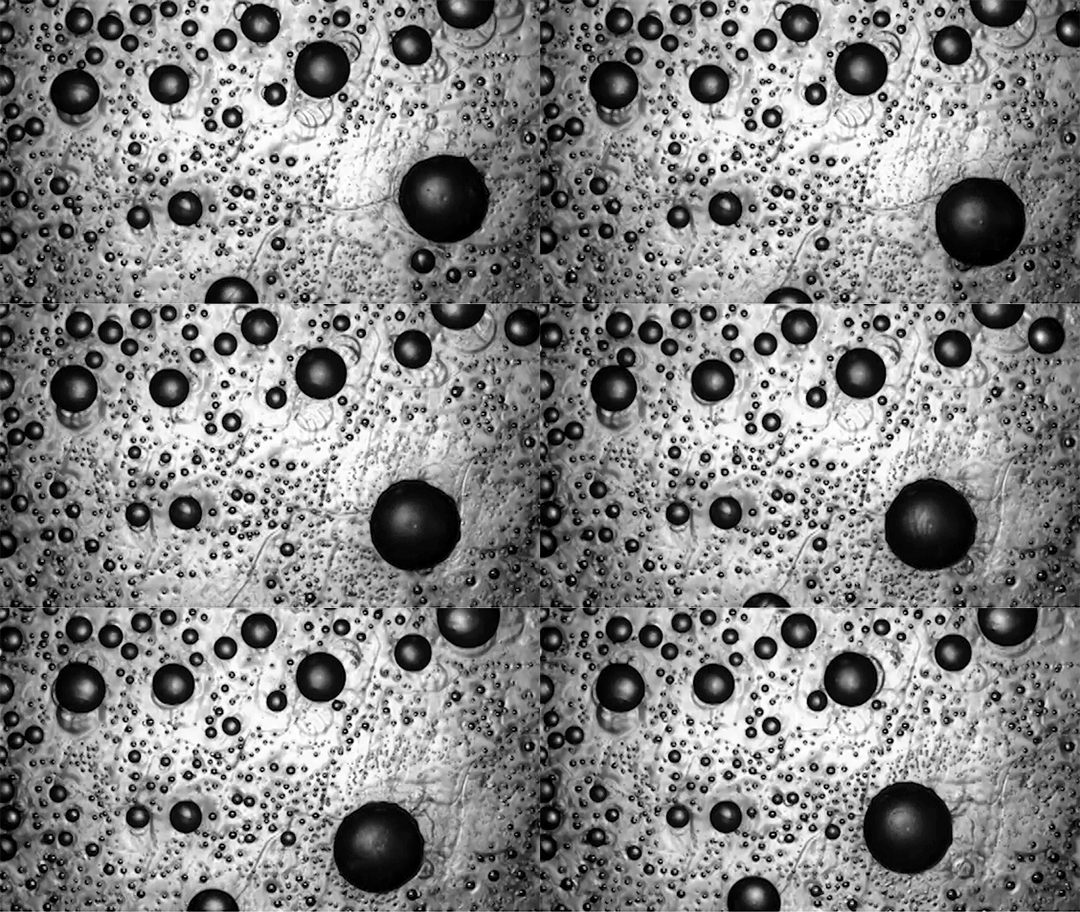
    Water droplets on these coatings move in a random stick-slip walk (above) but they tend not to freeze. This is because freezing requires the droplets to release heat, which melts part of the phase-switching liquid. Now, instead of solidifying to the surface, the droplet moves on a film of the phase-switching liquid. Re-freezing that liquid is tough because it’s thermodynamically unfavorable, and the smoothness of the liquid layer makes it harder for ice to find a nucleation point. In lab tests, the phase-switching liquid surfaces resisted ice and frost more than an order of magnitude longer than conventional materials. (Image and research credit: R. Chatterjee et al.; video credit: Univ. of Illinois at Chicago; submitted by Night King)

  • Featured Video Play Icon

    Freezing Drop Impact

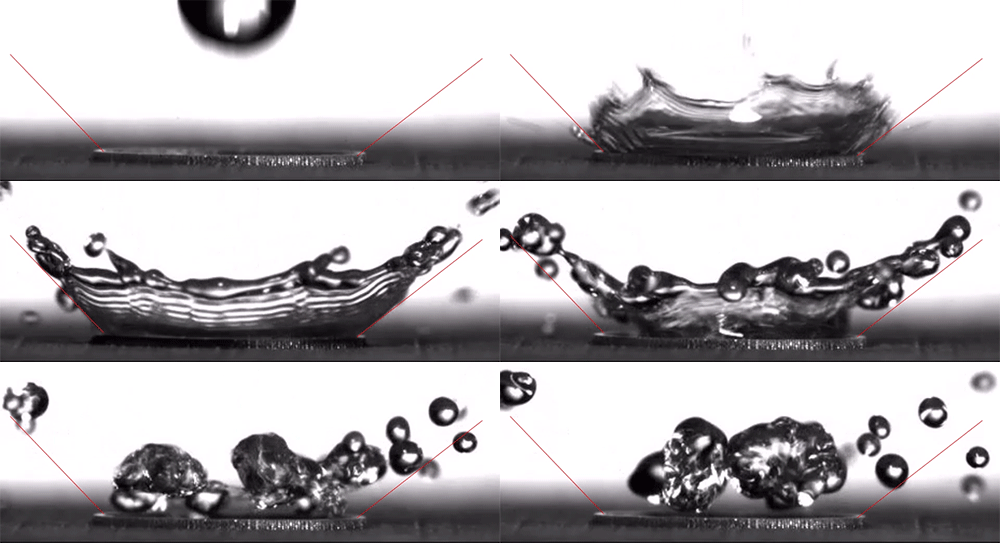
    At the altitudes where aircraft fly, it’s often cold enough for water drops to freeze in seconds or less. Once attached to a wing, such frozen drops disrupt the flow, reducing lift and increasing drag. To help understand how such droplets freeze, scientists study droplet impact on cold surfaces. Starting at room temperature (counter-clockwise from upper left), a drop will spread on the surface, then retract. When the temperature is colder, parts of the droplet freeze before retraction completes, leaving a thin sheet with a thicker center. At even colder temperatures, the droplet’s rim destabilizes and freezing occurs before the droplet has time to retract fully. And at the coldest temperatures, the droplet breaks apart into a frozen splash. (Image and video credits: V. Thievenaz et al.)

  • Avoiding Ice

    Avoiding Ice

    Keeping ice from forming on a surface is a major engineering challenge. Typically, there’s no controlling certain factors – like the size and impact speed of droplets – so engineers try to tame ice by changing the surface. This can be through chemicals – as with deicing fluids used on aircraft – or by tuning the surface itself.

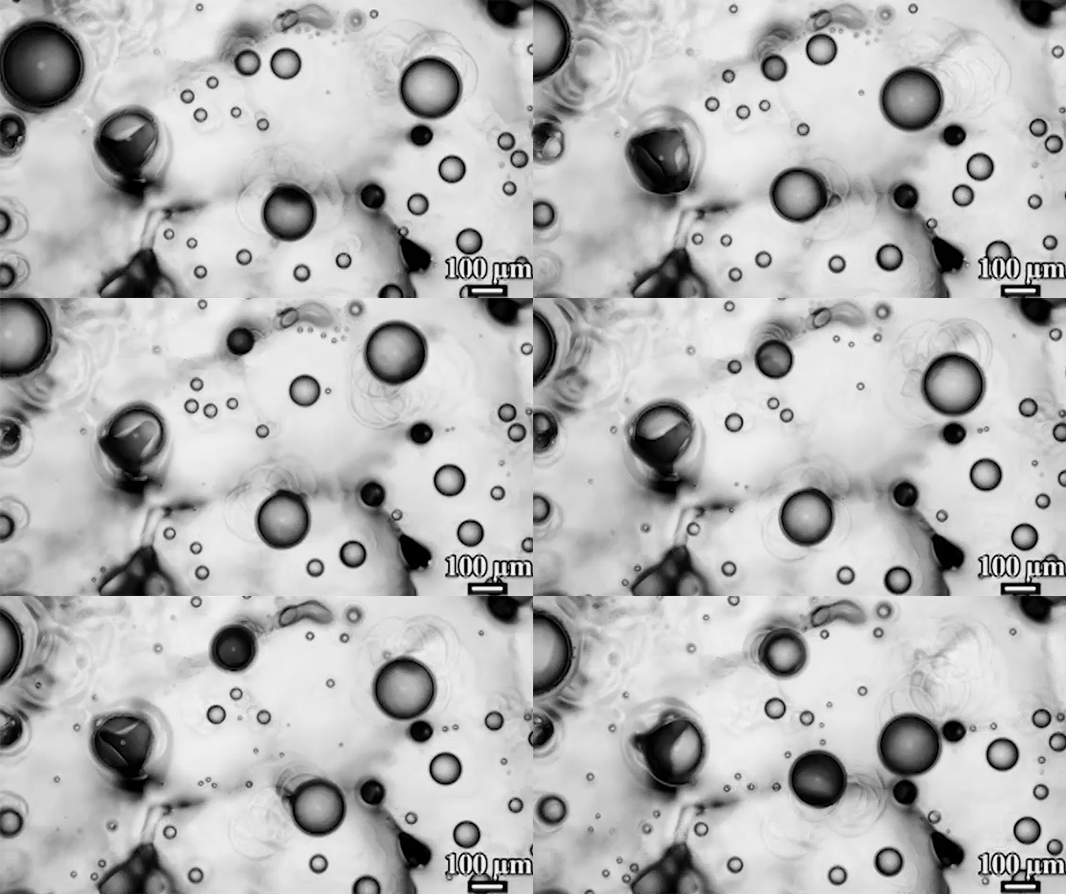
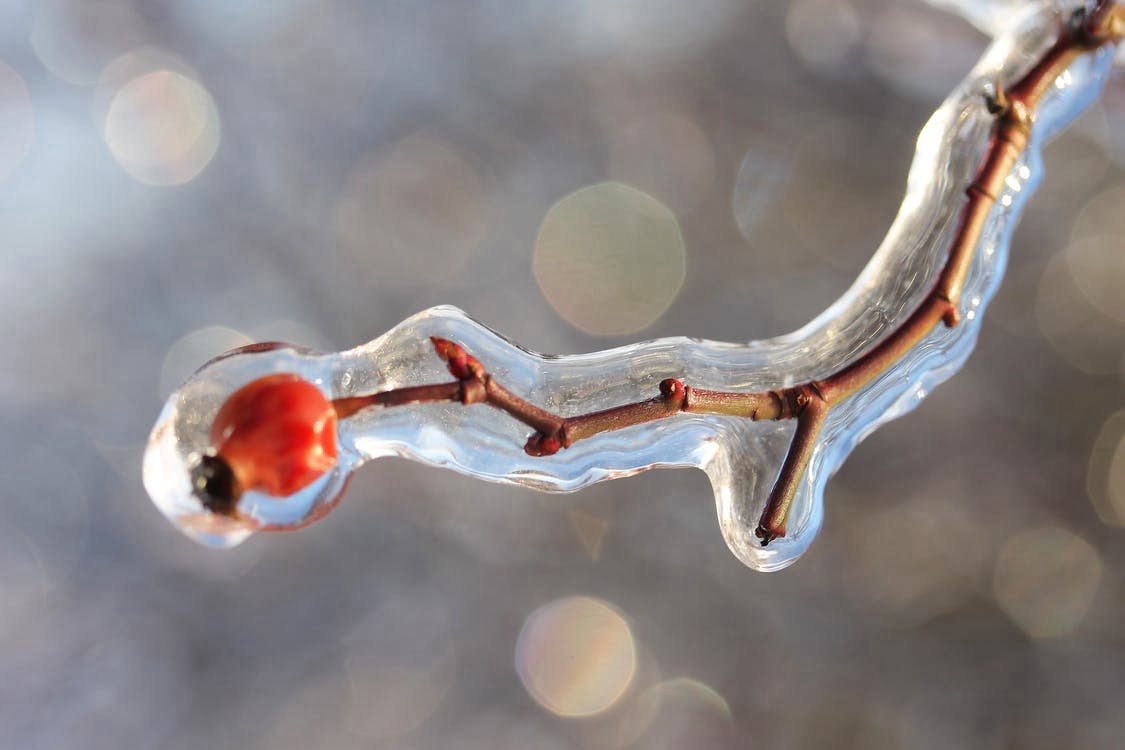
    One way to do this is by making the surface superhydrophobic – or extremely water repellent. These surfaces are rough on a nanoscale level, but they’re delicate, and once ice gets a grip on them, it’s even harder to remove. In a recent study, however, researchers used particles with both hydrophobic and hydrophilic – water-attracting – properties to create a superior ice-resistant surface. The combination of hydrophobic and hydrophilic aspects to the particles made supercooled droplets break up on contact with the surface. This made the drops smaller and decreased their contact time, making it harder for them to stick and freeze. (Image credit: Pixabay; research credit: M. Schwarzer et al.; via Chembites; submitted by Kam-Yung Soh)

  • Enormous Ice Disk

    Enormous Ice Disk

    We’ve seen spinning ice disks before, but this month Westbrook, Maine has developed the largest one I’ve ever seen. A research paper from 2016 indicates that this seemingly alien formation spins due to an oddity of water. Water is at its densest around 4 degrees Celsius, so as the ice of the disk melts in the warmer waters of the river, it sinks. That downward plume sets up a vortex in the water beneath the disk. And as the water spins, it drags the ice with it, causing the disk’s rotation. The warmer the water is, the faster the disk spins. (Image credit: T. Radel/City of Westbrook; research credit: S. Dorbolo et al.; via Gizmodo; submitted by jpshoer)

  • An Inverted Leidenfrost Drop

    An Inverted Leidenfrost Drop

    Leidenfrost drops – liquid drops that levitate on a layer of their own vapor over a hot surface – have been all the rage in recent years. We’ve seen how they can be guided, trapped, and self-propelled. What you see here is a bit different. This is a droplet of room-temperature ethanol deposited on a bath of liquid nitrogen. What levitates the droplet in this case is vaporous nitrogen evaporating from the bath.

    The droplet is quickly cooling down; it freezes after its second or third bounce off the side walls of the beaker. What causes the droplet to self-propel is an asymmetry of the thin vapor layer beneath the droplet. As soon as some instability causes a slight difference in the thickness of the vapor layer, that triggers the propulsion, which the drop maintains even after freezing. (Image and research credit: A. Gauthier et al.)