Ice stupas are conical artificial glaciers built with snow cannons; they’re used to store water for spring irrigation. Here, researchers explore a miniaturized lab-grown version made from atomized water droplets. The growing drop breaks and spills, forming frozen fingers in all directions. Further drops flow and freeze as rivulets atop the stupa — or they destabilize and rotate toward another finger, leaving behind a wrinkling shape. Although the formation works very differently (and the scales are completely different) these tiny ice stupas remind me of volcanic flows. (Image credit: D. Papa et al.)
Tag: freezing

Frozen Ripples
Normally, freezing is a slow enough process that transient phenomena like ripples get smoothed out. But with the right conditions, even ripples can get frozen in time. This picture shows a backyard bird bath after a frigid winter storm passed overnight. For much of that time, the wind was active enough to keep the bath’s water from freezing. But when freezing did start, it happened so rapidly that the wavelets generated by the wind got frozen in place, too. Here’s a similar-looking effect (also in Colorado, ironically) that’s thought to have formed entirely differently. (Image credit: K. Farrell; via EPOD; submitted by Kam-Yung Soh)

Icelandic Glacial Caves


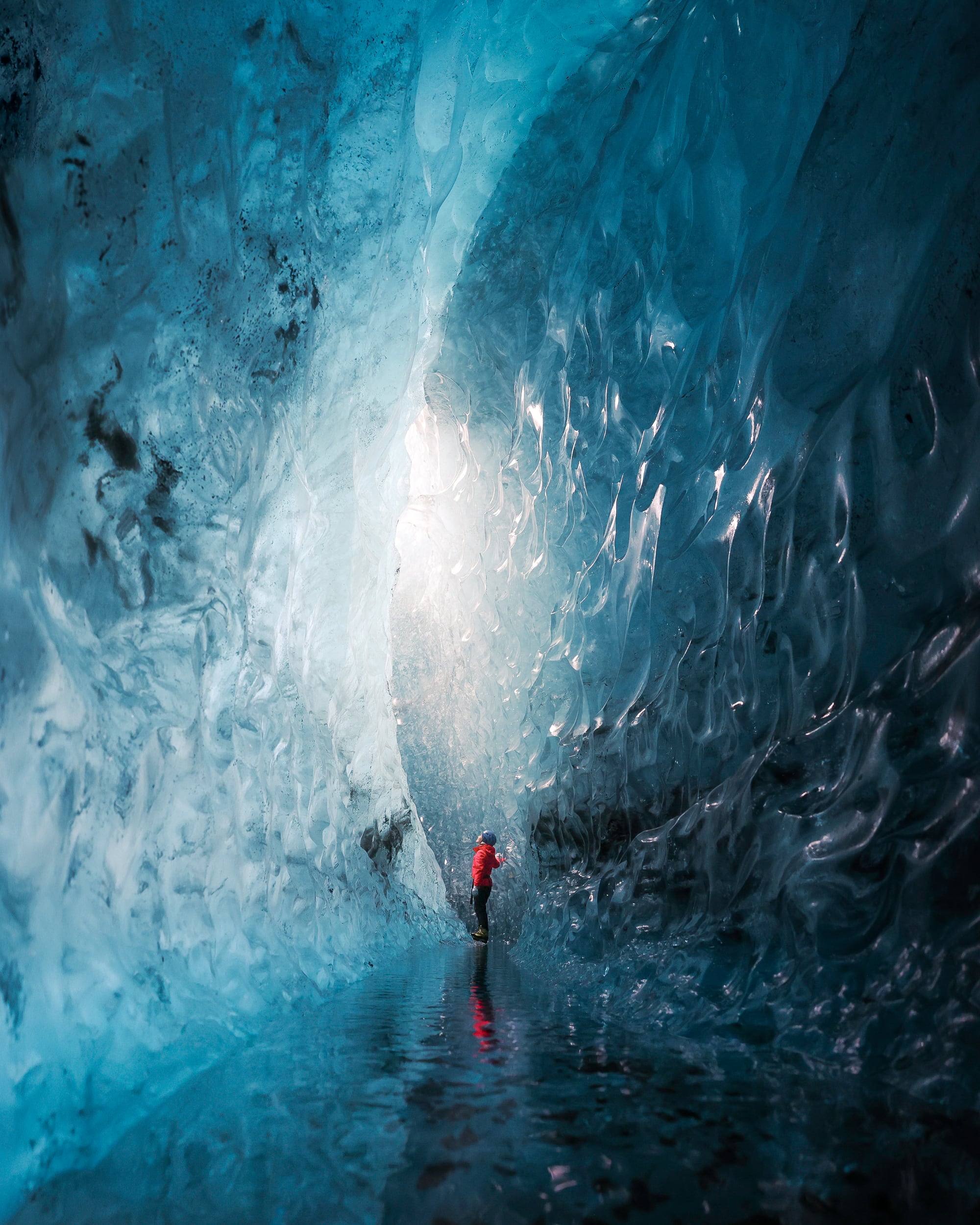


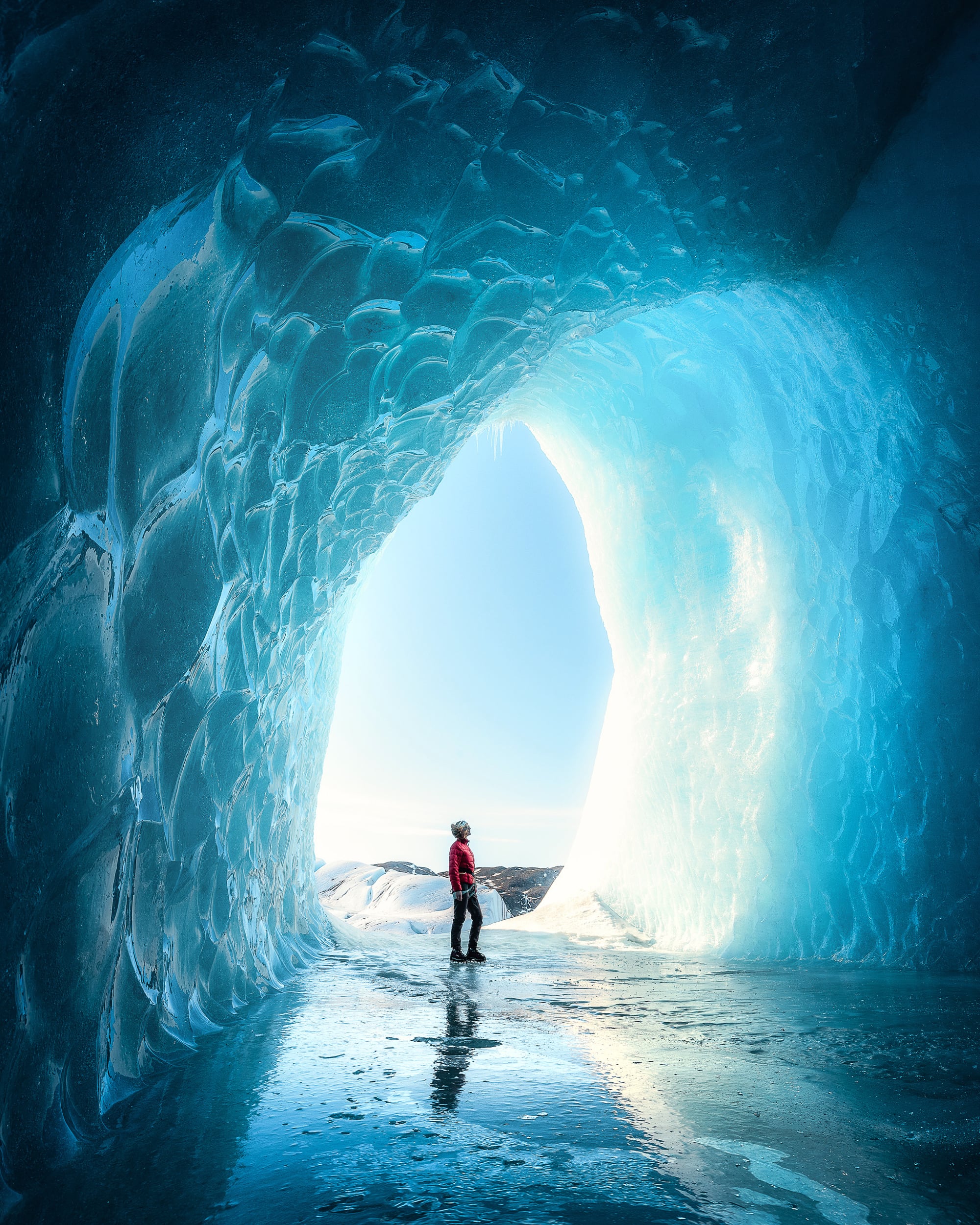


Expedition guide and photographer Ryan Newburn captures the ephemeral beauty of the glacial caves he explores in Iceland. These caves are in constant flux, thanks to the run and melt of water. The scalloped walls are a sign of this process of melting and dissolution. The icicles, too, hint at ongoing melting and refreezing. Caves can appear and disappear rapidly; they’re a dangerous environ, but Newburn freezes them in time, letting the rest of us experience a piece of their majesty. See more of his images on his Instagram. (Image credit: R. Newburn; via Colossal)

Snow-Covered Trees


In the Hakkōda Mountains of Japan, snow encases the trees, transforming the ski slopes into a hoodoo-filled winter wonderland. Photographer Sho Shibata captured these images while journeying through the area a few years ago. The combination of wind and snow sculpts the trees into surprisingly similar shapes! (Image credit: S. Shibata; via Colossal)

Spiral Ice Cracks
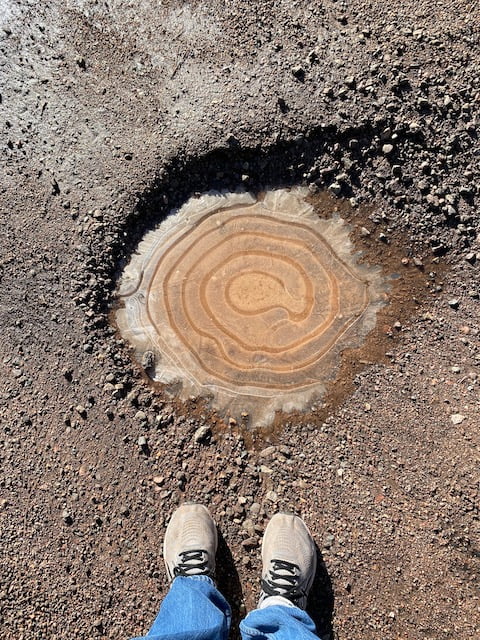
This odd puddle was found in Arizona after a night with low temperatures around -8 degrees Celsius (18 degrees Fahrenheit). Unlike the concentric rings sometimes seen on ice, this puddle formed one spiraling crack. It’s hard to know exactly what factors played into this formation since it was only found after the fact, but one possibility is that the puddle was initially frozen in a continuous sheet. Then, as the temperature cooled overnight, the ice contracted, forming a crack. As the ice kept cooling and contracting inward, the crack grew, spiraling toward the center of the puddle. (Image credit: M. Hendrickson; via EPOD; submitted by Kam-Yung Soh)

Rocket-Like Supercooled Drops
Many droplets can self-propel, often through the Leidenfrost effect and evaporation. But now researchers have observed freezing droplets that self-propel, too. The discovery came when observing the freezing of supercooled water drops inside a vacuum chamber. The researchers kept losing track of drops that seemingly disappeared. Upon closer inspection, though, they found that the drops weren’t shattering; they were flying away as they froze.
Inside a drop, freezing starts at a point, the nucleation point, and spreads from there. But the nucleation point isn’t always at the center of the drop. This asymmetry, the researchers found, is at the heart of the drop’s propulsion. When ice nucleates, the phase change releases heat that increases the drop’s evaporation rate, which can impart momentum to the drop. For an off-center nucleation, that momentum is enough to send the drop shooting off at nearly 1 meter per second. (Image credit: SpaceX; research credit: C. Stan et al.; via APS Physics)

Frozen in Ice
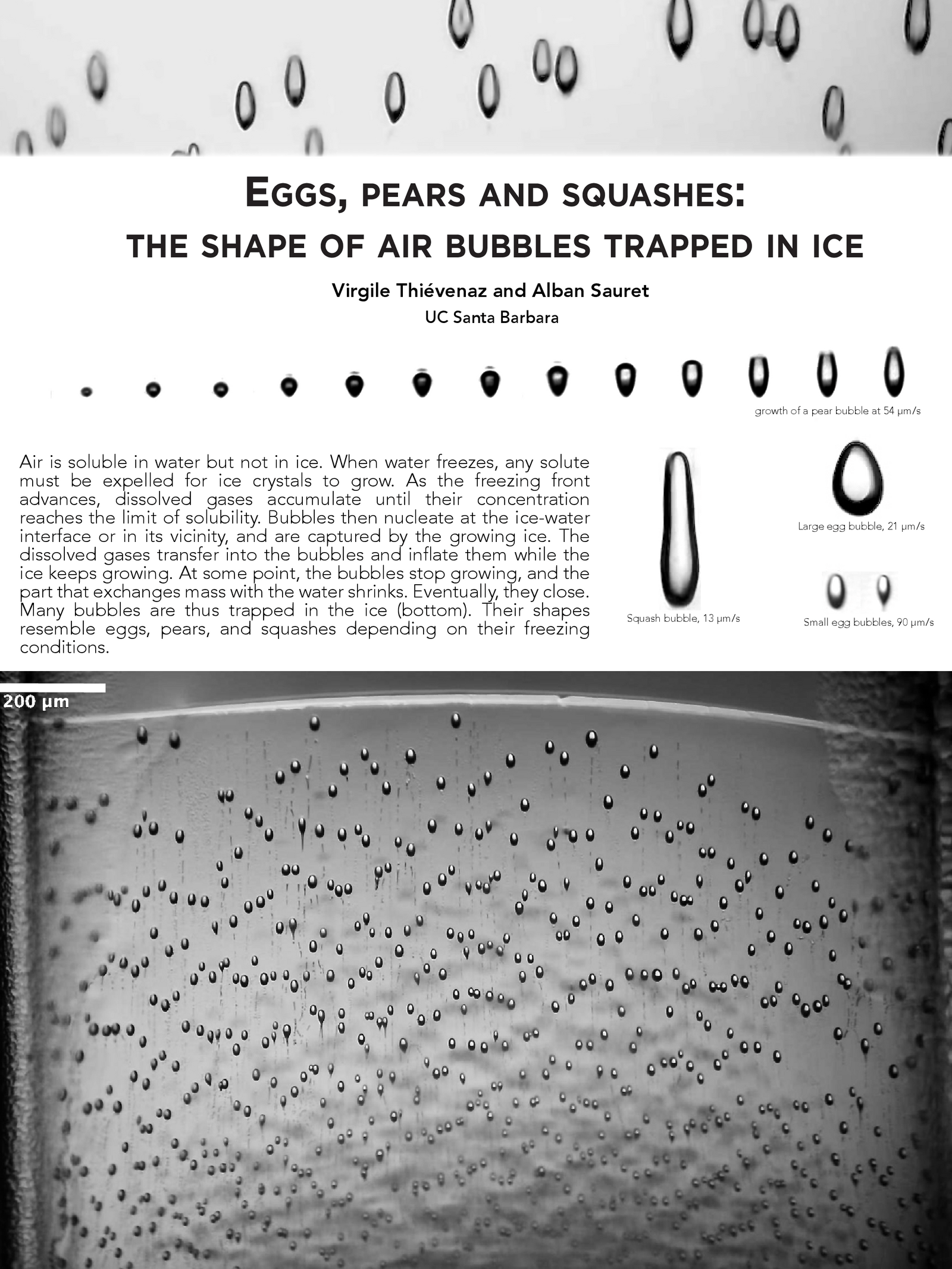
Air can dissolve in water, but not in ice. So as water freezes, any dissolved gases have to get squeezed out in order for the ice crystals to grow. Once the concentration of gases is high enough, a bubble nucleates and gets captured by the growing ice around it. The shape of the final bubble depends on its freezing conditions. As seen here, bubbles take on all kinds of shapes, ranging from egg-like to a long and skinny squash-like shape. (Image credit: V. Thiévenaz and A. Sauret)

Bendable Ice


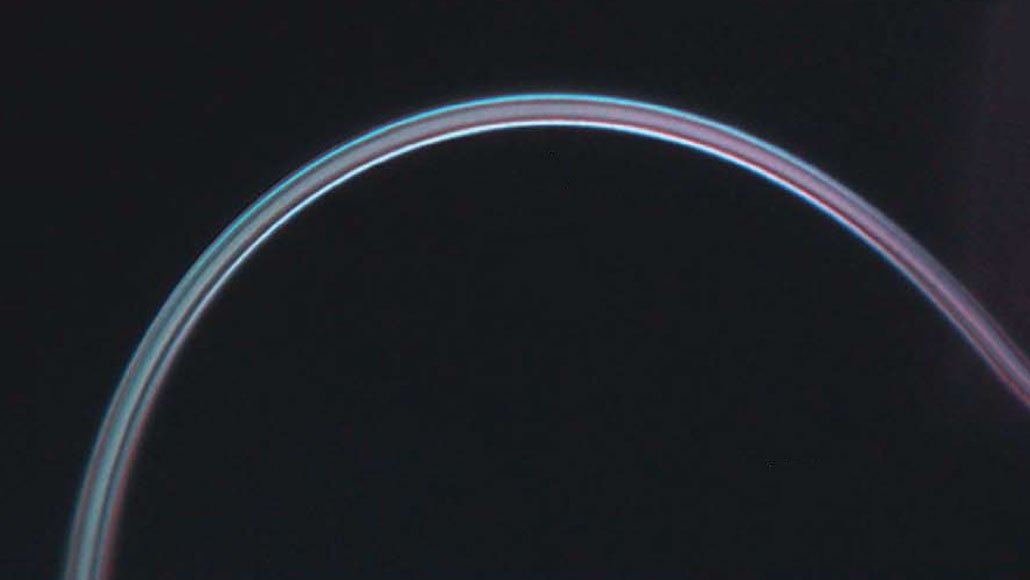
Ice — as we typically encounter it — is extremely brittle and easily broken. That’s due to defects in the ice, places where atoms have settled into a spot that does not match the perfect crystalline alignment. Because tiny defect-free threads of ice made by researchers turn out to be wildly flexible!
To make these perfect ice strands, each of which is a tiny fraction of the thickness of a human hair, researchers applied an electric voltage to a needle in a water-vapor-filled chamber. The technique condensed ice microfibers with perfect crystal structures in a matter of seconds. When bent, the microfibers actually shift from one crystalline arrangement to another in order to carry stress, and once the force is removed, the thread reverts back to its initial straight form. (Image and research credit: P. Xu et al.; via Science News; submitted by Kam-Yung Soh)

Mushy Layers
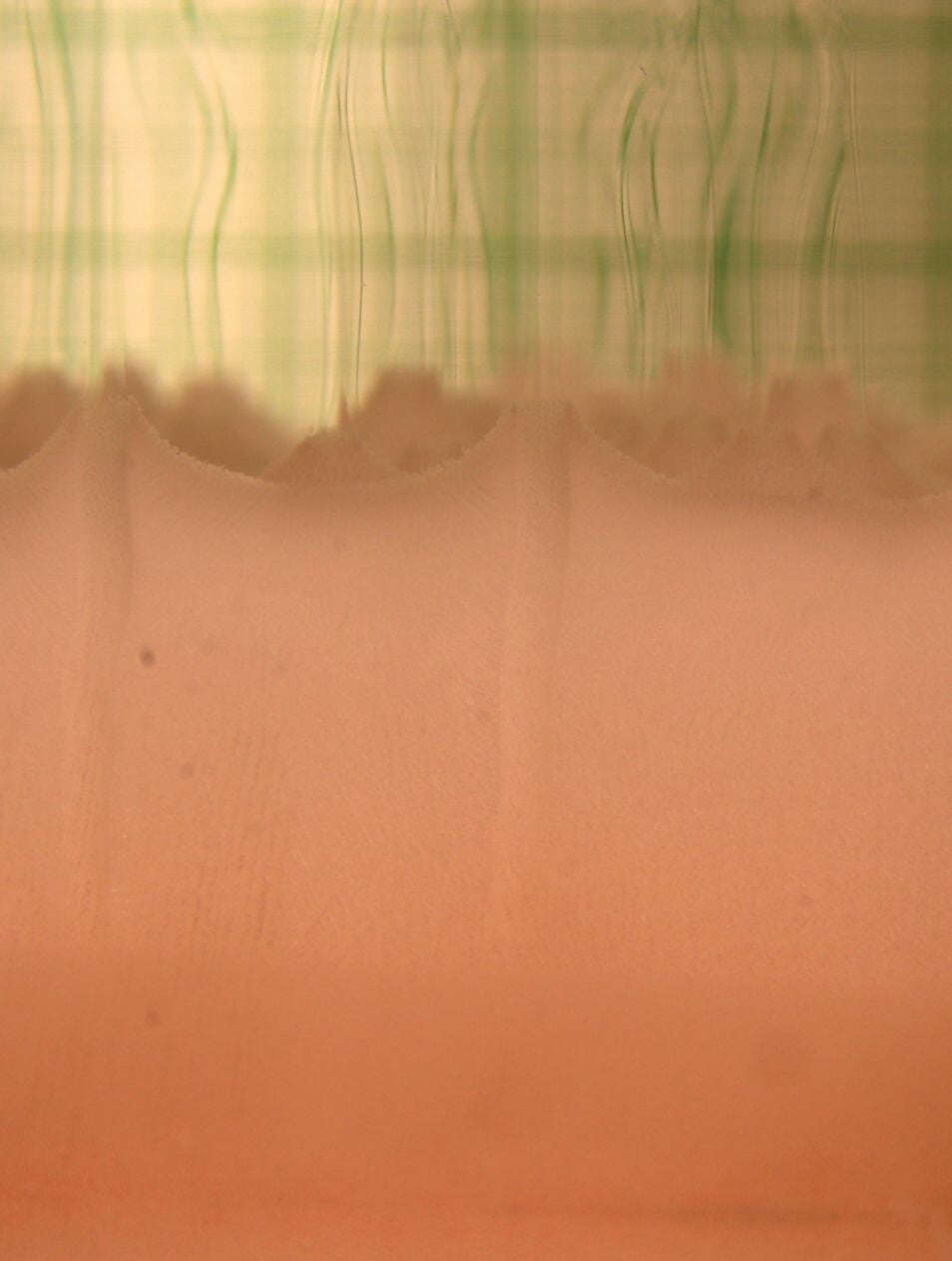
In many geophysical and metallurgical processes, there is a stage with a porous layer of liquid-infused solid known as a mushy layer. Such layers form in sea ice, in cooling metals, and even in the depths of our mantle. Within the mushy layer, temperature, density, and concentration can vary dramatically from one location to another.
The image above shows a mushy layer made from a mixture of water and ammonium chloride. Above the mushy layer, green plumes drift upward, carrying lighter fluid. Look closely within the mushy layer and you’ll see narrow channels feeding up to the surface. These are known as chimneys. In sea ice, chimneys like these carry salty brine out of the ice and into the seawater, increasing its salinity. See this Physics Today article for more details on the dynamics of mushy layers. (Image credit: J. Kyselica; via Physics Today)

Snowflake Still-Life


To take these high-resolution images of individual snowflakes, Nathan Myhrvold and his collaborators built a special camera. Their apparatus keeps the snowflakes chilled despite the strong illumination cast on them. It uses a 500 microsecond shutter and focus-stacking to produce incredibly detailed portraits of these ephemeral subjects. Each snowflake’s shape is the result of the temperature and humidity that crystal experienced as it grew. Since these are natural snowflakes, no two are alike, but, with enough environmental control, it is possible to make twin snowflakes. (Image credit: N. Myhrvold; via Colossal)