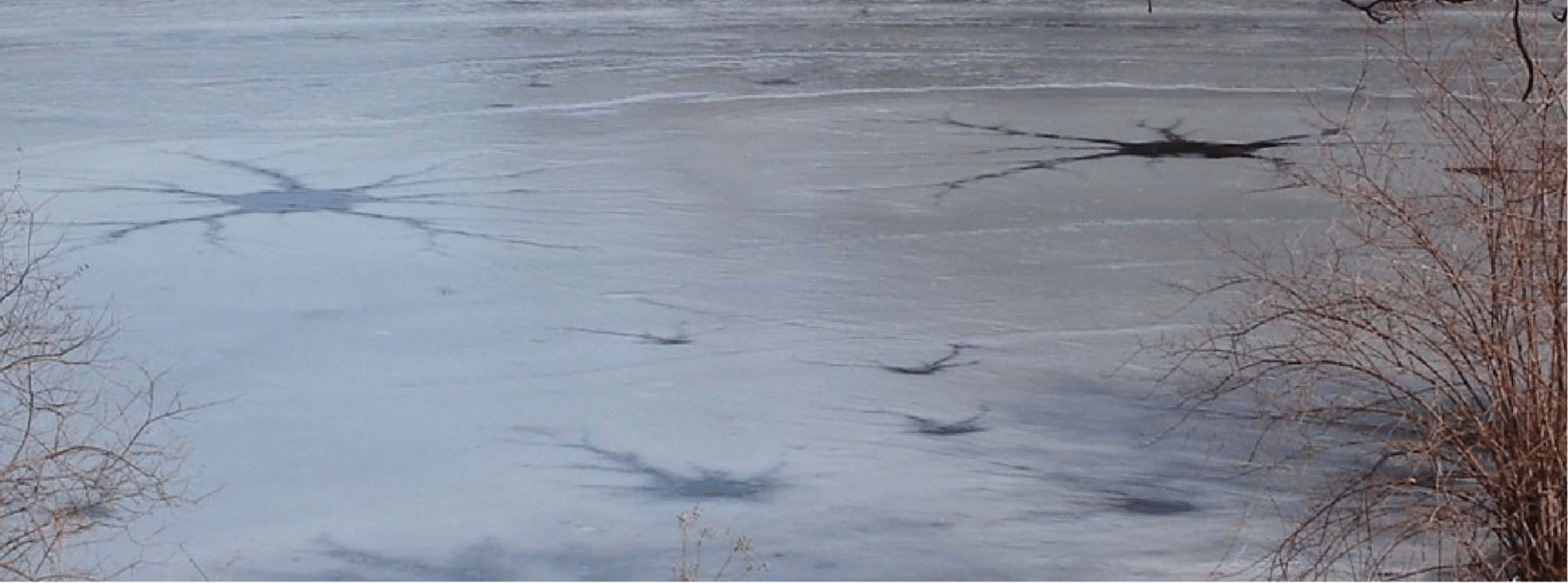
As snow-covered frozen lakes melt, stars appear on their surface. These lake stars form around holes in the ice where (relatively) warm water seeps up into the slush layer. The stars form through a competition between thermal effects and flow through the porous snow. Researchers have built mathematical models that capture the first-order effects, like predicting the number of arms a star will form. (Image and research credit: V. Tsai and J. Wettlaufer; submitted by keeonn)
Tag: freezing

Dual Structure of Water
Water is so ubiquitous in our lives that we rarely recognize just how strange it is. For example, when pure liquid water is supercooled well below its freezing temperature, it takes on not one but two molecular arrangements, one of which is high-density and one of which is low-density. Theory had posited this configuration for some time, but only recently has experimental evidence supported it.
The experimental challenge was water’s rapid crystallization in the temperature region of interest. Any time water was held at those temperatures in order to study it, it would crystallize before researchers could make their observations. To get around this, a team studied extremely thin layers of water which they heated with a laser before rapidly cooling. By repeating this heating-and-cooling cycle many times, they were able to measure water properties that only make sense if it conforms to the two-density theory. (Image credit: T. Holland/Pacific Northwest National Laboratory; research credit: L. Kringle et al.; via Science News; submitted by Kam-Yung Soh)

The Best of FYFD 2020
2020 was certainly a strange year, and I confess that I mostly want to congratulate all of us for making it through and then look forward to a better, happier, healthier 2021. But for tradition and posterity’s sake, here were your top FYFD posts of 2020:
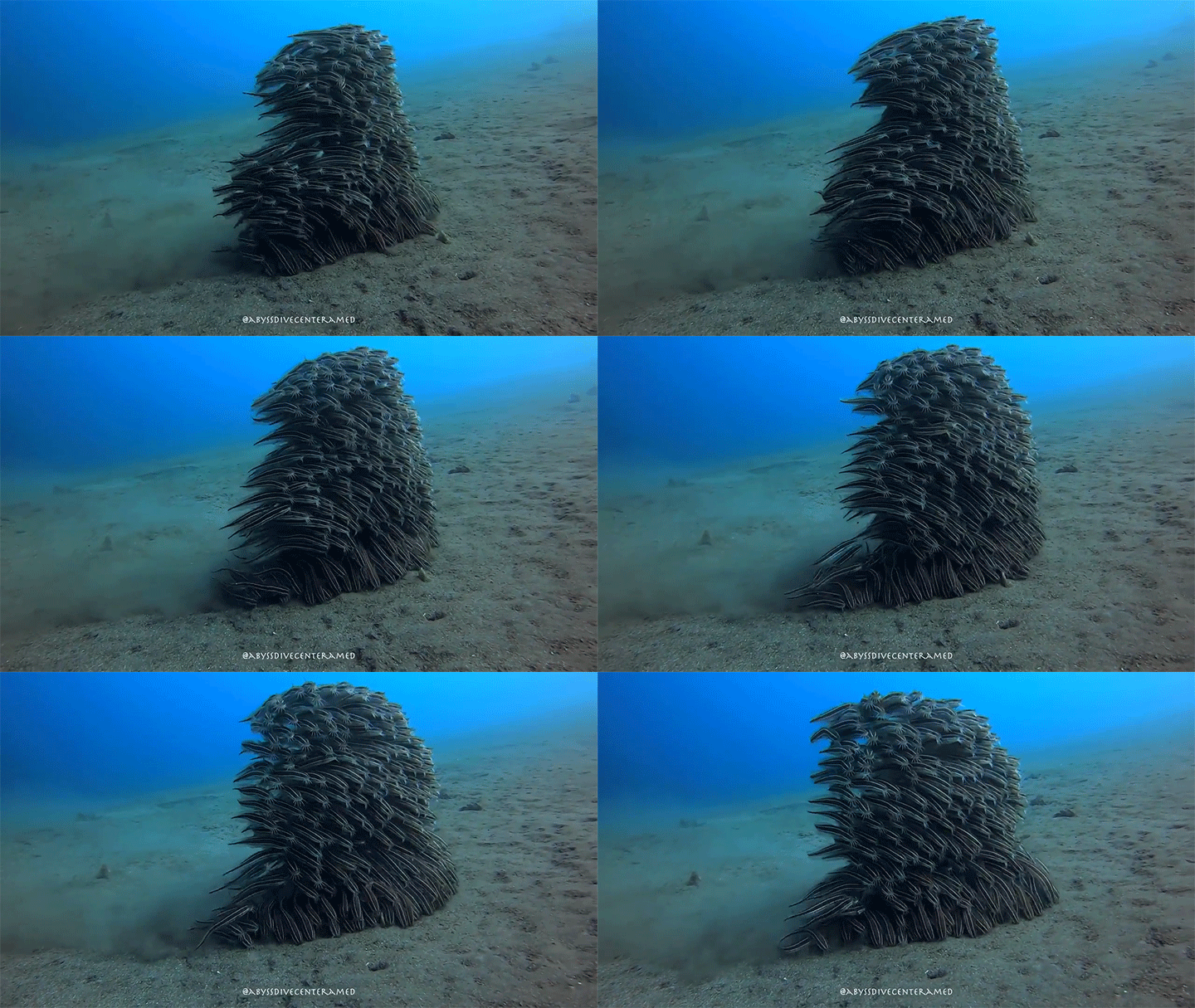
- Juvenile catfish collectively convect for protection
- Gliding birds get extra lift from their tails
- How well do masks work?
- Droplets dig into hot powder
- Updating undergraduate heat transfer
- Branching light in soap bubbles
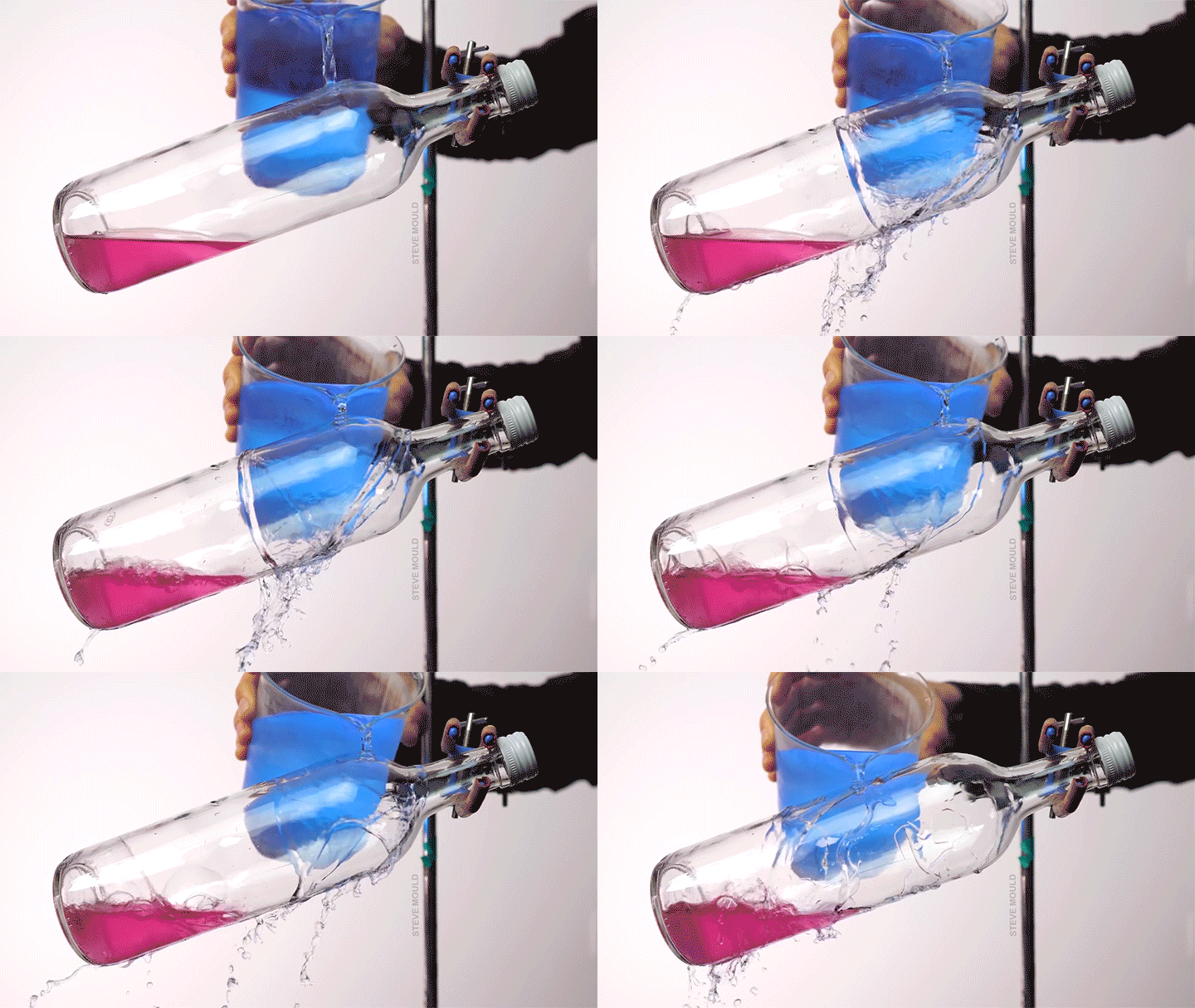
- Boiling water using ice water
- Concentric patterns on freezing and thawing ice
- Bouncing off superhydrophobic defects
- To beat surface tension, tadpoles blow bubbles
There’s a good mix of topics here! A little bit of biophysics, some research, some phenomena, and some good, old-fashioned fluid dynamics.
If you enjoy FYFD, please remember that it’s primarily reader-supported. You can help support the site by becoming a patron, making a one-time donation, buying some merch, or simply by sharing on social media. Happy New Year!
(Image credits: catfish – Abyss Dive Center, owl – J. Usherwood et al., masks – It’s Okay to Be Smart, droplet – C. Kalelkar and H. Sai, boundary layer – J. Lienhard, bubble – A. Patsyk et al., boiling – S. Mould, ice – D. Spitzer, defects – The Lutetium Project, tadpoles – K. Schwenk and J. Phillips)

Rings of Ice
Heavy rains followed by a sudden freeze can produce icy puddles like this one. Because the pool was shallow to begin with, it likely froze rapidly. As the temperature continued dropping, the newly-formed ice contracted; the ring pattern of the cracks tells us the stress in the ice was primarily radial. Once formed, the cracks provided a path for any unfrozen water still in the puddle to get squeezed up onto the surface through capillary action and any further expansion or contraction of the ice. (Image credit: D. Stith; via EPOD; submitted by Kam-Yung Soh)

Freezing Splats
When a drop hits a surface colder than its freezing point, there’s a competition between retraction and solidification that determines the final shape of the splat. For many materials, like wax or soldering metals, the contact angle between their liquid and solid phase is zero, so there’s no major shape change once solidification begins. But water — as is so often the case — is an exception.
Water and ice have a non-zero contact angle, which means that retraction can continue even after the drop begins freezing. As a result, the final shape of the splat varies depending on how cold the surface is. For a surface only a little colder than the freezing point, the final splat forms a spherical cap (Image 1). But once the surface is colder, freezing happens before the water can fully retract and the final splat forms a ring (Image 2). (Image and research credit: V. Thiévenaz et al.)

Exploring Martian Mud Flows
When looking at Mars and other parts of our solar system, planetary scientists are faced with a critical question: if what I’m looking at is similar to something on Earth, did it form the same way it does here? In other words, if something on Mars looks like a terrestrial lava flow, is it actually made of igneous rock or something else?
To tackle this question, a team of researchers explored mud flows in a pressure chamber under both Earth-like and Martian conditions. They found that mud flowed quite freely on Earth, but with Martian temperatures and pressures, the flows resembled lava flows like those found in Hawaii or the Galapagos Islands.
On Mars, mud begins boiling once it reaches the low pressure of the surface. This boiling cools it, causing the outer layer of the mud to freeze into an increasingly viscous crust, which changes how the mud flows. In this regard, it’s very similar to cooling lava, even though the heat loss mechanisms are different. (Video and research credit: P. Brož et al.; image credit: N. Sharp; see also P. Brož; submitted by Kam-Yung Soh)

Watching a Droplet Freeze
Whether it’s rain hitting an airplane wing or droplet-based 3D printing, the dynamics of a droplet impacting and solidifying on a surface are important. This new study observes the process from below, tracking the progress of freezing on a scale of hundreds of nanoseconds.
All three of the drops you see above are liquid hexadecane. Each droplet was the same size and impacted at the same velocity. What differs in each image is how much colder the surface was than hexadecane’s melting point. The leftmost image shows a droplet on a surface only a few degrees cooler than the melting point. The initial expanding ring shows the droplet’s contact line expanding as it impacts. Then frozen crystals appear and grow inside the drop until the entire thing freezes.
With a slightly colder surface (middle image), frozen crystals form while the contact line is still expanding, and rather than form in distinctive spots, they form as a cloud that quickly expands throughout the drop.
But with an even colder surface (right image), something entirely new happens. As the drop freezes, we see multiple dark rings expand through the drop. Each of these rings is made up of frozen crystals. The researchers argue that we’re seeing a combination of freezing and hydrodynamics here. Essentially, whenever the frozen crystals get large enough, the outward flow of the impacting drop sweeps them toward the contact line. As new crystals grow near the center of the drop, they’re dragged out in a subsequent wave. (Image, research, and submission credit: P. Kant et al.)

Frozen Wavelets
Photographer Eric Gross captured these surreal alpine landscapes in Colorado’s Rocky Mountains. Although the lake’s surface appears to have frozen waves, the prevailing theory is that these mounds and divots occur when snowdrifts form atop the lake, melt and refreeze. Over multiple melting and freezing cycles, the lake builds up with what appear to be wind-driven waves frozen in time. (Image credit: E. Gross; via Colossal)

Ice Patterns
Periods of freezing and thawing can leave complicated patterns in ice, as seen in this aerial photo of Binnewater Lake in New York. Ice rarely forms evenly on large bodies like this, so there are always underlying weaknesses. A hard freeze may have caused the ice to contract, forming the initial radial pattern. Then warmer periods of melting allowed water to rise into the cracks and expand them. As the process repeats, the visible pattern emerges.
Also note the star-like crack patterns near the shore. These may have formed in spots where something like a stick protruding from the water’s surface allowed warmer water up onto the ice to melt the snow sitting atop it. (Image credit: D. Spitzer; via EPOD; submitted by Kam-Yung Soh)

Freezing Bubbles
Scientists have observed distinctive differences in the way soap bubbles freeze depending on their environment. If a bubble is surrounded by room temperature air but placed on a cold surface (top), it freezes from the bottom up, with a clear freeze front that slowly creeps upward.
In contrast, bubbles in an isothermal environment – one where it’s equally cold everywhere – freeze with a snow-globe-like effect of ice crystals (bottom). This freezing mode is actually triggered by a Marangoni flow. As the thin bottom layer of the soap bubble begins to freeze, it releases latent heat. That local heating changes the surface tension enough to generate an upward flow. You can see the plumes form right as the bubble touches the surface. Those plumes lift up tiny ice crystals, which continue to grow, ultimately forming the snowy crystals we see take over the surface. (Image and research credit: S. Ahmadi et al.; submitted by Kam-Yung Soh)