
A drop of ferrofluid is shaped by seven small circular magnets sitting beneath the glass and paper. Ferrofluids are made up of nanoscale ferromagnetic particles suspended in a carrier liquid. Under the influence of magnetic fields, they can take on fantastic shapes, including sharp-tipped droplets and labyrinthine mazes. This image is taken from the National Academy of Science’s book Convergence, focused on the intersection between science and art. (Photo credit: Felice Frankel)
Tag: fluids as art

Chronoscapes

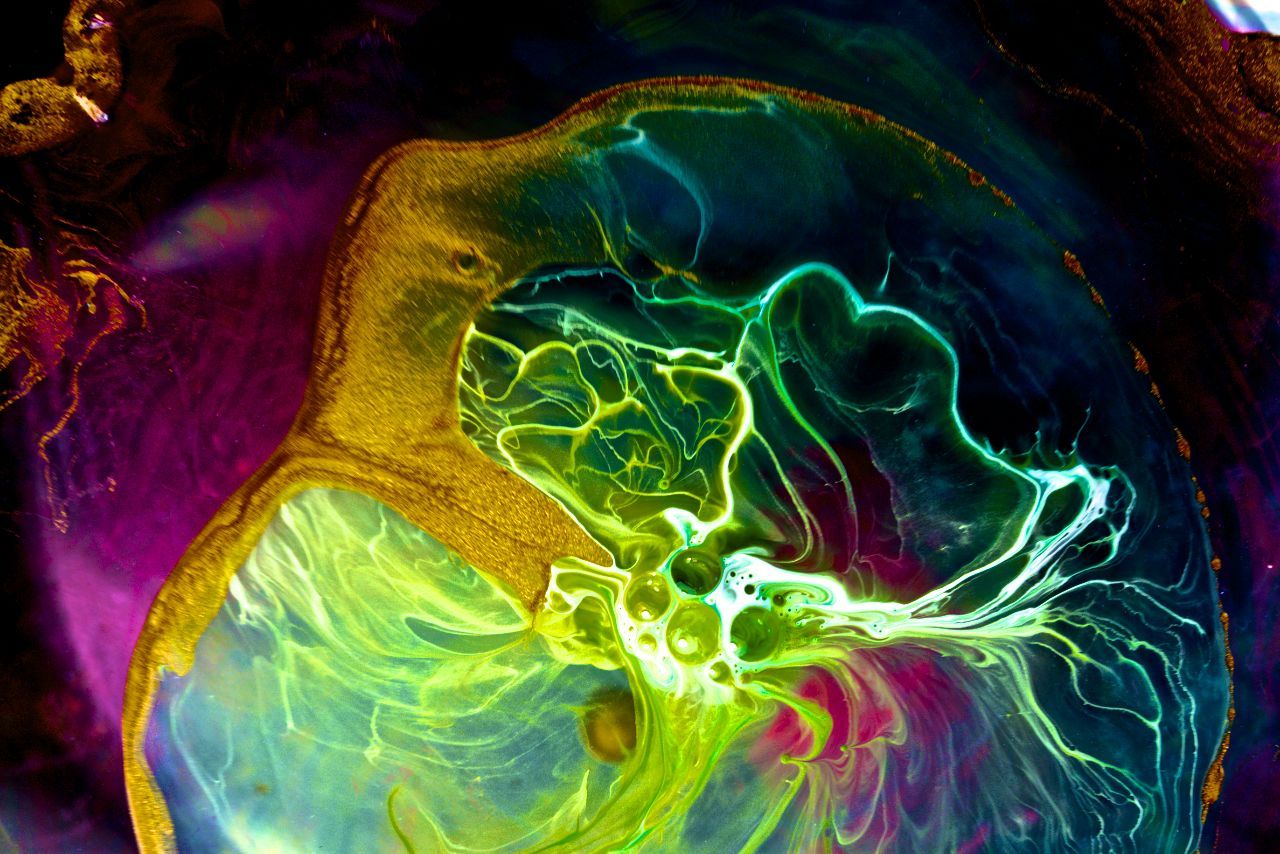
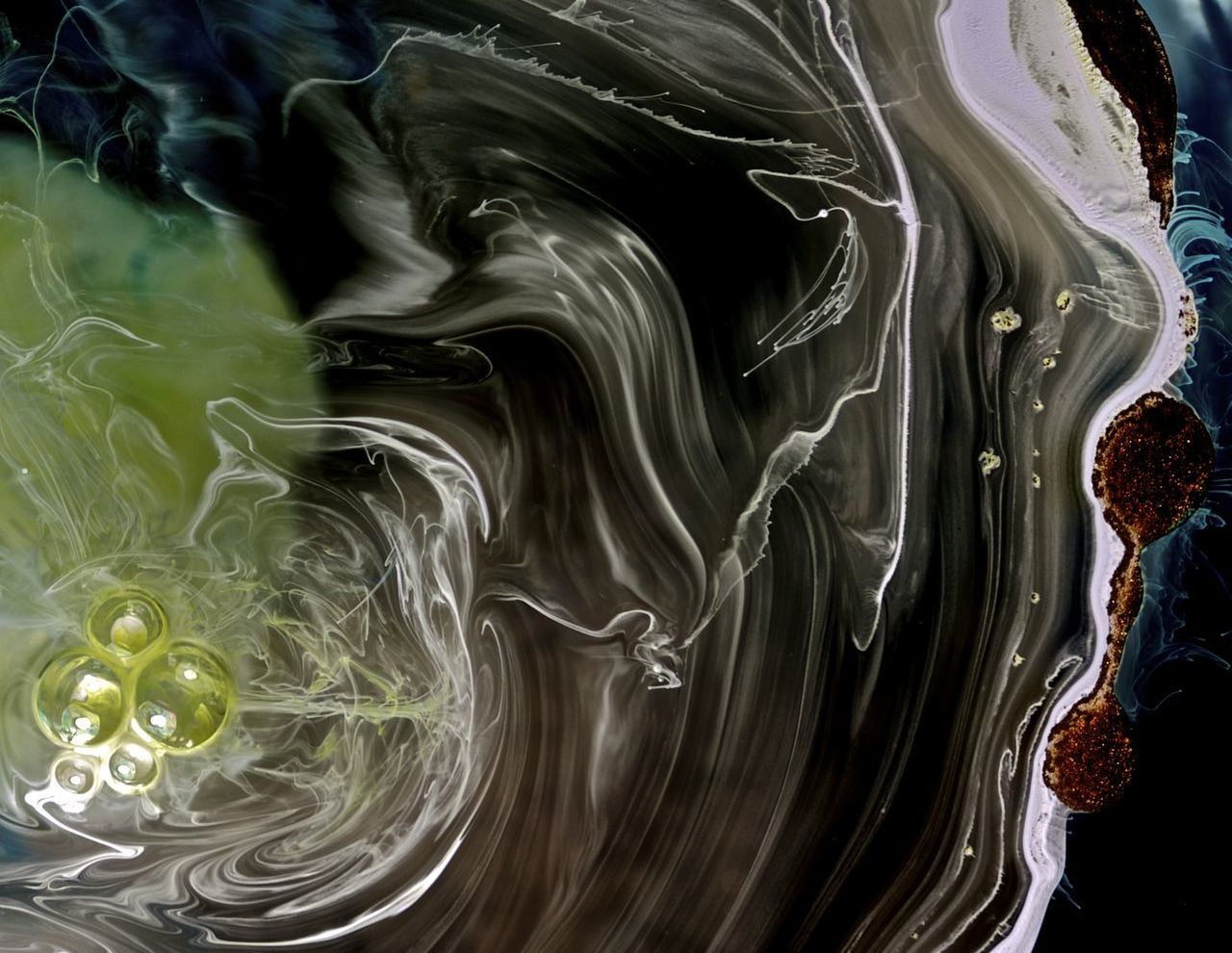
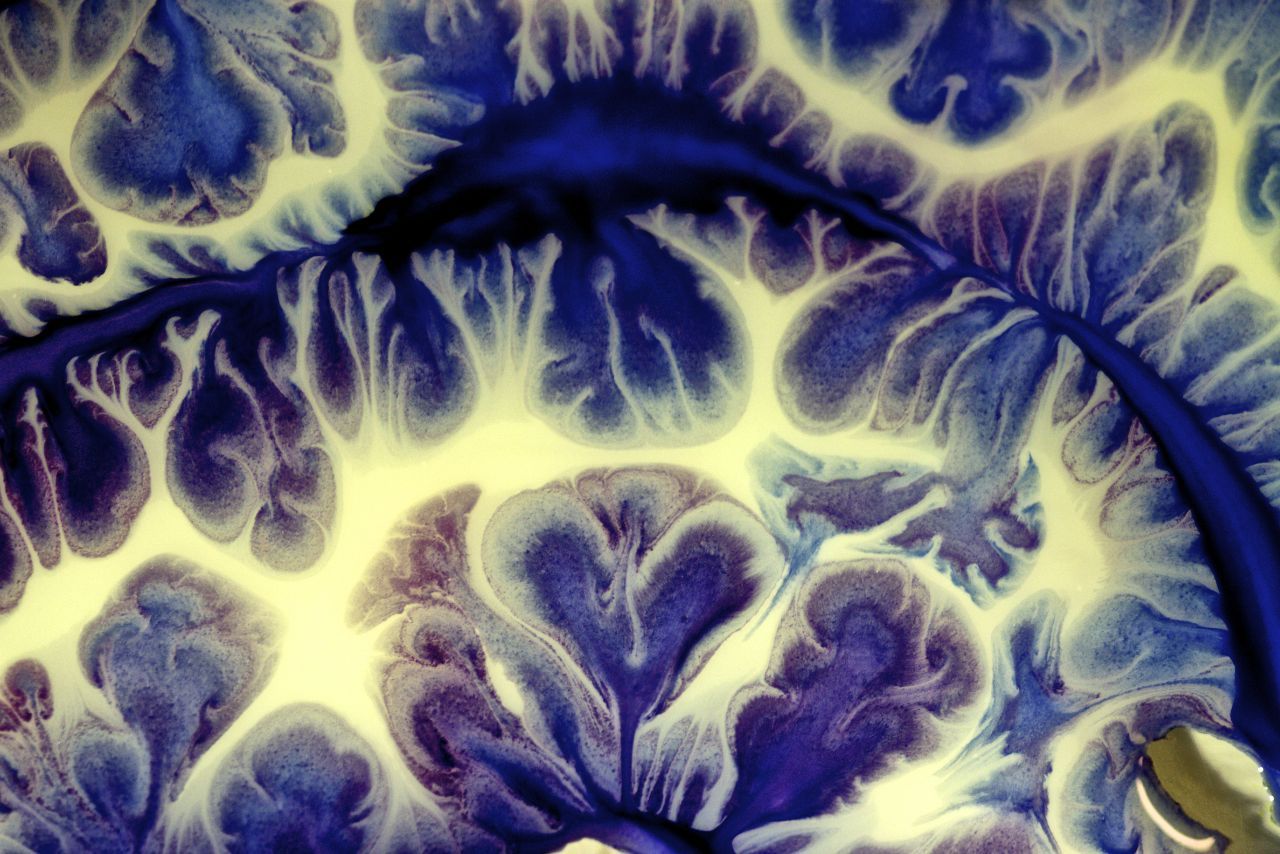
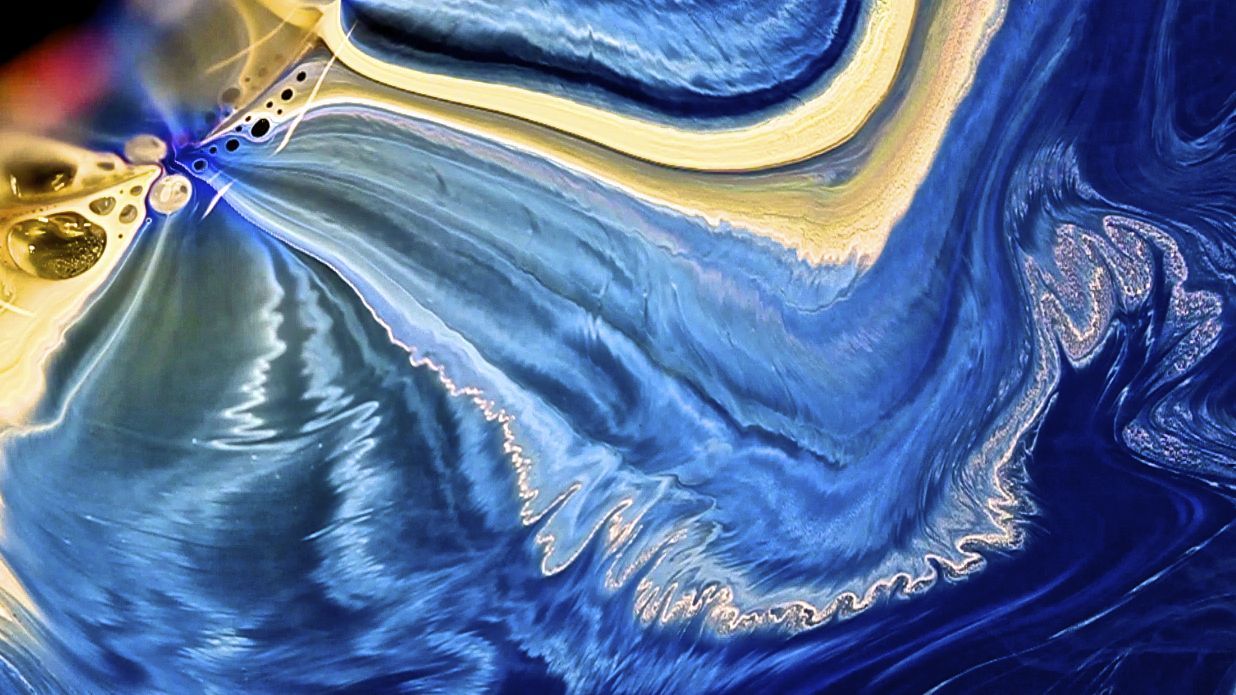
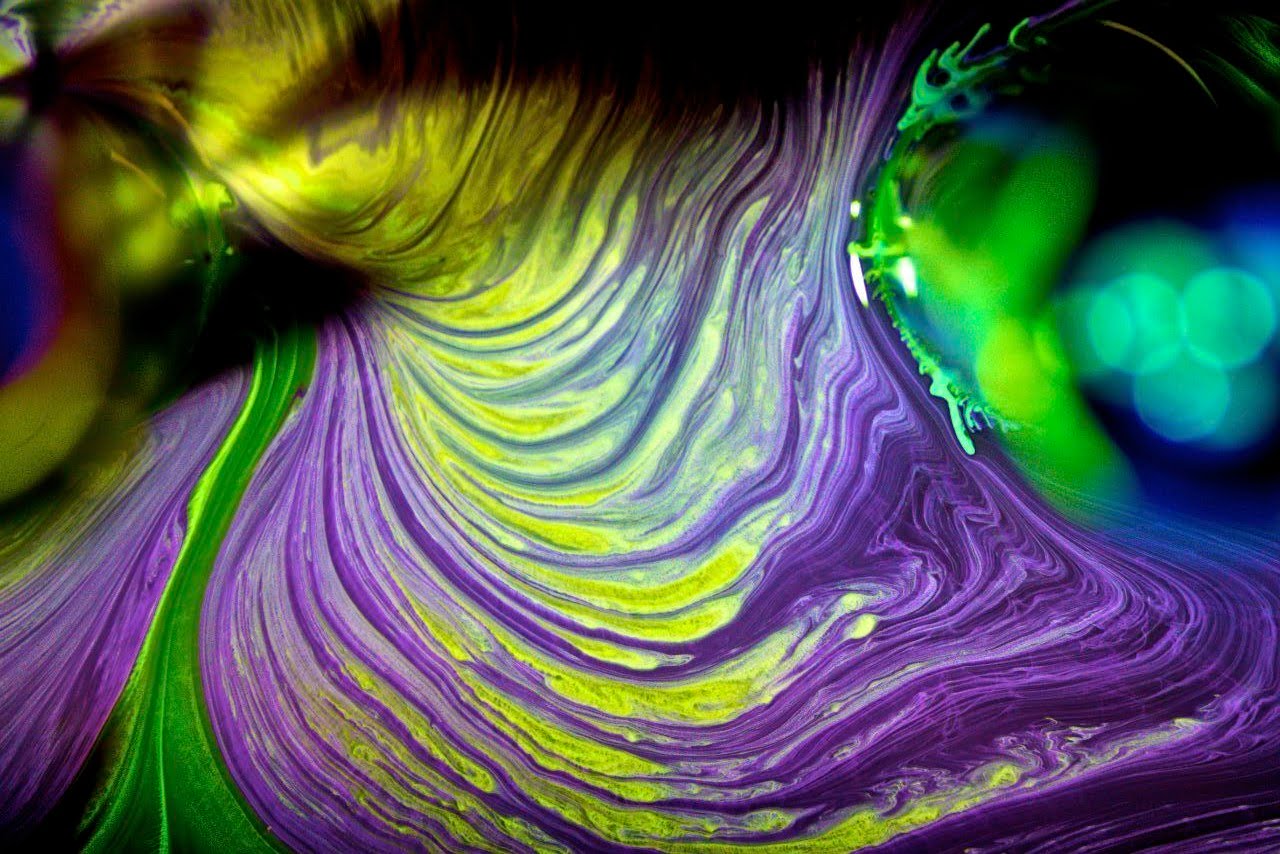
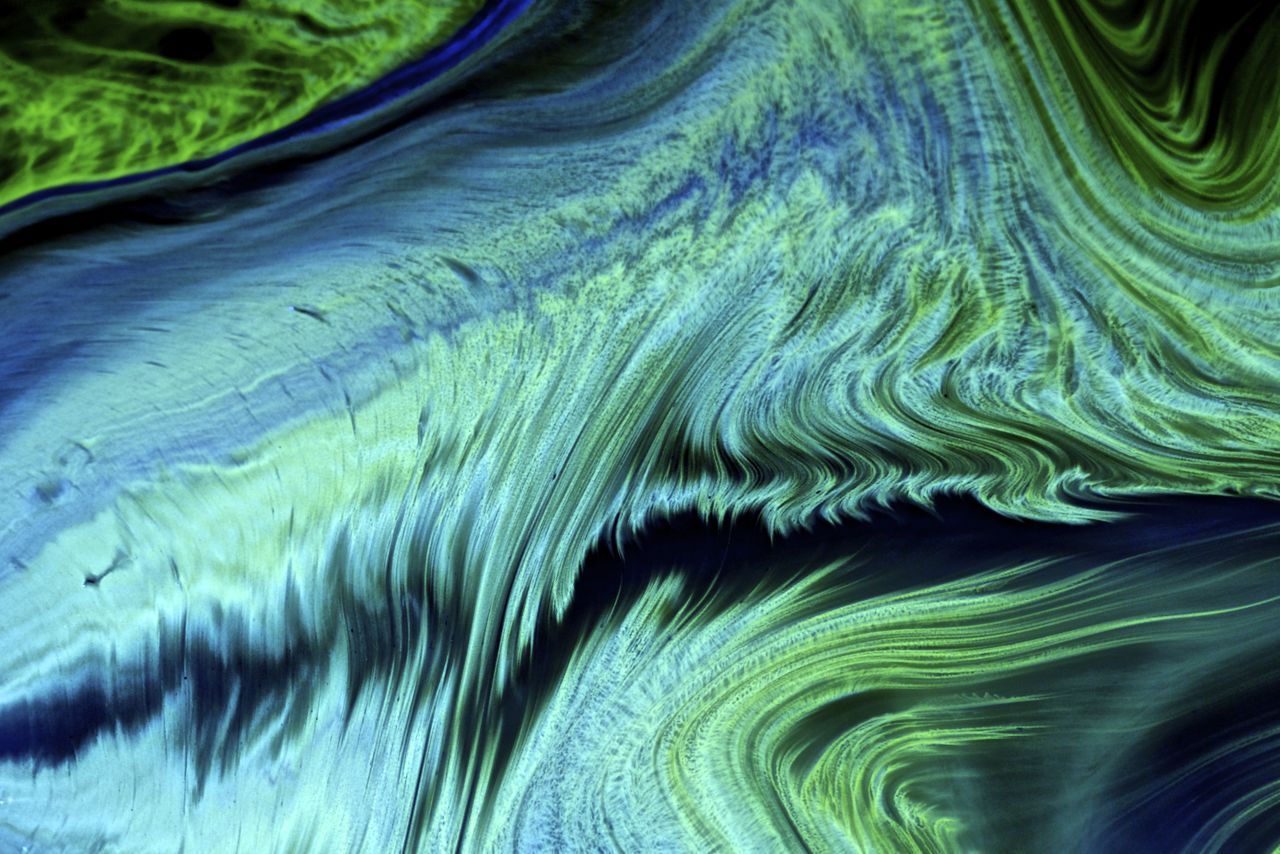
Exeter University artist-in-residence Pery Burge uses ink, water, soap films, and other fluids to create her spectacular “artistic flow visualization”. Looking closely, one sees the influence of bubbles, vortices, diffusion, and many fluid instabilities, all combined to create psychedelic and dream-like landscapes. For more on her work and additional galleries, see her website Chronoscapes. (Photo credit: Pery Burge)

Homemade Astronomy


Artist Julia Cuddy uses liquids, soaps, and glitter to create photographs that replicate the look of deep space astronomy. By adding soap to the dyes, she uses Marangoni effects to drive surface tension instabilities that cause swirling colors and motions reminiscent of galaxies and nebulae. Although I’ve seen fluid dynamics used in art before, this may be one of the cleverest usages I’ve seen! (Photo credits: Julia Cuddy)

Fractal Fluids
Part of the beauty of numerical simulation is its ability to explore the physics of a situation that would difficult or impossible to create experimentally. Here the Rayleigh-Taylor instability–which occurs when a heavier fluid sits atop a lighter fluid–is simulated in two-dimensions. Viscosity and diffusion are set extremely low in the simulation; this is why we see intricate fractal-like structures at many scales rather than the simulation quickly fading into gray. (The low diffusion is also what causes the numerical instabilities in the last couple seconds of video.) The final result is both physics and art. (Video credit: Mark Stock)

Bubble Art


Photographer Janet Waters uses liquids and bubbles to create her fascinating abstract macro art. Check out this interview with the artist and her portfolio for more. (Photo credits: Janet Waters)
Turing Patterns
Turing patterns form as a result of a particular kind of chemical reaction: a reaction-diffusion system. It consists of an activator chemical capable of making more of itself, and an inhibitor chemical which slows the production of the activator as well as a mechanism for diffusing the chemicals. Although Turing’s original work was theoretical in nature, scientists have since proven that Turing patterns do occur in nature, both in petri dishes and in the markings of animals. Here artist Jonathan McCabe explores multi-scale Turing patterns in a fluid-like environment. (Video credit: Jonathan McCabe and Jason Forrest; submitted by Stuart R)
Paper Marbling
[original media no longer available]
Suminagashi, the Japanese art of “floating ink”, is one of many methods historically used for paper marbling. In it, a shallow layer of water or other viscous fluid serve as a medium for drops of ink that diffuse across the fluid surface and are manipulated with straws, brushes, or other tools. Once a design is complete, an absorbent surface like paper or fabric is carefully placed on top to preserve the art. Among other applications, the technique has historically been used for calligraphy and book bindings.
“Cascades”
Ryan Teague’s “Cascades” music video features the enchanting process of ice growth. A chamber full of supercooled water vapor subject to a strong electric field is stimulated to grow crystals by providing a needle as the initial nucleation site. Because the vapor is supercooled, it will freeze upon contact with the nucleation site; the electric field keeps the water molecules aligned so that the crystal patterns formed are more even. The tree-like pattern seen here is called dendritic crystal growth; branches form at faults in the crystalline pattern. (Video credit: Ryan Teague, Village Green, Words are Pictures; via Gizmodo)
Viscous Dripping
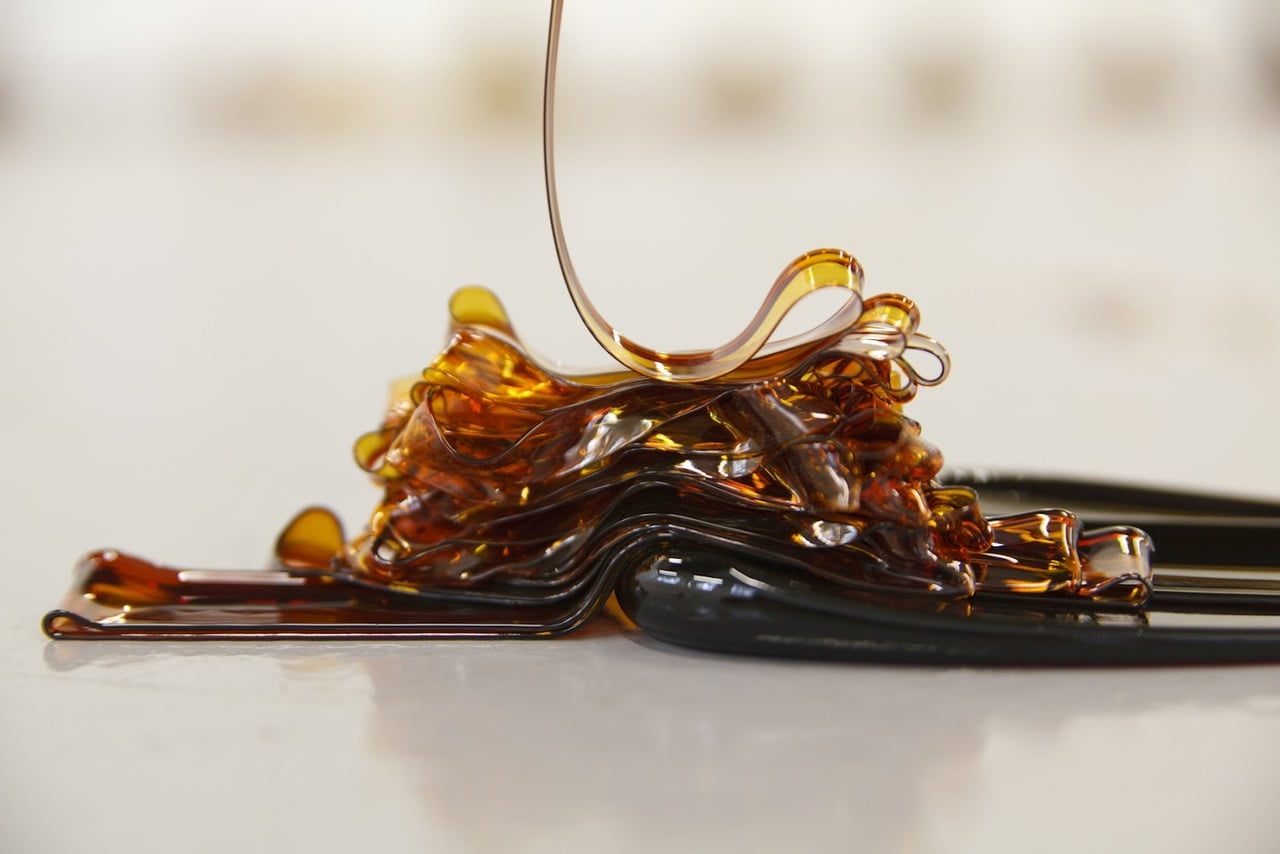


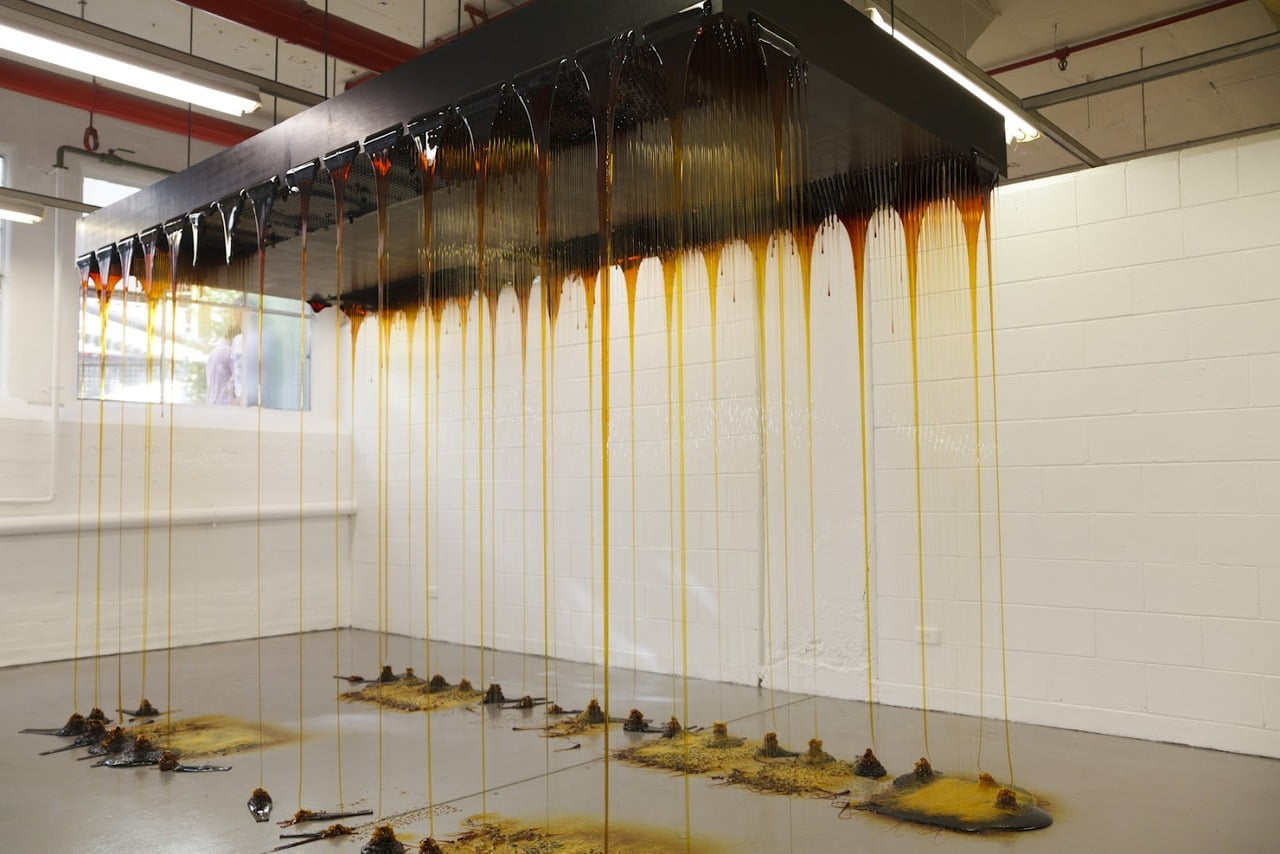

Artist Skye Kelly’s “Creep (strain)” sculpture shown above is made from toffee. The viscous fluid deforms under the force of gravity, resulting in elongated drips and slow jets that buckle and coil upon reaching the floor. (Photo credits: Skye Kelly; via freshphotons)

Fractal Fluids
These images from a numerical simulation of a mixing layer between fluids of different density show the development and breakdown to Kelvin-Helmholtz waves. The black fluid is 3 times denser than the white fluid, and, as the two layers shear past one another, billow-like waves form (Fig 1(a)). Inside those billows, secondary and even tertiary billows form (Fig 1(a) and (b)). Fig 1 (c)-(e) show successive closeups on these waves, showing their beautiful fractal-like structure. (Photo credit: J. Fontane et al, 2008 Gallery of Fluid Motion) #

