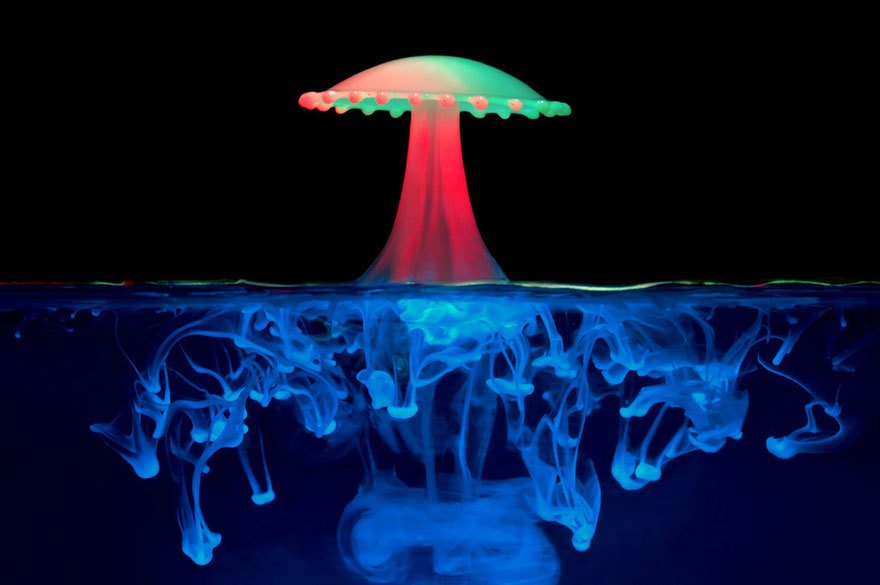
Artist Corrie White uses dyes and droplets to capture fantastical liquid sculptures at high-speed. The mushroom-like upper half of this photo is formed when the rebounding jet from one droplet’s impact on the water is hit by a well-timed second droplet, creating the splash’s umbrella. In the lower half of the picture, we see the remains of previous droplets, mixing and diffusing into the water via the Rayleigh-Taylor instability caused by their slight difference in density relative to the water. There’s also a hint of a vortex ring, likely from the droplet that caused the rebounding jet. (Photo credit: Corrie White)
Tag: fluids as art

Spiraling Ferrofluid
Here a ferrofluid climbs a spiral steel structure sitting on an electromagnet. Magnetic field lines emanating from the sculpture’s edges tend to push the ferrofluid out into long spikes–part of the normal field instability–but surface tension resists. The short, somewhat squat spikes we see are the balance struck between these opposing forces. Though known for their wild appearance, ferrofluids appear many in common applications, including hard drives, speakers, and MRI contrast agents. Researchers have also recently suggested they might help understand the behavior of the multiverse. (Photo credit: P. Davis et al.)

Ink Drops
This super high resolution video (check the original on YouTube) by filmmaker Jacob Schwarz features slow motion diffusion of ink into water. The subtle differences in density between the ink and the water promote instabilities such as the Rayleigh-Taylor instability and its distinctive cascade of mushroom- or umbrella-like shapes. The mixing of two fluids seems like a simple concept, but the reality is beautiful, complex, and always fascinating. (Video credit: J. Schwarz; submitted by Rebecca S.)
Inksplosion
Artist Pery Burge utilizes surface tension driven flows created with inks and water for much of her work. As mesmerizing as this is in still-life, it is more lovely still to see it develop and evolve in motion. The explosive outward motion of the ink is driven by the addition of a liquid with a lower surface tension than the ink/water mixtures. This is known as the Marangoni effect. You can observe it yourself using a plate of milk and food coloring into which you drop a tiny bit of dish soap. (The experiment works best with milk with some fat content.) Or, like the artist herself, you can experiment with other fluids you have on-hand! For more of Bruge’s work, see her website. (Video credit: Pery Bruge)
The Water Bridge
This short film offers an artistic look at the phenomenon of the water bridge. When subjected to a large voltage difference, such as the 30 kV used in the film, flow can be induced between water in two separated beakers. This creates a water bridge seemingly floating on air. There are two main forces opposing the bridge: gravity, which causes it to sag, and capillary action, which tries to thin the bridge to the point where it will break into droplets. These forces are countered by polarization forces induced at the liquid interface due to the electrical field separating the water’s positive and negative charges. This separation of charges creates normal stresses along the water surface, which counteracts the gravitational and capillary forces on the bridge. The artist has done a beautiful job of capturing the unsteadiness and delicacy of the phenomenon. (Video credit: Lariontsev Nick)

Ripples
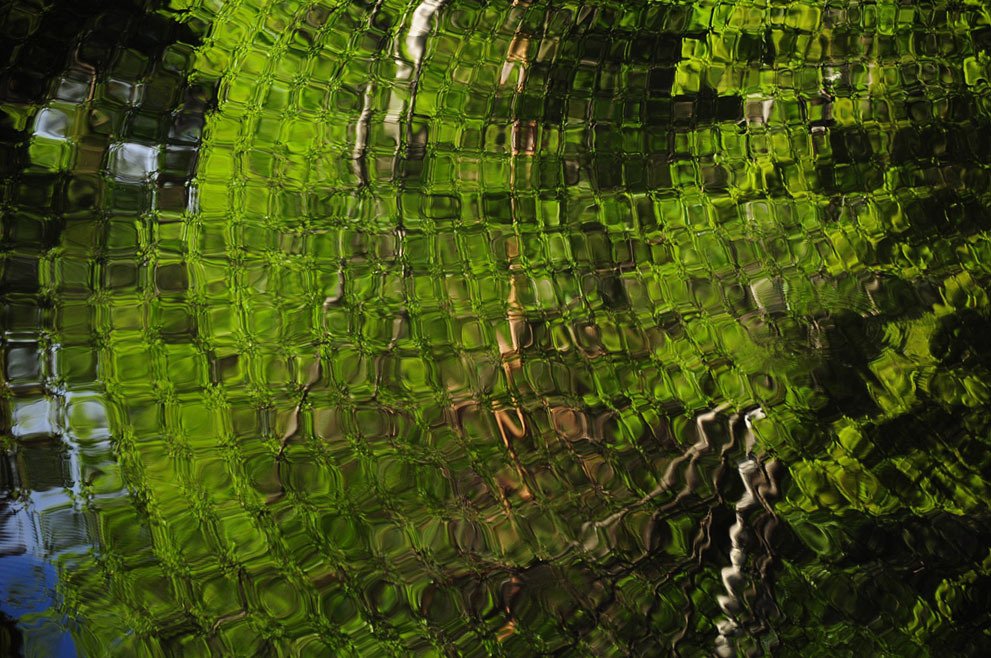
Capillary waves–ripples–interfere with one another after the photographer throws objects into a narrow point in a small lake. The reflections of these waves off the lake’s boundaries and against one another creates a mosaic-like geometric effect on the liquid surface. (Photo credit: Jorgen Tharaldsen/National Geographic Photo Contest)
INK World v01
In this video, mixtures of inks (likely printer toners) and fluids move and swirl. Magnetic fields contort the ferrofluidic ink and make it dance, while less viscous fluids spread into their surroundings via finger-like protuberances. (Video credit and submission: Antoine Delach)
Laminar Fountain
In the midst of holiday travels, take a moment (particularly if you’re flying through Detroit) to enjoy the simple beauty of WET Design’s fountain in the McNamara Terminal. Laminar jets arc through the air almost like perfect crystalline columns of fluid. Watch closely and you’ll see a few wavy variations–like a Plateau-Rayleigh instability creeping in–but there will be no turbulence to distress passengers and passers-by. (Video credit: WET Design)

Ferrofluid Sculptures


Artist Sachiko Kodama is known for her mesmerizing ferrofluid sculptures. Ferrofluids are a colloidal liquid consisting of nanoscale ferromagnetic particles and a carrier fluid such as water or oil. They can react strongly to magnetic fields, forming spikes, brain-like whorls, and even labyrinths. (Photo credits: Sachiko Kodama; via freshphotons)
Stirring Faces
This video features simulation of the laminar flow around a plate plunging sinusoidally in a quiescent flow. As the plate moves up and down, it mixes the fluid around it. This is visualized in several ways, beginning with the vorticity. Clockwise and anti-clockwise vortices are shed by the edges of the plate as it moves. The flow is also visualized using particle trajectories, which are classified by their tendency to accumulate (attract) or lose (repel) particles. These trajectories are particularly intriguing to watch develop as they appear to show ornate faces and designs. (Video credit: S. L. Brunton and C. W. Rowley)