Tag: fluids as art

  • The Colorful Dissolution of Candies

    The Colorful Dissolution of Candies

    Many solids can dissolve in liquids like water, and while this is often treated as a matter of chemistry, fluid dynamics can play a role as well. As seen in this video by Beauty of Science, the dissolving candy coating of an M&M spreads outward from the candy. This is likely surface-tension-driven; as the coating dissolves, it changes the surface tension near the candy and flow starts moving away thanks to the Marangoni effect. With multiple candies dissolving near one another, these outward flows interfere and create more complex flow patterns. 

    These flows directly affect the dissolving process by altering flow near the candy surface, which may increase the rate of dissolution by scouring away loose coating. They can also change the concentration of dissolved coating in different areas, which then feeds back to the flow by changing the surface tension gradient. (Video and image credit: Beauty of Science)

  • When Vortices Collide

    When Vortices Collide

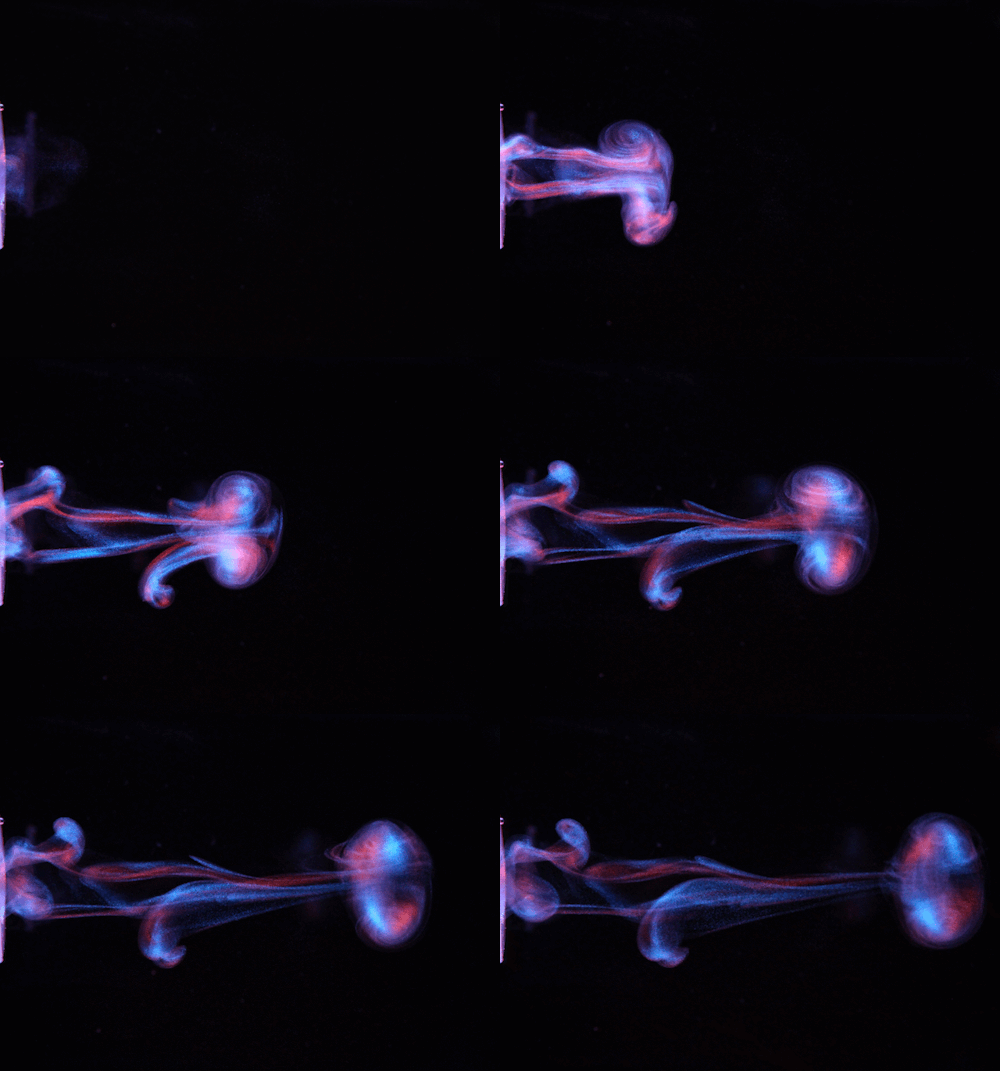
    In a new ad campaign for paint manufacturer Sherwin-Williams, the production team at Psyop show off some awesome fluid dynamics by swirling and injecting paint underwater. You can see one sequence above, where red and blue paint vortex rings collide head-on before breaking down into a purple turbulent cloud. (What a great way to demonstrate the mixing power of turbulence, right?) Here’s the full 30-second ad clip. Impressively, everything in the video is a practical effect, even the segment that flies past multicolored turbulent plumes. You can see how they filmed everything in their behind-the-scenes featurette below. In the meantime, enjoy the mesmerizing beauty of real-world physics and check out FYFD’s “fluids as art” tag for more examples. (Image and video credit: Psyop for Sherwin-Williams; submitted by Alan B.)

  • Featured Video Play Icon

    Hawaii’s Lava

    Sometimes the best way to appreciate a flow is standing still. In “Hawaii – The Pace of Formation” filmmakers explore how the Big Island is constantly changing, from fresh lava flows to towering waterfalls. Much of the footage presented is timelapse, which gives viewers a different perspective on familiar subjects; it highlights the similarities between clouds and the ocean, and it reminds us that a lava flow and the syrup flowing down a stack of pancakes have a lot in common. To me, this is one of the most beautiful parts of fluid dynamics: physics of flows on different length-scales and time-scales – even in different fluids – are still very much the same. (Video credit: A. Mendez et al.)

  • Breaking Wave

    Breaking Wave

    This animation shows a cinemagraph of a breaking wave photographed by Ray Collins. The motion was inferred and digitally added by a second artist, Jersey Maria. The result is hypnotic, as if we are traveling beside the wave and watching it tear apart ever so slowly. The wave seems to be poised on a tipping point, only breaking up along its back edge, when instinct tells us it will keep steepening and tipping forward until its top curl crashes down in a wave of white foam. Surf photography like Collins’ work shows us an alternative perspective on waves, their power frozen into a single instant. Reanimated, it feels like we’re seeing the wave in hyper-slow-motion, watching every tiny movement of water before everything crashes down. Even if it’s not physically realistic, it is an awesome view.  (Image credit: R. Collins / J. Maria, source, original; via Iwan A.)

  • Acrylic and Oil

    Acrylic and Oil

    Photographer Alberto Seveso is well-known for ink in water art, some of which FYFD has featured previously (1, 2, 3). More recently, he’s been experimenting with alternative methods, dropping fluids like acrylic paint into sunflower oil. The effect is quite different but no less beautiful. Because the paint and oil are immiscible, the boundaries between the two fluids are much more clearly defined and highlighted in an iridescent sheen. Instead of appearing like billowing waves of silk, the paint forms abstract and alien shapes driven by gravity, inertia, and density differences. For many more great examples, check out Seveso’s website. (Photo credit: A. Seveso)

  • Breaking Soon

    Breaking Soon

    Australian photographer Warren Keelan captures spectacular photos of waves just before and during the moment they break. Fluid dynamics is defined by motion – specifically the motion of substances that do not hold a single form – but one thing I love about wave photography is how crisp and solid water appears when frozen in time. In a way, it feels like a reminder that, even though we classify matter into different states, ultimately those states have a lot in common. (Image credit: W. Keelan; via Colossal)

  • Leidenfrost Atop a Fluid

    Leidenfrost Atop a Fluid

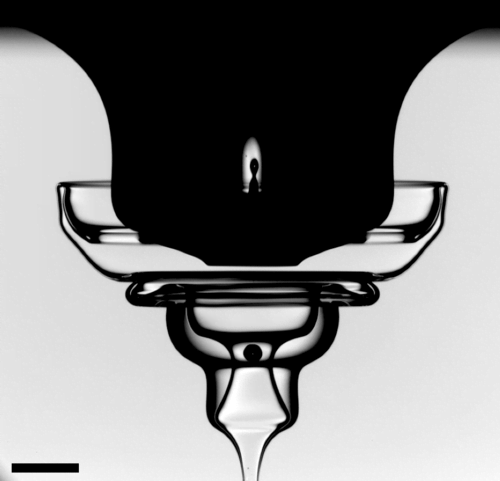
    Leidenfrost droplets typically hover on a thin layer of vapor above a surface that is much hotter than the boiling point of the liquid. Such drops move almost frictionlessly across these surfaces and can even propel themselves. The question of how hot is hot enough to produce the Leidenfrost effect is still being debated, but recent research suggests that the answer may depend strongly on surface roughness.

    To test the role of surface roughness, one group tested drops of ethanol atop a heated pool of silicone oil, as pictured above. Ethanol’s boiling point is 78 degrees Celsius, and the researchers found they could hold the ethanol drop in a Leidenfrost state by heating the pool to 79 degrees Celsius – only 1 degree above ethanol’s boiling point! Thanks to surface tension, a liquid surface is essentially molecularly smooth. The fact that solid surfaces require much higher temperatures before the Leidenfrost effect is observed indicates that even the slightest roughness can have a large impact on the Leidenfrost temperature. (Image credit: F. Cavagnon; research credit: L. Maquet et al., pdf)

    Heads-up for Boston-area folks! I’ll be taking part this Saturday evening in the Improbable Research show at the AAAS conference. The show is free and open to the public but fills up quickly, so be sure to come early for a seat.

  • Featured Video Play Icon

    Four Seasons

    The team behind Beauty of Science decided to explore the four seasons in this video combining macro footage of crystal growth, chemical reactions, and fluid dynamics. It’s always a fun game with videos like this to try and guess exactly what makes the mesmerizing patterns we see. Are those blue streaming waves in Spring caused by alcohol shifting the surface tension in a mixture? Are the dots of color welling up in Autumn a lighter fluid bursting up from underneath a denser one? As fun as the visuals are, though, what really made this video stand out for me was its excellent use of “The Blue Danube” to tie everything together. Check it out and don’t forget the audio! (Video credit: Beauty of Science; via Gizmodo)

  • Featured Video Play Icon

    Freezing Bubbles

    Soap bubbles are wonderfully ephemeral, their surfaces constantly in motion as air currents, surface tension variations, and temperature differences make them dance. In this video, though, photographer Paweł Załuska focuses on freezing soap bubbles. Watching the growth of ice crystals across the bubbles’ thin surface is mesmerizing. Snowflake-like crystals can nucleate anywhere on the film and, as in the sequence at 0:48, those crystals can float around on the bubble’s surface like snowflakes drifting on a breeze until enough of the film solidifies to bring the bubble to a halt and, then, a collapse. (Video credit: P. Załuska/ZALUSKart; via Gizmodo)

  • Accidental Painting

    Accidental Painting

    Some paintings of Mexican artist David Alfaro Siqueiros feature patchy, spotted areas of contrasting color formed by what Siqueiros described as “accidental painting”. Many modern artists use this technique as well. By pouring thin layers of two different colors atop one other, Siqueiros was able to generate seemingly spontaneous patterns like those shown above. In fact, what Siqueiros was using was a density-driven fluid instability! These patterns will only appear when a denser paint is poured atop a lighter one. They’re the result of a Rayleigh-Taylor instability – the same behavior that makes beautiful swirls of cream in coffee and the finger-like protrusions seen in supernovae.

    Although a density difference is necessary to generate accidental painting, other factors like the paint layer’s thickness and viscosity affect the final pattern. For those who are mathematically-inclined, this paper has a linear stability analysis that shows how density difference, viscosity, and other factors affect the cell sizes in the pattern. (Image and research credits: S. Zetina et al.; GIF source)