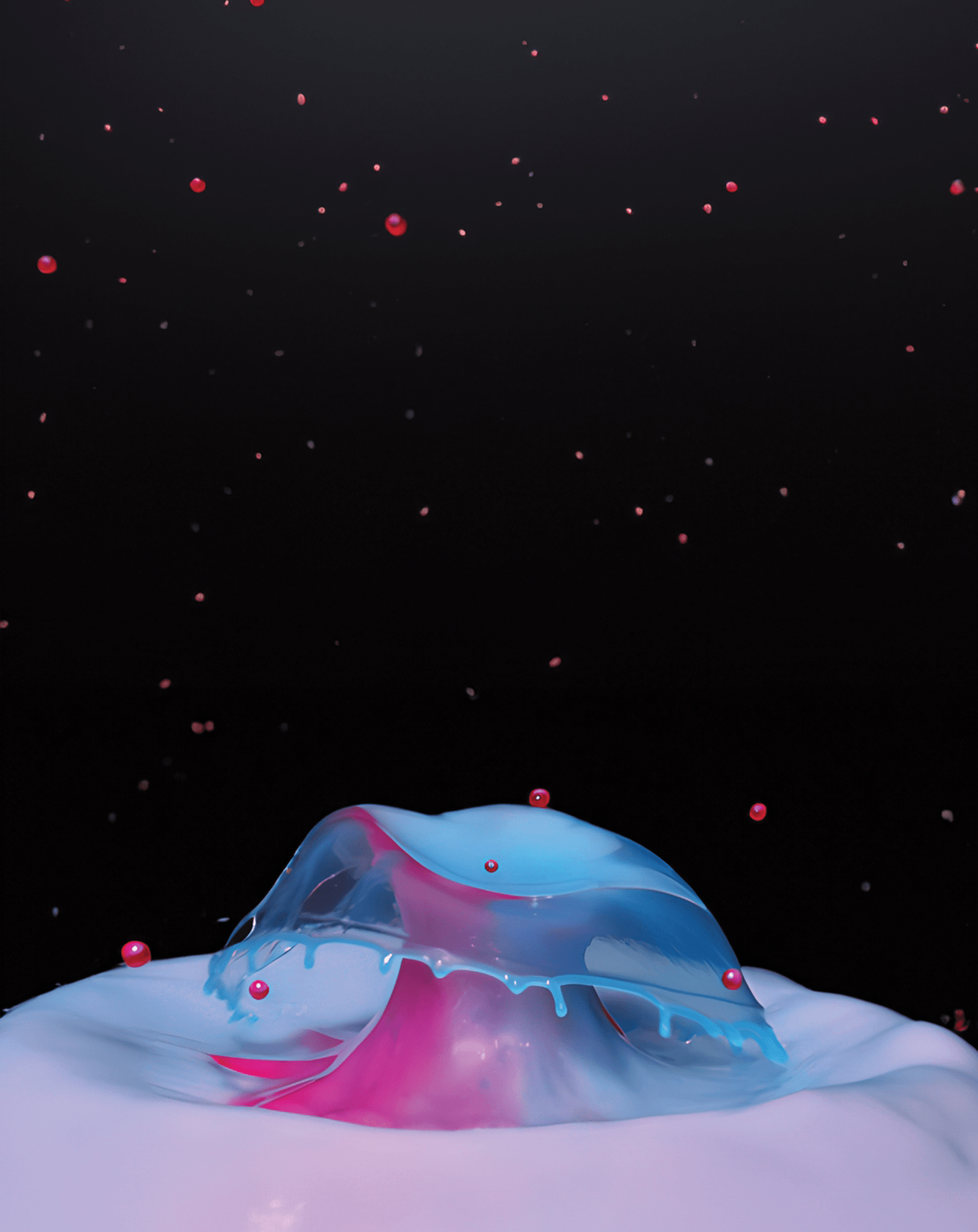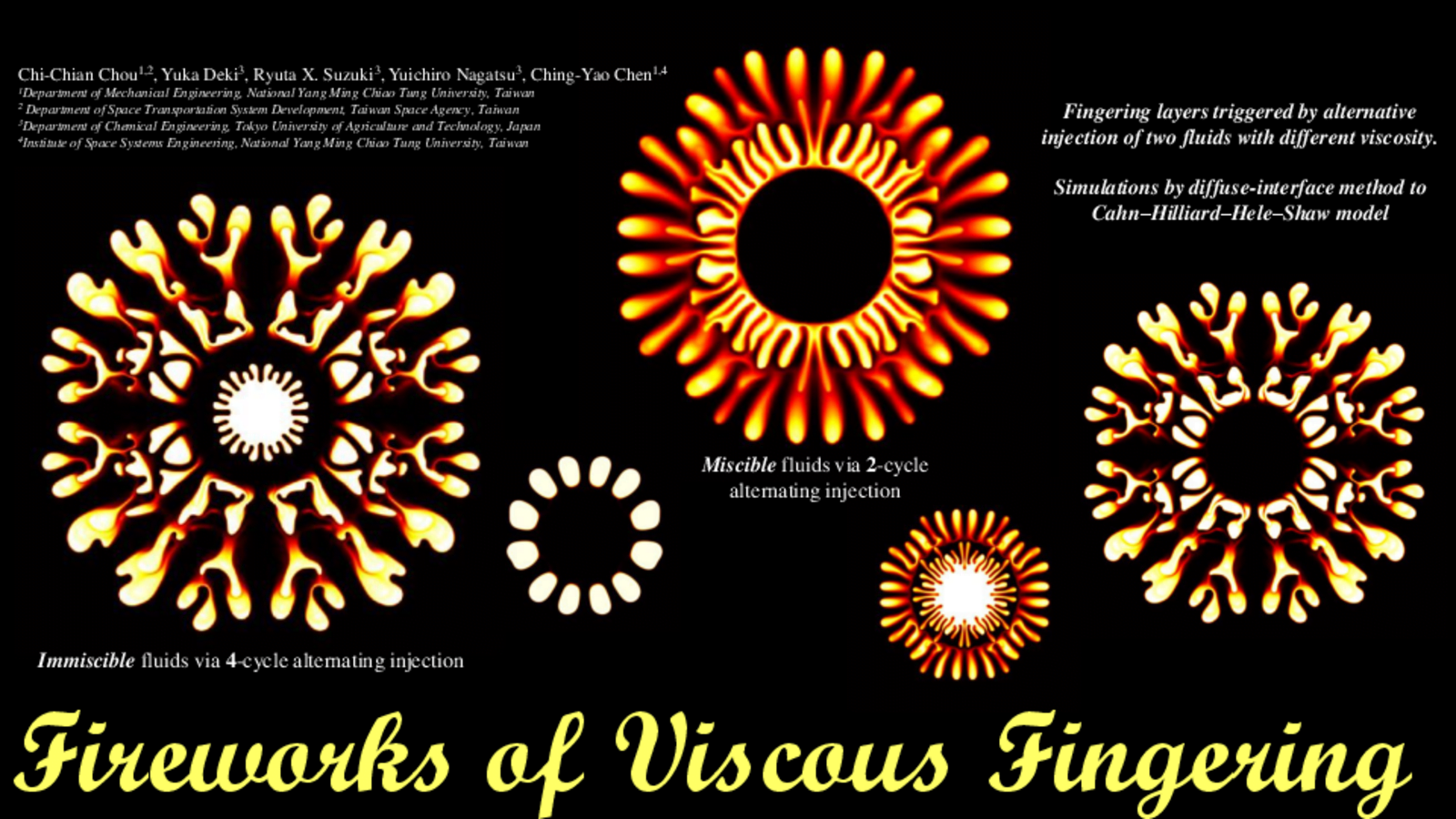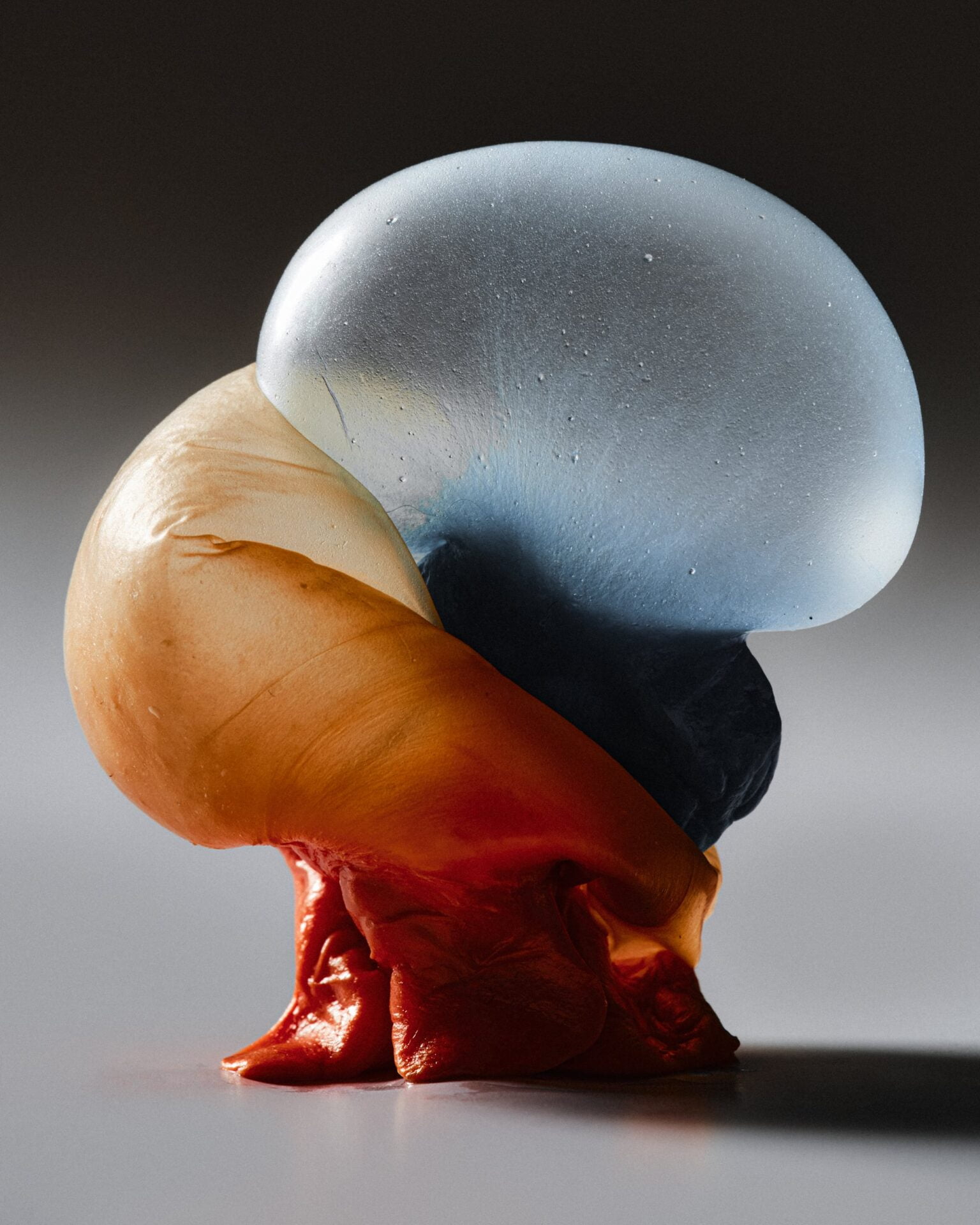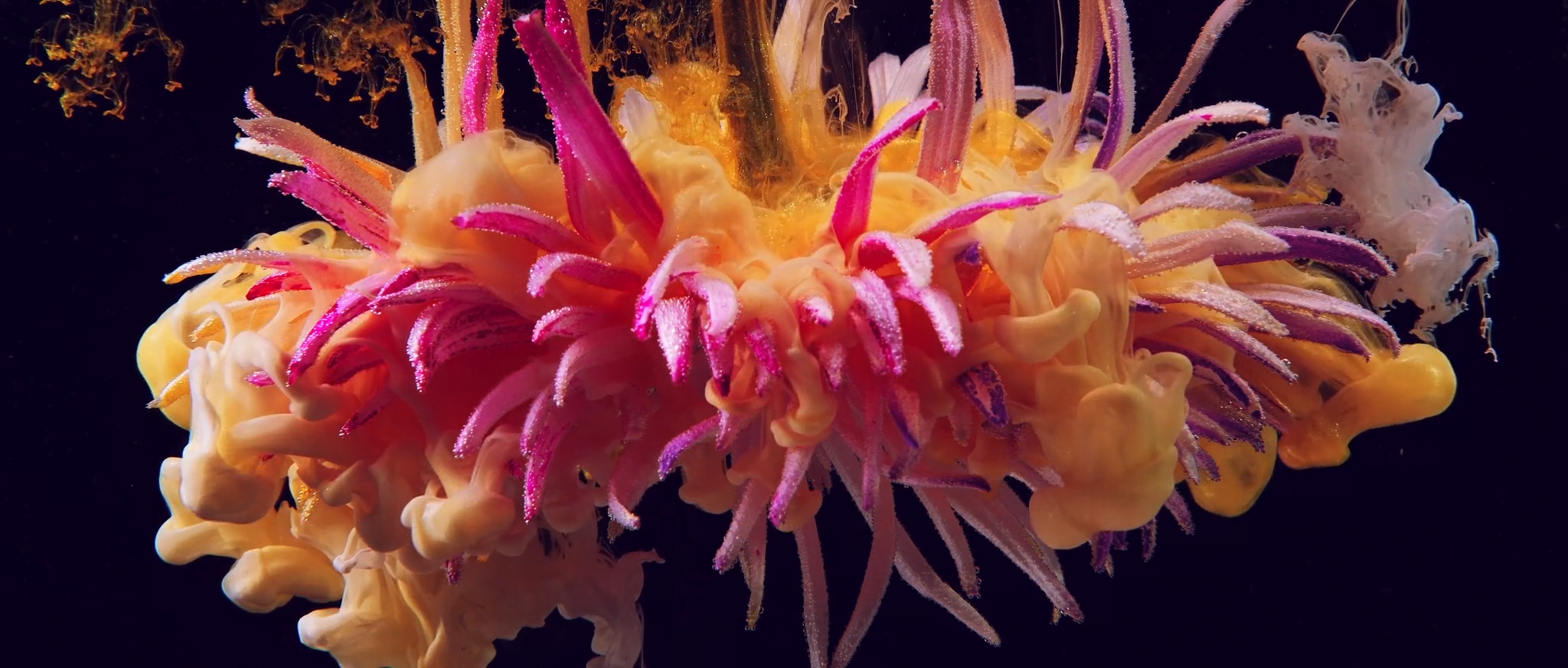
Brightly colored paints and inks mix and flow in artist Roman De Giuli’s “Color Show.” De Giuli typically creates this fluid art in thin layers atop paper. He’s a master of the form, manipulating surface tension gradients to create streaming flows, dendritic patterns, and feathery wisps. If this kind of art is your jam, he offers an app full of live wallpapers* for Android phones. See more of his work on his website and on Instagram. (Video and image credit: R. De Giuli)
*Not sponsored, I just like his art!
Tag: fluids as art

“Color Show”

Dendritic Painting Physics
In the art of Akiko Nakayama, colors branch and split in a tree-like pattern. In studying the process, researchers found the physics intersected art, soft matter mechanics, and statistical physics. In dendritic painting, the process starts with an underlying layer of acrylic paint, diluted with water. Atop this wet layer, you place a drop of acrylic ink mixed with isopropyl alcohol.
The combination of both layers is key. The alcohol-acrylic drop on a Newtonian substrate will show spreading, driven by Marangoni forces, but no branching. It’s the slightly shear-thinning nature of the diluted acrylic paint substrate that allows dendrites to form. As the overlying drop expands, it shears the underlayer, changing its viscosity and allowing the branches to form. You can see video of the process here. (Image credit: A. Nakayama; research credit: S. Chan and E. Fried; via Physics World)

“Nimbus”
Ephemeral clouds drift through unusual places in artist Berndnaut Smilde‘s works. He creates his clouds from smoke and water, launching them for a matter of seconds before they dissipate. During that time, he and his collaborators take photographs of the clouds, creating a memento of a time already past. Catch more of Smilde’s short-lived weather on his website and Instagram. (Image credit: B. Smilde and collaborators; via Colossal)

“Sfumato”
Handmade kinetic sculptures by artists Marion Pinaffo and Raphaël Pluvinage spin and paint the sky in colorful smoke in “Sfumato”. Named for an artistic technique in which shading gradually changes tone and hue, the installation was built, the artists note, “without motors, electronics, computer generated images, or artificial intelligence”. Just pure hands-on engineering and physics. Watch the short video of the installation in action for the full effect. You can find more of their work on their website, Vimeo, and Instagram. (Image and video credit: M. Pinaffo and R. Pluvinage; via Colossal)

“Origin”
Billowing turbulence, mushroom-like Rayleigh-Taylor instabilities, and spreading flows abound in Vadim Sherbakov’s “Origin.” The short film takes a macro looks at fluids — inks, alcohols, soaps, and other household liquids. It was filmed entirely on a DJI Pocket 2, a rather small, stabilized pocket camera. It’s a testament to what you can achieve with some experimentation and relatively inexpensive equipment. (Video and image credit: V. Sherbakov)

“Lucid”
Artist Roman Hill made this official music video to go with Thomas Vanz’s “Lucid.” The imagery, formed from ink and other fluids, warps our sense of scale. Though the camera focuses on an extremely small area, to our eyes the results shift from nebulas to oceans and back again. There are likely a whole host of phenomena going on here, but without knowing more about Hill’s ingredients, I can only speculate that there are Marangoni flows driven by variations in surface tension and maybe some density instabilities going on between fluid layers. I’m also fairly confident that Hill has played with time reversal in the video editing. Regardless of the secrets in its making, the film is captivating and gorgeous. (Image and video credit: R. Hill)

“Spitting Out Water Babies”
When Tomasz Wilk settled to camp one evening on the banks of a Polish river, he didn’t expect to find fountains in the shallows. Though reminiscent of an archer fish’s shot, this stream comes from a freshwater mussel. In spring, the mature female thick-shelled river mussels head to the shallows, where they edge a bit of their shell out of the water and release this fountain of water and larvae. Once dispersed, the larvae will attach (harmlessly) to the gills of fish until they grow into a juvenile mussel. (Image credit: T Wilk; via Wildlife POTY)

Open Call for the Traveling Gallery of Fluid Motion
This year’s Traveling Gallery of Fluid Motion will be hosted in Salt Lake City. There’s currently an open call to scientists and artists for submissions inspired by Leonardo Da Vinci. From the organizer:
This particular exhibition aims to showcase the historical interplay between art and science, with Da Vinci serving as a guiding luminary whose multifaceted genius continues to inspire innovation and creativity.
Artists and scientists from diverse backgrounds and disciplines are invited to submit their works, whether new creations or existing pieces, that delve into the fascinating themes of fluid dynamics, aerodynamics, and flight. The exhibition will take place at The Leonardo Museum in Salt Lake City, Utah, during the Fall/Winter season of 2024.
We welcome submissions in any medium, size, or stage of production, including, but not limited to video, photography, painting, 3D printed models, sculpture, installation, mixed media, and beyond. Although not a requirement, artists and scientists are encouraged to explore the intersections between art and science by drawing inspiration from Da Vinci’s legacy while infusing their unique perspectives and interpretations.
Submission Deadline: April 1, 2024You can find out more on Instagram and apply for consideration here. (Image credit: L. Da Vinci; submitted by Azar P.)

“Perfect Sky”
It’s all blue skies in Roman De Giuli’s short film, “Perfect Sky.” Created with paint, ink, and glitter on paper, it’s a relaxing piece of fluid art. Put on your headphones, take a deep breath, and plunge in. You’ll see lots of gorgeous Marangoni effects, some low Reynolds number mixing, and various instabilities. (Video and image credit: R. De Giuli)

“-37F Winter in Yellowstone”
Yellowstone National Park is always fascinating and surreal, but especially so in winter when volcanically-heated geysers and springs meet frigid, snowy weather. This short film from Drew Simms shows the park and its wildlife in the depths of winter. The bison rely on thick, shaggy fur coats to trap heat and keep dry. Steam and mist mingle around springs and giant plumes rise from geysers. What a strange and beautiful landscape! (Video and image credit: D. Simms)