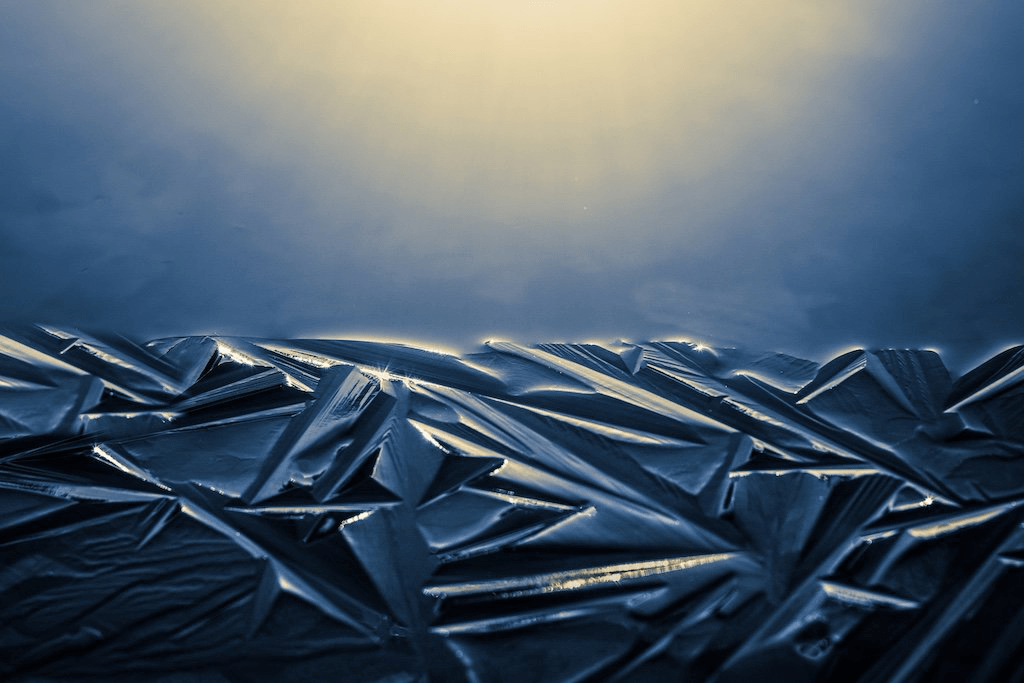
The early light of dawn illuminates ice forming at the edge of this pond in Vermont. Caught after a frigid mid-November night, the ice is some of winter’s first. The interface between seasons reflects the interface in water phases. (Image credit: A. Raeder; via CUPOTY)
Tag: fluid dynamics

Tweaking Coalescence


When a drop settles gently against a pool of the same liquid, it will coalesce. The process is not always a complete one, though; sometimes a smaller droplet breaks away and remains behind (to eventually do its own settling and coalescence). When this happens, it’s known as partial coalescence.
Here, researchers investigate ways to tune partial coalescence, specifically to produce more than a single droplet. To do so, they add surfactants to the oil layer surrounding their water droplet. The surfactants make the rebounding column of water skinnier, which triggers the Rayleigh-Plateau instability that’s necessary to break the column into more than one droplet. (Image and video credit: T. Dong and P. Angeli)
Billowing Ouzo


Pour the Greek liquor ouzo into water, and your glass will billow with a milky, white cloud, formed from tiny oil droplets. The drink’s unusual dynamics come from the interactions of three ingredients: water, oil, and ethanol. Ethanol is able to dissolve in both water and oil, but water and oil themselves do not mix.
In this video, researchers explore the turbulent effects of pouring ouzo into water. In particular, pouring from the top creates a fountain-like effect, due to a tug-of-war between the ouzo’s momentum and its buoyancy. Momentum wants the ouzo to push down into the water, and buoyancy tries to lift it back up. For an extra neat effect, they also show what happens when the ouzo is confined to a 2D plane and what happens when momentum and buoyancy act together instead of oppositely. (Image and video credit: Y. Lee et al.)
Fediverse Reactions
-

Underground Convection Thaws Permafrost Faster
In recent years, Arctic permafrost has thawed at a surprisingly fast pace. Much of that is, of course, due to the rapid warming caused by climate change. But some of that phenomenon lives underground, where water’s unusual properties cause convection in gaps between rocks, sediment, and soil.
Water is densest not as ice but as water. This is why ice cubes float in your glass. Water’s densest form is actually a liquid at 4 degrees Celsius. For water-logged Arctic soils, this means that the densest layer is not at the frozen depth but at a higher, shallower depth. This places a dense liquid-infused layer over a lighter one, a recipe for unstable convection.

Illustration of underground convection and permafrost thaw. On the left: temperature and density of the water in Arctic soil varies with depth. The temperature gets colder the deeper you go, but because water is densest at 4 degrees Celsius, the density is greatest at a shallower depth than the freezing interface. As a result of this unstable configuration (dense water over less dense water), convection can occur (right). In a recent numerical simulation, researchers found that this underground convection caused permafrost to thaw much more quickly than it would due to heat conduction alone. In fact, the effects appeared in as little as one month, so in a single summer, this convection could have a big effect on the thaw depth. (Image credit: top – Florence D., figure – M. Magnani et al.; research credit: M. Magnani et al.)
Building Underwater Foundations


For bridges, deep-sea platforms, and marine wind turbines, engineers have to build secure foundations able to withstand extremely heavy loads. Just how do they do this? One technique — driven piles — is as simple as driving poles into the ground. This is the method medieval engineers used to establish the city of Venice, but the origins of the technique are lost to history. Driving piles compacts the ground around and beneath the foundation, enabling it to withstand far greater loads.
In some applications, hammering piles just isn’t practical. Drilling piles is another common technique. In this method, the drilled hole is reinforced with an outer casing, then concrete is pumped in to harden. Drilled piles will work even underwater, as long as the concrete gets pumped in from the bottom. Then it can push water up and out of the casing without absorbing enough water to change its properties. (Video and image credit: Practical Engineering)
“Microscopic World”


So many natural processes take place right in front of us, but they’re too small and too fast to see. Here, the Beauty of Science team puts some of those processes — crystallizing solids, nucleating bubbles, and more — front and center. The shapes and colors draw you in, inviting you to engage with science we see daily but rarely appreciate. (Video and image credit: Beauty of Science)

Pterosaur Tail Vanes
Among vertebrates, pterosaurs were the first to achieve powered flight. Early pterosaurs have tail vanes — similar in appearance to the frills seen on some lizards — but later species lost this feature. Whether the tail vanes helped in flight or served a display purpose is an open question among paleontologists. One group, in a recent pre-print, studied the vanes’ fossilized interior structure and found a cross-linked lattice that provided internal tension to the vanes. That means the vanes could potentially be held stiff, even in the face of aerodynamic forces that would cause untensioned surfaces to flutter. The result suggests that the tail vanes could have helped early fliers steer, even if evolution later moved that function (along with display) to other parts of the body. (Image credit: Sviatoslav-SciFi; research credit: N. Jagielska et al.; via jshoer)
The Shape of Rain


In our collective imagination, a raindrop is pendant shaped, wide at the bottom and pointed at the top. But, in fact, a falling raindrop experiences much more complicated shapes. Here, researchers blow a jet of air onto a still droplet, a good facsimile for a raindrop falling through the atmosphere. The jet of air first squishes the drop, then inflates it into a shape known as a bag. The thin sides of the bag stretch and eventually break, spraying tiny droplets. As the disintegration continues, the thick rim of the bag breaks up into big droplets. As the video demonstrates, viscosity and viscoelasticity can affect the break-up, too. (Image and video credit: I. Jackiw and N. Ashgriz)

Jamming Soft Grains
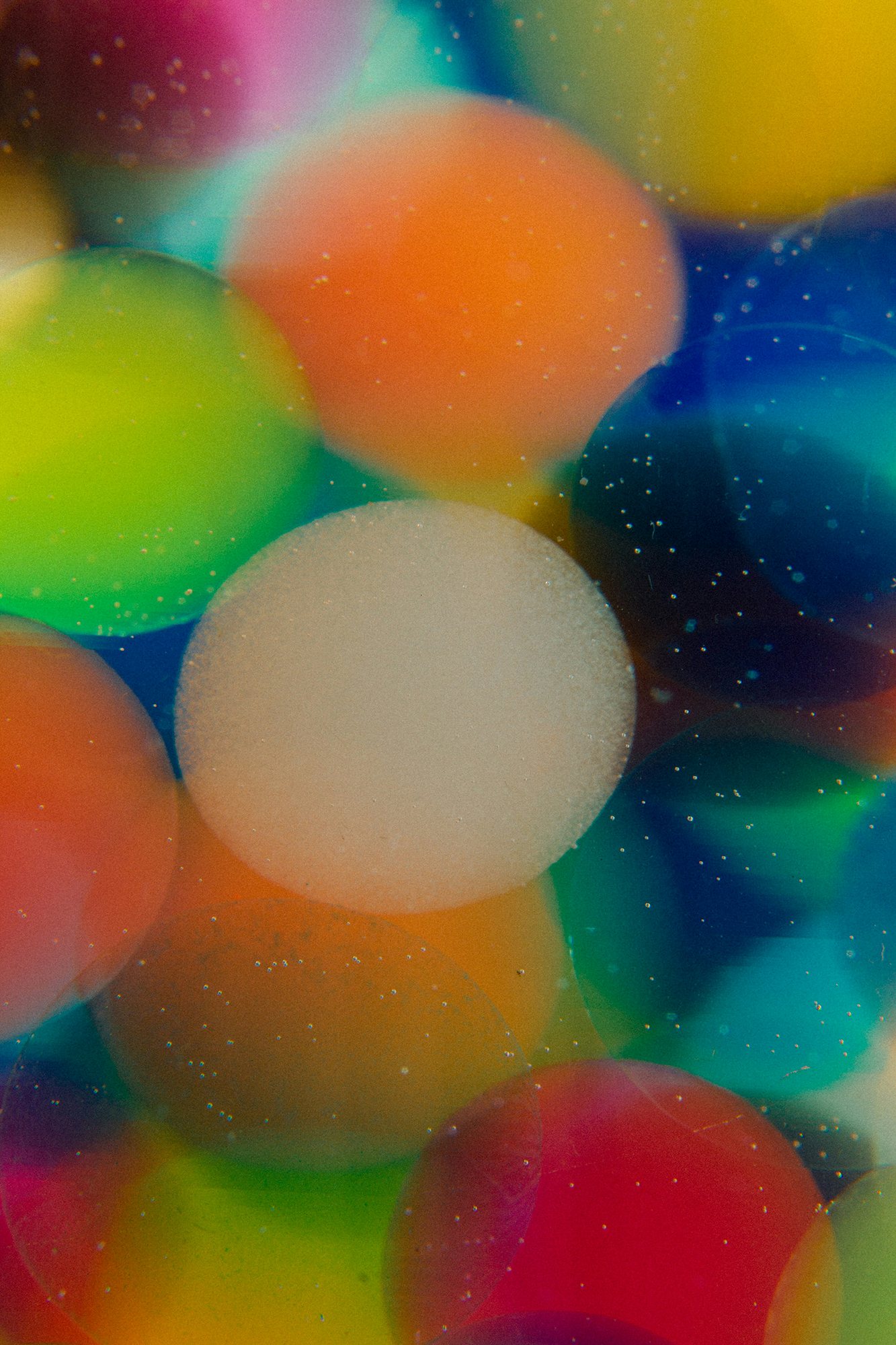
Hard granular materials — sand, gravel, glass beads, and so on — can flow, but, in narrow regions or under large forces, they can also jam up, essentially turning into a solid. Soft particles can also flow and jam, but do so under different conditions than hard particles. One group of researchers used a custom-built rheometer to measure jamming in soft particles like the hydrogel beads pictured here. They found that they could extend existing models for jamming in hard particles, but they had to rescale the mathematics to account for the way soft particles change their shape under pressure. (Image credit: Girl with red hat; research credit: F. Tapia et al.; via APS Physics)

Martian Auroras
Auroras happen when energetic particles — usually from the solar wind — interact with the atmosphere. Here on Earth, they’re most often found near the poles, where our strong global magnetic field converges, funneling particles down from space. Our neighbor Mars has no global magnetic field. Instead, its magnetic field is a hybrid of two sources: 1) induced magnetism from electric currents in the ionosphere and 2) patches of magnetized iron-rich crust. Together, they form an uneven and changeable field that deflects the solar wind less than one Mars radius above the planet’s surface. In contrast, Earth deflects the solar wind about 10-20 Earth radii away.
Discrete auroras (left panel) occur when electrons plunge down into the atmosphere on magnetic lines coming from Mars’ patchy crust. Global diffuse auroras (center panel) are caused by energetic solar storms that light up the whole atmosphere, sometimes for days at a time. In proton auroras (right panel), incoming solar protons steal electrons from native Martian hydrogen to form high-energy hydrogen atoms that cannot be magnetically deflected. Instead, they penetrate the planet’s bow shock and plunge into the atmosphere, creating a daytime aurora. (Image credit: UAE Space Agency/EMM/EMUS and NASA/MAVEN/IUVS; via Physics Today)