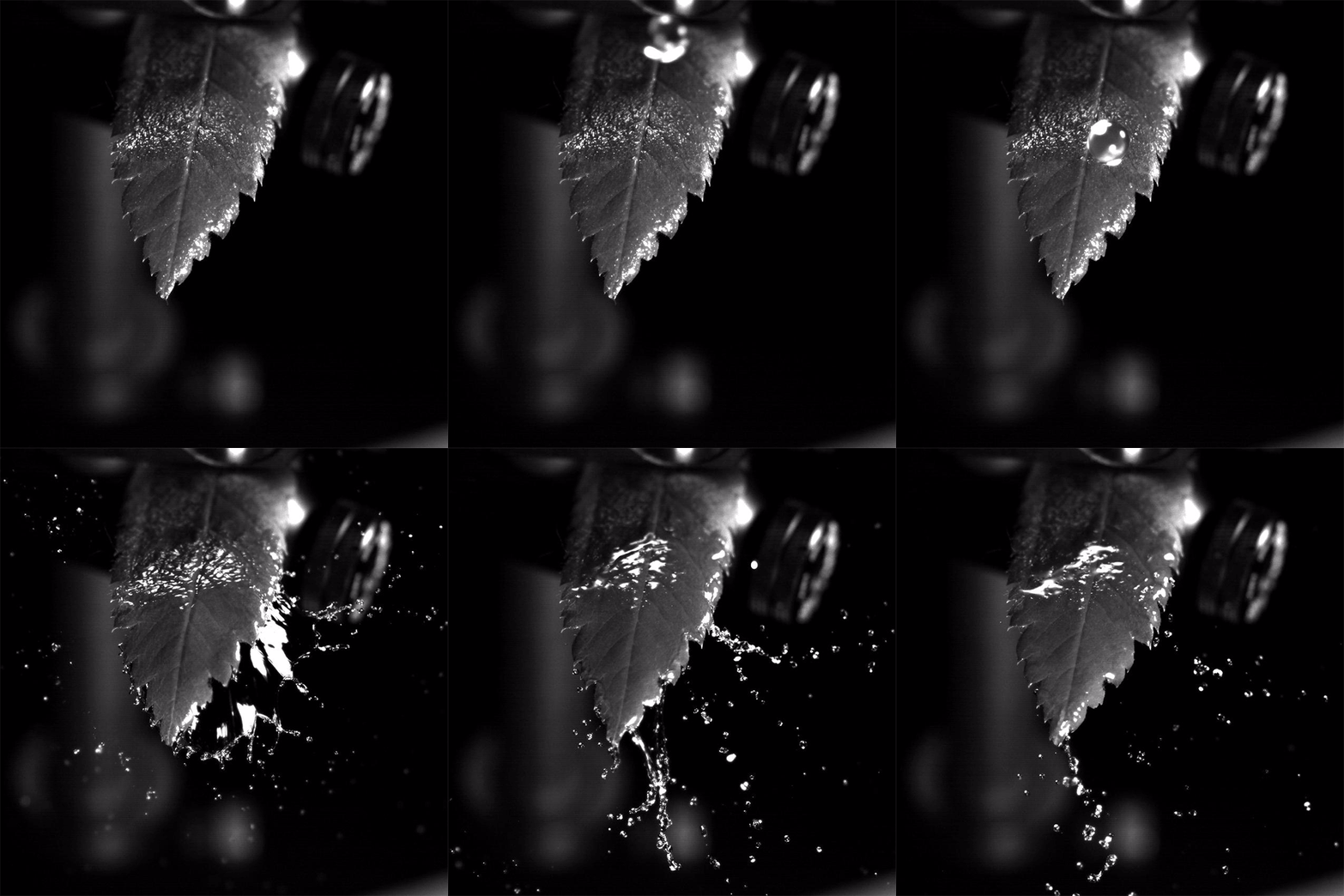
Honeybees, with their stingers, get lots of attention, but the Americas have plenty of stinger-less honeymakers, too. These stingless bees are native to Mexico, where beekeepers cultivate them for pollination. Without stingers and venom, the bees use their building prowess to keep out unwanted visitors. Much of the hive — from the entrance’s nightly gate to the pods where young are stored — is built from cerumen, a substance the bees create by mixing wax with resins they collect from nearby trees. Just as they do with pollen, worker bees collect drops of resin and store them on their hind legs before flying back to the hive. The viscous fluid sticks well, until a swipe of a leg shears it enough to lower its viscosity and slide it off. (Video and image credit: Deep Look)
Tag: fluid dynamics

Melting Permafrost Stains Alaskan Rivers Orange
The swiftly melting permafrost of the Arctic is releasing toxic metals like zinc, cadmium, and iron into Alaskan waterways. The contaminant levels are so high that it’s staining many rivers orange — a feature that can be seen from space. A new study identified at least 75 affected rivers in the Brooks mountain range.
In addition to staining the rivers, these metals make the water acidic, with some waterways reaching a pH as low as 2.3, similar to the acidity of vinegar. The combination is deadly to aquatic life in the rivers, and the acidity, unfortunately, will accelerate the dissolution of rocks that can release even more metals into the water. (Image credit: K. Hill/National Park Service; research credit: J. O’Donnell et al.; via LiveScience; submitted by Emily R.)

A contaminated portion of the Kutuk River runs orange alongside an uncontaminated portion of the same waterway. 
Helping Fish Bypass Hydro Power Dams
Many dams in the U.S. were built at a time when their ecological impact was not a major concern. But, thanks to ongoing efforts to study affected species and upgrade infrastructure, many dams now balance human energy needs with the needs of non-humans, like migratory fish populations. In this video, Grady from Practical Engineering takes us behind-the-scenes at McNary Dam in the Pacific Northwest, where special plans and equipment help adult fish swim upstream and juvenile fish pass downstream with as little impact as possible. It’s impressive just how widespread and thorough their infrastructure for letting fish and lampreys through is! There are even facilities to help naturalists track and study the populations passing through. (Video and image credit: Practical Engineering)

Bubblegum Sculptures
Like soap bubbles, bubbles blown in gum are ephemeral, lasting only seconds. Their break-up mechanism is quite different, though. Where surface tension rips a bubble apart once it is pierced, bubblegum instead deflates and wrinkles around a hole that does not grow, thanks to the elasticity of the gum. This photographic series by Suzanne Saroff features a rainbow of gum sculptures, all frozen in the moments of their disintegration. (Image credit: S. Saroff; via Colossal)

Venus Flower Basket Sponges
Venus flower basket sponges have an elaborate, vase-like skeleton pocked with holes that allow water to pass through the organism. A recent numerical study looked at how the sponge’s shape deflects incoming (horizontal) ocean currents into a vertical flow the sponge can use to filter out food.
The sponges’ structure is porous and lined with helical structures. In their simulation, researchers reproduced a version of this structure (shown below) that used none of the real sponge’s active pumping mechanisms. The digital sponge was, instead, purely passive. Nevertheless, the simulation showed that, by their skeletal structure alone, sponges could redirect a significant fraction of incoming flow toward its filtering surfaces. Interestingly, the highest deflection fraction occurred at relatively low flow speeds, showing that the sponges are set up so that their structure is especially helpful for scavenging nutrients from nearly-still waters.
In the real world, these sponges use a combination of passive filtering and active pumping to capture their food, but this study shows that the sponge’s clever structure helps it save energy, especially in tough flow conditions. (Image credit: sponges – NOAA, simulation – G. Falcucci et al.; research credit: G. Falcucci et al.; via APS Physics)

A detail from a numerical simulation shows streamlines around and inside a model sponge. 
Growing Hydrogels in an Active Fluid
Active nematic fluids borrow their ingredients from biology. Using long, rigid microtubules and kinesin motor proteins capable of cross-linking between and “walking” along tubules, researchers create these complex flow patterns. Here, a team took the system a step further by seeding the flow with a hydrogel that turns into a polymer when exposed to light. Then, by shining light patterns on the flow, the scientists can create rigid or flexible structures inside the active fluid. In this case, they show off some of the neat flow patterns they can create. (Video and image credit: G. Pau et al.)

Slipping Along Enceladus
Home to a sub-surface ocean, Saturn‘s moon Enceladus is a fascinating candidate for life in our solar system. As it orbits Saturn, plumes periodically shoot out long surface features known as tiger stripes that sit near the icy moon’s southern pole. A recent study, based on numerical simulation, suggests a geophysical mechanism that could account for the plumes.
The team suggests that, like the San Andreas Fault, the tiger stripes are a fault subject to strike-slip motion. In this type of fault, the ice on either side meets along a vertical face and the two sides will slide past one another in opposite directions. As Enceladus orbits, its proximity to Saturn causes tidal compression across the fault that modulates how much slip motion occurs. In their model, the authors found that strike-slip motion would intermittently open gaps in the fault that would allow water from the subsurface ocean to create plumes at intervals consistent with those observed. (Image credit: top – NASA/JPL-Caltech/Space Science Institute, illustration – A. Berne et al.; research credit: A. Berne et al.; via Gizmodo)
Illustration of the strike-slip mechanism over the course of Enceladus’s tides. The two sides of the “tiger stripe” fault move in opposite directions. How much they move depends on the amount of tidal compression caused by Enceladus’s orbit around Saturn. At times, motion along the fault pulls apart narrow sections of the ice, allowing a plume to spray out. 
Soyuz Exhaust
Here, a Soyuz rocket takes off in 2023, carrying three of the Expedition 70 crew to the International Space Station. This initial stage of the Soyuz launch vehicle uses four identical rocket boosters lashed around the second stage core. Each of the boosters has a rocket engine with four combustion chambers (and thus four exhaust nozzles) of its own. That creates the fiery flurry of engine plumes seen here. Most of the exhaust plumes are directed downward to provide the thrust needed to lift the rocket, but you can see a few angled slightly to either side to help stabilize the launch vehicle as it rises. (Image credit: NASA)

“Earth’s Treasure”
Streams of blue and yellow braid across Iceland’s volcanic landscape in this award-winning photo from Miki Spitzer. Glacial water shows an icy blue and sediments glisten in gold. Together, their interplay creates an arresting delta viewed from above. (Image credit: M. Spitzer; via WNPA)

Searching for Stability in Cleaner Flames
Spiking natural gas power plants with hydrogen could help them burn cleaner as we transition away from carbon power. But burners in power plants and jet engines can be extremely finicky, thanks to thermoacoustic instabilities. As a flame burns, it can sputter and fluctuate in its heat output. That creates pressure oscillations (which we sometimes hear as sound waves) that reflect off the burner’s walls and return toward the flame, causing further fluctuations. This feedback loop can be destructive enough to explode combustion chambers.
Adding hydrogen to a burner designed purely for natural gas can trigger these instabilities (above image), but researchers hope that by exploring fuel-mixtures and their effect at lab-scale, they can help designers find safe ways to adapt industrial burners for the cleaner fuel mixture. (Image and research credit: B. Ahn et al.; via APS Physics)