Tag: fluid dynamics

  • Soyuz Exhaust

    Soyuz Exhaust

    Here, a Soyuz rocket takes off in 2023, carrying three of the Expedition 70 crew to the International Space Station. This initial stage of the Soyuz launch vehicle uses four identical rocket boosters lashed around the second stage core. Each of the boosters has a rocket engine with four combustion chambers (and thus four exhaust nozzles) of its own. That creates the fiery flurry of engine plumes seen here. Most of the exhaust plumes are directed downward to provide the thrust needed to lift the rocket, but you can see a few angled slightly to either side to help stabilize the launch vehicle as it rises. (Image credit: NASA)

  • “Earth’s Treasure”

    “Earth’s Treasure”

    Streams of blue and yellow braid across Iceland’s volcanic landscape in this award-winning photo from Miki Spitzer. Glacial water shows an icy blue and sediments glisten in gold. Together, their interplay creates an arresting delta viewed from above. (Image credit: M. Spitzer; via WNPA)

  • Searching for Stability in Cleaner Flames

    Searching for Stability in Cleaner Flames

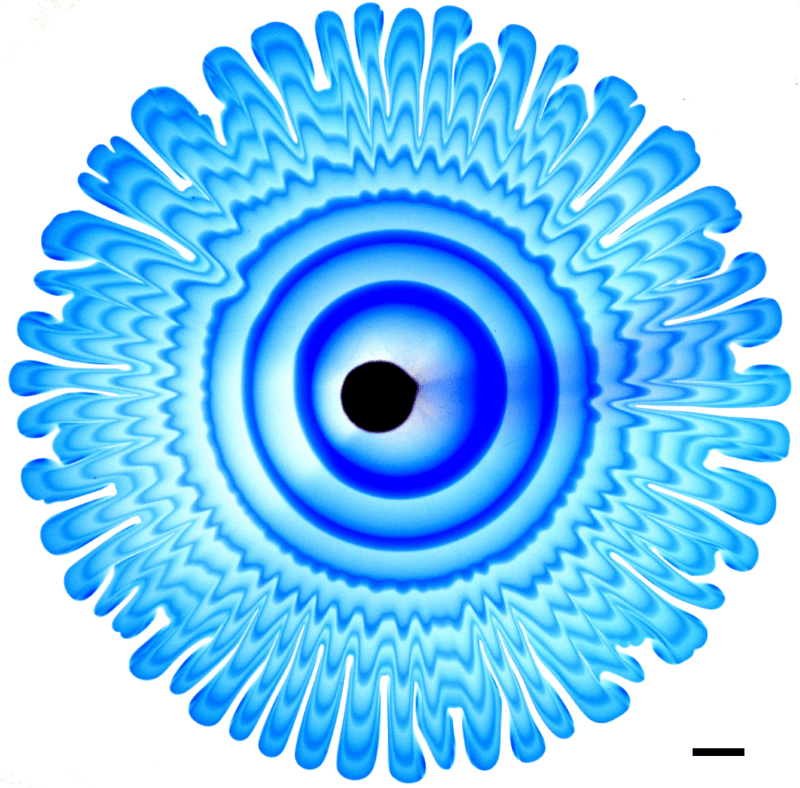
    Spiking natural gas power plants with hydrogen could help them burn cleaner as we transition away from carbon power. But burners in power plants and jet engines can be extremely finicky, thanks to thermoacoustic instabilities. As a flame burns, it can sputter and fluctuate in its heat output. That creates pressure oscillations (which we sometimes hear as sound waves) that reflect off the burner’s walls and return toward the flame, causing further fluctuations. This feedback loop can be destructive enough to explode combustion chambers.

    Adding hydrogen to a burner designed purely for natural gas can trigger these instabilities (above image), but researchers hope that by exploring fuel-mixtures and their effect at lab-scale, they can help designers find safe ways to adapt industrial burners for the cleaner fuel mixture. (Image and research credit: B. Ahn et al.; via APS Physics)

  • Featured Video Play Icon

    The Solar Corona in Stunning Detail

    The ESA’s Solar Orbiter captured this beautifully detailed video of our sun‘s corona last September. The Solar Orbiter took this footage from about 43 million kilometers away, a third of the distance between the sun and the Earth. Scattered across the visible surface are fluffy, lace-like features known as coronal moss. Along the curving horizon, gas spires called spicules stretch up to heights of 10,000 kilometers. The video also highlights a “small” eruption of plasma that is nevertheless larger than the entire Earth. We can even see evidence of coronal rain, denser and darker clumps of plasma that gravity pulls back toward the sun. (Video and image credit: ESA; via Colossal)

  • Making Reconfigurable Liquid Circuits

    Making Reconfigurable Liquid Circuits

    Microfluidic circuits are key to “labs on a chip” used in medical diagnostics, inkjet printing, and basic research. Typically, channels in these circuits are printed or etched onto solid surfaces, making it difficult to reconfigure them. A group in China developed an alternative design, inspired by reconfigurable toys like Lego blocks. Their set-up, shown above, uses a pillared surface immersed in oil. To create the channels, they pipette water — one droplet at a time — into the space between pillars. The combination of oil and pillars traps the drop. With multiple drops linked together, they get channels, like the ones above that mix two fluids. When the time comes to reconfigure the channels, they just pipette the water out and cut the channel with a sheet of coated paper. (Image and research credit: Y. Zeng et al.; via Physics Today)

  • Featured Video Play Icon

    Making Magnetic Crystals From Ferrofluids

    Ferrofluids are a great platform for exploring liquids and magnetism. Here, researchers trap ferrofluid droplets along an oil-water meniscus and then apply a magnetic field that makes the drops repel one another. The results are crystalline patterns formed from magnetic droplets. For a given patch of drops, increasing the magnetic field’s strength pushes drops further apart. But changing the drops’ size and levels of self-attraction also shifts the patterns. Check out the video to see the crystals in action. (Video and image credit: H. Khattak et al.)

  • “Storm Warning”

    “Storm Warning”

    A calm, sunny day erupted into a thunderstorm off the coast of Scotland for photographer Brian Matthews. Turbulent clouds streak the sky, and a downpour on the left releases a stream of precipitation. Storms like these were once uncommon in the United Kingdom, but with increasingly hot weather due to climate change, more water vapor and more energy in the atmosphere create conditions for storms like these. (Image credit: B. Matthews; via Wildlife POTY)

  • How Venus Is Losing Its Water

    How Venus Is Losing Its Water

    Since Venus formed at the same time as Earth and is similar in size, scientists believe it once had the same amount of water our planet does. Today, hellish Venus has hardly any water, a fact scientists have struggled to explain completely. Most of its water was lost long ago, as incoming particles from the solar wind stripped water from the upper atmosphere; unlike Earth, Venus doesn’t enjoy the protection of a magnetic field.

    But that mechanism doesn’t explain just how arid Venus is now. A new study instead suggests that Venus’s water loss is ongoing, driven by simple chemical reactions. The team found that molecules of HCO+ (an ion made from one hydrogen, one carbon, and one oxygen atom) could mix with any remaining water to form a positively-charged molecule. Due to that charge, the chemical easily attracts loose electrons. Once combined, however, the resulting molecule is too energetic and breaks apart; when it does so, it releases highly-energetic hydrogen, which escapes the atmosphere into space. Without that hydrogen, water molecules can’t reform. This process of dissociative recombination could explain why the rest of Venus’s water has disappeared.

    Science missions that have flown to Venus so far haven’t been equipped to measure HCO+, and the authors recommend this as a priority for future missions to our neighbor. With that data, we could confirm or disprove this mechanism for Venusian water loss. (Image credit: NASA; research credit: M. Chaffin et al.; via Gizmodo)

  • A Comet’s Tail

    A Comet’s Tail

    A comet‘s tail changes from day-to-day depending on how much material the comet is losing and how strong the solar wind it’s facing is. This image sequence shows Comet 12P/Pons-Brooks over nine days in 2024 from March 6th (top) through March 14th (bottom). The variations in the comet’s appearance are striking; some days show nearly no tail while others have long plumes with swirls of turbulence. It’s a reminder that, even if they appear unchanging in the moment you see one, a comet is in constant flux. (Image credit: Shengyu Li & Shaining; via APOD)

  • Saving Screens with Shear-Thinning Fluids

    Saving Screens with Shear-Thinning Fluids

    These days glass screens travel with us everywhere, and they can take some big hits on the way. Manufacturers have made tougher glass, but they continue to look for ways to protect our screens. Recently, a study suggested that non-Newtonian fluids are well-suited to the task.

    The team explored the physics of sandwiching a layer of fluid between a glass top layer and an LCD screen bottom layer, mimicking structures found in electronic devices. Through simulation, they searched for the fluid characteristics that would best minimize the forces felt by the solid layers during an impact. They found that shear-thinning fluids — fluids that, like paint or shampoo, get runnier when they’re deformed — provided the best protection. Having the impact energy go into reducing the local viscosity of the fluid stretches the length of time the impact affects the glass, which lowers the bending forces on it and helps avoid breakage. (Image credit: G. Rosenke; research credit: J. Richards et al.; via Physics World)