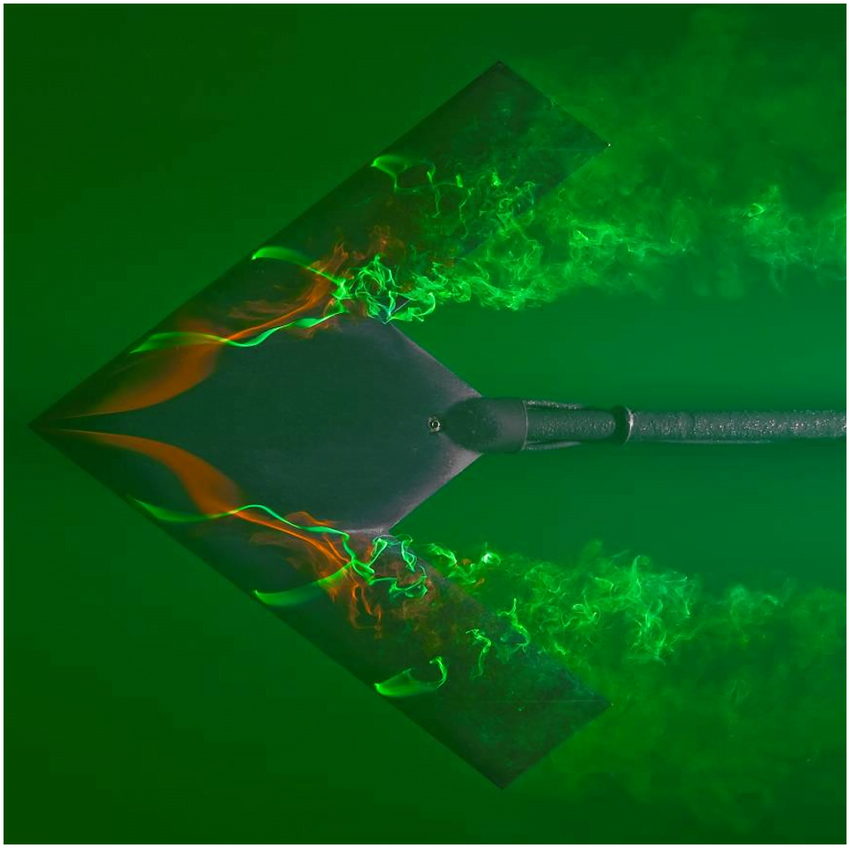
Designing new aerodynamic vehicles typically requires a combination of multiple experimental and numerical techniques. The photo above shows a model for an unmanned flying wing-type vehicle. Here it’s tested in a water tunnel with dye introduced to the flow to highlight different areas. The model is at a high angle of attack (18 degrees) relative to the oncoming flow. This puts it in danger of flow separation and stall, the point where a wing experiences a drastic loss in lift. The smooth flow over the front of the model indicates it hasn’t reached this point yet, but notice how both the green and red dyes are separating from the model and becoming very turbulent over the back of the wing. If the model were pushed to an even higher angle of attack, that separation point would move further forward, bringing stall that much closer. (Image credit: L. Erm and J. Drobik; research credit: R. Cummings and A. Schütte)
Tag: fluid dynamics

Singularities
Black holes, like the collapse of a cavity in a fluid, are a singularity – a point where the mathematical rules we use to describe physical systems break down. No one knows what exists in a black hole, but the short film “Intra” explores one theory – that the exit to a black hole is a white hole, a singularity from which time and space themselves are born. The journey from one to the other is illustrated in the film with CGI visualizations of a black hole (a la Interstellar) and with fluid dynamical sequences depicting diffusion and chemical reactions driving flows. Although no true white holes have ever been observed, there are fluid dynamical analogs for them, namely circular hydraulic jumps, like the one you can make in your kitchen sink! (Video credit: T. Vanz et al.)

Lincolnshire KH Clouds


These beautiful Kelvin-Helmholtz clouds were spotted over Lincolnshire on December 19th. They form between two layers of air, one of which is moving faster than the other. Although that situation is not very unusual, the conditions have to be just right for visible clouds to form at that interface between layers, and the clouds themselves are typically short-lived. This set is particularly lovely with its smooth curves and breaking wave form. If you, like me, love these clouds but never manage to see them yourself, you can always try wearing some instead! (Image credit: A. Towriss; via BBC News; submitted by Vince D.)

Growing Fingers
Branching, tree-like structures are found throughout nature. Take a thin layer of a viscous fluid pressed between two glass plates and inject a less viscous fluid like air and you’ll get branch-like structures. These are the result of the Saffman-Taylor instability and usually result in a fairly random outcome because of the instability’s sensitivity to small variations. In a new study, researchers use multiple air injection ports to finely control the formation and growth of air fingers, allowing them to build well-ordered branching structures like the one above. By placing the air ports in an array, the same technique can be used to create fluid meshes. The authors suggest this new technique could have wide-ranging applications including the design of heat exchangers and the growth of artificial tissues. (Image and research credit: T. ul Islam and P. Gandhi, source)

Rolling Along
Leidenfrost drops – droplets deposited onto a surface much hotter than their boiling point – are known for their mobility. With the right surface, they can be propelled, trapped, and even guided through a maze, typically by directing the vapor layer that cushions them. But new work shows that these drops have internal dynamics that also contribute to their propulsion.
By adding tracer particles to each droplet, researchers can visualize flows inside the droplet. Large drops tend to have a flatter shape and contain two or more rotating vortices. Such drops won’t propel themselves without another force in play. But smaller droplets are more spherical and contain only a single rotating flow. Once these drops detach, they roll away! Despite the similarity to wheels, these liquid drops aren’t moving the same way. Remember that the drop is not actually in contact with the surface. To see what sets the drop’s direction, researchers examined the shape of the bottom of the drop. They found that it sits at a slant on its vapor cushion. That pushes evaporating gases out one side, propelling the drop the other way. (Image and video credit: A. Bouillant et al., source)

Layered Latte Physics


Latte lovers may be familiar with the layered latte, a beverage with distinctive horizontal layers mixing espresso and milk, but you may not have taken the time to wonder how these layers form. Like many layering phenomena in our oceans, the layered latte is the result of double-diffusive convection. This means that there are two variables that both affect density in the fluid mixture and that they act at different rates.
In the latte, those factors are 1) the different densities of the milk and espresso and 2) density changes caused as the latte cools to room temperature. A layered latte forms when the lighter espresso is poured into denser milk. If it’s poured quickly enough, the momentum of the pour forces some of the espresso down into the milk, despite the buoyant force that tries to keep the espresso on top. So that initial pour sets up a density gradient that runs from pure espresso at the top to pure milk on the bottom, with varying mixtures of the two in between.
The distinct layers won’t form until the latte begins cooling off. Along the walls of the container, heat is lost more quickly, causing fluid to cool and start sinking. But a specific bit of fluid can only sink until the fluid surrounding it is the same density. That can carry a cooler bit of latte to the bottom of a layer, but not into the denser layer below. At this point, our bit of latte moves inward, starts to warm up, and circulates up through the center of its layer. As when it sank, the fluid can only move up until it encounters a layer with equal or lesser density, at which point it must move horizontally instead. This thermal convection, combined with the density gradient formed by the initial pour, sets up the distinctive layers of the latte. The layers are quite stable – neither gentle stirring nor taking a sip will disrupt them for long – provided the drink remains warmer than the surrounding air. (Image credits: kopeattugu/Instagram, N. Xue et al.; research credit: N. Xue et al.; via NYTimes; submitted by Kam-Yung Soh)

Liquid Sunbursts
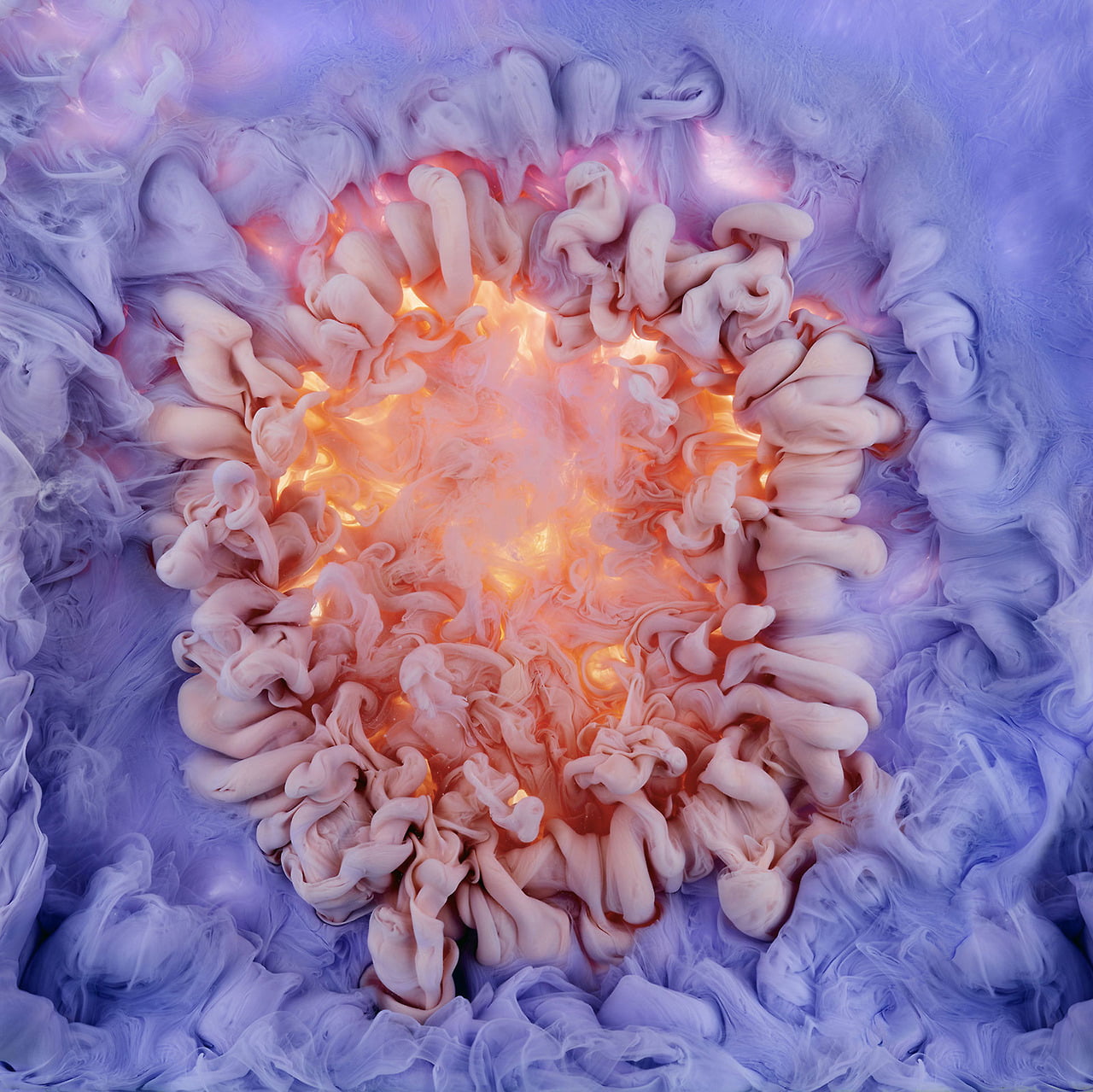
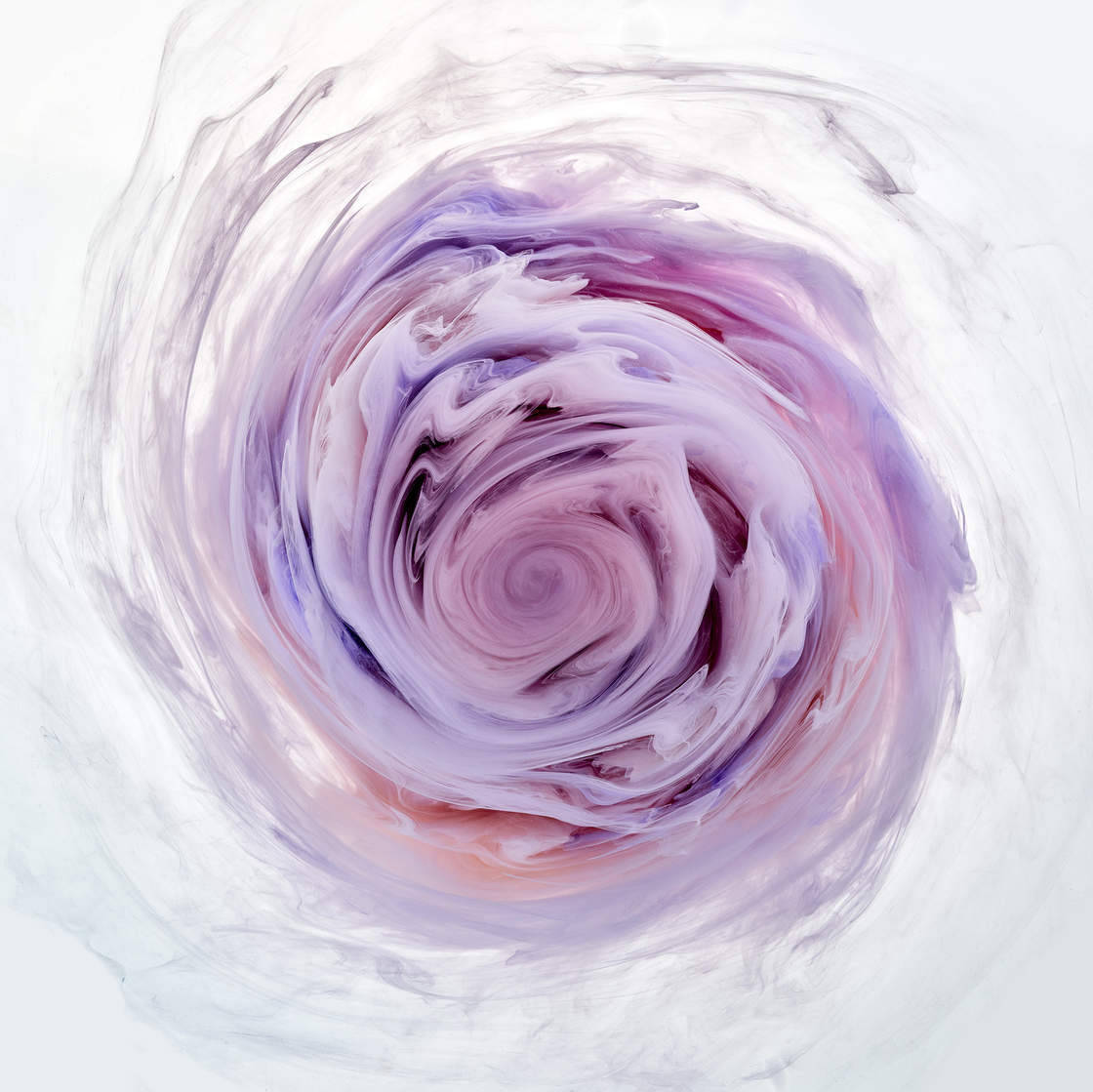
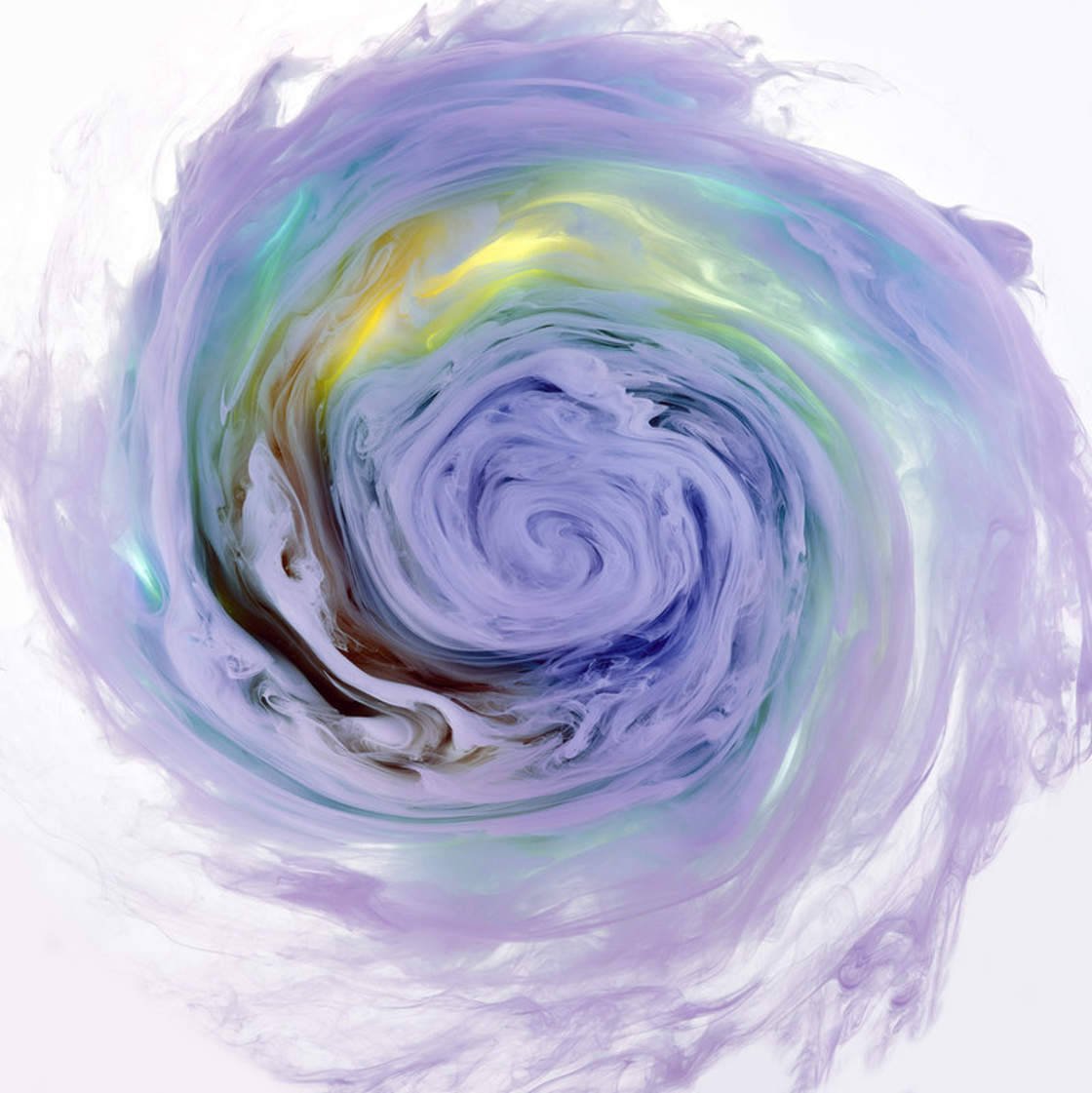

Liquid sunbursts and swirling aquatic roses abound in photographer Mark Mawson’s work. Images like these are created from dropping ink into water and photographing it as it diffuses. For the roses, the tank is additionally stirred or spinning to create the vortex-like appearance. Check out his website for more striking images, including more billowing ink, some great splashes and beautiful turbulent mixing between coffee and milk. (Image credit: M. Mawson; submitted by clogwog)
A Hot Tub, Turned Fluidized Bed
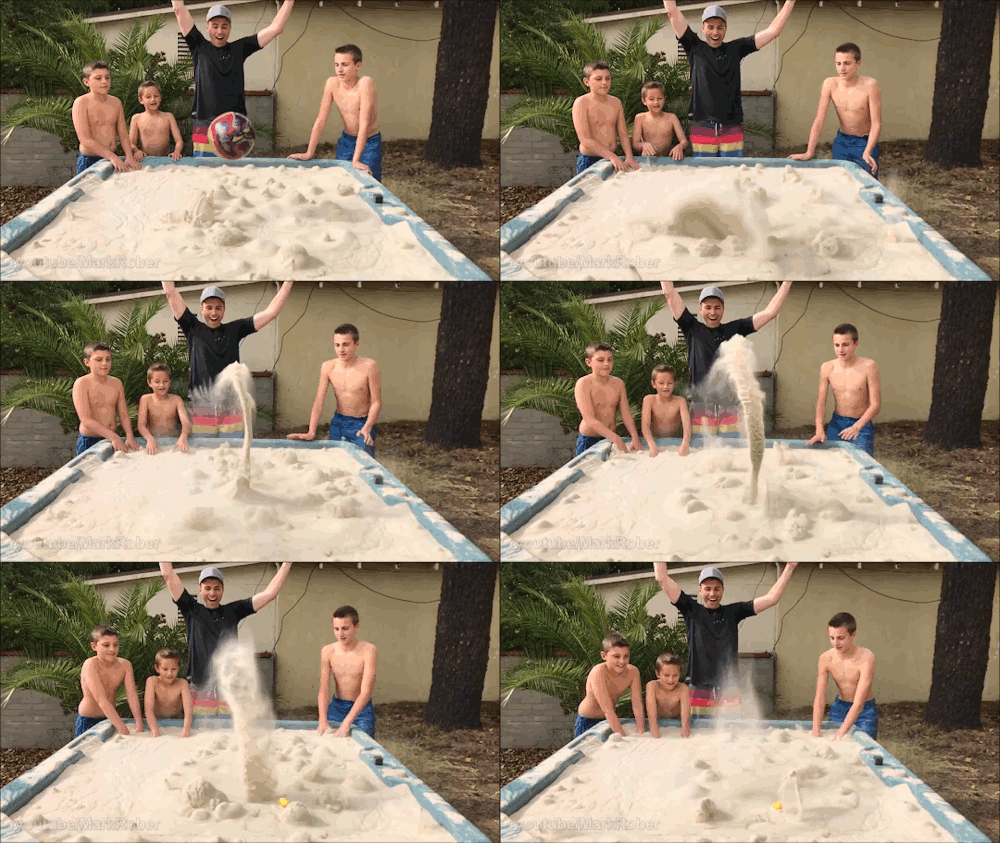
Fluidized beds continue to be all the rage among science YouTubers, but Mark Rober supersizes his by turning a broken hot tub into a massive bath of bubbling sand. His video includes a nice explanation of how a granular material like sand gets fluidized as well as how to make your own miniature bed. One of my favorite moments is shown in the animation below. When Mark drops a bowling ball into the fluidized bed, it creates a remarkably liquid-like splash. The ball sprays a splash curtain of sand up on impact and sinks into its own cavity. When the cavity seals behind the ball, it shoots up a tall jet of sand, just like a Worthington jet in water. Even with air fluidizing it, the sand doesn’t have surface tension, though, so the jet breaks up quite differently than water! (Video and image credit: M. Rober; submitted by clogwog)


Cloud Flows
When viewed at the right pace, clouds can flow. This timelapse of fog over Mt. Tamalpais State Park near San Francisco shows clouds moving over the hills there. Physically, this flow is an example of a familiar phenomenon known as a hydraulic jump. It happens when a fast-moving flow moves into a region of slower flow. The kinetic energy of the incoming flow gets transferred into potential energy, causing the flow to suddenly rise in height. It can also trigger turbulence, as seen on the right side of the animation. Watch carefully along a river, and you’ll see the same thing happening. Or, if your kitchen sink has a flat bottom, you can create a circular hydraulic jump just by turning on the faucet. You’ll get a region of fast flow right where the water impacts the basin, and a little ways out, you’ll see a circular jump where the water is suddenly taller and slower. That’s a hydraulic jump, too! (Image credit: Nicholas Steinberg Photography, source; submitted by Madi R.)

Corrugating Water
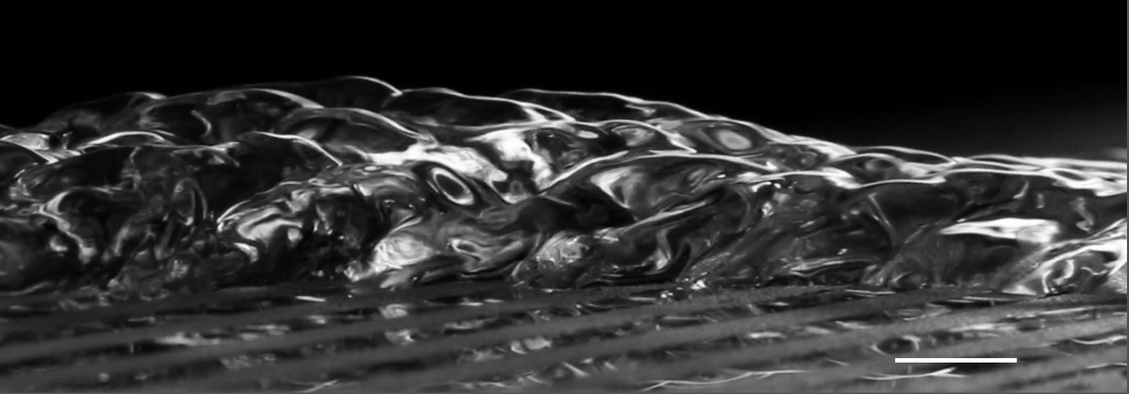
The characteristics of a surface can have a major impact on the form a flow takes. The photo above shows a corrugated, almost pinecone-like water surface. It’s the result of a sheet of water flowing over a surface with alternating bands of hydrophobic (water-repelling) and hydrophilic (water-loving) properties. The water sheet narrows over hydrophobic sections and expands over hydrophilic ones. Gravity, inertia, and surface tension compete to create the overall braided appearance. You can see a top-down view of the flow in the original poster. (Image credit: M. Grivel et al., source)