Tag: flow visualization

  • Featured Video Play Icon

    An Introduction to Turbulence

    With some help from Physics Girl and her friends, Grant Sanderson at 3Blue1Brown has a nice video introduction to turbulence, complete with neat homemade laser-sheet illuminations of turbulent flows. Grant explains some of the basics of what turbulence is (and isn’t) and gives viewers a look at the equations that govern flow – as befits a mathematics channel! 

    There’s also an introduction to Kolmogorov’s theorem, which, to date, has been one of the most successful theoretical approaches to understanding turbulence. It describes how energy is passed from large eddies in the flow to smaller ones, and it’s been tested extensively in the nearly 80 years since its first appearance. Just how well the theory holds, and what situations it breaks down in, are still topics of active research and debate. (Video and image credit: G. Sanderson/3Blue1Brown; submitted by Maria-Isabel C.)

  • Featured Video Play Icon

    Making a Square Vortex

    As someone who has played with her share of vortex cannons, I can assure you that messing around with smoke generators and vortex rings is a lot of fun. And in this video, Dianna gives things a little twist: she makes the vortex cannon’s mouth a square instead of a circle.

    Now, that doesn’t create a square vortex ring. (Vortex rings don’t really do 90-degree corners.) But it does make the vortex ring all neat and wobbly. Whenever you have two vortices near one another (or, in this case, two parts of a vortex line near one another), they interact. As Dianna shows with hurricanes, depending on the direction of rotation and their relative strength, nearby vortices can orbit one another or travel together in straight lines – or they can cause more complicated interactions, like in the case of the square-launched rings.

    I think there may also be some interesting effects here from vortex stretching, but that’s a topic for another day! (Video and image credit: D. Cowern/Physics Girl; see also: LIBLAB; submitted by Maria-Isabel C.)

  • Solar Prominence

    Solar Prominence

    Near the surface of the sun, the interplay of magnetic fields and plasma flow creates solar prominences that appear to dance. The prominence shown here was recorded in 2012 by the NASA Solar Dynamics Observatory, and its arc is large enough to easily surround the Earth. This is fluid dynamics – specifically magnetohydrodynamics – on a scale difficult for us earthbound humans to imagine. Scientists are still working to understand the complex processes that drive flows like this one. Fortunately, we can appreciate their beauty regardless. (Image credit: NASA SDO, source; via APOD; submitted by jpshoer)

  • Swirls of Color

    Swirls of Color

    These beautiful swirls show the wake downstream of a thin plate. Here water is flowing from left to right and dye introduced on the plate (upstream and unseen in the photo) curls up into vortices. The vortices in the top row rotate clockwise, while the vortices along the bottom rotate anti-clockwise. This pattern of alternating vortices is extremely common in the wakes of objects and is known as a von Karman vortex street. Similar patterns are seen in soap films, behind cylinders, in the wakes of islands, and behind spaceships.  (Image credit: ONERA, archived here)

  • Stall with Pitching Foils

    Stall with Pitching Foils

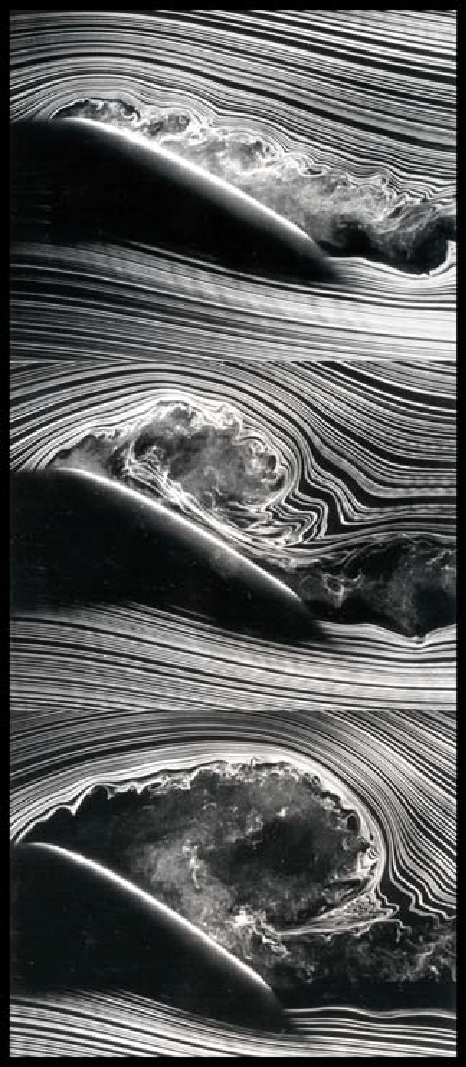
    For a fixed-wing aircraft, stall – the point where airflow around the wing separates and lift is lost – is an enemy. It’s the precursor to a stomach-turning freefall for the airplane and its contents. But the story is rather different when the wing is actively pitching through these high angles of attack. In this case, you get what’s known as dynamic stall, illustrated in three consecutive snapshots above.

    In the top image, the flow has clearly separated from the upper surface of the wing, but this isn’t a cause for panic. As the middle image shows, there’s a vortex that’s formed in that separated region and it’s moving backward along the wing as the angle of attack continues to increase. That vortex causes a strong low-pressure region on the upper surface of the wing, allowing it to maintain lift.

    In the final image, the vortex is leaving the wing, taking its low-pressure zone with it. This is the point where the pitching wing loses its lift, but if the vortex’s departure is immediately followed by a pitch down to lower angles of attack, the aircraft will recover lift and carry on. (Image credit: S. Schreck and M. Robinson, source)

  • Phytoplankton Swirl

    View this post on Instagram

    Every summer, phytoplankton spread across the northern basins of the North Atlantic and Arctic Oceans, with blooms spanning hundreds and sometimes thousands of kilometers. One of our Earth-observing satellites captured this natural-color image of striking swirls of green seawater rich with blooms of phytoplankton whirling in the Gulf of Finland, a section of the Baltic Sea. Note how the phytoplankton trace the edges of a vortex; it is possible that this ocean whirlpool is pumping up nutrients from the depths. Credit: NASA/U. S. Geological Survey/ Joshua Stevens/Lauren Dauphin #nasa #science #vortex #phytoplankton #earth #landsat #picoftheday #finland #earthview #views #satellite #lava #balticSea #beautiful #blooms

    A post shared by NASA (@nasa) on

    During the warm summer months, phytoplankton blooms pop up in waters around the world. This natural-color satellite image shows a bloom in the Gulf of Finland. The tiny phytoplankton serve as tracker particles for the flow, revealing large-scale features like the spectacular vortex in the center of this image. The presence of the phytoplankton here suggests that this vortex could be pumping nutrients up from the deep. 

    Researchers also use particles for flow visualization. This can be as simple as adding small, neutrally buoyant particles, illuminating smoke, or even using natural snowfall to see what’s happening in the flow. (Image credit: NASA/USGS/J. Stevens/L. Dauphin)

  • The Livers of Our Rivers

    The Livers of Our Rivers

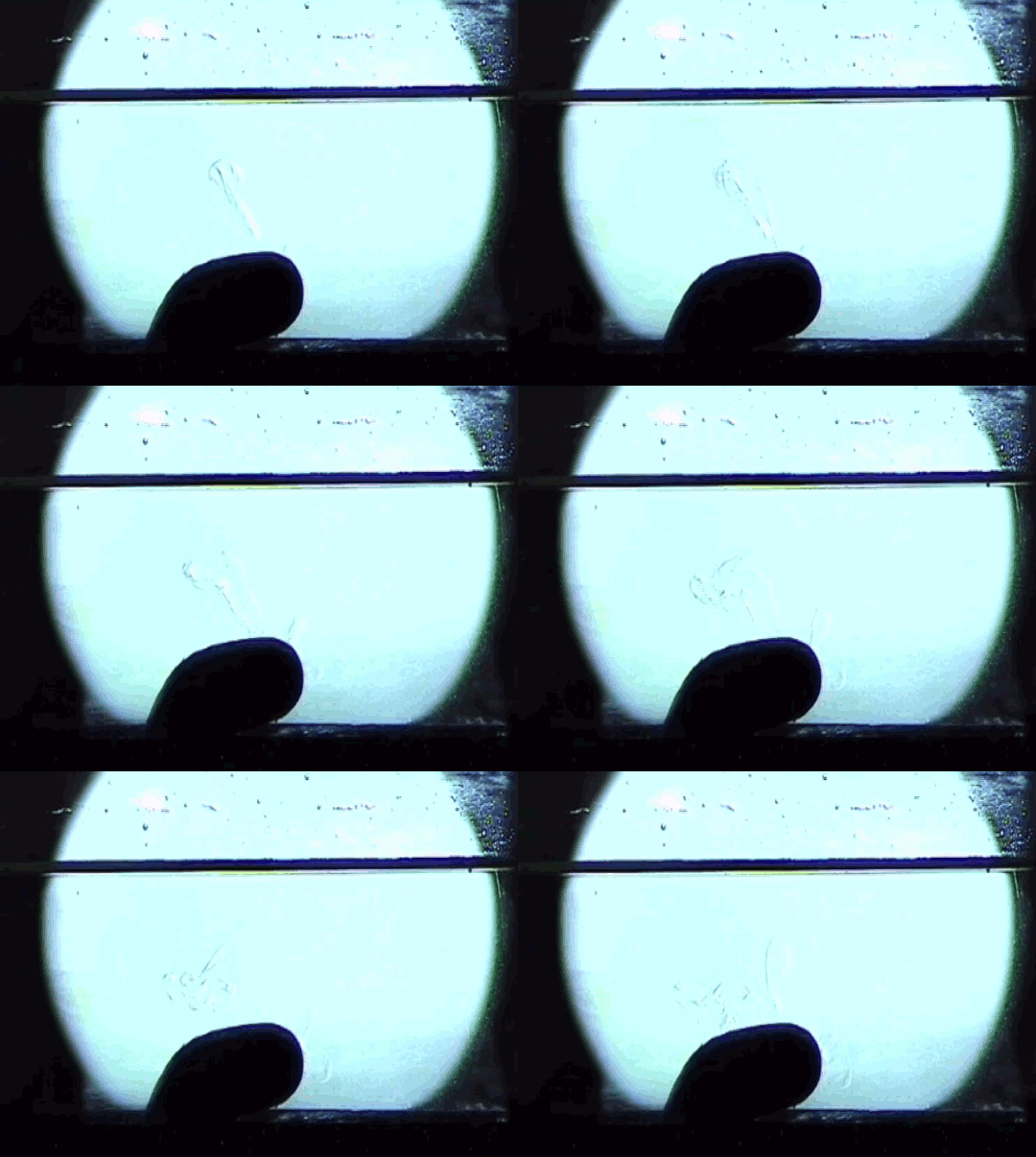
    To the naked eye, mussels and other bivalves don’t appear to be doing much. But these filter feeders are hard at work. The mussel takes in water through its incurrent siphon (on the right side in this image), and tiny cilia move the water through its gills, which filter out plankton and other edibles. Wastewater flows out the exacurrent siphon, seen here as the plume coming out the top of the mussel.

    Mussel species are important indicators of the health of both fresh and marine water bodies. Because they’re stationary and they are constantly processing the water, the health of these bivalves is indicative of the ecosystem’s overall health. (Image credit: S. Allen, source)

  • Merging Black Holes

    Merging Black Holes

    At the heart of many galaxies, including our own, lies a supermassive black hole millions of times the mass of our sun. Scientists have yet to observe the merger of two such black holes, but using simulations, they are trying to learn what such collisions might look like. Simulations like the one shown here require combining relativity, electromagnetism, and, yes, fluid dynamics to capture what happens during the in-spiral.

    Supermassive black holes like these are surrounded by gas disks that flow around them. Magnetic and gravitational forces heat the gas, causing it to emit UV light and, at times, high energy X-rays, both of which may be observable.

    Gravitational wave detectors, similar to LIGO, may also measure evidence of supermassive black hole mergers, but physicists expect that will require a next-generation observatory, like the space-based LISA to be launched in the 2030s.   (Image and video credit: NASA Goddard; research credit: S. d’Ascoli et al.; submitted by @lh7)

  • Watery Veins

    Watery Veins

    Glacial river veins wend and meander through these aerial photographs of Iceland by photographer Stas Bartnikas. Rivers naturally change their course over time, but here seasonal melts and the slow grinding of glaciers adds further chaos to the scene. Captured from above, these landscapes show the scars of past flows. (Image credit: S. Bartnikas; via Colossal)

  • How Mantas Filter But Never Clog

    How Mantas Filter But Never Clog

    Manta rays spend much of their time leisurely cruising through the water with their meter-wide mouths open. As they swim, they filter plankton, which makes up most of their diet, from the water. And they do so without ever clogging. 

    The inside of the manta’s mouth is lined with gill rakers (upper right), a series of comb-like teeth. When flow hits the leading edge of these (bottom), it creates a vortex that accelerates any particles caught in the flow. They essentially ricochet along the top of the gill rakers, getting led straight into the manta’s digestive system – while excess water gets deflected between the gill rakers and back out the manta’s gills. To drive this, all the manta has to do is swim; with the right flow speed, the shape of the gill rakers handles all the filtration with no additional effort. (Image credit: manta ray – G. Flood; gill rakers – M. Paig-Tran; flow vis – R. Divi et al., source; research credit: M. Paig-Tran et al.; via The Atlantic; submitted by Kam-Yung Soh)