Tag: flow visualization

  • Featured Video Play Icon

    Ink Explosion

    Sometimes beautiful flows come from simple combinations. Here the artists of Chemical Bouillon combine ink and hydrocarbons to create lovely explosions of color. Eschewing quick cuts between views, they allow us to linger and explore the flow ourselves as it changes. Differences in surface tension drive streaming flows along the surface, but there seem to be some chemical reactions contributing as well. Watch along the edges and you may even see convection pulling ink down and back. The whole video is only 2 minutes long and worth a full watch. (Image and video credit: Chemical Bouillon)

  • Order in Chaos

    Order in Chaos

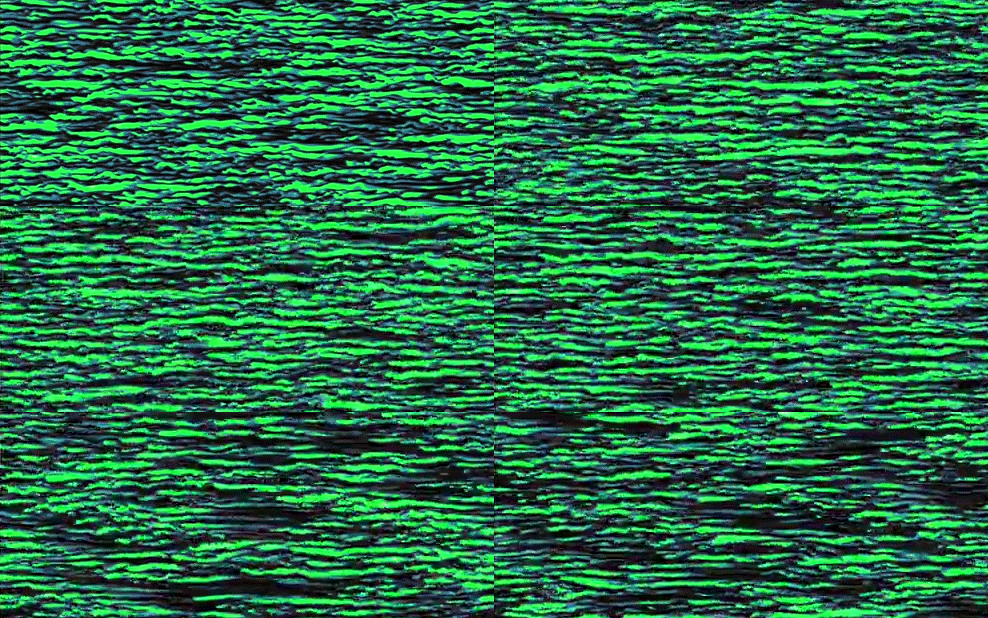
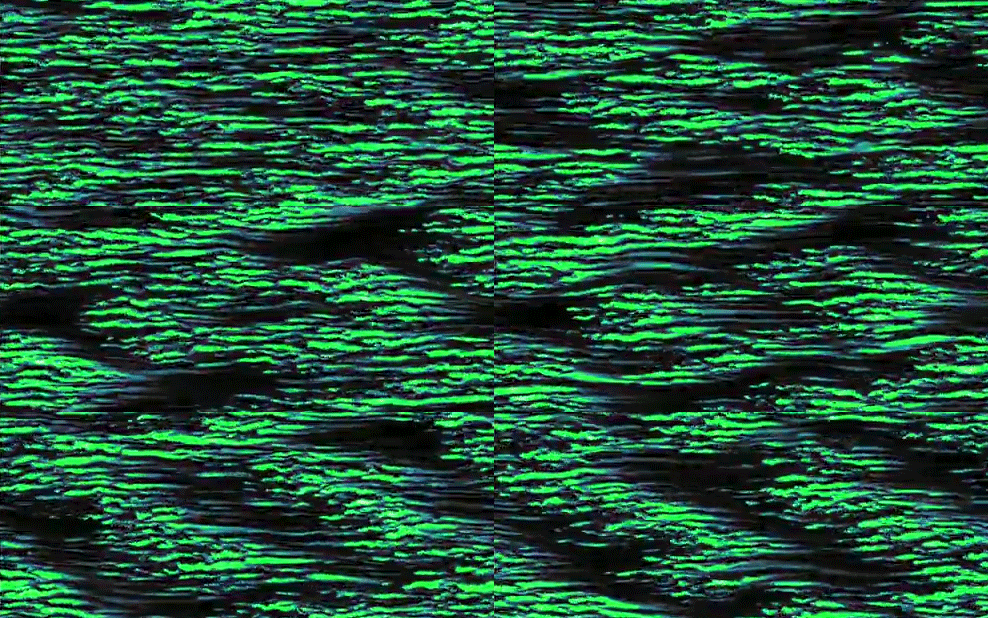
    Although turbulent flow is chaotic, it’s not completely disordered. In fact, order can emerge from turbulence, though exactly how this happens has been a long-enduring mystery. Take the animations above. They show the flow that develops between two plates moving in opposite direction that are separated by a small gap. (The formal name for this is planar Couette flow.) The visualization is taken in a plane at a fixed height between the plates.

    Initially (top), the flow shows narrow bands of turbulence, shown in green, separated by calmer, laminar zones in black. As time passes, these areas of laminar and turbulent flow self-organize, eventually forming diagonal stripes that are much longer than the gap between plates (bottom), the natural length-scale we would expect to see in the flow. Researchers have wondered for years why these distinctive stripes form. What sets their spacing, and why are they along diagonals?

    To answer those questions, researchers explored the full Navier-Stokes equations, searching for equilibrium solutions that resemble the striped patterns seen in experiments and simulation. And for the first time, they’ve found a mathematical solution that matches. What the work shows is that the pattern emerges naturally from the equations; in fact, given the characteristics of the solution, the researchers found that many disturbances should lead to this result, which explains why the pattern appears so frequently. (Image and research credit: F. Reetz et al., source; via phys.org; submitted by Kam-Yung Soh)

  • Featured Video Play Icon

    Active Foam

    Geometrically, biological tissues and two-dimensional layers of foam share a lot of similarities. To try and understand how active changes in one cell affect neighbors, researchers are studying how foams shift when air is injected (below) at one or more sites. When a foam cell expands, it forces topological changes in neighboring cells, which researchers built an algorithm to track in real-time. 

    With some processing, they can actually visualize the radially-expanding waves of strain that pass through the foam (bottom image). This allows them to visualize the effects and interaction of multiple injection sites at once, hopefully helping unlock the mechanics behind both the foam’s shifts and those that occur in tissues. (Image and video credit: L. Kroo and M. Prakash)

  • Evaporative Convection

    Evaporative Convection

    Since we spend so much of our lives around transparent fluids like air and water, we often miss seeing some of their coolest-looking flows. Here, we see a layer of water only 3 centimeters deep but a full meter wide. It’s seeded with tiny crystals that reflect light depending on their orientation, which allows us to see the flow. Initially, the tank is spun up, then left stationary for 2 hours while evaporation cools the water.

    Normally, the resulting flow would be too slow to notice, but that’s where the magic of timelapse comes in. With it, we can see the wriggling dark lines marking areas where cool, dense water sinks and brighter regions where warm fluid rises. What begins as an array of polygonal convection cells quickly merges into a couple of large, rounded cells. Check out the full video below, where you can see the streaming patterns far better than in animation. (Image and video credit: UCLA Spinlab)

  • How Rain Can Spread Pathogens

    How Rain Can Spread Pathogens

    Rainfall can help spread pathogens from an infected plant to healthy ones. This transfer can happen both through droplets and by dry-dispersal of pathogen spores (top). When a raindrop hits a leaf, its initial spread triggers a vortex ring of air that can lift thousands of dry spores into a swirling trajectory (bottom). That boost in height carries spores beyond the slower wind speeds of the plant’s boundary layer and into faster air streams that disperse it toward healthy plants. (Image and research credit: S. Kim et al.)

  • Granular Instabilities

    Granular Instabilities

    Granular mixtures show surprising similarities to fluids, even though their underlying physics differ. The latest example of this is a Rayleigh-Taylor-like instability that occurs when heavy particles sit atop lighter ones. By combining vertical vibration and an upward gas flow, researchers found that the lighter particles form fingers and bubbles that seep up between the heavier grains (upper left). Visually, it looks remarkably similar to a lava lamp or other Rayleigh-Taylor-driven instability (upper right).

    But the physics behind the two are distinctly different. In the fluid, buoyancy drives the instability while surface tension acts as a stabilizing force. There’s no surface tension in a granular material, though. Instead, the drag force from gas flowing upward provides the vertical impetus while friction between the grains – essentially an effective viscosity – replaces surface tension as a stabilizing influence.

    The similarities don’t stop there, though. When the researchers tested a “bubble” of heavy grains suspended in lighter ones (lower left), they found that, instead of sinking, the granular bubble split in two and drifted downward on a diagonal. Eventually, those daughter bubbles also split. Again, visually, this looks a lot like what happens to a drop of ink or food coloring falling through water (lower right), but the physics aren’t the same at all. 

    In the fluid, the breakup happens when a falling vortex ring splits. In the granular example, gas moving upward tends to channel around the heavy grains because they’re harder to move through. Eventually, this builds up a solidified region under the bubble. When the heavy grains can’t move directly down, they split and sink through the surrounding suspended particles until they build up another jammed area and have to split again. (Image credits: granular RTI – C. McLaren et al.; RTI simulation – M. Stock; bag instability – D. Zillis; research credit: C. McLaren et al.; submitted by Kam-Yung Soh)

  • Tornado from a Drone

    Tornado from a Drone

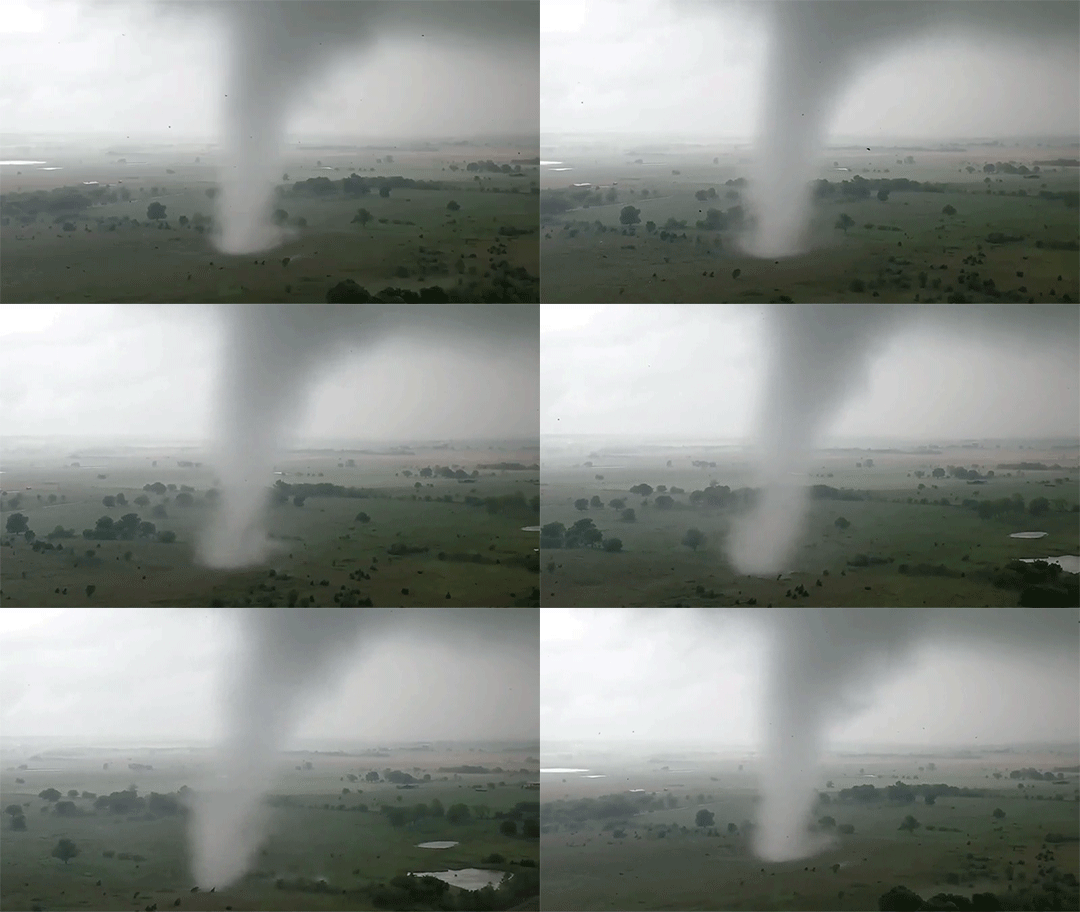
    One of the challenges in studying tornadoes is being in the right place at the right time. In that regard, storm chaser Brandon Clement hit the jackpot earlier this week when he captured this footage of a tornado near Sulphur, Oklahoma from his drone. He was able to follow the twister for several minutes until it apparently dissipated.

    Scientists are still uncertain exactly how tornadoes form, but they’ve learned to recognize the key ingredients. A strong variation of wind speed with altitude can create a horizontally-oriented vortex, which a localized updraft of warm, moist air can lift and rotate to vertical, birthing a tornado. These storms most commonly occur in the central U.S. and Canada during springtime, and researchers are actively pursing new ways to predict and track tornadoes, including microphone arrays capable of locating them before they fully form. (Image and video credit: B. Clement; via Earther)

  • Featured Video Play Icon

    Fluid at Work

    For many engineering students, their first experience with flow visualization comes in undergraduate labs, where dye introduced into a flume demonstrates basic flow features around airfoils, cylinders, and spheres. This short video by undergraduate Nick Di Guigno and partners quietly illustrates that experience, from the introduction to the equipment to loading the dye and watching the flow develop under the commentary of one’s professor. For those of you who have done this, I suspect it may ignite a bit of nostalgia. For those who haven’t, I think it captures some of the magical feeling of stepping into the lab the first time, even when you’re just recreating a phenomenon others have seen a thousand times before. (Image and video credit: N. Di Guigno et al.)

  • Vibrating in the Flow

    Vibrating in the Flow

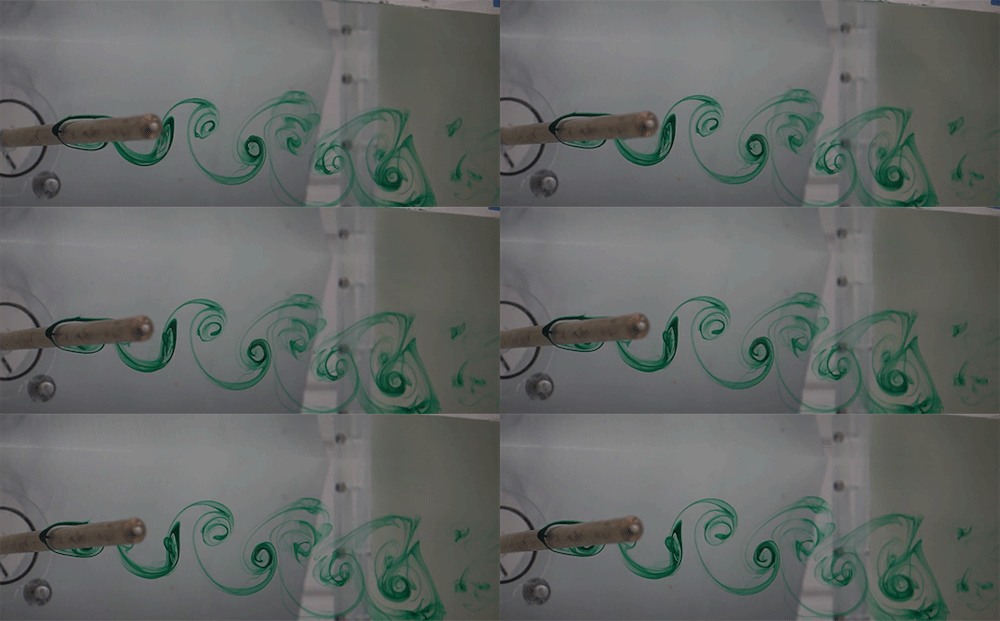
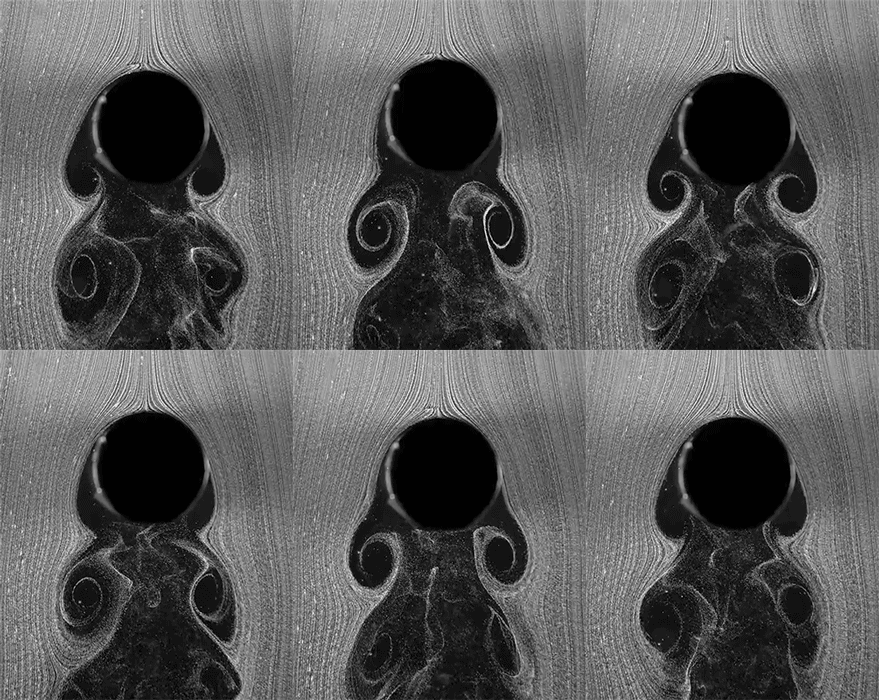
    Objects can obviously affect flows, but that’s not a one-way street. Flows can also affect objects, even ones as simple a circular cylinder. If you live somewhere with traffic lights mounted to a horizontal bar, you’ve probably seen this. On a windy day, the beam holding the traffic lights will oscillate up and down. This is an example of vortex-induced vibration, a coupling between the flow structures formed by an object and the motion of the object itself. With cylinders, engineers have mostly studied a situation like the traffic light – one where the motion of the cylinder is perpendicular to the direction of the flow. 

    But it’s also possible to get vortex-induced vibration in the same direction as the flow. That’s what you see visualized in the images above. Notice how the oscillation of the cylinders is inline with the flow direction. As with the crossflow version of vortex-induced vibration, this inline example has several wake forms that vary based on flow conditions. (Image and research credit: T. Gurian et al.)

  • Paddling

    Paddling

    When I lived in New England, I often spent summers paddling around a lake in either a kayak or canoe. Every stroke was an opportunity to stare down into the dark water and watch how the flow curled around my oar. Here you see a bit of what that looks like from underwater.

    The animation above shows a flat plate – twice as tall as it is wide – submerged about 20 mm below the surface and accelerated steadily from rest. As it starts moving, there’s a clear vortex ring formed and shed behind it. You can also see how the plate distorts the free surface into large depressions. Both of these cause extra drag on the plate. Eventually, though, the plate reaches a steady state.

    All together, what you see here is a good representation of what’s going on when a rower first begins to accelerate their boat from rest. Hydrodynamically speaking, the best way to do that isn’t to dig in with a deep stroke. It’s to use a series of short, relatively shallow strokes to get the boat up to speed. This takes advantage of the efficiency of drag generation during acceleration to get the boat to its cruising speed quickly. (Image and research credit: E. Grift et al.)