Tag: flow visualization

  • Featured Video Play Icon

    “Mocean”

    Ocean waves are endlessly fascinating to watch. In “Mocean,” cinematographer Chris Bryan captures them in ways few ever see, thanks to his high-speed camera. Honestly, this film is so gorgeous that I don’t want to distract you with the science, so just go watch!

    All done? Pretty wonderful, right? There’s nothing quite like seeing those holes break and expand through sheets of water, tearing what looked solid into a spray of droplets that bleed salt into the atmosphere. Or how about those rib vortices underneath the waves? Or the cloud-like turbulence of the waves breaking overhead? How fortunate we are to see and capture and share such beauty! (Video and image credit: C. Bryan; via RedShark; submitted by Michael F.)

  • Trails from a Delta Wing

    Trails from a Delta Wing

    Top-down view of green and red dyes streaming off a delta wing

    Rhodamine (red) and fluorescein (green) dyes highlight the complex flows around a delta wing. To visualize the flow, researchers painted the apex of the delta wing with rhodamine, which gets drawn into the core of the wing’s leading edge vortex. The green fluorescein dye was added to the wing’s trailing edge, where it gets pulled into the secondary structure of the vortices. A laser illuminates the flow, making even the most delicate wisps of dye shine. As the wake behind the wing develops, the dyes reveal growing instabilities along the vortices. Given time and space, these instabilities will grow large enough to destroy any order in the wake, leaving behind turbulence. (Image and research credit: S. Morris and C. Williamson; see also poster)

  • Fiery Streaklines

    Fiery Streaklines

    Embers fly through the Kincade wildfire leaving streaks of light that reveal the strong winds helping drive the fire. This unintentional flow visualization mirrors techniques used by researchers to understand how flows are moving. The shutter of the camera remains open for a fixed time, so the length of each streak tells us about the speed of the flow. Longer streaks occur where embers moved faster. 

    Here we see the longest streaks in the upper left side of the image, which tells us that the wind was moving faster there than it did at lower heights, like near the photographer in the picture. That’s in keeping with what we would expect. In general, winds move faster above the ground than they do near the surface. That speed difference is one of the reasons wildfires are so difficult to contain; a single ember caught by high winds is easily carried to unburnt areas, allowing the fire to spread more quickly than if it had to burn along the ground. (Image credit: J. Edelson/Getty Images; via Wired)

  • Bay of Fundy Tides

    Bay of Fundy Tides

    Canada’s Bay of Fundy has some of the wildest tidal flows in the world. Every six hours, the flow direction through the strait shifts and tidal currents rise to several meters per second. This creates distinct jets a couple kilometers long that pour from one side of the strait to the other. 

    What you see here is a numerical simulation of the flow using a technique called Large Eddy Simulation (or LES, for short). It’s one method used by fluid dynamicists to model turbulent flows without taking on the complexity of the full Navier-Stokes equations. At large lengthscales, like those of the jets and eddies we see above, LES uses the exact physics. But when it comes to the smaller scales – like the flow nearest the shores or the bottom of the strait – the simulation will approximate the physics in order to make calculations quicker and easier. Models like these make large-scale problems – including modeling our daily weather patterns – possible. (Image credit: A. Creech, source)

  • Seeing Sound

    Seeing Sound

    It’s not always easy to imagine how waves travel, but with this demonstration, you can see sound waves and how they reflect and defract. The set-up uses schlieren optics that show light and dark bands where strong changes in density take place. This, combined with a stroboscopic light, makes it possible to see the wave fronts from the acoustic transducer on the left side of the screen. Once the wave is apparent, introducing a reflective object lets us see exactly how sound waves bounce, reflect, and interfere. (Image and video credit: Harvard Natural Sciences Lecture Demonstrations)

  • Arctic Swirls

    Arctic Swirls

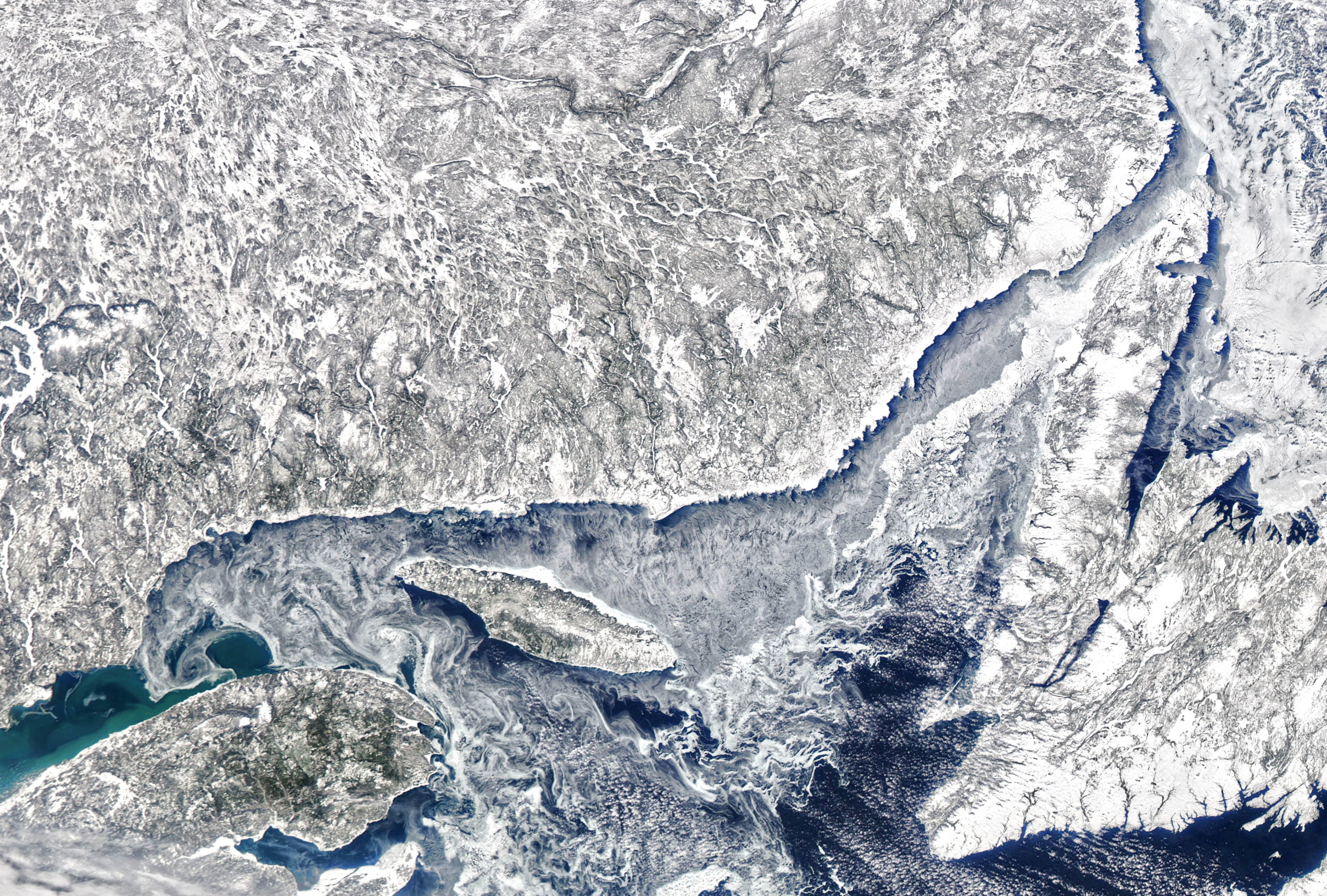
    These colorful swirls show sediment and organic matter carried into the Arctic Ocean. Like dyes or tracer particles in a lab experiment, this run-off reveals the complicated patterns of mixing where freshwater and salt water mix. Delicate as they appear, these eddies are tens of kilometers across. Zoom in on the full resolution image to really appreciate the details, like the feathery edges between layers. (Image credit: N. Kuring; via NASA Earth Observatory)

  • Inside the Canopy

    Inside the Canopy

    If you’ve ever gone into the woods on a windy day, you know that conditions there are drastically different than in the open. To blowing wind, trees of different sizes act like enormous roughness that disturbs the flow. Inside the canopy, flows can become incredibly complicated and many of the common techniques used by researchers no longer hold. 

    You can get a sense for this complexity with the second image above, which visualizes data from a wind tunnel experiment. The gray blocks represent roughness elements – the trees of this wind-tunnel-scale forest – and the large, blue arrow shows the direction of the flow. The thin colored lines show the paths taken by particles in the flow. The lines’ colors indicate what height the trajectory began at. 

    Notice how the blue and purple lines are relatively straight and oriented in the direction of the flow. This indicates that the flow here is relatively steady and uncomplicated. At the lower heights, though, especially in the green and yellow regions, the pathlines are far more twisted and complex. The flow here is turbulent, and the particles’ trajectories don’t necessarily correlate at all to the winds higher up. (Image credit: T. Japyassu and R. Shnapp et al.; research credit: R. Shnapp et al.; submitted  by Ron S.)

  • Entraining Bubbles

    Entraining Bubbles

    If you stand on a bridge and watch the current flow past pylons below, you’ll see disturbances marking the wakes. Dragging a rod – or an oar – at a high enough speed through the water creates something similar: a wavy cavity in the fluid surface that surfs along behind the rod. The faster you pull the rod, the harder you’ll have to work, until that wake becomes so turbulent that it begins entraining air bubbles, like the tiny ones seen above. Once entrainment starts, the drag coefficient drops somewhat, presumably due to changes in the pressure distribution around the rod. The characteristics of air entrainment change with object size as well. Larger rods can entrain air through the cavity and not just in the wake. (Image and research credit: V. Ageorges et al.)

  • Featured Video Play Icon

    Dissolving Pills

    This short film from Macro Room shows how pills dissolve in timelapseDissolution is a complex process driven both by flow and chemical concentration. Any small motion in the water helps erode the surface, and as the chemicals dissolve, the subsequent variations in the concentration drive additional flow. This is why we often see a turning point in how quickly the pills come apart. The initial breakdown is slow, but once enough of the pill dissolves, it enhances the surrounding flow, which increases erosion. Notice how many of the pills – liquid-filled capsules, especially – have a point where fluid begins streaming away from them. Unlike the capsules, the solid pills seem to get an extra boost from bubbles that form and then pull away material. (Image and video credit: Macro Room; submitted by clogwog)

  • Jets from Lasers

    Jets from Lasers

    Laser-induced forward transfer (LIFT) is an industrial printing technique where a laser pulse aimed at a thin layer of ink creates a tiny jet that deposits the ink on a surface. In practice, the technique is plagued with reproducibility issues, in part because it’s difficult to produce only a single cavitation bubble when aiming a laser at the liquid layer. This is what we see above. 

    The laser pulse creates its initial bubble just above the middle of the liquid layer. Shock waves expand from that first bubble and quickly reflect off the liquid surface (top) and wall (bottom). When reflected, the shock waves become rarefaction waves, which reduce the pressure rather than increasing it. This helps trigger the clouds of tiny bubbles we see above and below the main bubble. 

    The effect is worst along the path of the laser pulse because that part of the liquid has been weakened by pre-heating, but impurities and dissolved gases in the liquid layer are also prone to bubble formation, as seen far from the bubble. The trouble with all these unintended bubbles is that they can easily rise to the surface, burst, and cause additional jets of ink that splatter where users don’t intend. (Image and research credit: M. Jalaal et al.; submitted by Maziyar J.)