Tag: flow visualization

  • Featured Video Play Icon

    How Well Do Masks Work?

    Many mixed messages have been spread about the efficacy of masks in preventing transmission of COVID-19. Nevertheless, there is good evidence that they help, as discussed in this video from It’s Okay to Be Smart. Much of the video shows schlieren imaging of a (healthy) individual engaging in regular activities – like talking, breathing, and coughing — with and without a cloth mask.

    Now, it’s important to note that what you see in these images is airflow, not the droplets that can carry the virus. However, research has shown that these airflows play a significant role in transporting droplets. It follows that disrupting those airflows can disrupt transmission of diseases passed via droplet. This is one of the key reasons to wear a mask.

    Notice how far jets and plumes of air fly from a maskless person’s mouth and nose. We cannot even observe how far momentum carries that air because the area visualized in this schlieren set-up is smaller than the full distance the air moves! But wearing a mask breaks up that flow structure. It reduces the air’s momentum, and it forces any air that does escape to move in smaller, less efficient structures. Even without considering any filtering effects or the fact that masks catch large droplets coming out of the wearer’s mouth, it’s clear that mask-wearing keeps others nearby safer. (Video and image credit: It’s Okay to Be Smart; references)

  • New Signs of Turbulence in Blood Flow

    New Signs of Turbulence in Blood Flow

    Our bodies are filled with a network of blood vessels responsible for keeping our cells oxygenated and carrying away waste products. In many ways, our blood vessels are tiny pipes, but there’s a crucial difference in the flow they carry: it’s pulsatile. Because the flow is driven by our hearts, rather than a continuous pump, every heartbeat creates a distinct cycle of acceleration and deceleration in the flow. And new research has found that this cycle, when combined with curvature or flow restrictions like plaque build-up, can create turbulence in unexpected places.

    Specifically, the researchers found that decelerating pipe flows can develop a helical instability that breaks down into turbulence, even in vessels where purely laminar flow would be expected. In the animations above, you can see the flow slow, develop swirls and then break into turbulence. The flow becomes laminar again as it accelerates, but during that brief bout of turbulence there’s much higher forces on the walls of a blood vessel. Over time, that extra force could contribute to inflammation or even hardening of the arteries. (Image and research credit: D. Xu et al.; via phys.org)

  • Featured Video Play Icon

    Aerosol Transport

    NASA Goddard has produced another gorgeous visualization of how various aerosols move around our world. This visualization is constructed from data collected between August 2019 and January 2020, which means that it captures numerous typhoons as well as the extreme bushfires that occurred in Australia.

    Different colors represent different aerosol sources: carbon (red), sulfate (green), dust (orange), sea salt (blue), and nitrate (pink). The brighter the color, the higher the concentration of aerosols. With this, we see steady patterns of natural sea salt transport and the billowing flow of dust from Saharan Africa. But we can also see manmade pollution from sources across the Northern Hemisphere, as well as major output from the Australian bushfires. It’s a good reminder that none of us is truly isolated in this interconnected world of ours. (Video and image credit: NASA Goddard; via Flow Vis)

  • Colorful Tides

    Colorful Tides

    This false-color satellite image — the recent winner of NASA Earth Observatory’s Tournament Earth 2020 — shows sands and seaweed off the coast of the Bahamas. Ocean currents and tides eroded these elaborate fluted designs in much the same way that winds sculpt desert dunes. The overlap in form is no accident; as seen in recent work, researchers are finding that both air and water move granular materials like sand according to the same rules. (Image credit: S. Andrefouet; via NASA Earth Observatory)

  • Bioluminescence at the Beach

    Bioluminescence at the Beach

    A bioluminescent phytoplankton bloom is causing a stir among California beachgoers. During the daytime, aggregations of Lingulodinium polyedra appear reddish-brown in color (think the classic ‘red tide’). But at night the phytoplankton bioluminesce, specifically when they’re disturbed by a change in shear force. This is why the brightest glows are visible in crashing waves or around the boards of surfers.

    Beautiful as it appears, blooms like these are deadly to marine life. The excess numbers of phytoplankton strip water of oxygen, causing mass die-offs among fish. Even residents several miles inland of the beaches are reporting the unpleasant smell that results. (Image credits: AP; video credit: Scripps Institute of Oceanography; via Gizmodo)

  • Icy Swirls

    Icy Swirls

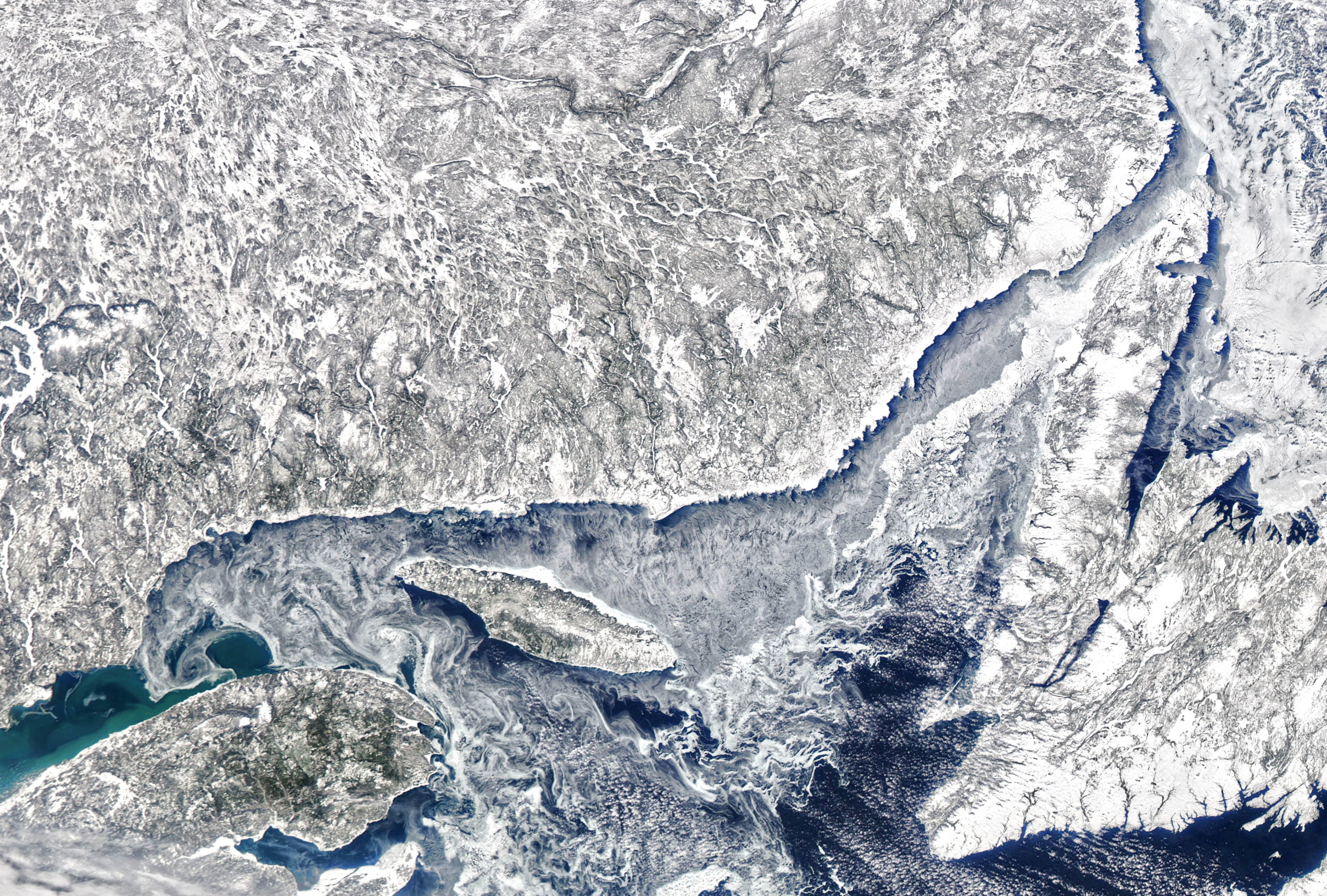
    Rafts of sea ice follow swirling eddies in this satellite image of the Gulf of St. Lawrence. Just as with phytoplankton blooms and sediment, this thin sea ice can be moved by wind and currents to reveal hidden flow patterns. Experimentalists use many similar diagnostics that introduce bubbles, particles, smoke, and other tracers into flows to visualize motion that’s otherwise invisible. (Image credit: J. Stevens/NOAA/NASA; via NASA Earth Observatory)

  • Featured Video Play Icon

    Colorful Dissipation

    Colorful eddies swirl in this short video from photographer Karl Gaff. Formed near the boundary at the bottom of the frame, these eddies act to dissipate some of the energy in the flow. Structures like these are key in turbulent flows, where energy must pass from large eddies to smaller and smaller ones until they reach a size where viscosity can extinguish them. (Video, image, and submission credit: K. Gaff)

    P.S. – Today’s post is FYFD’s 2,500th! Crazy, right? That means we have a pretty enormous archive. Want to explore? Click here for a random post.

  • Nitro Bubble Cascades

    Nitro Bubble Cascades

    Animation of nitrogen bubbles cascading in Guinness

    Fans of nitro beers — particularly Guinness’ stout — have probably noticed the fascinating cascade of bubbles that form as the beer settles. It’s a non-intuitive behavior — bubbles rise since they’re lighter than the surrounding fluid. So why do the bubbles appear to sink in these beers?

    There are several effects at play here. Firstly, overall the bubbles in the beer are rising; even mixing nitrogen gas into a beer in place of carbon dioxide doesn’t change that. But pint glasses typically flare so that they’re wider at the top than at the bottom. Since the bubbles rise essentially straight up, this causes a bubble-less film to form near the upper walls. And as that heavier fluid sinks, it pulls some of the tiny nitrogen bubbles with it. (You don’t see this effect in typical beers because the bubbles there are larger and thus too buoyant to get pulled down by the falling fluid.)

    As for the cascading waves we see in the bubbles, this, too, comes from the shape of the glass. Hydrodynamically speaking, what’s happens as the fluid film slides down the pint glass is similar to what happens when rain runs downhill. Beyond a certain angle, the flow becomes unstable and will form rolls and waves of varying thickness instead of sinking in a thin, uniform layer. As the film goes, so go the bubbles being dragged along, giving everyone at the bar a brief but entertaining fluid dynamical show. (Image credits: pints – M. d’Itri; bubble cascade – T. Watamura et al.; research credit: T. Watamura et al.)

  • Vortex Collisions Leave Clues to Turbulence

    Vortex Collisions Leave Clues to Turbulence

    Vortex ring collisions have long been admired for their beauty, but they’re now shedding light on the fundamental interactions that lead to turbulence. By dying just the cores of colliding vortex rings (Image 2), researchers observed anti-symmetric perturbations that develop along each core as they interact. These are indicative of what’s known as the elliptical instability.

    But the breakdown doesn’t stop there. Instead, as the elliptical instability develops, it generates a set of secondary vortex filaments that wrap around the original cores (Image 3). Just like the original vortex cores, those counter-rotating secondary filaments interact with one another, develop their own elliptical instability, and generate a set of smaller, tertiary filaments (Image 4).

    What’s exciting is that this process gives us a physical mechanism for the turbulent energy cascade. Researchers have talked for decades about energy passing from large-scale eddies to smaller and smaller ones, but this work lets us actually observe that cascade in the form of smaller and smaller pairs of vortex filaments interacting. To see more, check out some of our previous posts on this work. (Image and research credit: R. McKeown et al.; via Cosmos; submitted by Ryan M. and Kam-Yung Soh)

  • Inferring Flows with Neural Networks

    Inferring Flows with Neural Networks

    Fluid dynamicists have long used flow visualization methods to get a qualitative sense for flows, but it’s rare to derive much quantitative data from this imagery. But that may soon change thanks to a new computational technique, called Hidden Fluid Mechanics, that uses data from flow visualizations combined with physics-informed neural networks to derive the underlying velocities and pressures in a flow.

    The technique relies on two important ideas. One is that the dye, smoke, or other method of visualizing the flow does not alter the underlying flow; it’s just something carried along by the fluid. In other words, the flow behaves exactly the same whether or not you inserted dye or smoke.

    The second key idea is that the Navier-Stokes equations — which are derived from conservation of mass, momentum, and energy — accurately describe the physics of a flow. That assumption is critical to the technique since it uses those equations to constrain the flow fields the algorithm reconstructs.

    So here, roughly speaking, is what the algorithm actually does: researchers feed it concentration data from a flow visualization — essentially how much smoke or dye is present at every point in space and time — and the neural network reconstructs, based on the Navier-Stokes equations, what velocity and pressure field would produce that concentration data.

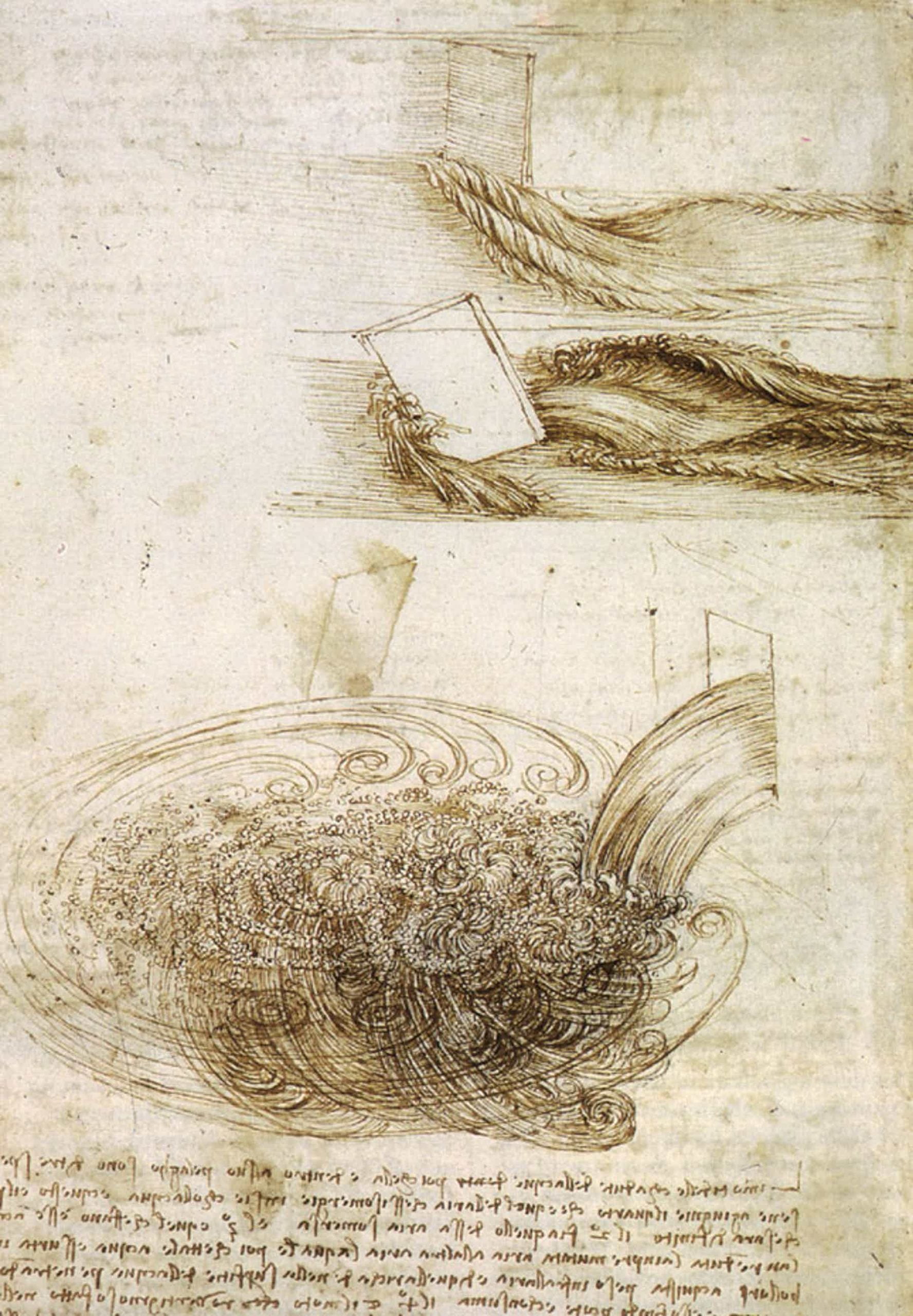
    The researchers demonstrate the capabilities of their algorithm by comparing its results to flows where all the information is known. The first image in the gallery above shows concentration data for the flow in an aneurysm. The full flow field is known already from a numerical simulation, but the researchers gave their new algorithm only the concentration data. From that, it reconstructed the streamlines for the aneurysm’s flow, shown in the second image as “Learned”. The “Exact” streamlines on the left are taken from the original numerical simulation data. As you can see, the results are remarkably similar. (Image credit: drawings – L. da Vinci, others – M. Raissi et al.; research credit: M. Raissi et al.; submitted by Stuart H.)