
Tag: flow visualization

  • Contrails From 4 Engines

    Contrails From 4 Engines

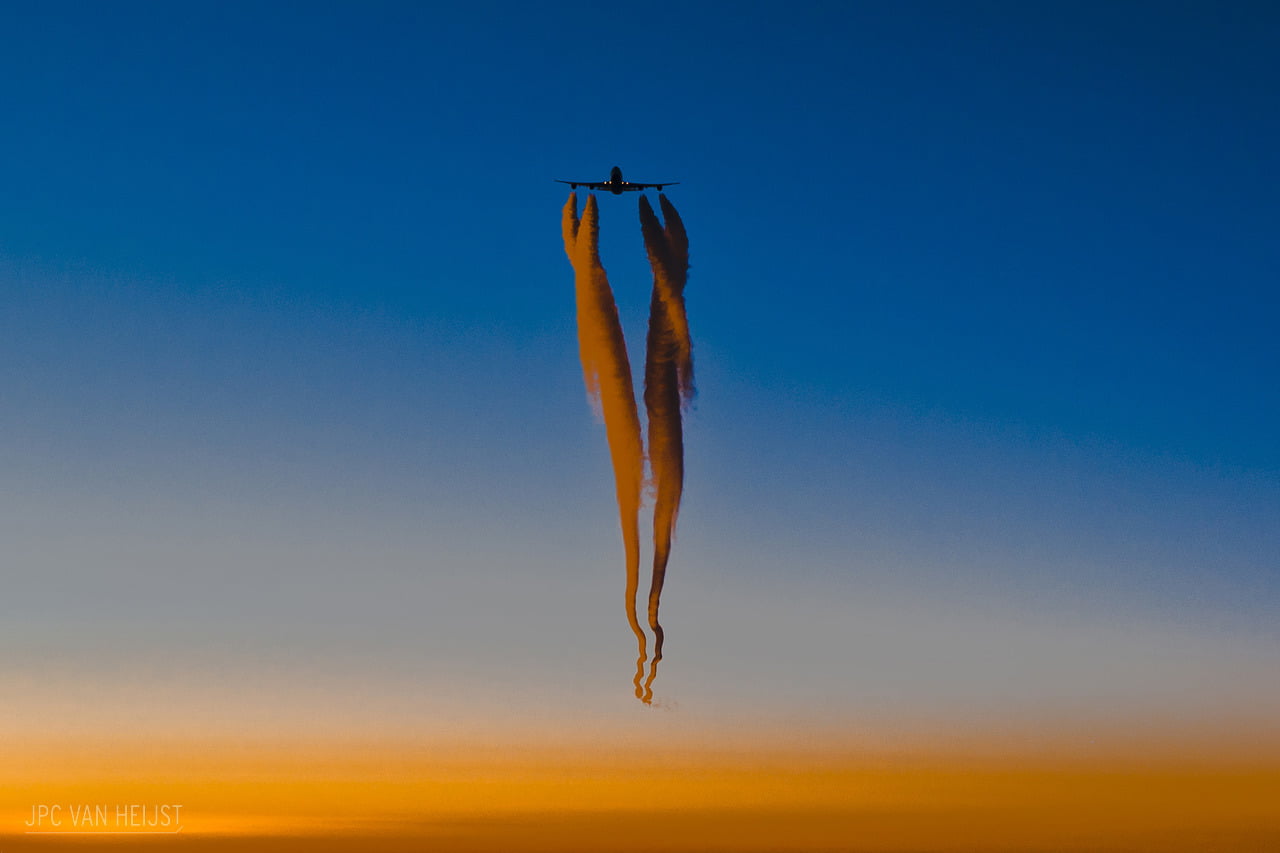
    The wingtip vortices of aircraft provide a veritable cornucopia of gorgeous imagery. There’s something inherently fascinating about these vortices that stretch behind moving aircraft. But four-engine aircraft add an extra twist to the imagery, as seen here.

    With four engines, these aircraft produce four separate contrails, each of which acts like a streakline for the flow behind the wing. So what we see in these images is not the wingtip vortices themselves, but what their effect is on flow moving across different parts of the wing.

    Nearby vortices influence one another, and one of the earliest models of aircraft physics takes advantage of this by modeling the wing itself as a series of vortices. Odd as it sounds, such models are quite good for capturing the basic flow physics behind a finite wing.

    Using one of these models, Joseph Straccia explored the physics of a 4-engine aircraft’s wake (Image 4), predicting that the outboard engine contrails should initially move outward before getting rolled up and inward by the wingtip vortices. That’s exactly what we see in these images, particularly Image 1. The inboard contrails undergo less deflection, as expected since they are further from the wingtips. (Image credits: aircraft and contrails – JPC Van Heijst, J. Willems, and E. Karakas; modeling and submission – J. Straccia)
  • As the Fog Rolls In

    As the Fog Rolls In

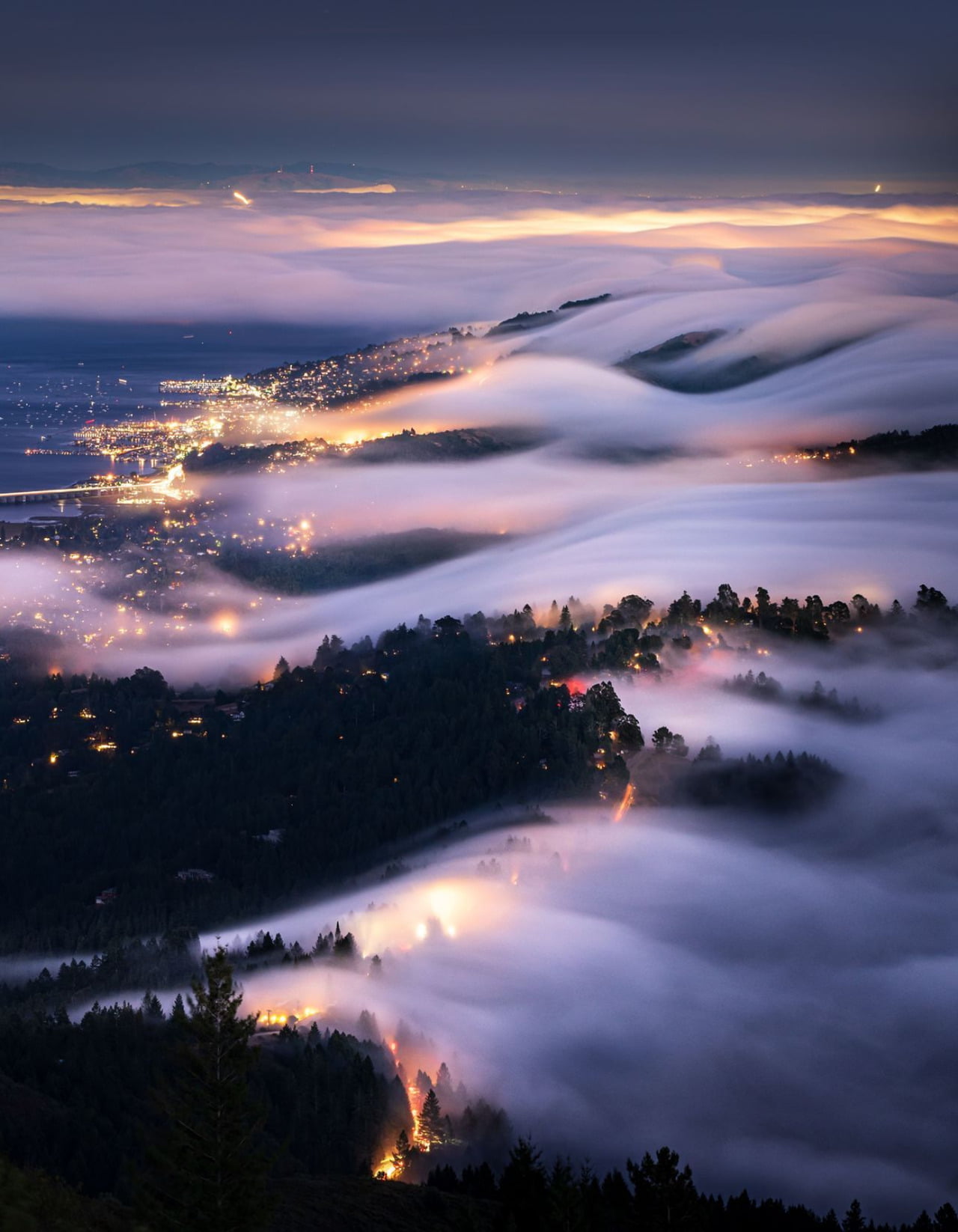
    Although we talk about fog rolling in, it’s rare for us to have a perspective where we can truly appreciate that flow. But this photograph from Tanmay Sapkal provides just that for the low summer fogs sweeping over Marin, CA. When hot summer temperatures make inland air rise, cold, moist air from the ocean sweeps in to replace it. Once the moisture condenses, it forms thick, low clouds of fog that surge past the Golden Gate Bridge and into San Francisco Bay. (Image credit: T. Sapkal; via NatGeo)

  • Featured Video Play Icon

    Dendritic

    “What happens when two scientists, a composer, a cellist, and a planetarium animator make art?” The answer is “Dendritic,” a musical composition built directly on the tree-like branching patterns found when a less viscous fluid is injected into a more viscous one sandwiched between two plates.

    Normally this viscous fingering instability results in dense, branching fingers, but when there’s directional dependence in the fluid, the pattern transitions instead to one that’s dendritic. In this case, that directionality comes from liquid crystals, whose are rod-like shape makes it easier for liquid to flow in the direction aligned with the rods.

    For more on the science, math, and music behind the piece, check out this description from the scientists and composer. (Video, image, and submission credit: I. Bischofberger et al.)

  • Bright Volcanic Clouds

    Bright Volcanic Clouds

    Every day human activity pumps aerosol particles into the atmosphere, potentially altering our weather patterns. But tracking the effects of those emissions is difficult with so many variables changing at once. It’s easier to see how such particles affect weather patterns somewhere like the Sandwich Islands, where we can observe the effects of a single, known source like a volcano.

    That’s what we see in this false-color satellite image. Mount Michael has a permanent lava lake in its central crater, and so often releases sulfur dioxide and other gases. As those gases rise and mix with the passing atmosphere, they can create bright, persistent cloud trails like the one seen here. The brightening comes from the additional small cloud droplets that form around the extra particles emitted from the volcano.

    As a bonus, this image includes some extra fluid dynamical goodness. Check out the wave clouds and von Karman vortices in the wake of the neighboring islands! (Image credit: J. Stevens; via NASA Earth Observatory)

  • Bacterial Turbulence

    Bacterial Turbulence

    Conventional fluid dynamical wisdom posits that any flows at the microscale should be laminar. Tiny swimmers like microorganisms live in a world dominated by viscosity, therefore, there can be no turbulence. But experiments with bacterial colonies have shown that’s not entirely true. With enough micro-swimmers moving around, even these viscous, small-scale flows become turbulent.

    That’s what is shown in Image 2, where tracer particles show the complex motion of fluid around a bacterial swarm. By tracking both the bacteria motion and the fluid motion, researchers were able to describe the flow using statistical methods similar to those used for conventional turbulence. The characteristics of this bacterial turbulence are not identical to larger-scale turbulence, but they are certainly more turbulent than laminar. (Image credits: bacterium – A. Weiner, bacterial turbulence – J. Dunkel et al.; research credit: J. Dunkel et al.; submitted by Jeff M.)

  • Two Views of Ocean Eddies

    Two Views of Ocean Eddies

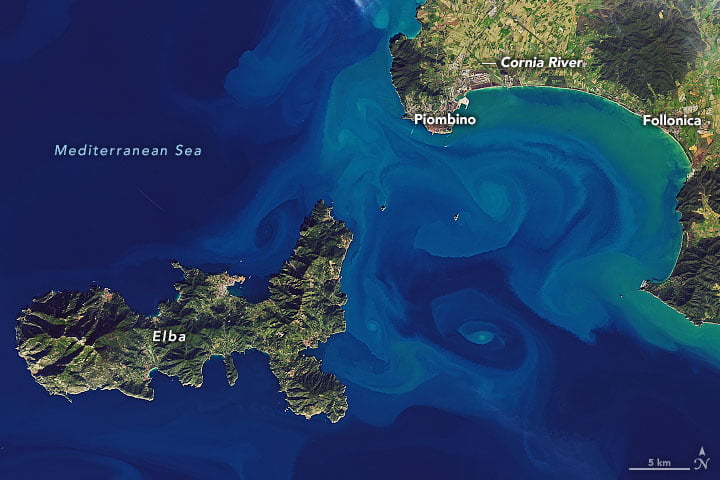
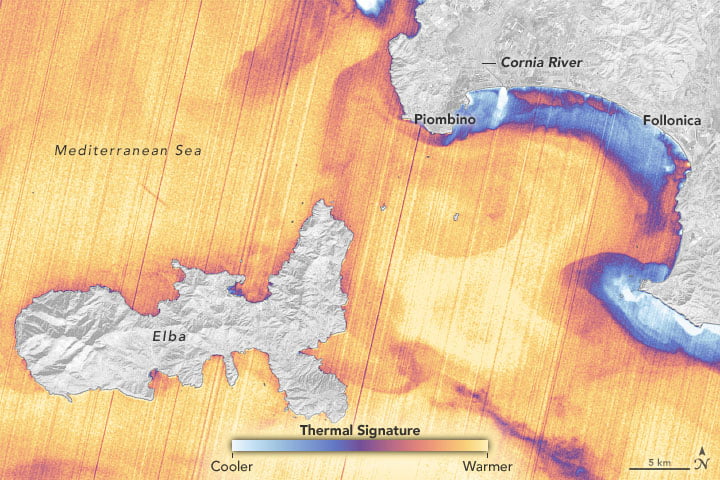
    Colorful, sediment-laden eddies swirl off the Italian coast in this satellite image. These small-scale eddies — less than 10 km in diameter — can be short-lived and are often difficult to capture in numerical models, but remote sensing can help scientists better understand their impact on oceanic mixing, especially when we capture more than one view of the same event.

    The image below shows the same eddies in an infrared (thermal) view. The resolution on this instrument is not as fine as the natural color one, but we can still make out some of the same swirling motions. It’s also worth comparing the features we don’t see in both images. For example, the Cornia River discharges in infrared as a bright, white plume of cooler water, but it’s barely visible in the color-image, suggesting that the river is not contributing much sediment to the bay. (Image credit: USGS; via NASA Earth Observatory)

    Infrared satellite image of waters off the coast of Italy.
  • Flexible Filament Reduces Drag

    Flexible Filament Reduces Drag

    Most shapes aren’t streamlined for fluid flow. We call these bulky, often boxy shapes, bluff bodies. Above, we see two examples of a bluff body, a flat plate, in a soap film. On the left, the plate sits perpendicular to the soap film’s top-to-bottom flow. Two large, counter-rotating vortices form behind the plate and a wide wake stretches behind it.

    On the right, we see the same flat plate but now a long, flexible filament is attached to either end. As the flow moves past, it deforms the filament, creating a rounded shape. Researchers found that, under the right conditions, this flexible afterbody could reduce drag on the object by up to 10%. (Image and research credit: S. Gao et al.)

  • Ghostly Chandeliers

    Ghostly Chandeliers

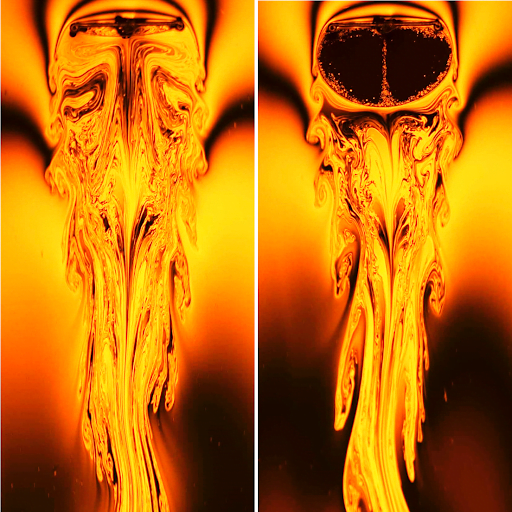
    Highlighter ink sinks from the surface of water, like upside-down green mushrooms.

    Under a black light, highlighter fluid creates ghostly trails as it drips through water. The vortices that form and break into this chandelier-like shape are the result of density differences between the ink and water. Since ink is heavier than water, it sinks, but as the two fluids flow past, they shear one another, forming elaborate shapes. Formally, this is known as the Rayleigh-Taylor instability. While you may be most familiar with it from pouring cream into coffee, it’s also a key to mixing in the ocean and the explosions of supernovas. (Image credit: S. Adams et al.; via Flow Vis)

  • Featured Video Play Icon

    “Waves”

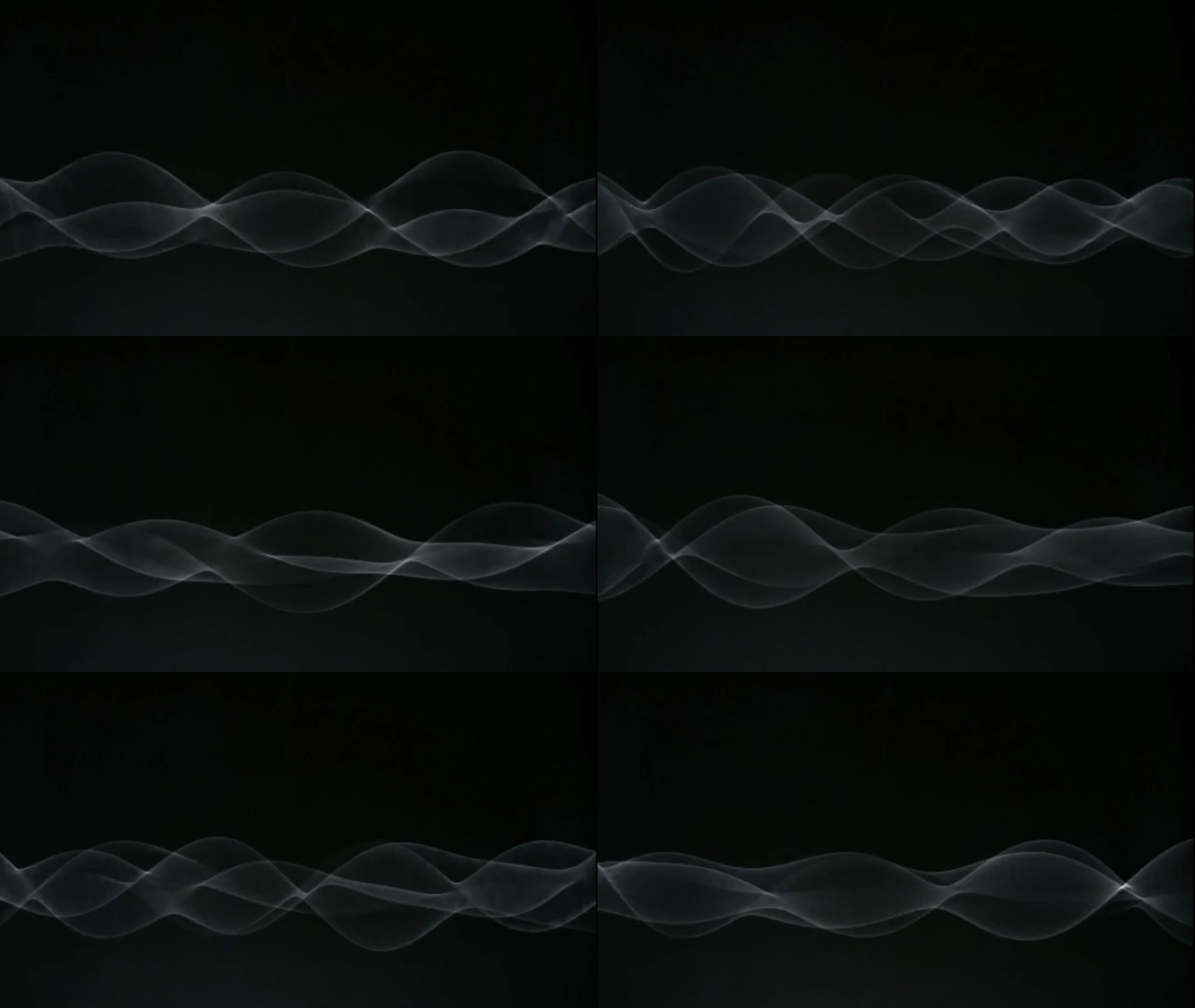
    The “Waves” installation by artist Daniel Palacios appears deceptively simple, just a rope mounted between two motors. But once the motors start spinning, it is anything but. The installation shifts in response to those around it, creating varying numbers of steady, standing waves or even wildly chaotic ones that whistle through the air. It’s a neat visualization of one of the most commonly-measured quantities in physics: the changes in a wave with time. (Video and image credit: D. Palacios; via Flow Vis)

  • Quantifying Bioluminescence

    Quantifying Bioluminescence

    Some single-celled organisms, like dinoflagellates, light up when disturbed. This bioluminescence is considered a defense mechanism, triggered by threats to the organism. Now researchers are quantifying just what it takes to light up a single dinoflagellate.

    Dinoflagellates respond both to stress caused by the fluid flow around them and to mechanical deformation — in other words, getting poked. Both methods involve bending and stretching the dinoflagellate’s cell wall, which stretches calcium-ion channels connected to bioluminescence. The researchers found that the intensity of the light produced depended both on the amount and speed of cell wall deformation.

    The model built from their observations should help scientists better understand what forces cause a specific response. That means dinoflagellates could be used as a non-invasive means of understanding fluid flow around swimmers like dolphins or sea lions! (Image and research credit: M. Jalaal et al.; via APS Physics)