Tag: flow visualization

  • Gliding Birds Get Extra Lift From Their Tails

    Gliding Birds Get Extra Lift From Their Tails

    Gorgeous new research highlights some of the differences between fixed-wing flight and birds. Researchers trained a barn owl, tawny owl, and goshawk to glide through a cloud of helium-filled bubbles illuminated by a light sheet. By tracking bubbles’ movement after the birds’ passage, researchers could reconstruct the wake of these flyers.

    As you can see in the animations above and the video below, the birds shed distinctive wingtip vortices similar to those seen behind aircraft. But if you look closely, you’ll see a second set of vortices, shed from the birds’ tails. This is decidedly different from aircraft, which actually generate negative lift with their tails in order to stabilize themselves.

    Instead, gliding birds generate extra lift with their maneuverable tails, using them more like a pilot uses wing flaps during approach and landing. Unlike airplanes, though, birds rely on this mechanism for more than avoiding stall. It seems their tails actually help reduce their overall drag! (Image and research credit: J. Usherwood et al.; video credit: Nature News; submitted by Jorn C. and Kam-Yung Soh)

  • Siberia’s Rivers

    Siberia’s Rivers

    Each winter the Kolyma River in Siberia freezes to a depth of several meters. But by June the river thaws and discharges its annual 136 cubic kilometers of  water into the Arctic. The dark color of the river comes from the sediment and organic material it carries. The Kolyma is the world’s largest river underlain with continuous permafrost. Parts of the river system’s permafrost date back to the Pleistocene more than 12,000 years ago. Since much of its organic matter comes from its permafrost, researchers expect the amount of organic material in the Kolyma’s discharge to increase as the permafrost degrades in our warming climate. (Image credit: NASA Earth Observatory)

  • Featured Video Play Icon

    Blowing Vortex Rings from Bubbles

    When bubbles burst, we often pay attention to the retracting film and forming droplets, but what happens to the air that was inside? By placing a little smoke inside them, we can see. The air inside these bubbles is slightly pressurized compared to the ambient, and as such a bubble ruptures, its air gets pushed out the expanding hole. That momentum makes the air curl as it forces its way into the surrounding air, creating a stack of vortex rings. The researchers observed as many as six stacked vortices from bubbles just under 4 cm in diameter. (Image and research credit: A. Dasouqi and D. Murphy; video credit: Science; see also A. Dasouqi and D. Murphy)

  • CU Flow Vis 2019

    CU Flow Vis 2019

    I love when science and art come together, which is why I’ve long been a fan of the Flow Vis course at CU Boulder. Some of my earliest posts on FYFD date from previous editions of the course. Here are a few of my favorite images from the Fall 2019 class, from the top:

    •  Ferrofluid and India ink merge in this colorful photo. A magnet underneath the mixture on the left side causes the dark spikes of ferrofluid, but without magnetic influence, the ink and ferrofluid form cell-like droplets.
    • Although it looks like a shower head, this is actually fluorescent oobleck dripping through a strainer. A relatively long exposure time means that it’s impossible to tell whether the oobleck is falling in a fluid stream or broken-up chunks.
    • These colorful water droplets are sitting on a hydrophobic surface, hence their extremely rounded edges. I particularly like how this makes each one like a little lens for the light shining through them and into their shadows.
    • A thin layer of ferrofluid reacts to the magnet beneath. Gotta love those little streaks left behind the flow.

    For those in the Front Range area, the Flow Vis class will be showcasing their work on Saturday, December 14th at the Fiske Planetarium. Snacks are at 4:30 pm and the show starts at 5 pm. For those not nearby, you can peruse the art from this semester and previous ones at your leisure online. (Image credits: colorful ferrofluid – R. Drevno; falling oobleck – A. Kumar; droplets – A. Barron; macro ferrofluid – A. Zetley)

  • Swirling Vortex

    Swirling Vortex

    So much of fluid dynamics comes down to finding the right way to observe a flow. This image of a swirling tropical system was captured by an astronaut aboard the International Space Station in April 2019. The low sun angle at the time makes the shadows stretch long across the cloud tops, giving them greater definition as well as a tint of sunset color. As drastic as the system looks from this angle, it was a short-lived vortex that never made landfall, so it was never officially named. (Image credit: Expedition 59 Crew; via NASA Earth Observatory)

  • Featured Video Play Icon

    “Mocean”

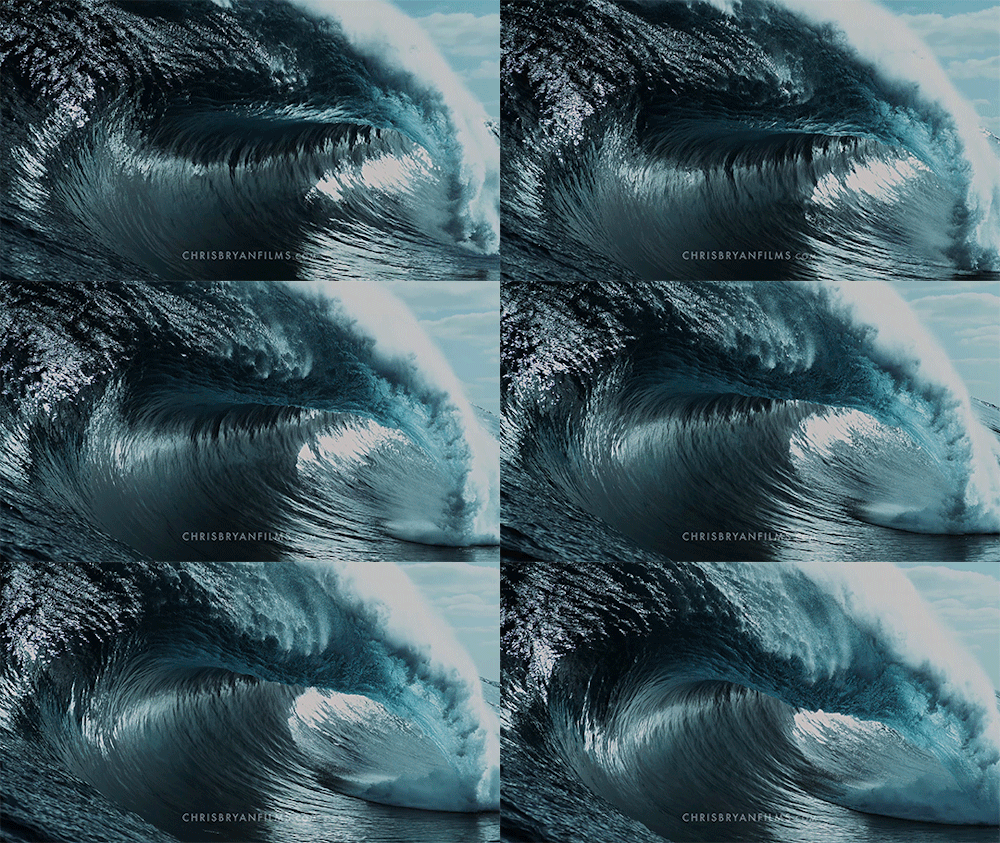
    Ocean waves are endlessly fascinating to watch. In “Mocean,” cinematographer Chris Bryan captures them in ways few ever see, thanks to his high-speed camera. Honestly, this film is so gorgeous that I don’t want to distract you with the science, so just go watch!

    All done? Pretty wonderful, right? There’s nothing quite like seeing those holes break and expand through sheets of water, tearing what looked solid into a spray of droplets that bleed salt into the atmosphere. Or how about those rib vortices underneath the waves? Or the cloud-like turbulence of the waves breaking overhead? How fortunate we are to see and capture and share such beauty! (Video and image credit: C. Bryan; via RedShark; submitted by Michael F.)

  • Trails from a Delta Wing

    Trails from a Delta Wing

    Top-down view of green and red dyes streaming off a delta wing

    Rhodamine (red) and fluorescein (green) dyes highlight the complex flows around a delta wing. To visualize the flow, researchers painted the apex of the delta wing with rhodamine, which gets drawn into the core of the wing’s leading edge vortex. The green fluorescein dye was added to the wing’s trailing edge, where it gets pulled into the secondary structure of the vortices. A laser illuminates the flow, making even the most delicate wisps of dye shine. As the wake behind the wing develops, the dyes reveal growing instabilities along the vortices. Given time and space, these instabilities will grow large enough to destroy any order in the wake, leaving behind turbulence. (Image and research credit: S. Morris and C. Williamson; see also poster)

  • Fiery Streaklines

    Fiery Streaklines

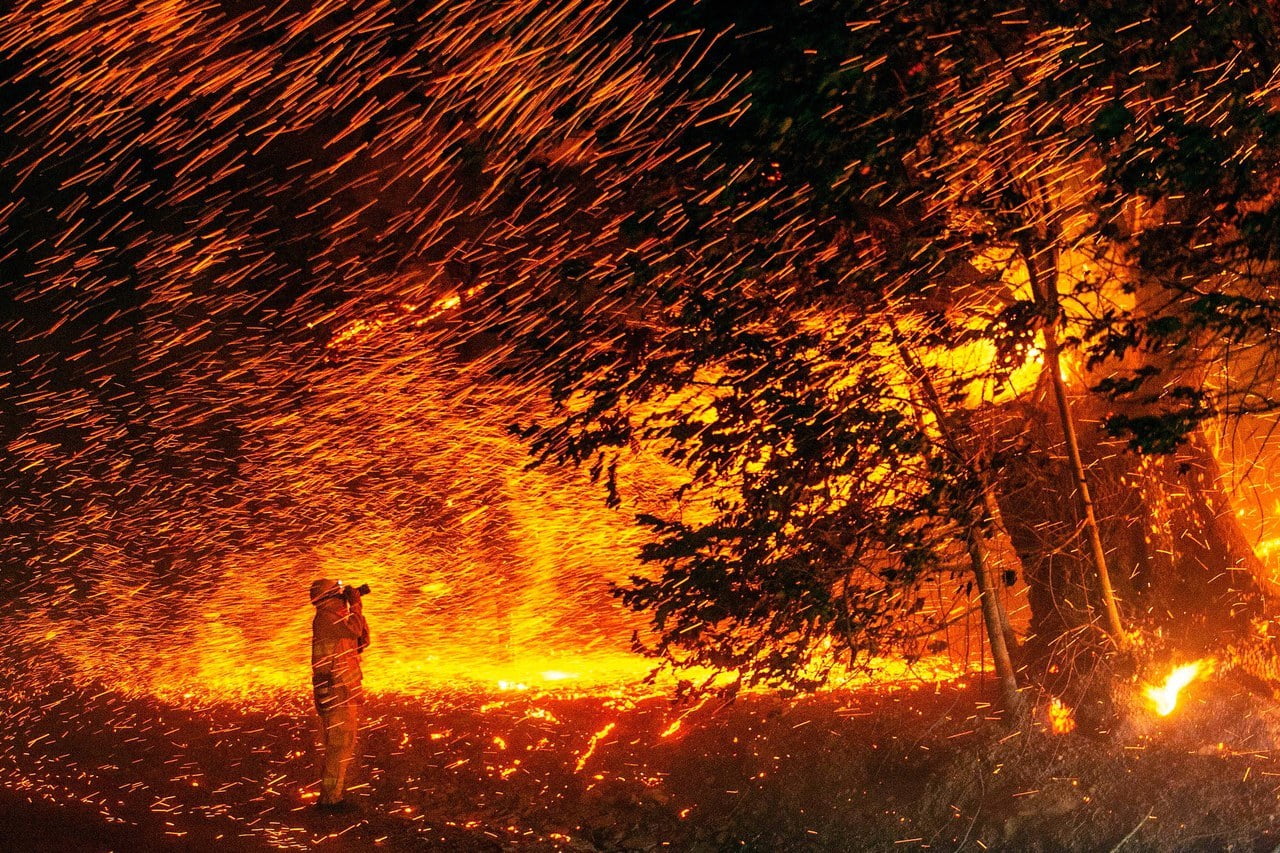
    Embers fly through the Kincade wildfire leaving streaks of light that reveal the strong winds helping drive the fire. This unintentional flow visualization mirrors techniques used by researchers to understand how flows are moving. The shutter of the camera remains open for a fixed time, so the length of each streak tells us about the speed of the flow. Longer streaks occur where embers moved faster. 

    Here we see the longest streaks in the upper left side of the image, which tells us that the wind was moving faster there than it did at lower heights, like near the photographer in the picture. That’s in keeping with what we would expect. In general, winds move faster above the ground than they do near the surface. That speed difference is one of the reasons wildfires are so difficult to contain; a single ember caught by high winds is easily carried to unburnt areas, allowing the fire to spread more quickly than if it had to burn along the ground. (Image credit: J. Edelson/Getty Images; via Wired)

  • Bay of Fundy Tides

    Bay of Fundy Tides

    Canada’s Bay of Fundy has some of the wildest tidal flows in the world. Every six hours, the flow direction through the strait shifts and tidal currents rise to several meters per second. This creates distinct jets a couple kilometers long that pour from one side of the strait to the other. 

    What you see here is a numerical simulation of the flow using a technique called Large Eddy Simulation (or LES, for short). It’s one method used by fluid dynamicists to model turbulent flows without taking on the complexity of the full Navier-Stokes equations. At large lengthscales, like those of the jets and eddies we see above, LES uses the exact physics. But when it comes to the smaller scales – like the flow nearest the shores or the bottom of the strait – the simulation will approximate the physics in order to make calculations quicker and easier. Models like these make large-scale problems – including modeling our daily weather patterns – possible. (Image credit: A. Creech, source)

  • Seeing Sound

    Seeing Sound

    It’s not always easy to imagine how waves travel, but with this demonstration, you can see sound waves and how they reflect and defract. The set-up uses schlieren optics that show light and dark bands where strong changes in density take place. This, combined with a stroboscopic light, makes it possible to see the wave fronts from the acoustic transducer on the left side of the screen. Once the wave is apparent, introducing a reflective object lets us see exactly how sound waves bounce, reflect, and interfere. (Image and video credit: Harvard Natural Sciences Lecture Demonstrations)