Tag: flow visualization

  • Why Moths Are Slow Fliers

    Why Moths Are Slow Fliers

    Hawkmoths and other insects are slow fliers compared to birds, even ones that can hover. To understand why these insects top out at 5 m/s, researchers simulated their flight from hovering to forward flight at 4 m/s. They analyzed real hawkmoths flying in wind tunnels to build their simulated insects, then studied their digital moths with computational fluid dynamics.

    During hovering flight, they found that hawkmoths generate equal amounts of lift with their upstroke and downstroke. As the moth transitions into forward flight, though, its wing orientation shifts to reduce drag, and the upstroke stops being so helpful. Instead, the upstroke generates a downward lift that the downstroke has to counter in addition to the insect’s weight. At higher forward speeds, this trend gets even worse.

    The final verdict? Hawkmoths don’t have the flexibility to twist their wings on the upstroke the way birds do to avoid that large downward lift. Since they can’t mitigate that negative lift, the insects have a slower top speed overall. (Image and research credit: S. Lionetti et al.; via APS Physics; submitted by Kam-Yung Soh)

  • Featured Video Play Icon

    Pumping With Faraday Waves

    Vibrate a liquid pool vertically, and it will form a pattern of standing waves known as Faraday waves. Here, researchers confine those waves to a narrow ring similar in size to the wave. The confinement causes a type of secondary flow — a streaming flow — beneath the water surface. As a result, the wave pattern rotates around the ring. The applications of this rotation are pretty neat. As the team demonstrates, it can drive complex fluid networks and even create a pump! (Image and video credit: J. Guan et al.)

  • Featured Video Play Icon

    “Reconfiguring It Out”

    Leaves flutter and bend in the breeze, changing their shape in response to the flow. Here, researchers investigate this behavior using flexible disks pulled through water. The more flexible the disk and the faster the flow, the more cup-like the disk’s final shape. Adding tracer particles to the water allows them to visualize the flow behind the disk. Every disk leaves a donut-shaped vortex ring spinning in its wake, but the more reconfigured the disk, the narrower the vortex. This, ultimately, reduces drag on the disk. That’s why trees in heavy winds streamline their branches and leaves; that flexibility lowers the drag the tree’s roots have to anchor against. (Image and video credit: M. Baskaran et al.)

  • Mixing Effectively

    Mixing Effectively

    Mixing two fluids is a tougher task than you might think. One of my favorite asides from a fluids lecture concerned how to mix fruit into yogurt in an industrial setting. Mix too quickly, and you’ll obliterate the yogurt’s consistency, but mix too little and you may as well sell it as fruit-on-the-bottom. Apparently that particular problem got solved by sending the fruit and yogurt flowing through a series of specially-shaped ducts to slowly and carefully mix them together.

    In this study, researchers tackle a similar problem — mixing two fluids in a circular cross-section — through optimization. As you can see above, circular stirrers on their own don’t do a great job of mixing. So the researchers searched for the right combination of stirrer shape, mixing speed, and mixing trajectory to give the best mixing for a set mixing time and energy input. Their final stirrer shapes are anything but circular and often move in jerks and fits to help shed vortices that do the actual job of mixing. (Image and research credit: M. Eggl and P. Schmid; via APS Physics)

  • Featured Video Play Icon

    Cleaning the Skies

    Those of us who live in urban environments have experienced the clear, pollution-free air that comes after a rainstorm. But how exactly does rain clean the air? Air pollution typically has both gaseous and particulate components to it. As a raindrop falls, it experiences collision after collision with those particles. Depending on the particle’s surface characteristics — is it hydrophilic or hydrophobic? — and its momentum during impact, it can get trapped in the raindrop, skip off, or even pass through entirely. The physics, it turns out, are identical to those of a rock falling into or skipping off a lake — even though the raindrop and particle might be 1000 times smaller! (Image and video credit: N. Speirs et al.)

  • Featured Video Play Icon

    Flow Between Fibers

    Two vertical fibers, with a gap left between them, form a playground for flow in this Gallery of Fluid Motion video. If the fiber spacing is small enough, the flow will form a stable liquid sheet that runs the full length of the fibers. With a little more distance, though, the fluid forms intermittent bridges, whose spacing depends on flow rate. And when the fibers are not perfectly vertical, even more complex flows are possible. I love how a seemingly simple situation begets such complexity! (Image and video credit: C. Gabbard and J. Bostwick)

  • Testing Full-Size Engines

    Testing Full-Size Engines

    Engineers can often use small-scale models to test the physics of their creations, but sometimes there’s no substitute for going large. In this photo, we see a full-size commercial engine used on an airplane, mounted at the Instituto Nacional de Tecnica Aeroespacial (INTA) in Madrid.

    Behind the engine, in red, is an optical rig used for a brand-new measurement technique that allows engineers to directly measure the carbon dioxide emissions of the engine as it runs. The optical frame is 7 meters in diameter and uses 126 beams of near-infrared laser light to probe the engine’s exhaust without interrupting the flow. It’s the first chemically specific imaging of a full-scale gas turbine like those found on commercial aircraft. Given the high carbon emissions associated with air travel, the technique will be important for engineers building greener aircraft engines. (Image and research credit: A. Upadhyay et al.; via The Engineer; submitted by Simon H.)

  • Featured Video Play Icon

    Chemical Flowers

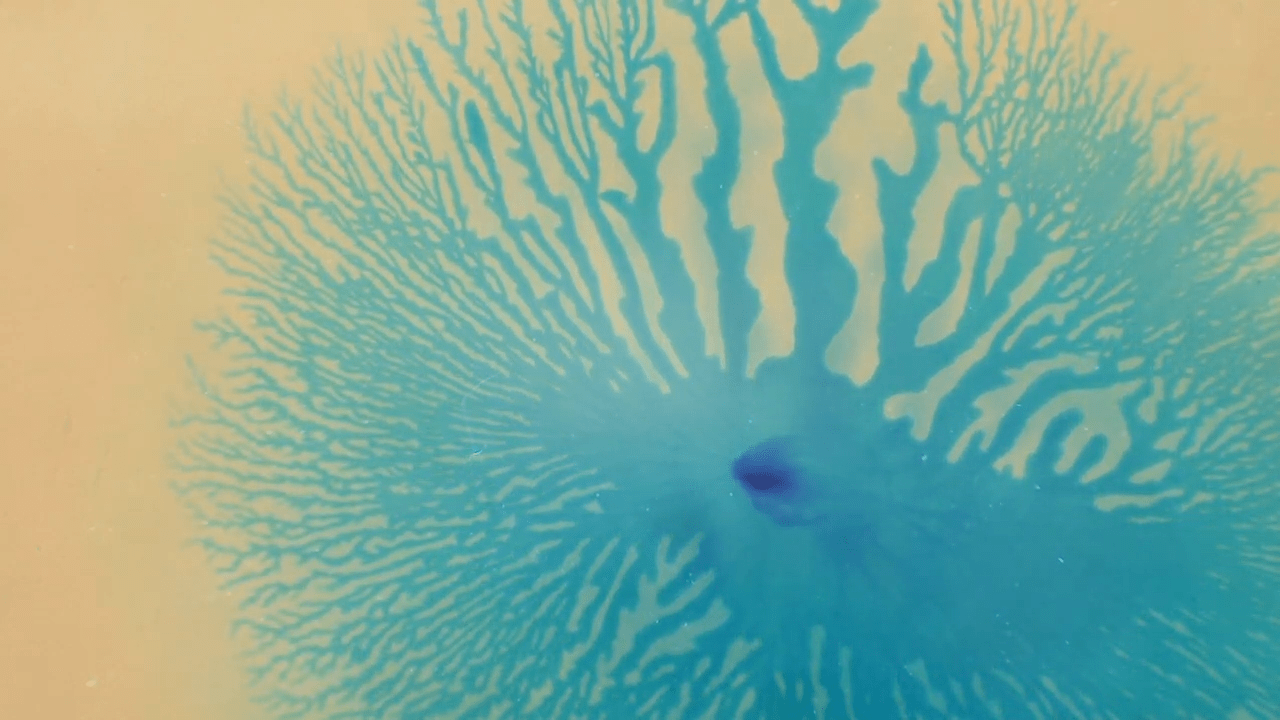
    These “flowers” blossom as two injected chemicals react in the narrow space between two transparent plates. The chemical reaction produces a darker ring that develops a streaky outer edge due to competition between convection and chemical diffusion.

    To show how gravity affects the instability, the researchers repeated the experiment on a parabolic flight. In microgravity conditions, no instability formed. That’s exactly what we’d expect if convection (i.e. flow due to density differences) is a major cause. No gravity = no convection. In contrast, under hypergravity conditions, the instability was initially spotty before developing streaks. (Image and video credit: Y. Stergiou et al.)

  • Aerosols and Instruments

    Aerosols and Instruments

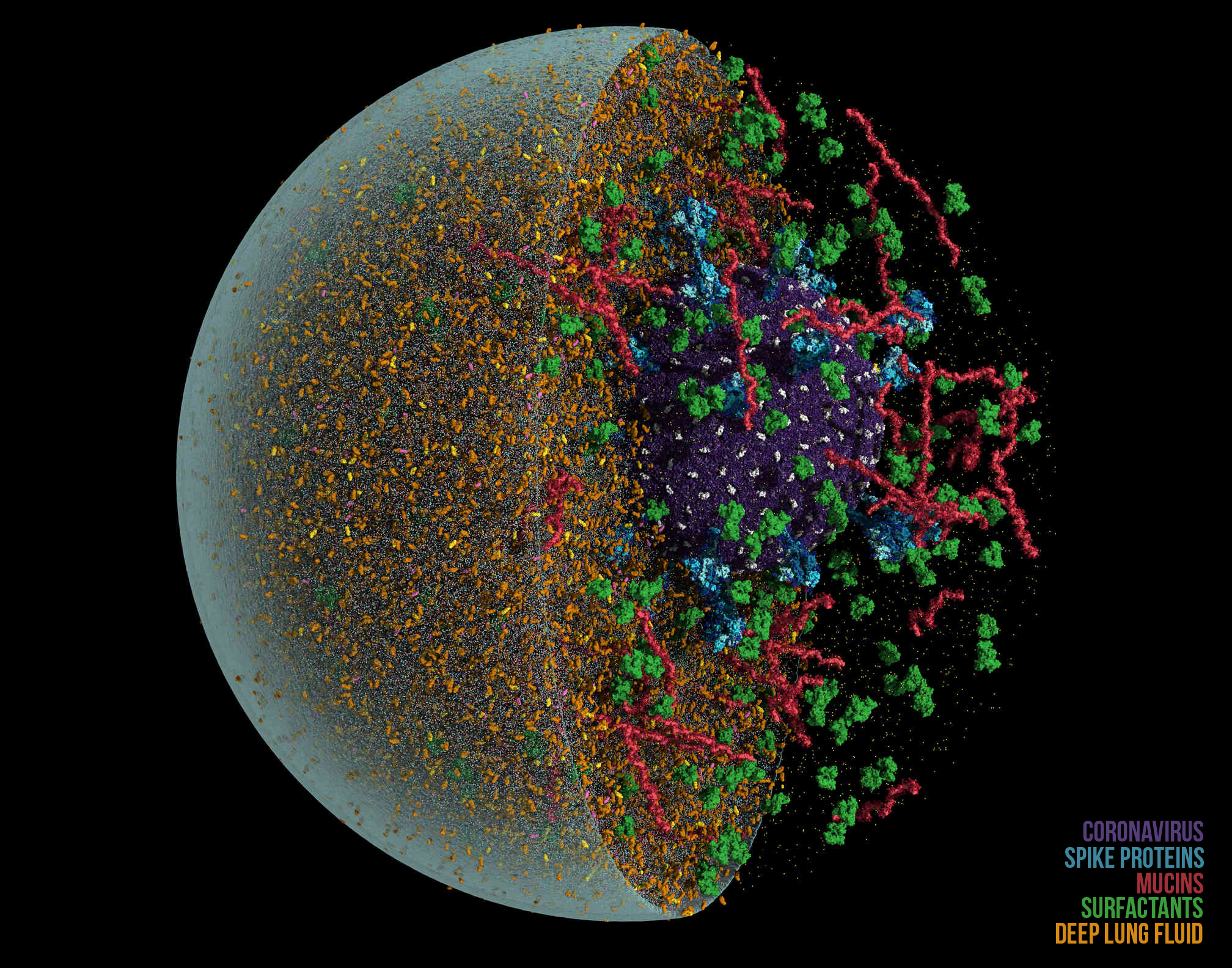
    Although COVID has disrupted all of our lives, orchestras saw particular disruption, as little was known about how instruments spread aerosol droplets. In this recent study, a team looked at many wind instruments, as played by professional musicians, for the aerosol load and air flow each instrument creates. They found that, on the whole, wind instruments — like flutes, clarinets, trumpets, and others — create aerosol loads comparable to normal speech. The air flow from each instrument comes primarily from the bell (for brass instruments) or tone holes (for woodwinds) and has a much lower velocity than coughing or sneezing. As a result, the flow decays away to the background air-flow after about 2 meters. (Image credit: trumpet – E. Awuy, trombone – Q. Brosseau et al.; research credit: Q. Brosseau et al.)

    Flow from the bell of a trombone disrupts artificial fog.
    As a musician plays a scale on their trombone, flow from the bell is revealed through artificial fog and laser illumination.
  • “Keeping Our Sheet Together”

    “Keeping Our Sheet Together”

    When two liquid jets collide, they form a falling liquid sheet. Here researchers explore how that sheet breaks up when the liquids involved contain polymers. The intact areas of the sheet show as dark red or almost black. The edges of the sheet appear in brighter red and yellow, outlining the holes that form and grow during breakup. The type of breakup observed depends on the concentration of polymer in the liquid. (Image credit: C. Galvin et al.)