Tag: flow visualization

  • Beneath the Cavity

    Beneath the Cavity

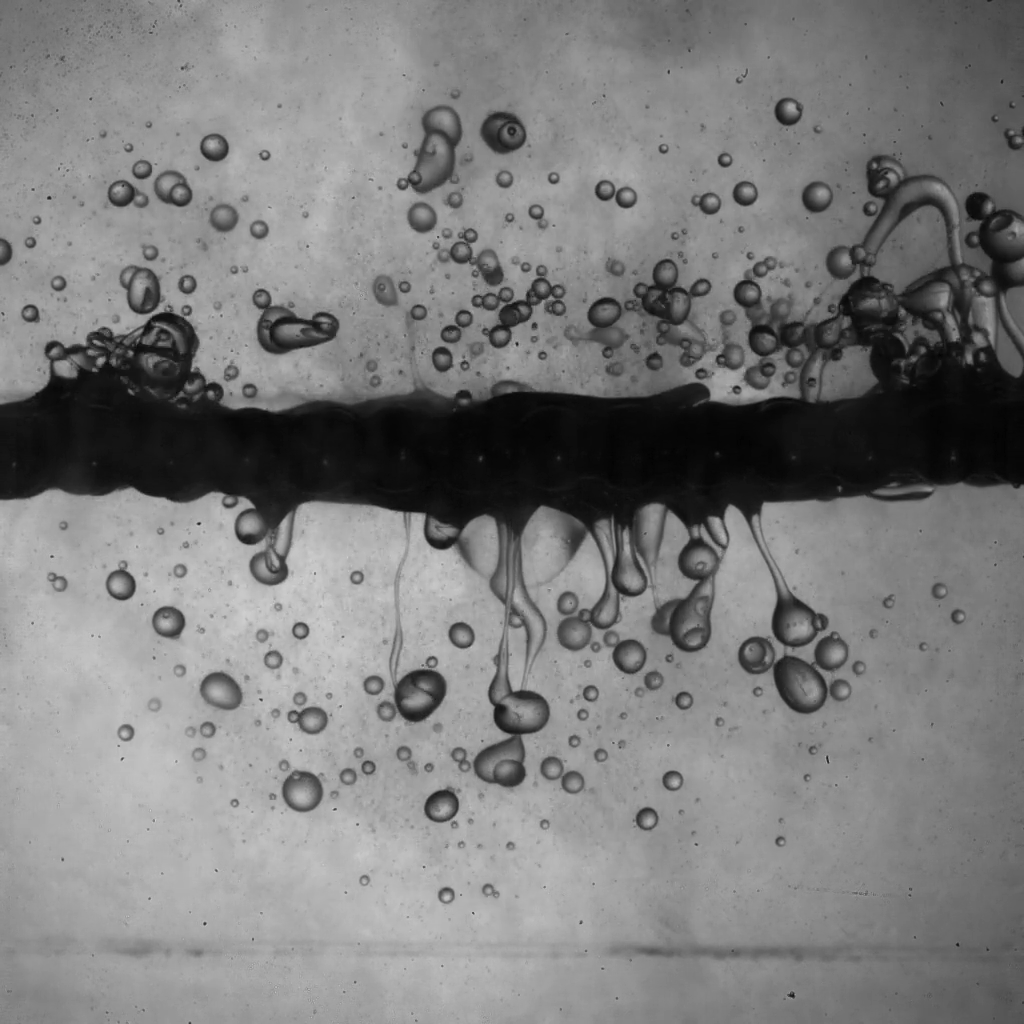
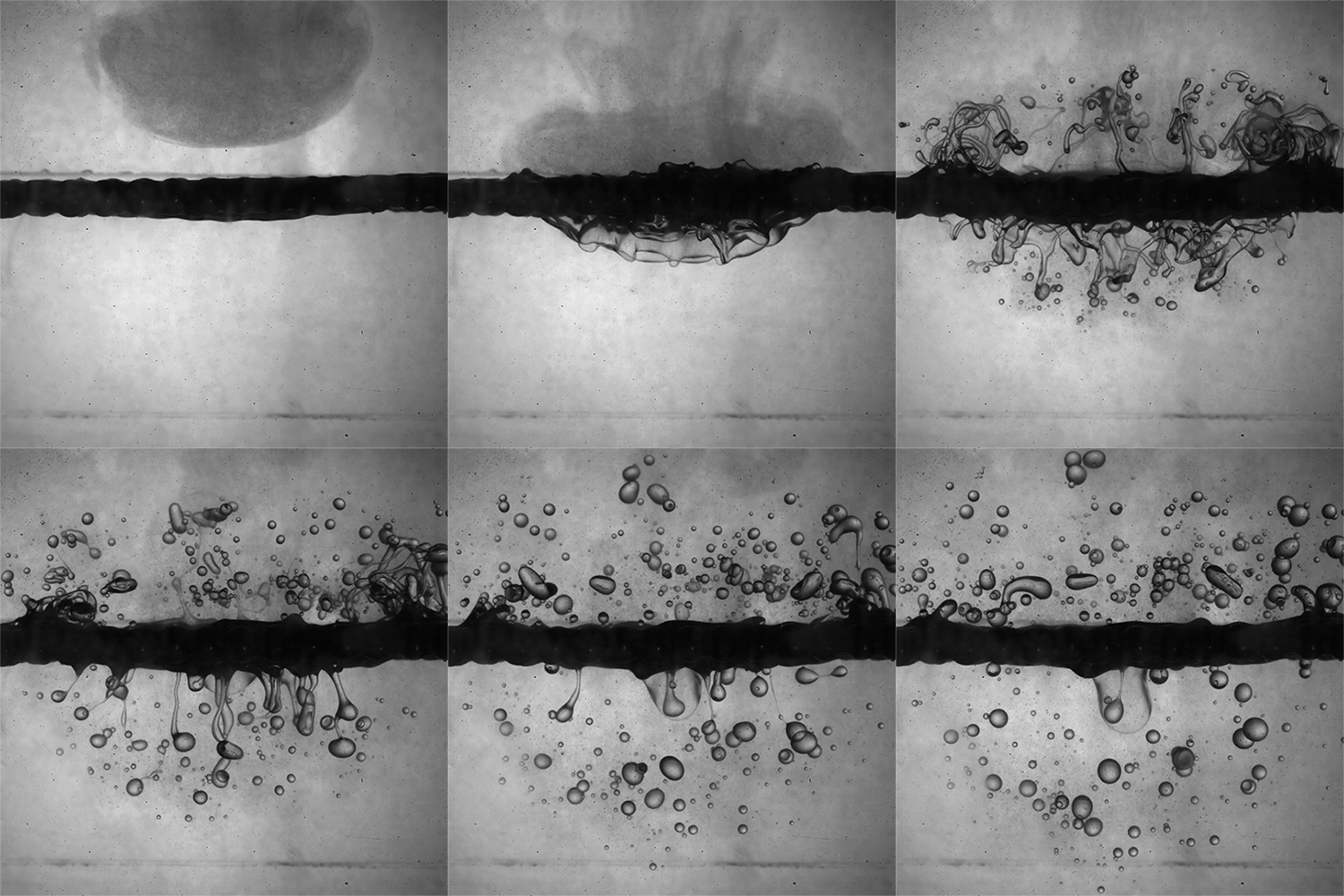
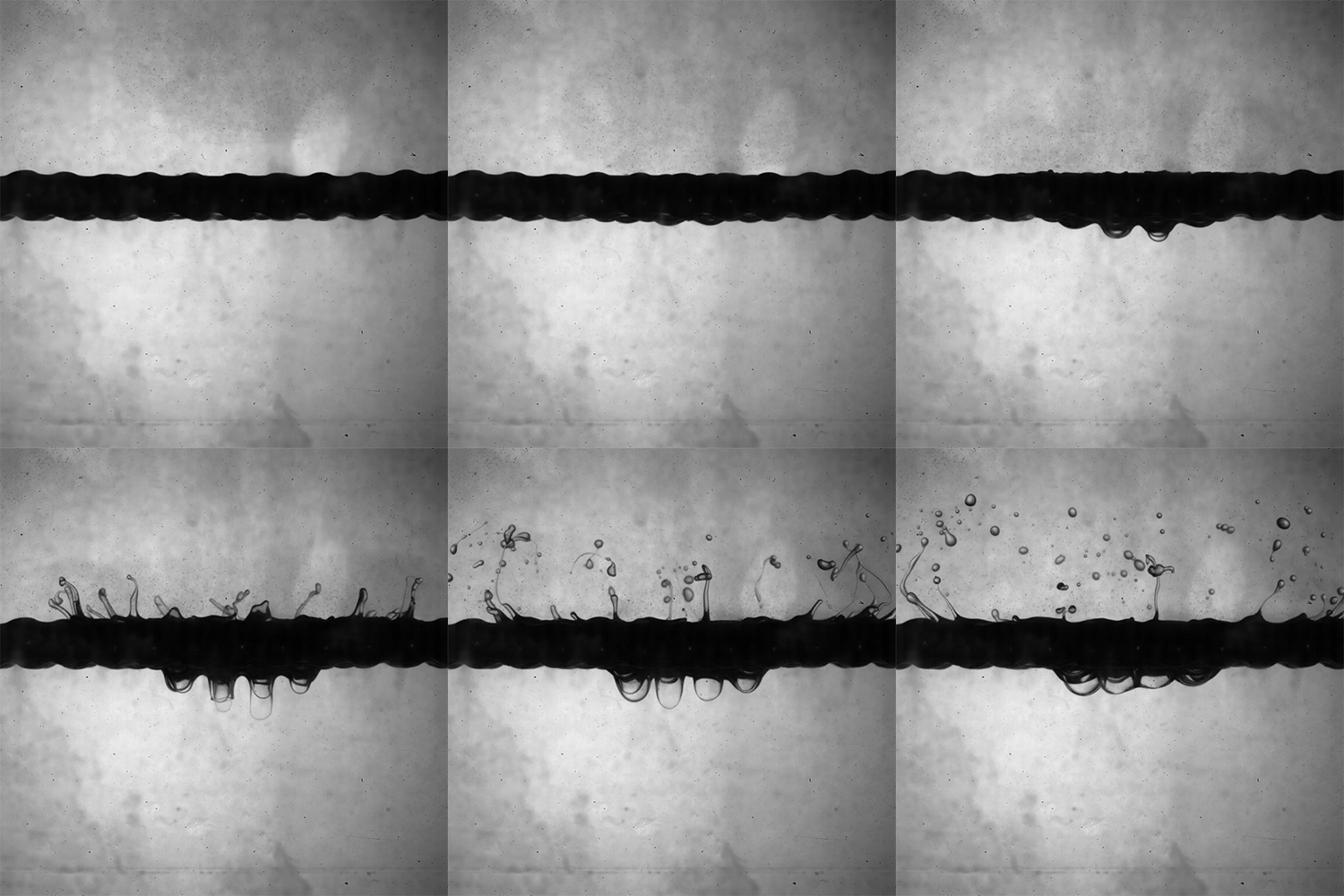
    When a drop falls into a pool of liquid, it creates a distinctive cavity, followed by a jet. From above the surface, this process is well-studied. But this poster offers us a glimpse of what goes on beneath the surface, using particle image velocimetry. This technique follows the paths of tiny particles in the fluid to reveal how the fluid moves.

    As the cavity grows, fluid is pushed away. But the cavity’s reversal comes with a change in flow direction. The arrows now point toward the shrinking cavity — and they’re much larger, indicating a strong inward flow. It’s this convergence that creates the Worthington jet that rebounds from the surface. And, as the jet falls back, its momentum gets transferred into a vortex ring that drifts downward from the point of impact. (Image credit: R. Sharma et al.)

  • Mixing With E. Coli

    Mixing With E. Coli

    What happens when a flow meets swimming micro-organisms? Does the flow affect the swimmers? And how do the swimmers affect the flow in turn? Those are the questions behind the experiment seen here. The apparatus contains a thin layer of saline water with swimming E. coli. Electromagnetism is used to mix the fluid in an array-like pattern that triggers chaotic mixing. To visualize what’s going on, dye is introduced into the right half of the image, while the left half remains undyed.

    On the right side of the image, bright blue and white mark areas of high dye concentration, where strong mixing occurs. On the undyed left side of the image, pale blue streaks mark areas where E. coli are clustered. By comparing the two, we see that the micro-swimmers are clustered in the very same regions of flow marked by strong mixing. This result suggests strong interactions and the potential for feedback between the mixing flow and the swimmers. (Image and research credit: R. Ran et al.; see also 1 and 2)

  • Featured Video Play Icon

    “Turbulence”

    In his recent short film, artist Roman De Giuli explores turbulence using metallic paints and inks in a fishtank. The effects are beautiful: sparkling pigments dispersing in clouds, mushroom- and umbrella-shaped Rayleigh-Taylor instabilities, and lots of swirling eddies. It’s exactly the kind of eyecandy to kick off your weekend with! (Image and video credit: R. De Giuli)

  • Featured Video Play Icon

    Spinning Liquids With Lego

    One way to explore the effects of spinning liquids at high-speeds is to build an expensive and precise lab apparatus. Another method is to raid the Lego bin. Here, a YouTuber builds ever-more-elaborate Lego constructions to spin a sphere of water. He begins with a relatively straightforward magnetic stirrer that creates a bathtub vortex in his sphere, but as the set-up grows, he eventually encases the sphere to spin the entire thing at high-speed. It’s a cool way to see how spinning liquids react, from forming a vortex to spin coating the interior of the sphere and to generating a parabolic interface between air and liquid. Set-ups like these are not merely for fun, though; scientists use them to simulate the interiors of planets. (Image and video credit: Brick Technology; submitted by clogwog)

  • Featured Video Play Icon

    “Iridescent”

    Soft colors and sudden coalescence combine in this short film from Susi Sie’s team. The visuals rely on liquid lenses (likely oil) floating atop a water bath. You can see how the fluids get manipulated in their behind-the-scenes video, which also provides a peek at how the sound effects get made. (Video credit: S. Sie et al.)

  • Toilet Plumes

    Toilet Plumes

    Toilet flushes are gross. We’ve seen it before, though not in the same detail as this study. Here, researchers illuminate the spray from the flush of a typical commercial toilet, like those found in many public restrooms. They found that flushing generates a plume of droplets that reaches 1.5 meters in under 8 seconds, producing many thousands of droplets across a range of sizes.

    The experiments were conducted in a ventilated lab space, and the flushes involved only clean water — no fecal matter or toilet paper — so they don’t perfectly mimic the confines of a public toilet stall. But the implications are still pretty gross. Without a lid to contain the flush’s spray, these energetic toilets are spraying droplets capable of carrying COVID, influenza, and other nastiness all over our bathrooms. (Image and research credit: J. Crimaldi et al.; via Gizmodo)

  • Featured Video Play Icon

    Kelvin-Helmholtz Flows Downhill

    Gravity currents carry denser fluids into lighter ones, like cold air drifting under your door in winter or dense fogs flowing downhill in San Francisco. Here, researchers visualize the situation using denser salt water flowing into fresh water. Once the gate separating the two fluids rises, the salt water slides down an artificial slope into the fresh water.

    Very quickly the flow forms a Kelvin-Helmholtz instability due to the different flow speeds between the two fluids. Kelvin-Helmholtz waves form distinctive swirls and billows that are reminiscent of a cat’s eye. As the swirls rotate, they can flow over one another, and break up into turbulence. (Image and video credit: C. Troy and J. Koseff)

  • Icicles and Impurities

    Icicles and Impurities

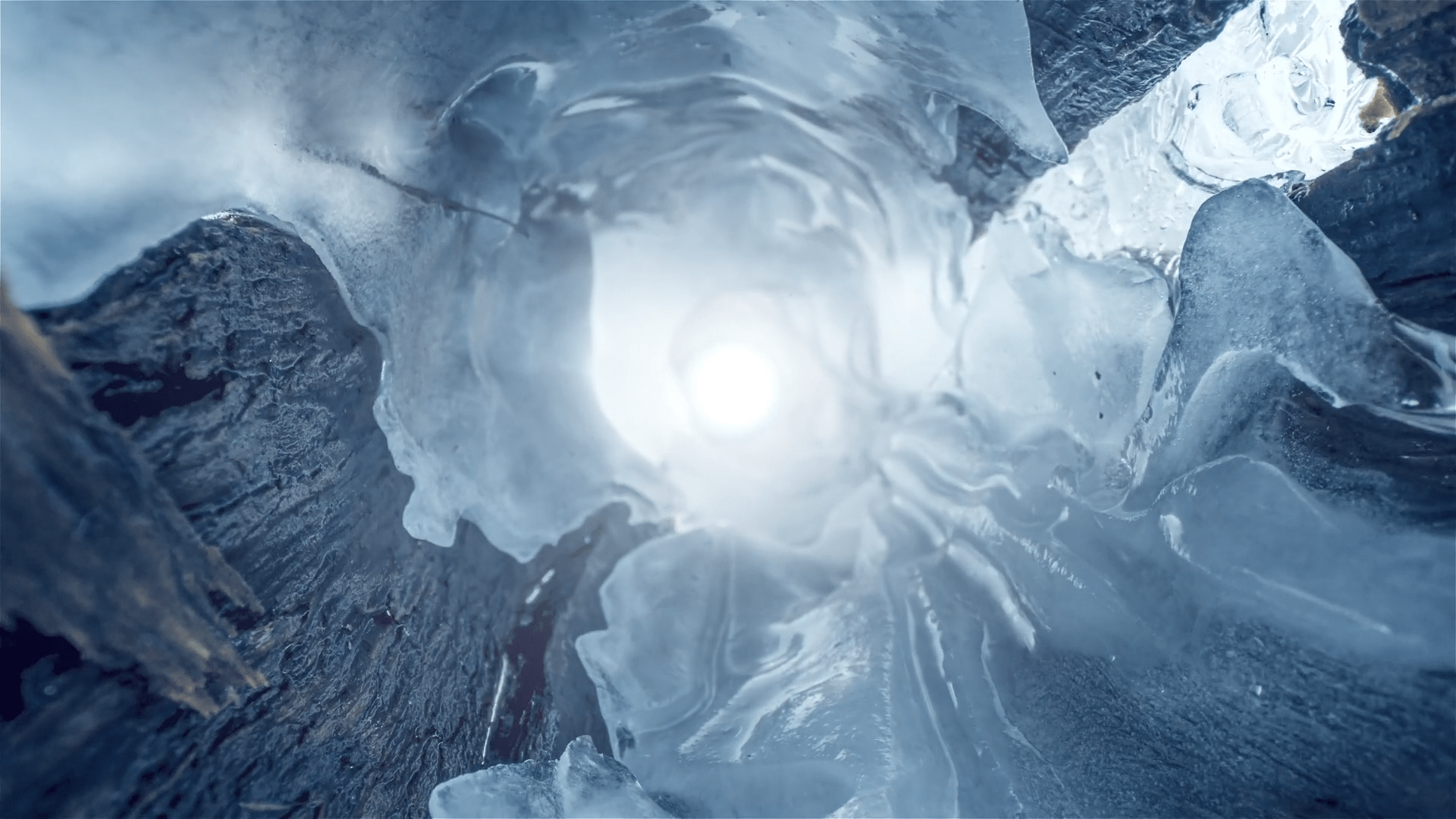
    In nature, icicles often form horizontal ripples along their outer surface. Researchers found that these shapes only form when impurities are present in the water forming icicles; icicles made from pure water are smooth. Now researchers are uncovering more details of the ripple formation process, though the underlying mechanism remains unknown.

    Cross-sections of an icicle reveal chevron-like inclusions of impurities.
    Icicle using sodium fluorescein as an impurity. a) A vertical cross-section through the icicle shows chevron-like inclusions where impurities are concentrated. b) A similar icicle using salt as the impurity shows a similar pattern. c) A horizontal cross-section through the icicle reveals tree-like rings of concentrated impurities.

    Researchers first grew wavy icicles, then melted through them to reveal cross-sections of the icicle. They found chevron-like patterns within the ice, corresponding to areas with higher concentrations of impurities. The team think these chevrons record the process by which flowing water accumulates on the surface of the icicle prior to freezing. (Image credit: top – M. Shturma, cross-sections – J. Ladan and S. Morris; research credit: J. Ladan and S. Morris; via APS Physics)

  • Featured Video Play Icon

    Exascale Simulations

    Capturing what goes on inside a combustion engine is incredibly difficult. It’s a problem that depends on turbulent flow, chemistry, heat transfer, and more. To represent all of those aspects in a numerical simulation requires enormous computational resources. It’s not simply the realm of a supercomputer; it requires some of the fastest supercomputers in existence.

    Exascale computing, like that used for the simulations in this video, is defined as at least 10^18 (floating-point) operations per second. For comparison, my PC has a recent, high-end graphics card, and it’s about a million times slower than that. These are absolutely gigantic simulations. (Image and video credit: N. Wimer et al.)

  • Featured Video Play Icon

    Dancing Over Ridges

    When flowing over a ridged surface, particles follow a drifting, helical trajectory. In this video, researchers delve into the physics behind this phenomenon. Differences in the pressure gradient along different parts of the corrugation push particles along the groove. With their analysis, the team is able to predict particle trajectories above surface roughness of any shape. With these tools, they can design roughened microchannels that disperse particles at a desired speed, something that could be especially helpful in medical diagnostics. (Image and video credit: D. Chase et al.; research credit: D. Chase et al.)