Eric Mesplé is an artist, but he’s also a blacksmith, welder, programmer, engineer, and innovator. Many of his sculptures feature ferrofluids, magnetic liquid whose movement is driven by electromagnets Mesplé designs and builds himself. In this video from Wired, we get a behind-the-scenes look at some of his work, and to me, one of the big takeaways is just how clearly science, engineering, and technology are married to art in Mesplé’s work. I imagine this is true of many of today’s artists! (Video credit: Wired)
Newton’s 3rd law states that any action has an equal and opposite reaction. Often engineers use this to our advantage; the thrust from expelling propellants is what lifts our rockets to space. But sometimes those reactions are undesirable, as illustrated in this Practical Engineering video with underground pipes.
Anytime flow through the pipe is forced to change direction, the flow causes an equal and opposite force on the joint. Just as with rockets, engineers refer to this reaction force as thrust. And if the thrust goes unaccounted for, it will force pipe joints apart. Civil engineers use several methods to fix pipelines against these forces, including concrete blocks that distribute the force to the surrounding soil and flange fittings that resist pipe movement. (Video and image credit: Practical Engineering)
One production technique for biofuel converts agricultural waste through pyrolysis. These systems heat biomass particles in a mixture of sand and nitrogen gas until the biomass particles release tar and syngas, a key ingredient of biofuel. All this heating and mixing takes place in a fluidized bed, where the injected nitrogen gas helps the particle mixture move like a fluid.
Building prototypes of these systems can be costly, so industry has largely relied on computational studies to predict performance. But capturing the complicated physics behind turbulent gas and particle interactions is tough, and some models discard key information in favor of faster and cheaper simulations. In this study, the authors found that clustering between particles has a major effect on syngas production, something that industrial studies must account for.
This is one of the challenges of computational fluid dynamics; although the codes have become more and more accessible over time, getting reliable results still requires a solid understanding of the strengths and limitations of each model used. (Image, video, and research credit: S. Beetham and J. Capecelatro, source; submitted by Jesse C.)
For 3D printers to reach their potential, they need to handle more than one material and be able to swap quickly and seamlessly between them. That’s a tall order given how different materials like silicone and wax are. But a new 3D printer tackles that challenge using microfluidic nozzles designed extrude multiple fluids in quick succession.
The nozzle controls which fluid it ejects by pressurizing individual fluids, allowing it to switch from one to another up to 50 times a second (first image). Multiple nozzles, each containing multiple fluids, can be used to print periodically-patterned designed more quickly than previously possible (second image). The system can even directly print air-powered robots with both soft and hard components (third image). (Image and video credit: Nature, with M. Skylar-Scott et al.; research credit: M. Skylar-Scott et al.; via Nature; submitted by Kam-Yung Soh)
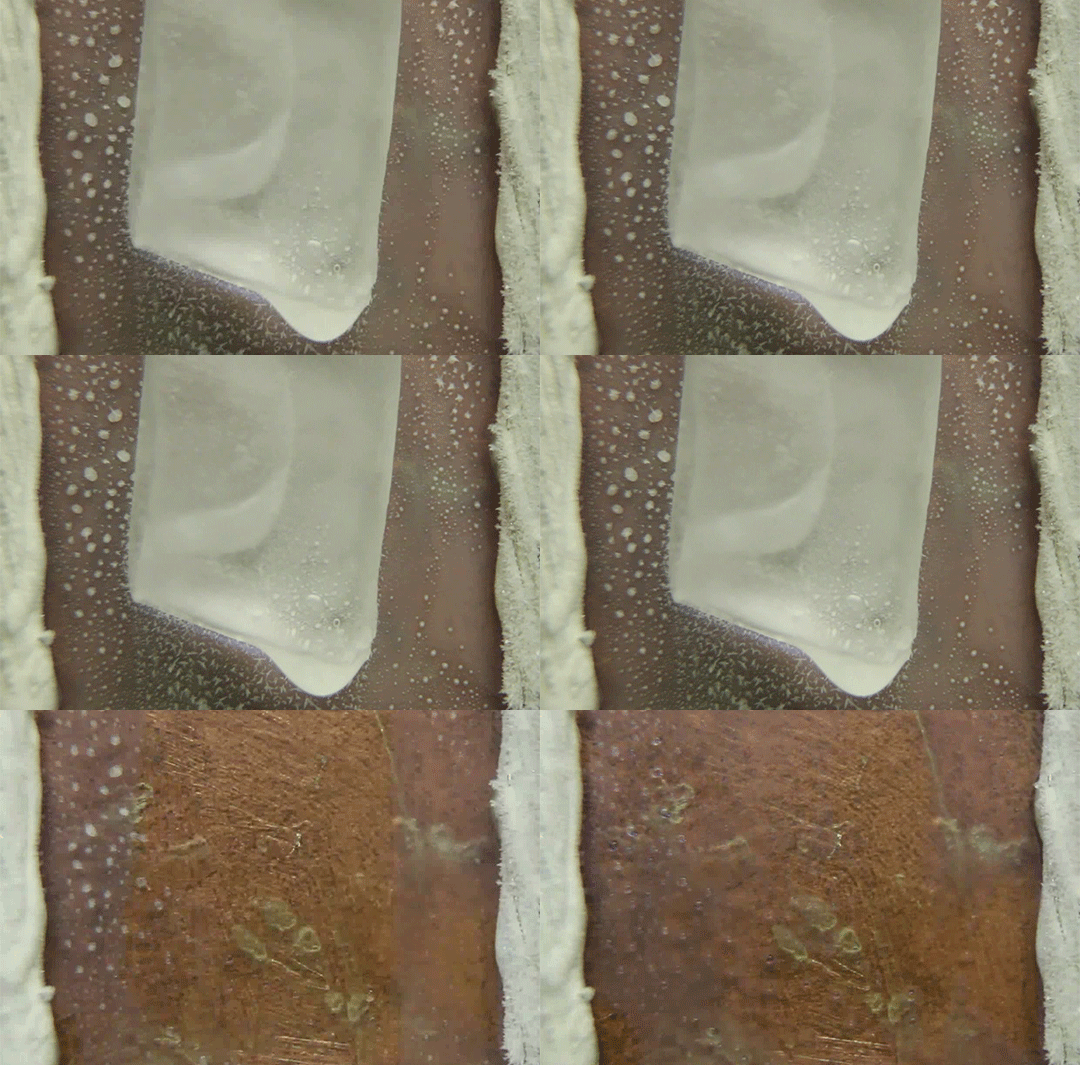
Defrosting and deicing surfaces is an energy-intensive affair, with lots of heat lost to warming up system components rather than the ice itself. In a new study, researchers explore a faster and more efficient method that focuses on heating just the interface. They coated their working surface in a thin layer of iridium tin oxide, a conductive film used in defrosting. Then, once the surface was iced over, they applied a 100 ms pulse of heating to the film. That localized heat melted the interface, and gravity pulled away the detached ice. Compared to conventional defrosting methods, this technique requires only 1% of the energy and 0.01% of the time. If the method scales reliably to applications like airplane deicing, it would provide enormous savings in time and energy. (Image and research credit: S. Chavan et al.)
If you’re looking for a new and impractical way to protect your home, here’s a great option: a lava moat. Nothing says “Don’t try to knock on my door” like a glowing inferno of molten rock. And Minute Physics – along with xkcd – has put together a short, handy guide to some of the challenges you’ll face in building and maintaining this fearsome fortification. If running your own commercial-scale power plant seems overly daunting but you still want to see what lava’s all about, I have good news; here’s a selection of some of my favorite looks at lava here at FYFD:
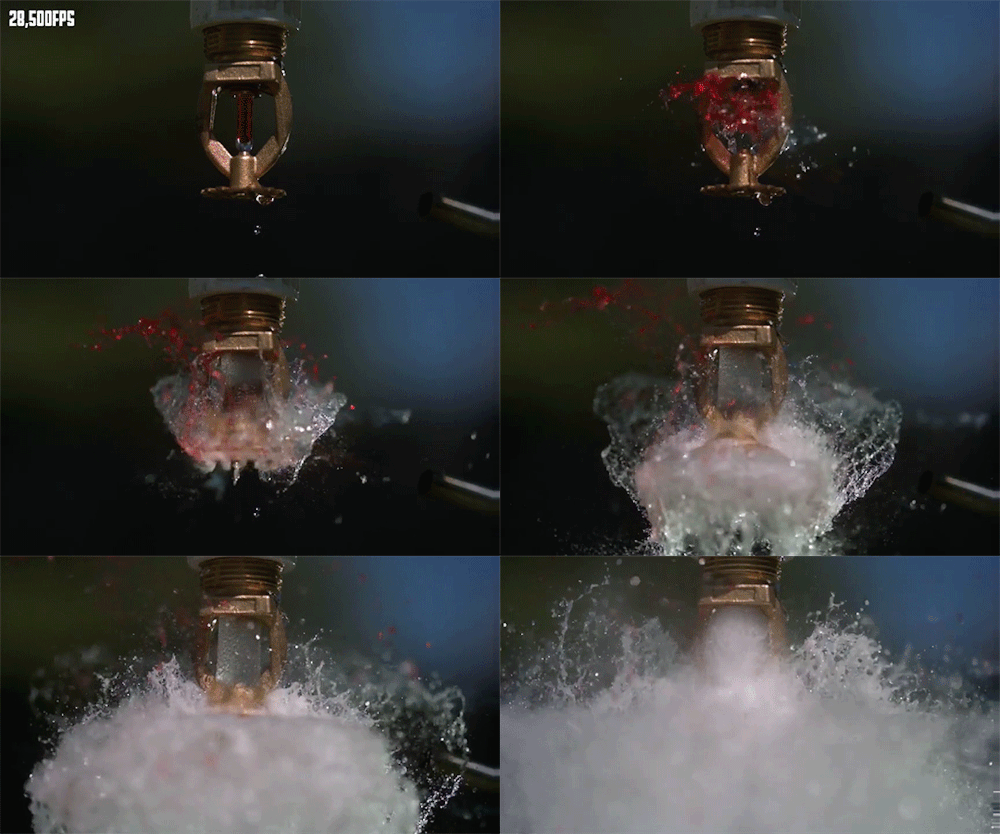
Most of us have probably never given much thought to how a fire sprinkler works, but fortunately, the Slow Mo Guys have used their high-speed skills to answer that question anyway. Sprinkler systems of this variety are constantly pressurized by a full pipe line of water that’s held back by a thin metal disk and a colored glass ampule containing a fluid like alcohol. The color of ampule indicates the temperature at which the system is designed to activate. As the ampule heats up, the fluid inside expands, breaking the ampule at or near the critical temperature. That allows the metal disk to fall away and releases a torrent of water, which falls onto the gear-like disk at the bottom of the sprinkler and gets flung out over a wider area. Despite appearances, that bottom disk is stationary, not spinning; its shape alone is what distributes the water. (Image and video credit: The Slow Mo Guys)
Adding particles to a viscous fluid can create unexpected complications, thanks to the interplay of fluid and solid interactions. Here we see a dilute mixture of dark spherical particles suspended in a layer of fluid cushioned between the walls of an inner and outer cylinder. Initially, the particles are evenly distributed, but when the inner cylinder begins to rotate, it shears the fluid layer. Hydrodynamic forces assemble the particles together into loose conglomerates known as flocs. Once the particles form these log-like shapes, they remain stable thanks to the balance between viscous drag on particles and the attractive forces that pull particles toward one another. (Image and research credit: Z. Varga et al.; submitted by Thibaut D.)
Human infrastructure like dams have the challenge of standing up to whatever nature can throw at them. It’s expensive, if not outright impossible, to build to every single contingency, so engineers have developed methods of dealing with problems like excess flow caused by a storm. For dams, one of the ways of dealing with this are spillways, which allow a method of controlled release from a reservoir.
Spillways come in many shapes and sizes, as seen in the video, but there are two general types: those that are actively managed and those that are automatic. An automatic spillway is like the “morning glory” type seen in the middle animation. There’s no on or off for a spillway like this. Instead, once the water level is high enough, water naturally flows out. In that sense, it’s like the overflow holes found in many bathroom sinks.
Controlled spillways are usually managed with gates that can be opened or closed as operators need them. This technique gives more granular control and can even end up being cheaper in some situations because it requires less space to implement. (Video and image credit: Practical Engineering)
A jet of falling liquid doesn’t remain a uniform cylinder; instead, it breaks into droplets. In this video, Bill Hammack explores why this is and what engineers have learned to do to control the size of the droplets formed.
The technical name for this phenomenon is the Plateau-Rayleigh instability. It begins (like many instabilities) with a tiny perturbation, a wobble in the falling jet. This begins a game of tug of war. One of the competitors, surface tension, is trying to minimize the surface area of the liquid, which means breaking it into spherical droplets. But doing so requires forcing some of the the liquid to flow upward, against both gravity and the liquid’s inertia. The battle takes some time, but eventually surface tension wins and the jet breaks up.
That’s not necessary a bad thing. It’s actually key to many engineering processes, like ink-jet printing and rocket combustion, as Bill explains in the full video. (Video and image credit: B. Hammack; submitted by @eclecticca)