Tag: droplets

  • Featured Video Play Icon

    “The Empire of C”

    Filmmaker Thomas Blanchard has once again released a beautiful, fluid-filled short to captivate us. Built from paint, oil, and liquid soap, “The Empire of C” feels like it gives viewers a birds-eye perspective over a fantastical land. I was particularly drawn to two fluid dynamical aspects of the film. The first were the dendritic sequences in the opening, which feel a bit like watching river deltas form in real time. Despite their resemblance to the Saffman-Taylor instability, I think these fingers are interfacially driven – meaning that they result from differences in surface tension between the different liquids Blanchard is using. 

    The second thing that caught my eye and made me rewind the video over and over were the glittery droplets. The glitter acts like tracer particles, allowing you to see the flow inside the droplets. Check out that counter-circulation compared to the paint flowing by outside! It’s a reminder that even inside a seemingly still droplet, there’s lots going on. (Video and image credit: T. Blanchard)

  • What Drives Droplets

    What Drives Droplets

    There’s been a lot of interest recently in what goes on inside droplets made up of more than one fluid as they evaporate. This can be entertaining with liquids like whiskey or ouzo, but it has practical applications in ink-jet printing and manufacturing as well. And a new experiment suggests that we’ve been fundamentally wrong about what drives the flow inside these drops.

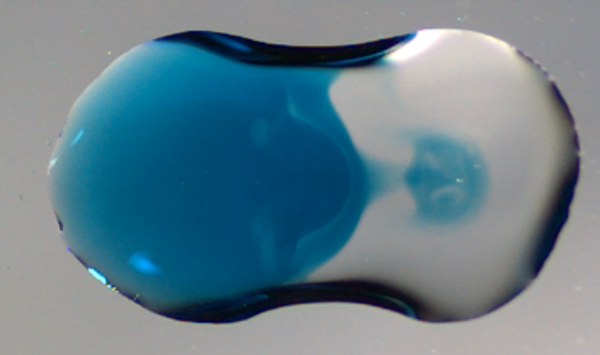
    As these drops evaporate, a donut-shaped recirculating vortex forms inside them, as seem in the cutaway views above. Conventional wisdom says that vortex is driven by surface tension. Evaporation of components like alcohol is more efficient at the edges of the drop, and as the alcohol evaporates, it creates a higher surface tension at the drop’s edge than at its peak. Marangoni forces then pull fluid down toward the edges, creating the vortex. That explanation is  consistent with observations of a sessile drop sitting on top of a surface (left side of images).

    But those observations are also consistent with another explanation: evaporating ethanol makes the local density higher, so alcohol-rich parts of the drop rise toward the peak while alcohol-poor regions sink. This difference in density would also create a flow pattern consistent with observations. So which is the real driver, surface tension or gravity?

    To find out, researchers flipped the drop upside-down (right side of images). When hanging, the preferred flow direction due to surface tension doesn’t change; flow should still go from the deepest point on the drop toward the edge. But gravity is swapped; alcohol-rich areas should be found near the edge and attachment points of the drop because buoyancy drives them there. And that is exactly what’s observed. The flow direction inside the hanging droplet is consistent with the direction prescribed by buoyancy-driven flow, thereby upending conventional wisdom. It turns out that gravity, not surface tension, is the major driver of internal flow in these multi-component droplets! (Image and research credit: A. Edwards et al.; via APS Physics; submitted by Kam-Yung Soh)

  • Featured Video Play Icon

    “Float”

    In “Float” artist Susi Sie uses water and oil to create a whimsical landscape of bubbles and droplets. Coalescence is a major player in the action, though Sie uses some clever time manipulations to make her bubbles and droplets multiply as well. Watching coalescence in reverse feels like seeing mitosis happen before your eyes. (Video and image credit: S. Sie)

  • A Splat is Born

    One day calligrapher Mae Nguyen accidentally squeezed a droplet out of her waterbrush pen, and a fun, new technique was born. Nguyen sometimes uses the arrays of droplets to paint and other times blows on them to create colorful splatters, like in the video above. I’d love to see the latter technique, in particular, in slow motion! I expect there is some really cool mixing as the droplets coalesce. Check out more of Nguyen’s work on her website and Instagram account. (Video credit: M. Nguyen)

  • Using Sound to Print

    Using Sound to Print

    Inkjet printing and other methods for directing and depositing tiny droplets rely on the force of gravity to overcome the internal forces that hold a liquid together. But that requires using a liquid with finely tuned surface tension and viscosity properties. If your fluid is too viscous, gravity simply cannot provide consistent, small droplets. So researchers are turning instead to sound waves

    Using an acoustic resonator, scientists are able to generate forces up to 100 times stronger than gravity, allowing them to precisely and repeatably form and deposit micro- and nano-sized droplets of a variety of liquids. In the images above, they’re printing tiny drops of honey, some of which they’ve placed on an Oreo cookie for scale. The researchers hope the technique will be especially useful in pharmaceutical manufacturing, where it could precisely dispense even highly viscous and non-Newtonian fluids. (Image and research credit: D. Foresti et al.; via Smithsonian Mag; submitted by Kam-Yung Soh)

  • Giving Droplets a Kick

    Giving Droplets a Kick

    Giving droplets a kick by accelerating the surface they sit on creates elaborate shapes as the drops respond. As the surface accelerates upward, the droplet flattens into a pancake. When the plate slows down, the droplet continues rising, stretching into a cone as its rim flies upward and its lower surface adheres to the surface. The rim retracts with a constant acceleration while the drop detaches with a constant velocity. That velocity depends on how well it adheres to the surface. The interplay between those two variables determines how conical or cylindrical the drop appears. See more in the full video below. (Image and video credit: P. Chantelot et al.)

  • Nestling Droplets

    Nestling Droplets

    Pay attention after a rainfall, and you may notice beads of water gathering in the corners of a spider’s web or along the leaves of a cypress tree (bottom right). Look closely and you’ll notice that the largest droplets don’t form along a straight fiber. Instead they nestle into the corners of a bent fiber (top image). Researchers recently characterized this corner mechanism and found that the angle at which the largest droplets form is about 36 degrees. This angle provides the optimal conditions for capillary action and surface tension to hold large drops in place. At smaller angles, a growing droplet’s weight pulls it down until the thin film holding the droplet near the top ruptures and the droplet falls. At larger angles, a heavy droplet will slowly detach from one side of its fiber and shift toward the other side until its weight is too great for the wetted length of fiber to hold. Then it detaches completely and falls. (Research and image credit: Z. Pan et al.; via T. Truscott)

  • Rolling Along

    Rolling Along

    Leidenfrost drops – droplets deposited onto a surface much hotter than their boiling point – are known for their mobility. With the right surface, they can be propelled, trapped, and even guided through a maze, typically by directing the vapor layer that cushions them. But new work shows that these drops have internal dynamics that also contribute to their propulsion.

    By adding tracer particles to each droplet, researchers can visualize flows inside the droplet. Large drops tend to have a flatter shape and contain two or more rotating vortices. Such drops won’t propel themselves without another force in play. But smaller droplets are more spherical and contain only a single rotating flow. Once these drops detach, they roll away! Despite the similarity to wheels, these liquid drops aren’t moving the same way. Remember that the drop is not actually in contact with the surface. To see what sets the drop’s direction, researchers examined the shape of the bottom of the drop. They found that it sits at a slant on its vapor cushion. That pushes evaporating gases out one side, propelling the drop the other way. (Image and video credit: A. Bouillant et al., source)

  • Moving Fluids in the Right Direction

    Moving Fluids in the Right Direction

    One challenge in creating miniature labs-on-a-chip is keeping fluids moving in the desired direction. The top image above shows red and blue droplets being moved toward one another on the top and bottom of a vibrating surface. Eventually, they meet and mix in the middle. To force the fluids in the right direction, the surface is highly textured, as seen in the lower image. These tiny posts and arcs help trap air between the surface and the drop. This makes the drop’s contact area with the superhydrophobic substrate quite small. The arcs provide directionality, and, as the surface shakes, the drops inch along, releasing the arc on the trailing edge as they make contact with a new one. In effect, the droplets walk themselves just where their designers want them to go. (Image and research credit: T. Duncombe et al.; via SciTechDaily)

  • Surfing Mists

    Surfing Mists

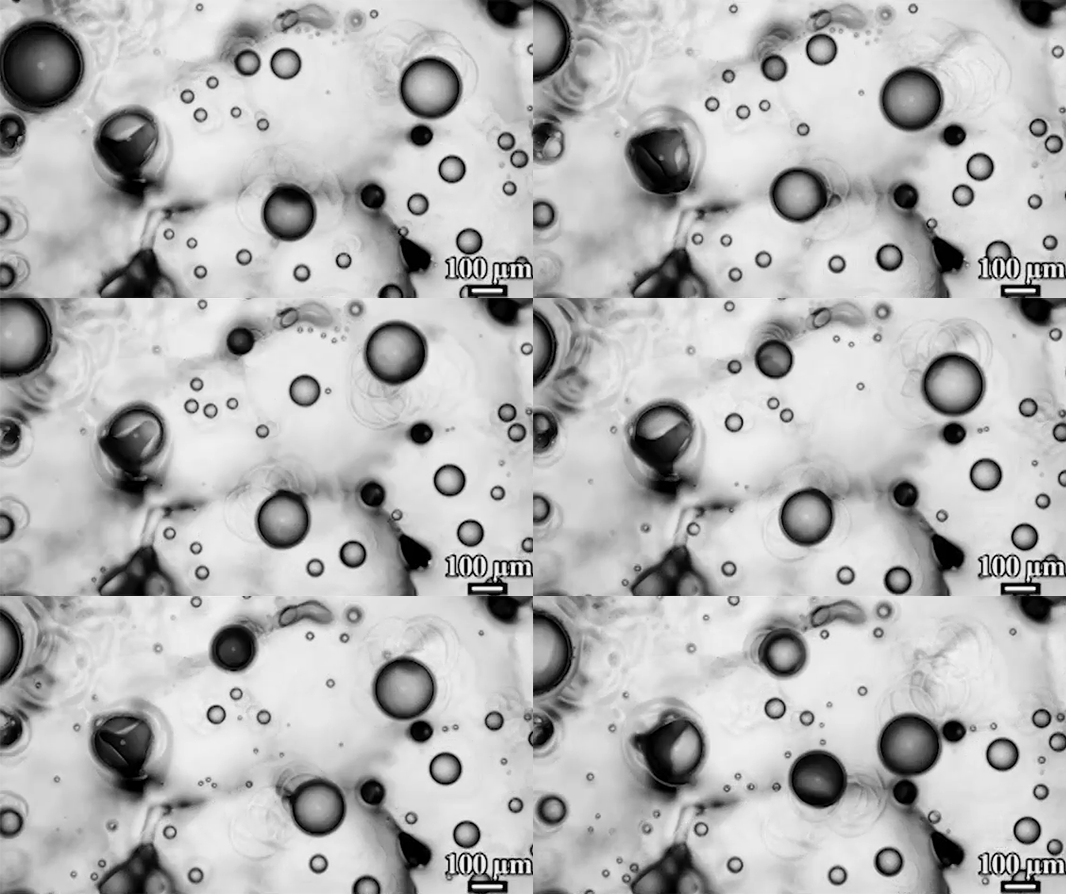
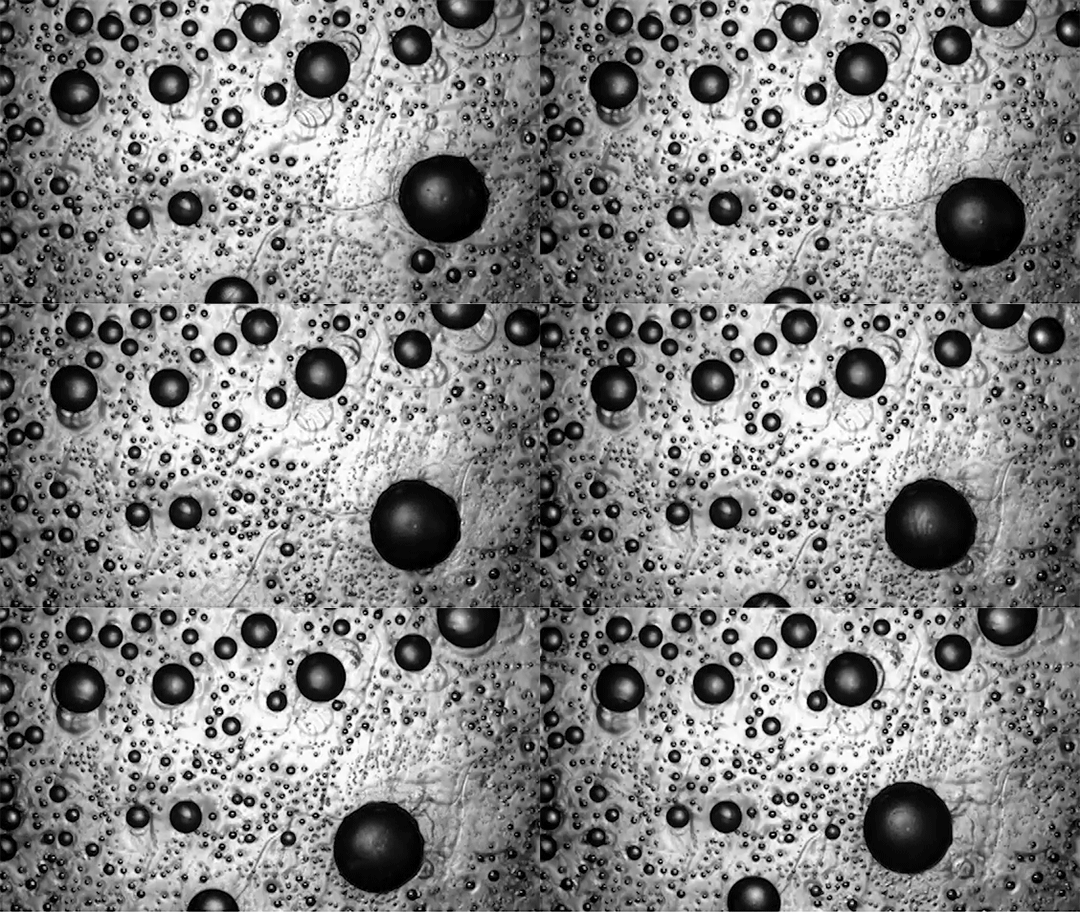
    Watch your hot cup of coffee or tea carefully, and you may notice a white mist of tiny micron-sized droplets hovering near the surface. These microdroplets are a little understood part of evaporation. They form over a heated liquid, levitating on vapor that diffuses out from them and reflects off the liquid surface. (This is similar to the Leidenfrost effect, but the authors note it occurs at much lower temperatures. Unrelated research has suggested the Leidenfrost effect can occur at lower temperatures when there is very little surface roughness.)

    One of the particularly peculiar behaviors of these tiny levitating microdroplets is that they can exist over dry surfaces as well. The image above shows microdroplets migrating from a liquid surface (right) to a dry surface (center and left). When the droplets near the contact line, they encounter a strong upward flow due to increased evaporation there. This launches the droplets upward and they sail to the dry area. There, their vapor layers continue creating levitation and provide a cushion between them and their neighbors, causing the drops to self-organize into arrays. (Image credit: D. Zaitsev et al.; via Physics World; submitted by Kam-Yung Soh)