Tag: droplets

  • Featured Video Play Icon

    “The Other Side”

    “The Other Side” is a short film imagining fluids on the other side of people’s eyes. The fast-paced editing makes this one feel rather different from Thomas Blanchard’s other films, which often take the time to linger on the mixing of soaps, inks, and paints that form the bulk of the imagery. There are hints of ferrofluids here, too, but like much of the action, if you blink you’ll miss it.

    Strange as it may sound, there’s actually a strong connection between eyes and fluid dynamics, whether you’re considering the optimal length for eyelashes, the way a tear film coats the eye, or how vision changes in microgravity. (Image and video credit: T. Blanchard)

  • Levitation Without Boiling

    Levitation Without Boiling

    One way to levitate droplets is to place them on a surface heated much higher than the droplet’s boiling point. This creates the Leidenfrost effect, where a droplet levitates on a thin layer of its own evaporating vapor. In this study, the situation is quite different.

    Although the underlying pool of liquid — here, silicone oil — is heated, its temperature is well below the boiling point of the water droplet. But the droplet still levitates over the pool, thanks to an air layer fed by convection. Aluminum powder in the oil reveals large-scale convection in the pool; note how the oil moves radially toward the droplet. That movement drags the air in contact with the oil with it, which forms the vapor layer keeping the droplet aloft.

    One side effect of this convection-driven levitation is that the droplet hovers over the coldest point in the oil. That fact suggests that users can manipulate the droplet’s motion by tuning the underlying heating. (Image and research credit: E. Mogilevskiy)

  • Surface Jets in Coalescing Droplets

    Surface Jets in Coalescing Droplets

    What goes on when droplets merge is tough to observe, even with a high-speed camera. There are many factors at play: any momentum in the droplets, surface tension, gravity, and Marangoni forces, to name a few. A new study that simultaneously records multiple views of coalescence is shedding some light on these dynamics.

    The results are particularly interesting for droplets that are somewhat physically separated so that they only coalesce after one drop impacts near the other. In this situation, with droplets of equal surface tension, researchers observed a jet that forms after impact (Image 1) and runs along the top surface of the coalescing drops (Image 2). That location is a strong indication that the jet is created by surface tension and not other forces.

    To test that further, the researchers repeated the experiment but with droplets of unequal surface tension. They found that when the undyed droplet’s surface tension was higher (Image 3), Marangoni forces enhanced the surface jet, as one would expect for a surface-tension-driven phenomenon. But if the dyed droplet had the higher surface tension (Image 4), it was possible to completely suppress the jet’s formation. (Image, research, and submission credit: T. Sykes et al., arXiv)

  • Featured Video Play Icon

    Coalescence in Heavy Metal Droplets

    When a drop of water falls into a pool, it doesn’t always coalesce immediately. Instead, it can go through a coalescence cascade in which the drop partially coalesces, a daughter drop bounces off the surface, settles, and itself partially coalesces. We’ve seen this many times before, but today’s video shows something a little different: here the drop and pool in question are made of a gallium alloy immersed in a background of sodium hydroxide. This means that the drop has very high surface tension (and density) but does not form an oxidation layer on its surface that could inhibit coalescence. And just like the water droplet, the gallium alloy undergoes a series of partial coalescences.

    A heavy metal droplet undergoes partial coalescence with a pool of the same liquid.

    There’s one key difference, though. Did you notice that the water droplets bounce higher as the drops get smaller, but the gallium droplets do the opposite? Previous research suggested that the droplet rebound height is driven by capillary forces, but the high surface tension of both of these liquids means that capillary forces should be large for both of them. Perhaps there’s much more viscous drag in the gallium and sodium hydroxide case? (Image, video, and research credit: R. McGuan et al.)

  • Collecting Dew

    Collecting Dew

    In areas of the world where fresh water is scarce, one potential source is dew collection. Scientists have been working in recent years on making overnight dew collection more efficient. The challenge is that drops won’t begin to slide down an inclined surface until they are large enough for gravity to overcome the surface tension forces that pin the drop. Most efforts have focused on reducing the critical size where drops begin to slide through surface treatments and chemical coatings. 

    A recent study, however, uses a different tactic. Instead of aiming to reduce the critical drop size, these researchers built a grooved surface designed to encourage drops to grow faster. By helping the droplets coalesce quickly, their surface (right side) is able to start shedding droplets much faster than a smooth surface (left side). Under test conditions, the grooved surface was shedding droplets after only 30 minutes, whereas the smooth surface shed its first drops after 2 hours. (Image and research credit: P. Bintein et al.; see also APS Physics)

  • Polygonal Droplets

    Polygonal Droplets

    Spheres are a special shape; they provide the smallest possible surface area necessary to contain a given volume. And since surface tension tries to minimize surface energy by reducing the surface area, drops and soap bubbles are, generally, spherical. There’s subtlety here, though: namely, what if reducing the surface area doesn’t minimize the surface energy?

    That’s the issue at the heart of this study. It looks at microscale oil droplets, like the ones above, that are floating in water and stabilized by surfactants. We’d expect droplets like these to be round, and above a critical temperature, they are. But as the temperature drops, the surfactant molecules along the droplet’s interface crystallize. The drop itself is still liquid, but interface is not.

    This changes the rules of the game. There’s no way for the surfactant molecules to form a sphere when solidified; they simply can’t fit together that way. So instead defects form along the interface and the drop becomes faceted. As the temperature drops further, the energy relationship between the water, oil, and surfactants continues shifting, causing the droplet to change shape – even to increase its surface area – all to minimize the overall energy. The effect is reversible, too. Raise the temperature back up above the critical point, and the interface “thaws” so that the drop becomes round again. (Image and research credit: S. Guttman et al.; via Forbes; submitted by Kam-Yung Soh)

  • Featured Video Play Icon

    Engineering Droplets

    A jet of falling liquid doesn’t remain a uniform cylinder; instead, it breaks into droplets. In this video, Bill Hammack explores why this is and what engineers have learned to do to control the size of the droplets formed.

    The technical name for this phenomenon is the Plateau-Rayleigh instability. It begins (like many instabilities) with a tiny perturbation, a wobble in the falling jet. This begins a game of tug of war. One of the competitors, surface tension, is trying to minimize the surface area of the liquid, which means breaking it into spherical droplets. But doing so requires forcing some of the the liquid to flow upward, against both gravity and the liquid’s inertia. The battle takes some time, but eventually surface tension wins and the jet breaks up.

    That’s not necessary a bad thing. It’s actually key to many engineering processes, like ink-jet printing and rocket combustion, as Bill explains in the full video. (Video and image credit: B. Hammack; submitted by @eclecticca)

  • The Bouncing Drop

    The Bouncing Drop

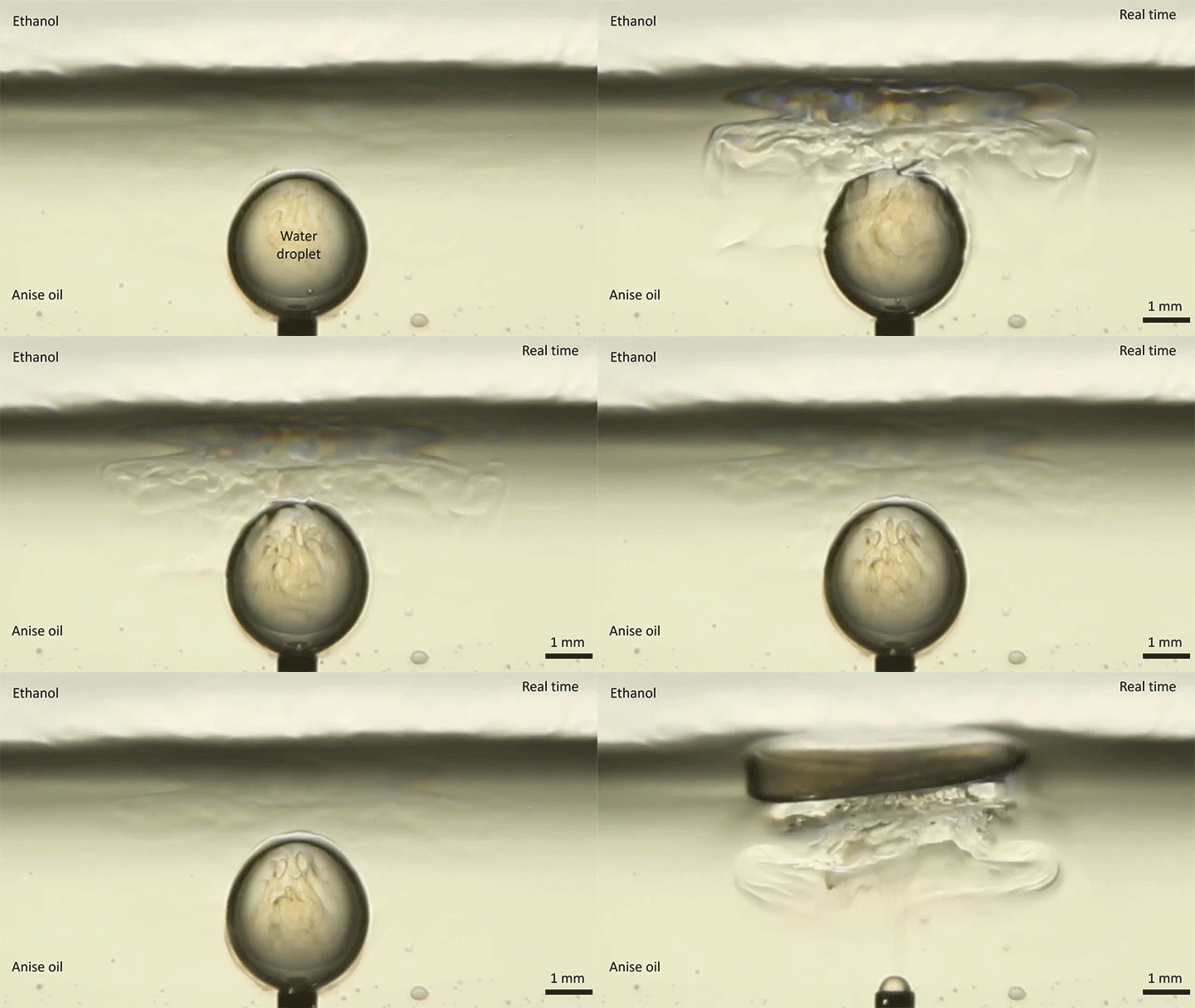
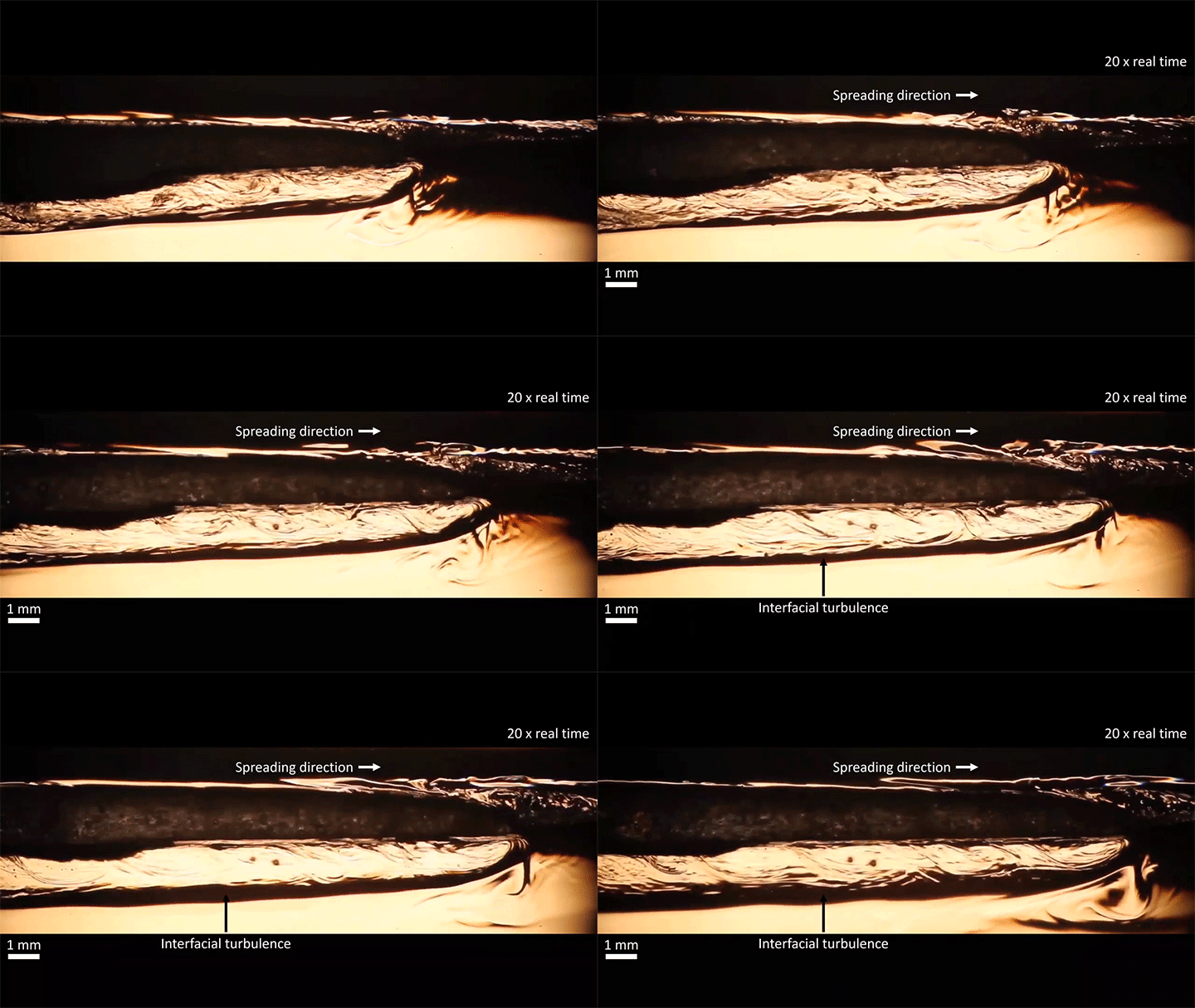
    For a droplet to bounce, we expect it to hit a wall or a sharp interface of some kind. But in a new study, researchers demonstrate a droplet that bounces with neither. Shown above is an oil droplet sinking through a stratified mixture of ethanol (toward the top) and water (toward the bottom). Because the oil is heavier than ethanol, it initially sinks, dragging some of the ethanol with it as it falls. Over time, some of that ethanol rises again, forming what’s known as a buoyant jet.

    Simultaneously, the gradient of ethanol to water between the top and bottom of the drop creates an imbalance in surface tension. The ethanol near the top of the drop has a lower surface tension than the water at the bottom. This creates a downward Marangoni flow along the drop interface.

    The bounce itself happens quickly after a long, slow sinking period. As the drop’s sinking slows, the buoyant jet weakens until it disappears completely. At the same time, the downward Marangoni flow pulls fresh ethanol-rich fluid toward the top of the drop. That increases the surface tension difference and strengthens the Marangoni flow, creating a positive feedback loop. In less than a second, the Marangoni flow increases by two orders of magnitude, pulling so hard that the drop shoots upward.

    That resets the cycle by weakening the Marangoni flow and strengthening the buoyant jet. The droplet can continue bouncing for about 30 minutes until the concentration gradient is so well-mixed that the cycle can’t continue. (Image and research credit: Y. Li et al.; via APS Physics; submitted by Kam-Yung Soh)

  • Phase-Switching to Avoid Icing

    Phase-Switching to Avoid Icing

    Preventing ice and frost from forming on surfaces – especially airplane wings – is a major engineering concern. The chemical de-icing cocktails currently used in aviation are a short-lived solution, and while superhydrophobic surfaces can be helpful, they tend to be easily damaged and therefore impractical. Another possible solution, shown here, are so-called phase-switching liquids – substances like cyclohexane that have freezing points higher than that of water. This means that they form a solid coating near the freezing temperature of water.

    Water droplets on these coatings move in a random stick-slip walk (above) but they tend not to freeze. This is because freezing requires the droplets to release heat, which melts part of the phase-switching liquid. Now, instead of solidifying to the surface, the droplet moves on a film of the phase-switching liquid. Re-freezing that liquid is tough because it’s thermodynamically unfavorable, and the smoothness of the liquid layer makes it harder for ice to find a nucleation point. In lab tests, the phase-switching liquid surfaces resisted ice and frost more than an order of magnitude longer than conventional materials. (Image and research credit: R. Chatterjee et al.; video credit: Univ. of Illinois at Chicago; submitted by Night King)

  • The Color of Droplets

    The Color of Droplets

    In nature, color comes from many sources: like the pigmentation of skin and hair, the structural iridescence of a butterfly’s wings, or the refraction of a rainbow from water droplets. Recently, scientists discovered another source of brilliant color in simple, hemispherical water droplets.

    When small droplets form on a transparent surface, they form concave shapes capable of total internal reflection. This means that two light rays entering from the same angle can follow different paths inside the droplet. After reflecting several times, the light rays exit the droplet with a phase difference and how large that phase difference is determines the color. Check out the video below for some brightly colored examples of the effect. The researchers hope the technique will eventually be suitable for creating dye-free, color-changing technologies. (Image credit: F. Frankel; video credit: MIT News; research credit: A. Goodling et al.)