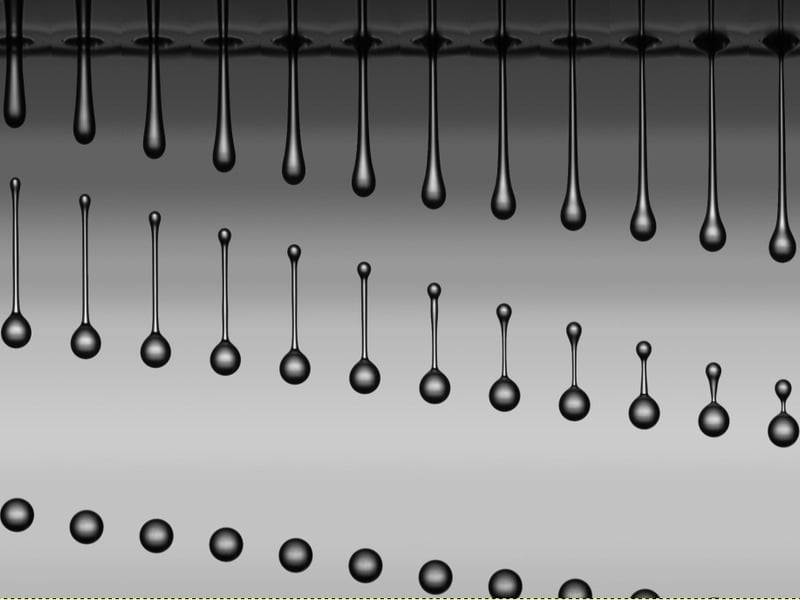
From spilling coffee to driving through puddles, our daily lives are full of examples of liquids fragmenting into drops. A recently published study describes how this break-up occurs and predicts what the distribution of droplet sizes will be for a given fluid. Viscoelasticity is the property that governs this droplet size distribution. Viscoelasticity describes two aspects of a fluid–its viscosity, which acts like internal friction, resisting motion–and its elasticity, the fluid’s ability to return to its original shape after stretching. Most fluids have a little bit of each of these properties, which makes them somewhat sticky, both in the sense of not-flowing-easily and in the sense of sticking-to-itself. These same properties cause viscoelastic fluids to wind up with a broader droplet size distribution, ultimately creating both more small droplets and more large droplets than a Newtonian liquid like water. (Video credit: MIT News; research credit: B. Keshavarz et al.; submitted by mrvmt)
Tag: droplets

Oil in Alcohol

A drop of oil impacts and falls through a pool of isopropyl alcohol. Momentum, viscosity, and diffusion combine to deform the drop into a shape that is initially like an upside-down wine glass (top image). Because the oil is both denser than the alcohol and soluble in it, the drop sinks and dissolves as it falls. The drop expands rapidly outward, thinning and formed a concave shape around its denser, sinking core (bottom image). Ultimately, the droplet will deform and fragment as it dissolves into the alcohol. (Image credit: R. La Foy et al.)

Surfing on Vapor
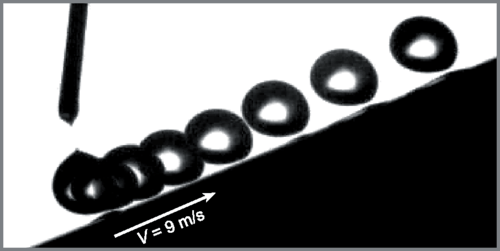
Place a drop of liquid on a surface much, much hotter than the liquid’s boiling point, and the portion of the drop that impacts will vaporize immediately. This leaves the droplet hovering on a thin layer of vapor. With a fluid like water, the vapor state is a much more efficient insulator than the liquid state. Thus, the vapor layer actually protects the liquid droplet, enabling it to boil off at a much slower rate than if the drop were touching the heated surface. This is known as the Leidenfrost effect, and it can be used to create self-propelled droplets. (Image credit: R. Thévenin and D. Soto)

Bouncing Droplets
Droplets bouncing on a pool form a beautiful and fascinating system, as recently featured by Physics Girl, Veritasium, and Smarter Every Day. The Lutetium Project – a consortium of French physics, graphic design, and music students – have their own take on the subject with beautiful short videos constructed from experimental research footage. With simple text explanations and lovely original music, they combine science, art, and outreach brilliantly. Also check out their quantum walker video and be sure to subscribe to their channel (in English or French) for more! (Video credit: The Lutetium Project; submitted by @g_durey)

Avoiding Coalescence
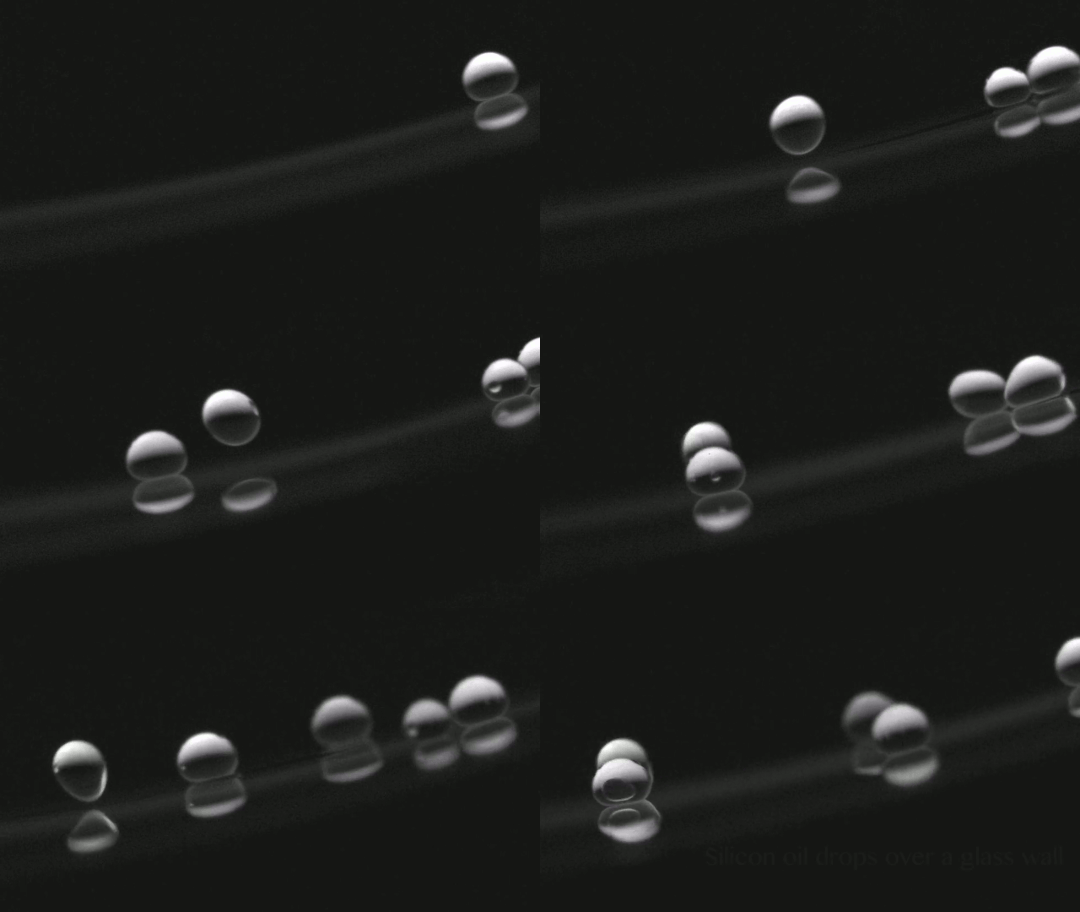
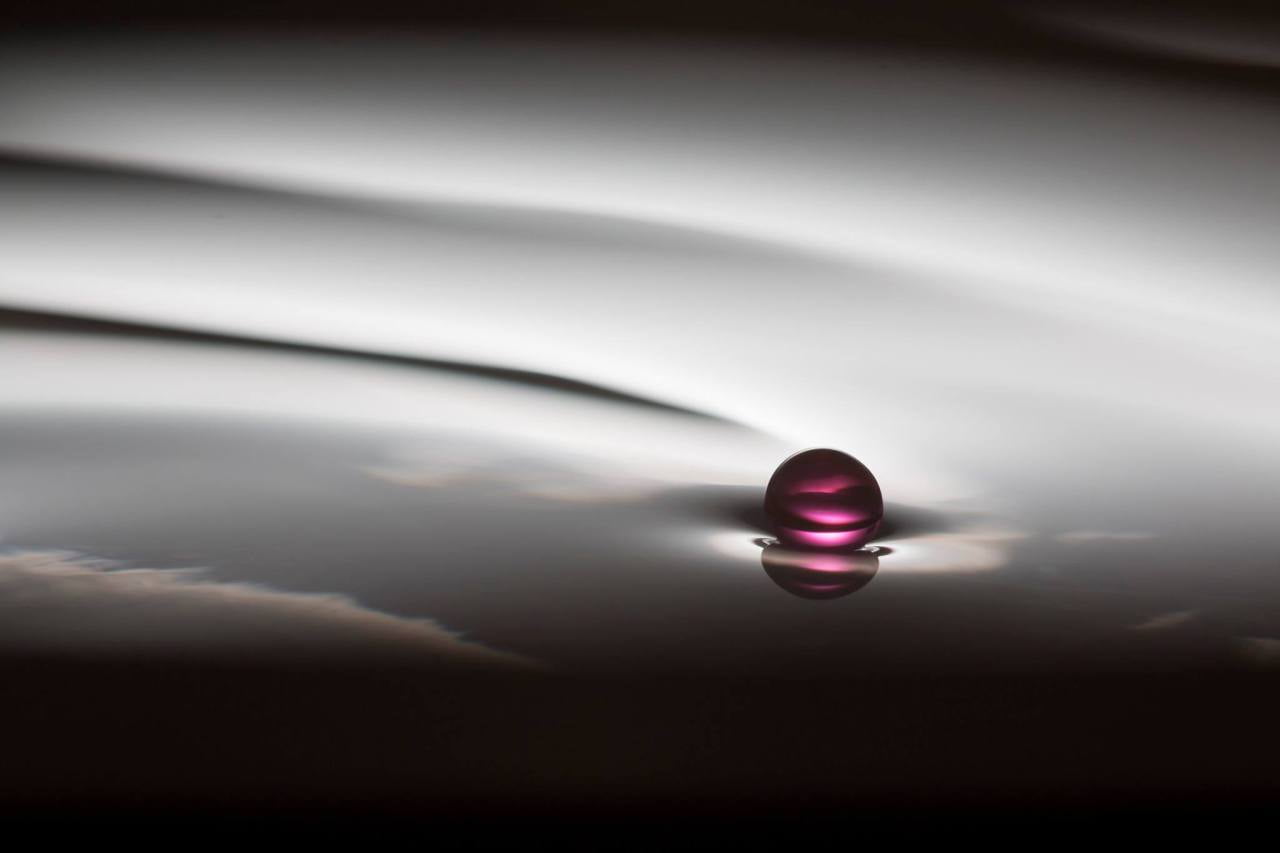
If you watch closely as you go about your day, you may notice drops of water sometimes bounce off a pool of water instead of coalescing. Fluid dynamicists have been fascinated by this behavior since the 1800s, but it was Couder et al. who explained that these droplets can bounce indefinitely as long as the thin air layer separating the drop and pool is refreshed by vibrating the pool. In this video, Destin teams up with astronaut Don Pettit to film the phenomenon in beautiful high-speed. My favorite part of the video starts around 8:18, where Destin shows Don’s experiments with this effect in microgravity. It turns out that the cello produces just the right frequencies to create a cascade of bouncing water droplets, much like a Tibetan singing bowl turned back on itself! (Video credit: Smarter Every Day; submitted by Destin and effyeahjoebiden)

Living Fluid Dynamics
This short film for the 2016 Gallery of Fluid Motion features Montana State University students experiencing fluid dynamics in the classroom and in their daily lives. As in her previous film (which we deconstructed), Shanon Reckinger aims to illustrate some of our everyday interactions with fluids. This time identifying individual phenomena is left as an exercise for the viewer, but there are hints hidden in the classroom scenes. How many can you catch? I’ve labeled some of the ones I noticed in the tags. (Video credit: S. Reckinger et al.)

Floating on a Granular Raft
A thin layer of hydrophobic particles dispersed at an oil-water interface is strong enough to prevent a water droplet from coalescing. The researchers refer to this set-up as their granular raft. As the red-dyed water droplet gets larger (top row), it deforms the raft more and more, but the grains continue to keep the drop separate from the fluid beneath (middle row). When water is removed from the droplet, wrinkles form on the raft as the drop’s volume shrinks. This is because the contact line – where the droplet, grains, and air meet – is pinned. The grains already touching the drop are held there by adhesion. But since the drop is shrinking, the area on the raft has to shrink, too – thus wrinkles! (Photo credits: E. Jambon-Puillet and S. Protiere, original)

Droplet Bounce
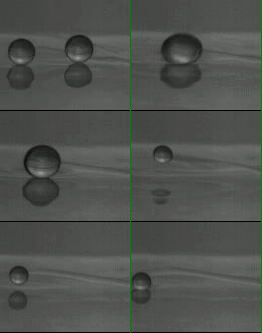
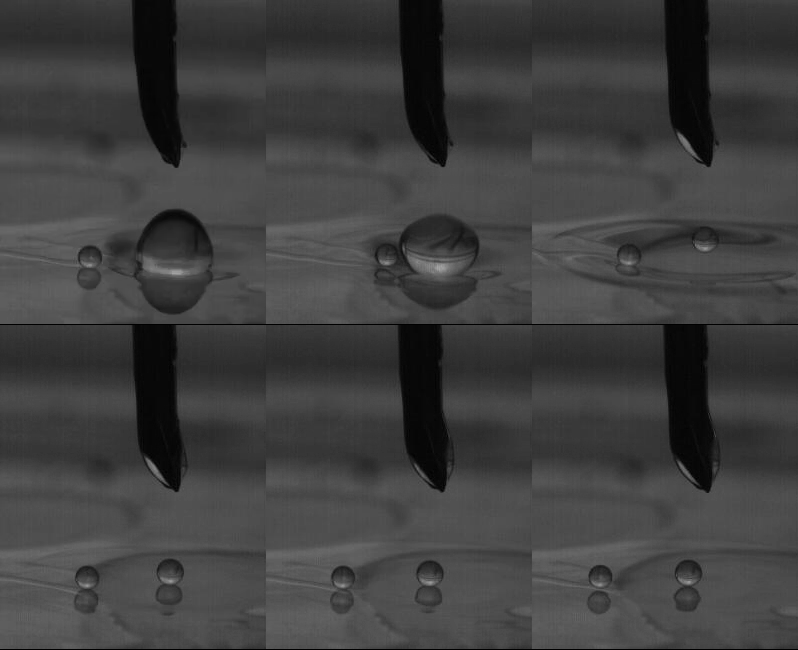
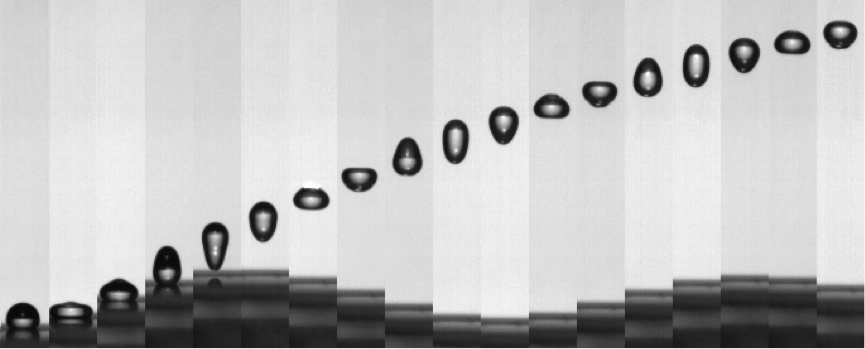
Water droplets don’t always immediately disappear into a pool they’re dropped onto. If the droplet is small and doesn’t have much momentum, it will join the pool gradually through a process known as the coalescence cascade, seen here in high speed video. The droplet bounces off the surface, then settles. A thin layer of air is caught between it and the pool. Slowly the weight of the drop pushes that air out until there is contact between the drop and pool. Before the drop can merge completely, though, surface tension pinches it off, creating a smaller daughter droplet. Ripples caused by the merger help bounce the little droplet, which repeats the same process until the tiniest droplet merges completely. (Video credit: B. ter Huume)

Quantum Droplets
Over the past decade, fluid dynamicists have been investigating tiny droplets bouncing on a vibrating fluid. This seemingly simple experiment has remarkable depth, including the ability to recreate quantum behaviors in a classical system. In this video, some of the researchers demonstrate their experimental techniques, including how they vary the frame rate relative to the bouncing of the drops. At the right frame rate, this sampling makes the droplets appear to glide along with their ripples, giving us a look at a system that is simultaneously a particle (drop) and wave (ripple). (Video credit: D. Harris et al.)

Skating on Vapor

Turn the stove up high enough and you may have noticed that drops of water stop boiling away and instead skate across the surface. This is the Leidenfrost effect, which occurs when a surface is so much hotter than a liquid’s boiling point that any liquid that contacts instantly vaporizes. That thin vapor layer insulates the rest of the drop and makes it skate around on very little friction. Previously, researchers found that putting these drops on patterned surfaces causes them to self-propel. Here you see Leidenfrost drops on a V-shaped “herringbone” surface. The grooves in the surface catch and direct the vapor out the Vs. If it seems counter-intuitive that the drops move in the same direction as their vapor, you’re not alone! It turns out that Leidenfrost drops aren’t propelled by vapor moving away from them – like, say, a rocket is. Instead the drops are being dragged along by friction between them and the escaping vapor. By controlling the direction of the vapor, researchers were able to create race tracks (top) and even traps (bottom) for the drops. (Image credit: D. Soto et al., from Supplemental Movies 2 and 3)