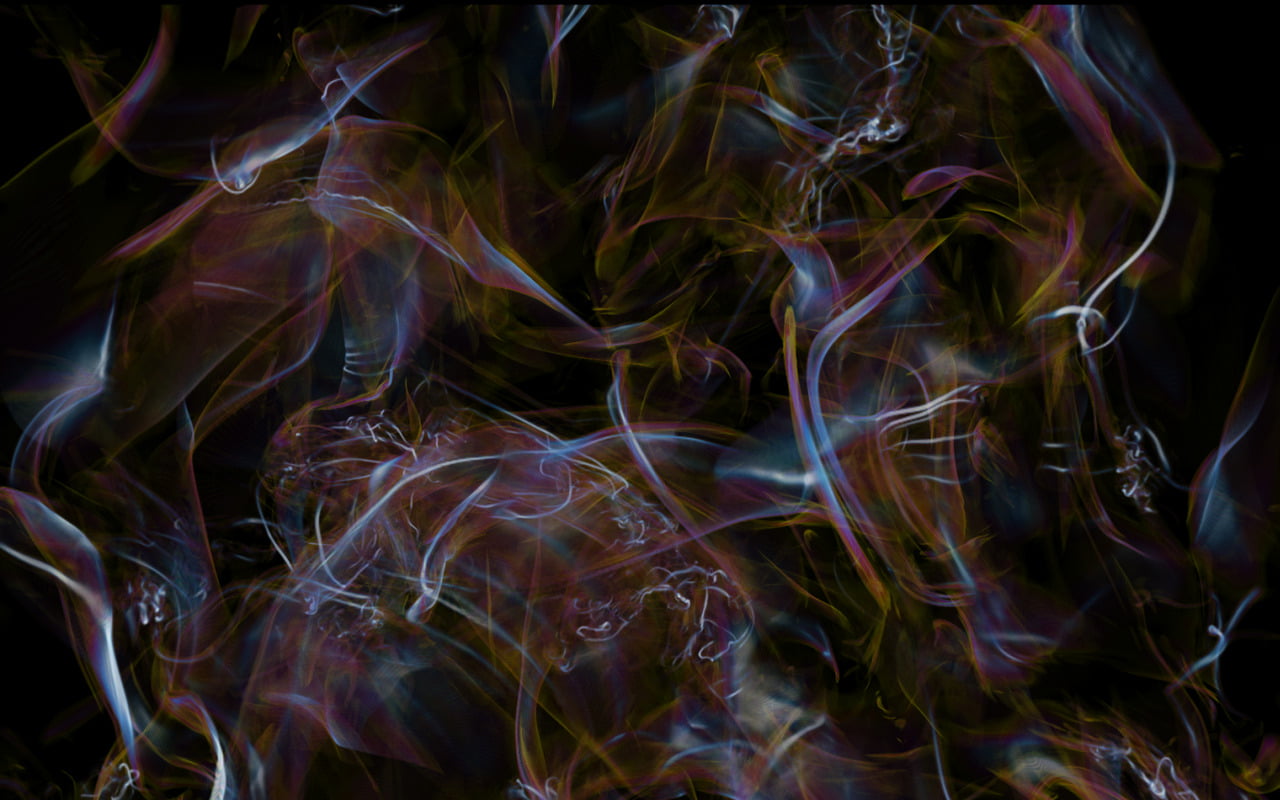
This numerical simulation shows the variation of salinity in the Atlantic Ocean near the mouth of the Amazon River over the course of 36 months. The turbulent mixing of the fresh river water and salty ocean shifts with the ebb and flooding of the river. Salt content causes variations in ocean water density, which can strongly affect mixing and transport properties between different depths in the ocean due to buoyancy. Understanding this kind of flow helps predict climate forecasts, rain predictions, ice melting and much more. (Video credit: Mercator Ocean)
Tag: computational fluid dynamics

Visualizing Ocean Currents
Researchers used computational models of ocean currents to produce this video visualizing worldwide ocean surface currents from June 2005 through December 2007. Dark patterns under the ocean are representative of ocean depths and have been exaggerated to 40x; land topography is exaggerated to 20x. Notice the wide variety of behaviors exhibited in the simulation: some regions experience strong recirculation and eddy production, while others remain relatively calm and unmoving. Occasionally strong currents sweep long lines across the open waters, carrying with them warmth and nutrients that encourage phytoplankton blooms and other forms of ocean life. (Video credit: NASA; submitted by Jason S)

Simulating Turbulence
Turbulent flows are complicated to simulate because of their many scales. The largest eddies in a flow, where energy is generated, can be of the order of meters, while the smallest scales, where energy is dissipated, are of the order of fractions of a millimeter. In Direct Numerical Simulation (DNS), the exact equations governing the flow are solved at all of those scales for every time step–requiring hundreds or thousands of computational hours on supercomputers to solve even a small domain’s worth of flow, as on the airplane wing in the video. Large Eddy Simulation (LES) is another technique that is less computationally expensive; it calculates the larger scales exactly and models the smaller ones. The video shows just how complicated the flow field can look. The red-orange curls seen in much of the flow are hairpin vortices, named for their shape, and commonly found in turbulent boundary layers.
Computational Shock Compression
[original media no longer available]
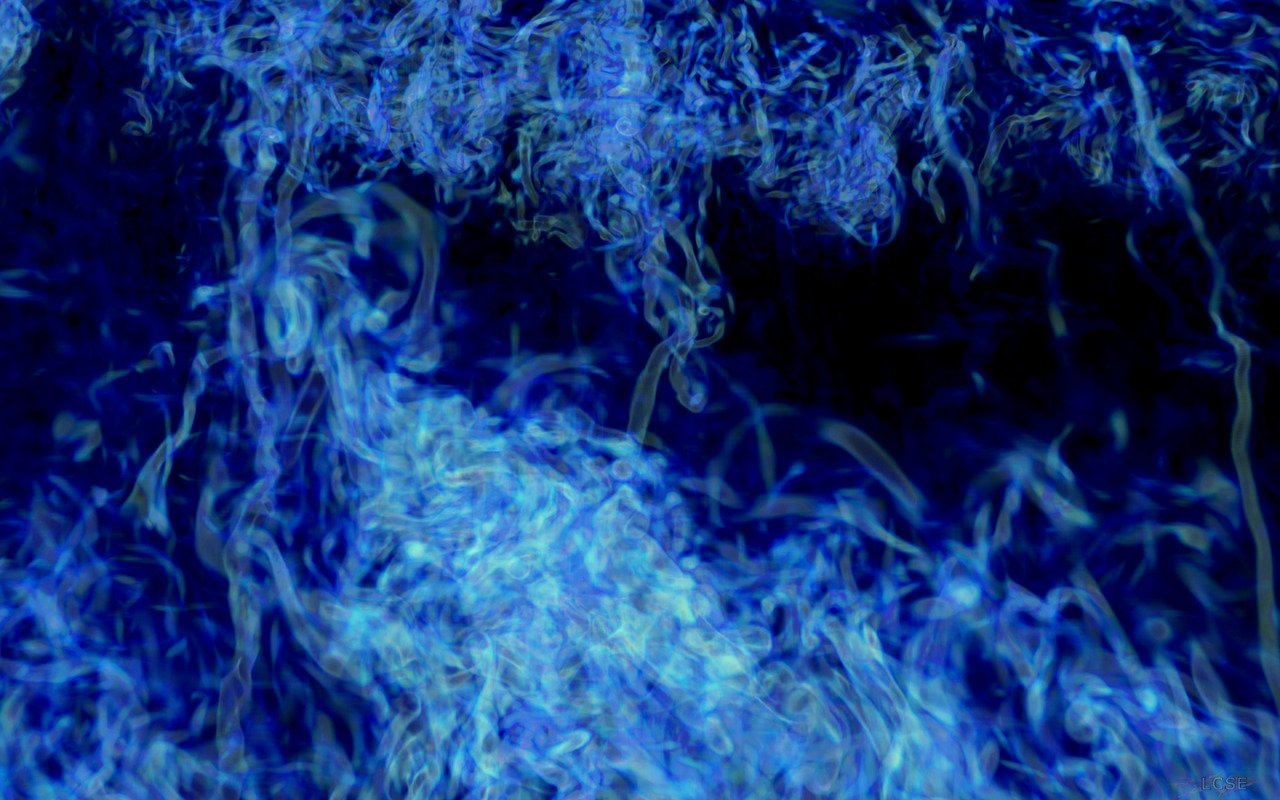
Computational modeling can help verify and visualize experimental results, as in this video of supersonic flow. Oak Ridge National Laboratory produced the work as part of a project using shock compression and turbines to capture carbon dioxide gas. Shock waves and velocity profiles are shown throughout the computational field, and velocity isosurfaces paint a telling portrait of the complicated flow pattern. Wired Science features other award-winning simulation videos, many of which also feature fluid dynamics. #
Supersonic Bullet
[original media no longer available]
This video shows a CFD simulation of a bullet passing through a parallel channel at Mach 2. The simulation captures 3 milliseconds of real-time and shows the Mach number in the top view and the temperature in the bottom view. Note how the bow shock near the front of the bullet and the trailing shock behind it reflect off the walls of the channel and interact. Even though the calculation is inviscid, the shock waves cause intense heating (white) in front of and behind the bullet.

Computational Vortex Rings
Computational fluid dynamics (CFD) sometimes gets a bad rep as “colorful fluid dynamics”, but as computers get faster and faster, more complicated and physically accurate simulations are possible. Shown here are simulations of vortex rings and wingtip vortices in stunningly gorgeous detail. Understanding the evolution of these vortices from a fundamental level helps fluid mechanicians design better methods of controlling them. As mentioned in the video, wingtip vortices are a particularly hazardous everyday example; the time it takes for one plane’s wingtip vortices to disperse determines how quickly the next airplane can take-off or land on that same runway. Being able to break down these vortices faster would allow more frequent use of existing facilities.

Swimming Sandfish Lizards
Sandfish lizards can “swim” through granular flows like sand using an undulating, sinusoidal motion. Having studied this motion, engineers have built a robot that swims similarly through large glass beads and have now created a numerical simulation of the physics that matches the measured forces on the swimmer to within 8%. This type of flow is, in some respects, tougher than actual fluids because individual particles have to followed, while in most of fluid mechanics, we can use the continuum assumption to treat a liquid or gas as a continuous medium. #

Volcanic Turbulence
One of the characteristics of turbulence is its large range of lengthscales. Consider the ash plume from this Japanese volcano. Some of the eddy structures are tens, if not hundreds, of meters in size, yet there is also coherence down to the scale of centimeters. In turbulence, energy cascades from these very large scales to scales small enough that viscosity can dissipate it. This is one of the great challenges in directly calculating or even simply modeling turbulence because no lengthscale can be ignore without affecting the accuracy of the results. #

Colorful Computational Combustion
Many fluid dynamics problems are so complicated that they require supercomputers to calculate the mathematical and physical details. This image shows a computer simulation of a cold ethylene jet combusting in hot air. Different colors indicate different combustion by-products. Researchers use simulations like this one to investigate ideal flames that improve efficiency in applications like cars or jet engines. #

Starting a Rocket
This computational fluid dynamics (CFD) simulation shows the start-up of a two-dimensional, ideal rocket nozzle. Starting a rocket engine or supersonic wind tunnel is more complicated than its subsonic counterpart because it’s necessary for a shockwave to pass completely through the engine (or tunnel), leaving supersonic flow in its wake. Here the situation is further complicated by turbulent boundary layers along the nozzle walls. (Video credit: B. Olson)