What happens to a wet washcloth when wrung out in space? Astronaut Chris Hadfield answers this question from students with a demonstration. Without gravity to pull the water downward, surface tension effects dominate and the wrung cloth forms a tube of water around it. Surface tension and capillary action draw the fluid up and onto Hadfield’s hands as long as he holds the cloth. After he lets go, we see that the water remaining around the cloth soaks back in (again due to capillary action) and the wet, twisted washcloth simply floats without releasing water or relaxing its shape. While pretty much what I would have expected, this was a very cool result to see! (Video credit: C. Hadfield/CSA; submitted by Bobby E)
Tag: capillary action

Spitting Droplets
Any phenomenon in fluid dynamics typically involves the interaction and competition of many different forces. Sometimes these forces are of very different magnitudes, and it can be difficult to determine their effects. This video focuses on capillary force, which is responsible for a liquid’s ability to climb up the walls of its container, creating a meniscus and allowing plants and trees to passively draw water up from their roots. Being intermolecular in nature, capillary forces can be quite slight in comparison to gravitational forces, and thus it’s beneficial to study them in the absence of gravity.
In the 1950s, drop tower experiments simulating microgravity studied the capillary-driven motion of fluids up a glass tube that was partially submerged in a pool of fluid. Without gravity acting against it, capillary action would draw the fluid up to the top of the glass tube, but no droplets would be ejected. In the current research, a nozzle has been added to the tubes, which accelerates the capillary flow. In this case, both in terrestrial labs and aboard the International Space Station, the momentum of the flow is sufficient to invert the meniscus from concave to convex, allowing a jet of fluid out of the tube. At this point, surface tension instabilities take over, breaking the fluid into droplets. (Video credit: A. Wollman et al.)
The Water Bridge
This short film offers an artistic look at the phenomenon of the water bridge. When subjected to a large voltage difference, such as the 30 kV used in the film, flow can be induced between water in two separated beakers. This creates a water bridge seemingly floating on air. There are two main forces opposing the bridge: gravity, which causes it to sag, and capillary action, which tries to thin the bridge to the point where it will break into droplets. These forces are countered by polarization forces induced at the liquid interface due to the electrical field separating the water’s positive and negative charges. This separation of charges creates normal stresses along the water surface, which counteracts the gravitational and capillary forces on the bridge. The artist has done a beautiful job of capturing the unsteadiness and delicacy of the phenomenon. (Video credit: Lariontsev Nick)
Perpetual Motion?
In the 17th century, scientist Robert Boyle proposed a perpetual motion machine consisting of a self-filling flask. The concept was that capillary action, which creates the meniscus of liquid seen in containers and is responsible for the flow of water from a tree’s roots upward against gravity, would allow the thin side of the flask to draw fluid up and refill the cup side. In reality, this is not possible because surface tension will hold it in a droplet at the end of the tube rather than letting it fall. In the video above, the hydrostatic equation is used to suggest that the device works with carbonated beverages (it doesn’t; the video’s apparatus has a hidden pump) because the weight of the liquid is much greater than that of the foam. Of course, the hydrostatic equation doesn’t apply to a flowing liquid! The closest one can come to the hypothetical perpetual fluid motion suggested by Boyle is the superfluid fountain, which flows without viscosity and can continue indefinitely so long as the superfluid state is maintained. (Video credit: Visual Education Project; submission by zible)

Tears of Wine
Physicist Richard Feynman once famously ended a lecture by describing how the whole universe can be found in a glass of wine. And there is certainly plenty of fluid dynamics in one. In the photo above, we see in the shadows how a film of wine drips down into the main pool below. This effect is known by many names, including tears of wine and wine legs; it can also be found in other high alcohol content beverages. Several effects are at play. Capillary action, the same effect that allows plants to draw water up from their roots, helps the wine flow up the wall of the glass. At the same time, the alcohol in this wine film evaporates faster than the water, raising the surface tension of the wine film relative to the main pool of wine below. Because of this gradient in surface tension, the wine will tend to flow up the walls of the glass away from the area of lower surface tension. This Marangoni effect also helps draw the wine upward. When the weight of the wine film is too great for capillary action and surface tension to hold it in place, droplets of wine–the legs themselves–flow back downward. (Photo credit: Greg Emel)

Green Fingers
Differences in surface tension between two layers of fluid can cause fascinating finger-like instabilities. Here glycerol is spread in a thin film on a silicon wafer. Then a wire coated in oleic acid, which has a lower surface tension than glycerol, was touched to the wafer. As the oleic acid spreads across the film surface, Marangoni and capillary stresses cause variations in the film thickness, which results in the dendritic patterns seen here. (Photo credit: B. Fischer et al.)

Falling Oil
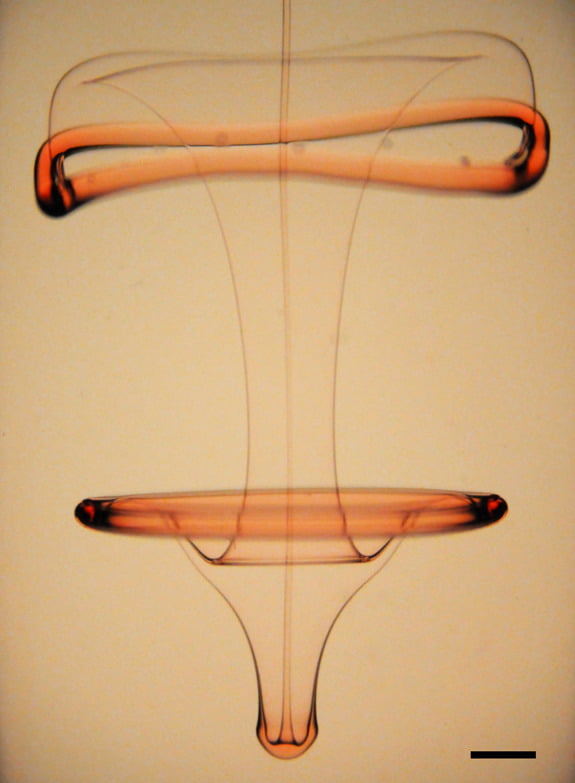
A drop of silicone oil falling through a liquid with lower surface tension distorts into multiple vortex rings connected by thin films. This behavior is caused by the interaction between viscous and capillary forces and is observable for only a narrow range of oil viscosities. (Photo credit: A. Felce and T. Cubaud)
Labyrinth
A labyrinthine pattern forms in this timelapse video of a multiphase flow in a Hele-Shaw cell. Initially glass beads are suspended in a glycerol-water solution between parallel glass plates with a central hole. Then the fluid is slowly drained over the course of 3 days at a rate so slow that viscous forces in the fluid are negligible. As the fluid drains, fingers of air invade the disk, pushing the beads together. The system is governed by competition between two main forces: surface tension and friction. Narrow fingers gather fewer grains and therefore encounter less friction, but the higher curvature at their tips produces larger capillary forces. The opposite is true of broader fingers. Also interesting to note is the similarity of the final pattern to those seen in confined ferrofluids. (Video credit and submission: B. Sandnes et al. For more, see B. Sandes et al.)
“Compressed” Outtakes
Bubbles, viscosity, diffusion, capillary action, and ferrofluids all feature in the artistic experiments of Kim Pimmel. Be sure to check out his previous film featured here. (Video credit: Kim Pimmel)
Particle Patterning
Here a container filled with a suspension of neutrally buoyant polystyrene beads and fluid is rotated. As the container rotates, a thin layer of fluid and bunches of particles get drawn up onto the wall by capillary forces capable of holding the particles in place even if the container stops rotating. The density and patterning of the particles on the wall depends on the container’s rotation speed and the volume fraction of particles. (Video credit: J. Kao and A. Hosoi)