Tag: capillary action

  • Nectar-Eating Bats

    Nectar-Eating Bats

    Nectar-eating bats have evolved to use several methods to drink. Some bats, like the Pallas’ long-tongued bat (top), use a lapping method. Hair-like papillae on the bat’s tongue increase the contact area with the nectar, helping to draw the fluid up in viscous globs as the bat repeatedly dips its tongue into the nectar. The orange nectar bat (middle and bottom), in contrast, has a tongue with a long central groove. This bat’s tongue stays submerged as it drinks. Researchers hypothesize that muscle action along the tongue, combined with capillary action in the narrow groove, allow the bat to actively pump nectar up to its mouth. It’s worth noting that the edges of the bat’s tongue do not curl around to touch, so the bat is definitely not using suction as one would with a straw. (Image credit: M. Tschapka et al., source)
  • Get Your Own Space Coffee Cup

    Get Your Own Space Coffee Cup

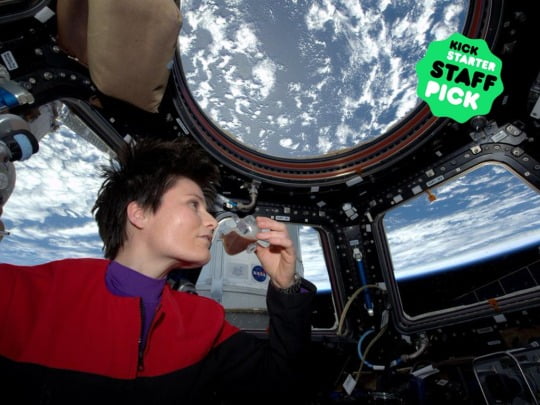
    A few weeks ago, we reported on the espresso machine NASA and the ESA sent to astronauts aboard ISS. The Capillary Beverage Experiment, known colloquially as the “Space Coffee Cup”, is an accompanying project that aims to use our understanding of fluid behavior in microgravity to design an open cup that simulates earthbound drinking experiences. As you can see above, astronauts are already enjoying drinks with it. The cup’s special shape is optimized so that surface tension can replace the role gravity plays in drinking on Earth. Where we pour drinks on Earth, the cup wicks liquid to the spout using surface-tension-driven capillary action. Right now there are only a handful of 3D printed cups on-orbit and here on Earth, but the company that designed them wants to manufacture glass versions for use here on the ground. So if you’d like your own space coffee cup, be sure to check out their Kickstarter campaign! (Video credit: IRPI LLC; image credit: NASA/IRPI LLC; Kickstarter project link)

    ETA: To those who have been asking, that’s European astronaut Samantha Cristoforetti, who is (clearly) a Star Trek fan. I believe she’s doing a tribute to Captain Janeway’s coffee. (Black.)

  • Espresso in Space

    Espresso in Space

    The International Space Station resupply mission launched yesterday included a long-awaited fluid dynamics experiment that offers astronauts a taste of home: the ISSpresso espresso machine. Built by two Italian companies, the specially-designed espresso maker contains a non-convectional heating system and high-pressure piping to safely enable proper brewing using real coffee while in microgravity. The machine is also ruggedized to withstand launch forces; prototypes were even dropped in drop towers to simulate microgravity brewing conditions. The machine dispenses the brewed espresso into plastic packets, but another experiment aboard the ISS, Capillary Effects of Drinking in Microgravity, includes 3D-printed cups designed to allow orbiting astronauts to sip their beverages from open containers without spilling. They’re an improvement on a design created by astronaut Don Pettit in 2008 while in orbit. The cup’s sharp interior angle causes surface tension and capillary action to wick liquid upward to the spout. (Image credits: Lavazza; NASA/Portland State University/A. Wollman)

  • The Capillary Channel Flow Experiment

    The Capillary Channel Flow Experiment

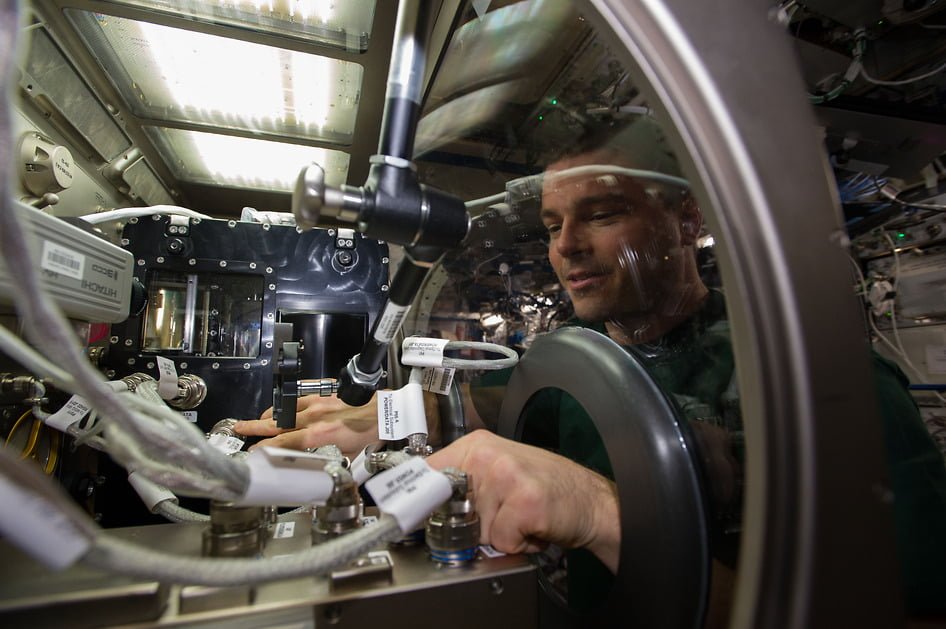
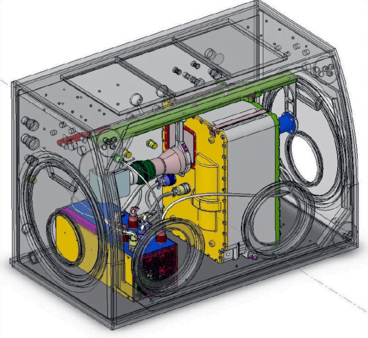
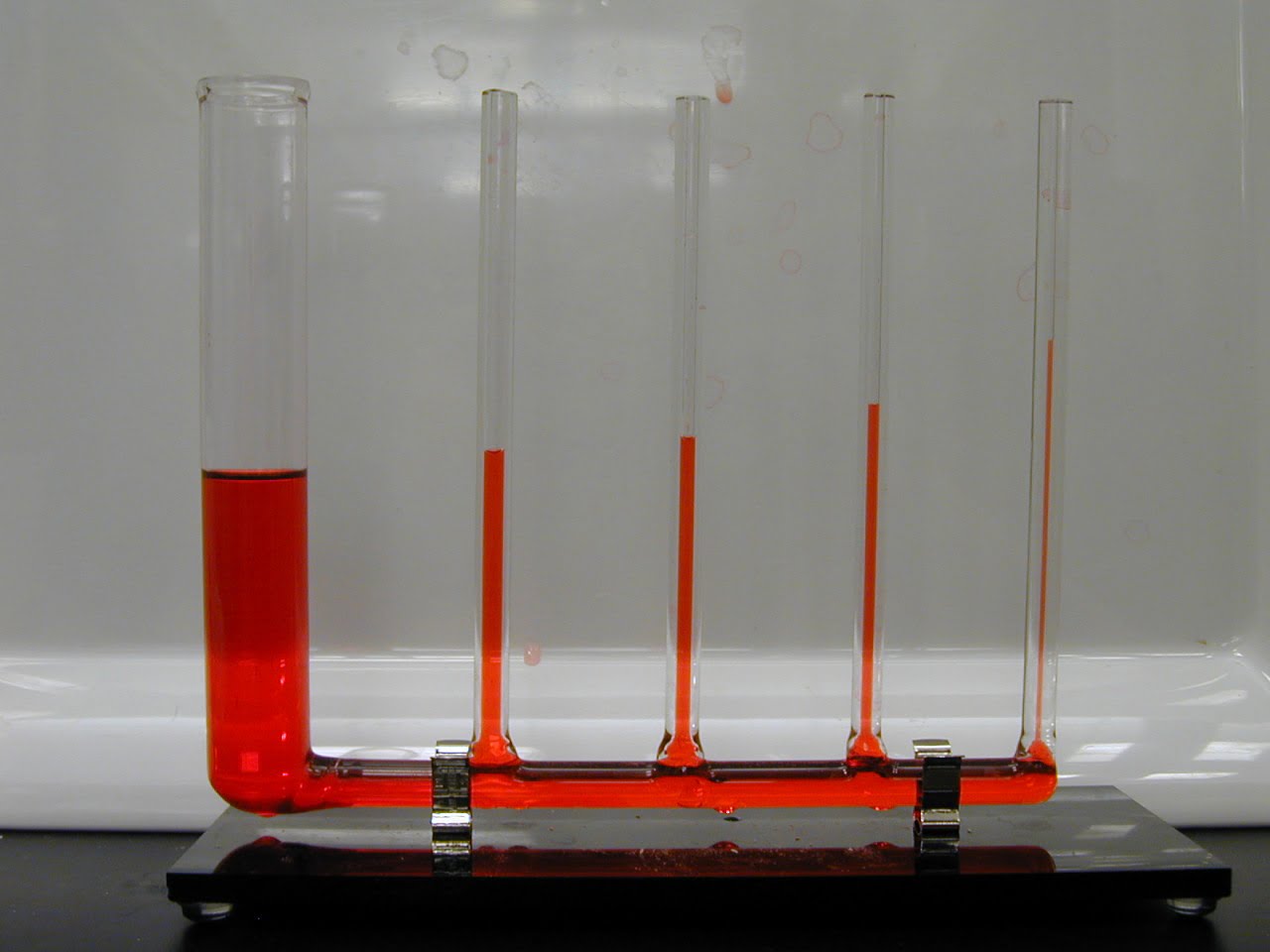
    Moving fluids around in microgravity can be a challenge. On Earth we experience buoyancy and other gravitational effects that dominate how fluids move. In space, on the other hand, the only options are to move fluids mechanically with pumps or fans or to use capillary action. Even on earth, adhesive forces between a liquid and its solid container can draw fluids in narrow tubes upward against the force of gravity. In microgravity, this capillary flow can be even more effective. But the best way to study and understand this flow regime is to do so in space. The Capillary Channel Flow experiment and similar studies have allowed astronauts on the space station and researchers back on Earth to explore the effects of capillary action on microgravity fluid transport. The results will be used to improve propulsion systems, heat exchangers, and life support systems used in space. (Photo credits: NASA, M. Dreyer et al., and A. Agrawala; submitted by jshoer)

  • Featured Video Play Icon

    Oily Foams

    It is common in many industries to use oil as a defoamer to break up existing foams or prevent foams from forming. But with the right surfactants–additives that change the foam’s surface tension–it’s possible to make aqueous foams that are actually stabilized by the presence of oil. This video explores some of the ways that oil can interact with these kinds of foam, beginning with capillary action, which draws the oil up into the junctions between foam films. For more, see Piroird and Lorenceau. (Video credit and submission: K. Piroird)

  • Featured Video Play Icon

    Floating Water Bridges

    Water bridges that seem to float on air are an electrohydrodynamic phenomenon. By filling two beakers with extremely pure deionized water and applying a large voltage across them, flow is induced from one beaker to the other, as seen in the first few seconds of the video above. This flow is stable enough that the beakers can then be separated by a few centimeters without disturbing the bridge. Gravity tends to make the water bridge sag and capillary action tries to thin the bridge, but both effects are countered by the polarization forces induced in the water by the electric field. You can learn much more about the effect and see both photos and videos of it in action at Elmer Fuchs’ webpage. The flow visualization videos are especially neat! (Video credit: E. C. Fuchs)

  • Featured Video Play Icon

    The Cheerios Effect and Tiny Swimmers

    Anyone who has eaten a bowl of Cheerios is familiar with the way solid objects floating on a liquid surface will congregate. This is a form of capillary force driven by the wetting of the particles, surface tension, and buoyancy. Using ferromagnetic particles and a vertical magnetic field, one can balance capillary action and lock the particles into a fixed configuration relative to one another. By adding a second, oscillating magnetic field, it’s possible to make the beads dance and swim together. Like all of this week’s videos, this video is an entry in the 2013 Gallery of Fluid Motion. (Video credit: M. Hubert et al.)

  • Ig Nobel Fluids: Cookie Dunking

    Ig Nobel Fluids: Cookie Dunking

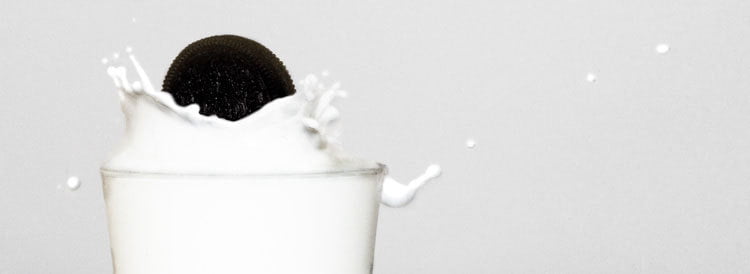
    Back in 1999 Len Fisher earned an Ig Nobel Prize in Physics for explaining the physics of dunking a biscuit or cookie in a liquid. The cookie is porous, with many tiny, interconnecting channels run throughout it. When dipped in a liquid, capillary action pulls the fluid up into these channels against the force of gravity. As most people discover, this wetting can soften the cookie to the point of collapse. The optimal manner of dunking then is to hold the cookie at a shallow angle; this allows the lower surface to soak in milk (or the hot beverage of your choice) while keeping the upper surface dry and structurally sound. Fisher further argued that Washburn’s equation, which describes the time necessary for capillary action to draw a liquid up a given length of a cylindrical pore gives a good estimate of the length of time for a cookie dunking. This proved so popular he even wrote a book about it. This is a part of a series on fluids-related Ig Nobel Prizes. (Photo credit: C. Lindberg; research credit: L. Fisher)

  • Fluids Round-up – 27 July 2013

    Fluids Round-up – 27 July 2013

    Fluids round-up time! Here are our latest fluidsy links from around the web:

    (Photo credit: T. Thai)

    Reminder: This weekend is your final chance to take the reader survey! Thank you to everyone who has taken a couple minutes to share their thoughts.

  • Featured Video Play Icon

    Lifting Liquids

    At very small scales, the interaction of solids and liquids is governed by molecular forces. Here researchers demonstrate how carbon nanowires of only a few nanometers in diameter draw liquid up in a film or bead when inserted in a pool. Capillary action is the name we give this gravity-defying force generated between the liquid and solid molecules. Although this behavior was predicted theoretically, it had not been previously observed at this scale due to the need for electron microscopy. Such microscopes require a vacuum, which boils off almost any liquid instantaneously. Researchers used a special fluid that remained in a liquid state even under near-vacuum pressures in order to make these observations. (Video credit: J. Li et al/MIT News; submitted by 20percentvitaminc)