Tag: acoustics

  • Featured Video Play Icon

    Listening to Tempura

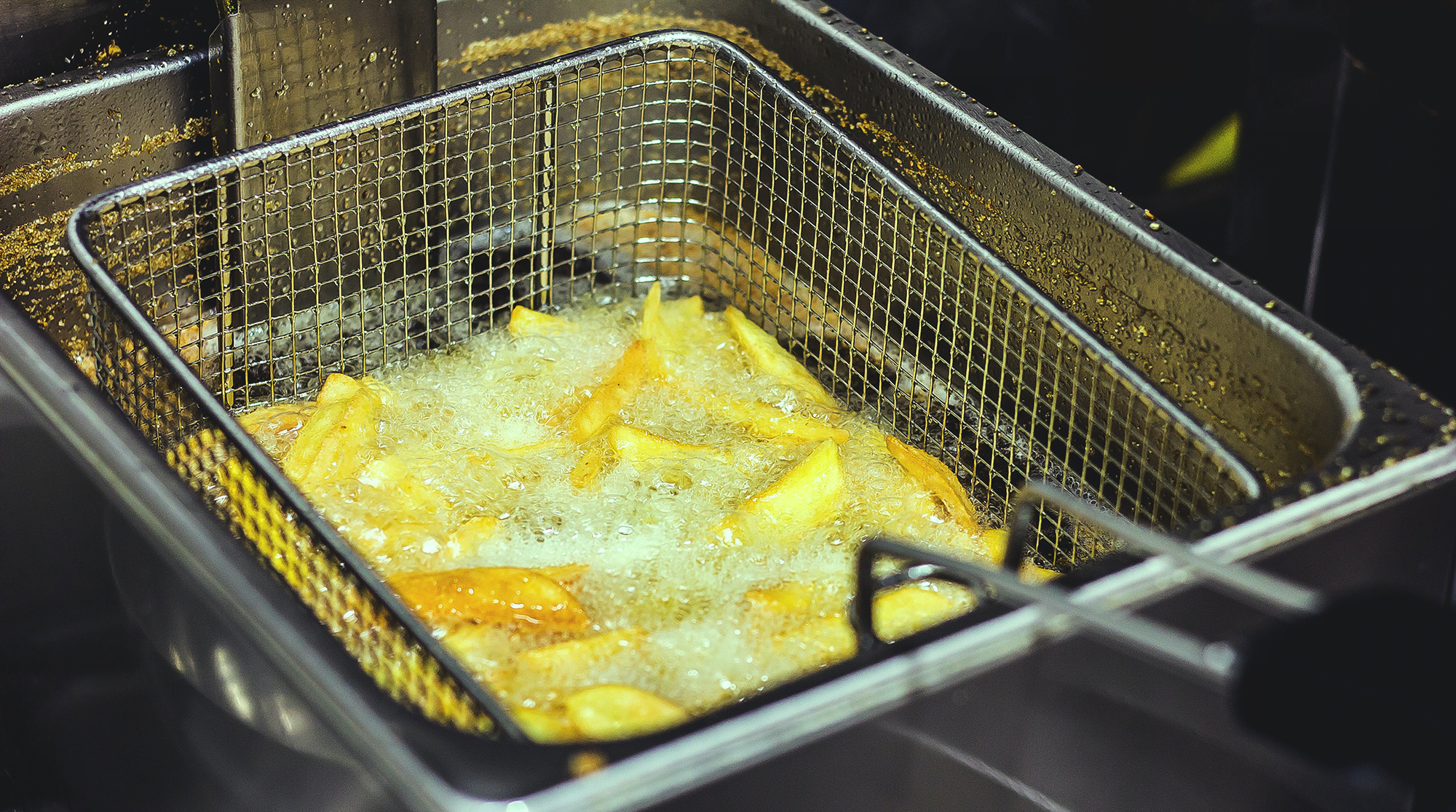
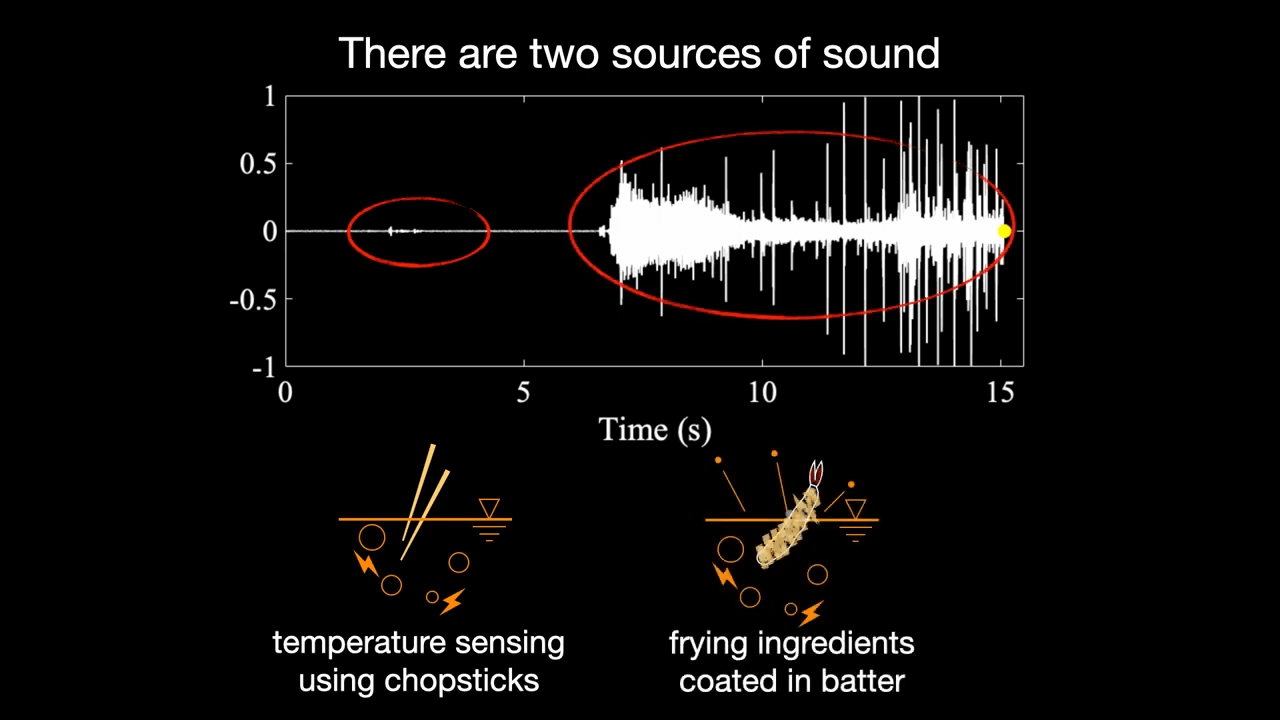
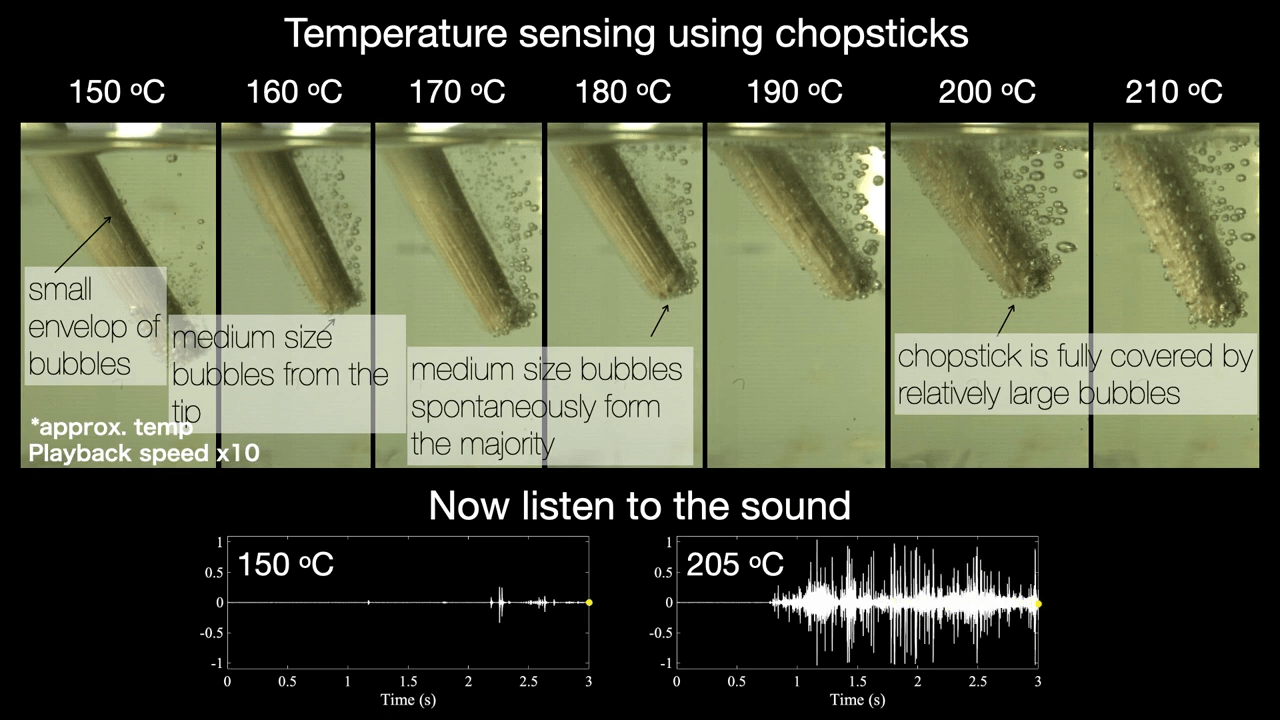
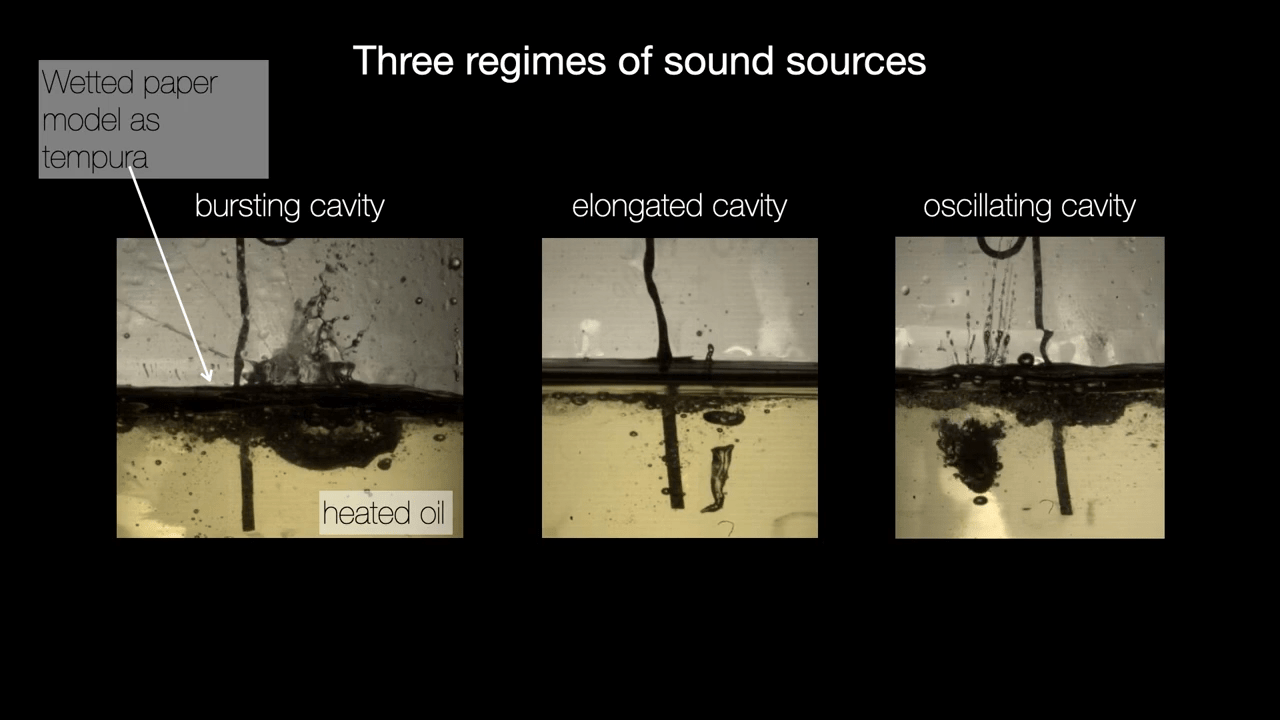
    Most cooks know that their frying oil isn’t hot enough if dropping the food in doesn’t create a furious burst of bubbles. But the canniest cooks know they can check the temperature just by listening to the sound made when inserting a utensil, like a wooden chopstick. When oil nears the right temperature, a cloud of bubbles forms around the utensil, leading to a flurry of sound as those bubbles break.

    In this video, researchers explore the sound and bubble dynamics together as a function of temperature. They show how the final sound carries the signature of the its bursting bubble, too. So next time you’re getting ready to fry and you can’t find your thermometer, don’t panic. Just listen! (Image and video credit: A. Kiyama et al.)

  • Sounds of Champagne

    Sounds of Champagne

    Lean in to a glass of champagne and you’ll hear a soft chorus of sound as the bubbles pop. Recently, researchers determined the specific mechanism in the process that’s responsible for that audible sound.

    Bubbles pop when the thin film of liquid separating them from the atmosphere drains away. The moment the film opens corresponds to the start of the sound, as overpressurized air inside the bubble has a chance to escape. The researchers found that the bubble behaves like a open-ended Helmholtz resonator, and by the time the sound emission ends, the bubble’s collapse has barely begun. (Image credit: L. Lyshøj; research credit: M. Poujol et al.)

  • Featured Video Play Icon

    The Hot Chocolate Effect

    Stir hot chocolate powder into milk or water, and you can recreate this bizarre acoustic phenomenon. Once the powder is mixed in, tapping the side of the cup creates a low pitch that steadily rises as you continue tapping. This is known as the hot chocolate, or allossonic, effect. When you stir, it creates tiny bubbles in the fluid, which changes the effective speed of sound. As the bubbles pop, the speed of sound goes up and the pitch of your tapping gets higher! Stirring the cup up again (even without adding more powder) should lower the pitch once more. (Video credit: C. Kalelkar)

  • The Best of FYFD 2021

    The Best of FYFD 2021

    A year ago I observed what a strange year 2020 had been, and in many ways, I could say the same of 2021. Before the pandemic, I spent quite a lot of time traveling. In 2021, the only nights I slept outside my own bed came on a long weekend up to the mountains with my family. But 2021 also saw a bit of a return to normalcy – I was giving keynote addresses and workshops again, albeit virtually. What will 2022 hold? Who knows?!

    As per tradition, here are the top FYFD posts of 2021:

    1. A superior mirage leaves a ship floating in mid-air
    2. Drone videos of sheep herding are mesmerizing
    3. Permeable pavement allows water to drain
    4. The slow and dreamy fluid landscape of “Le Temps et l’Espace”
    5. What do you do when you’re an insect researcher with a high-speed camera?
    6. Satellite images… or paint?
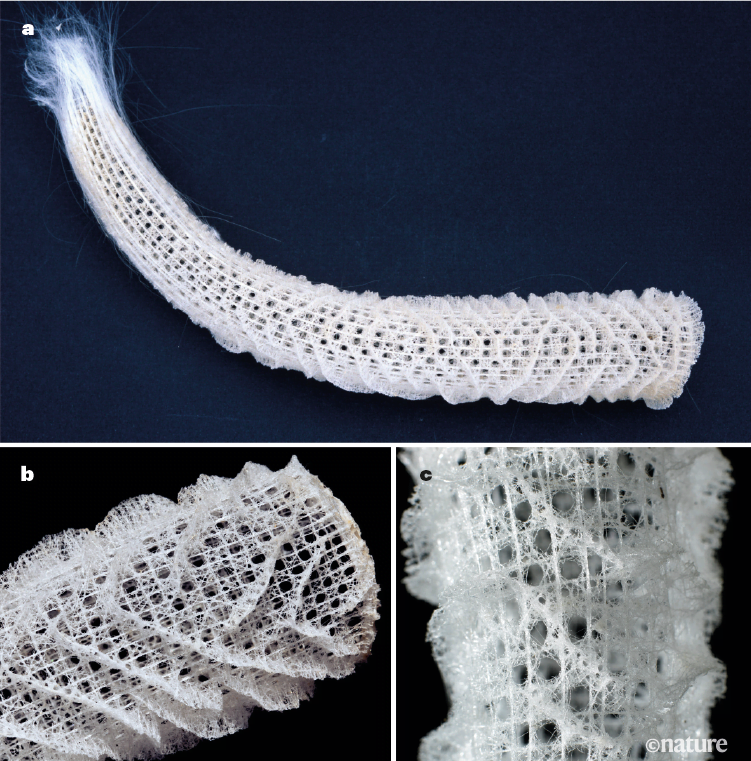
    7. The intricate lacework of the Venus’s flower basket sea sponge
    8. Building a Bluetooth speaker with ferrofluid music visualization
    9. Finding the acoustics of Stonehenge
    10. Making butter by traditional French methods

    It’s an eclectic mix of topics this year: bizarre phenomena, stunning art, archaeological exploration, and a touch of biophysics!

    If you enjoy FYFD, please remember that it’s primarily reader-supported. You can help support the site by becoming a patronmaking a one-time donationbuying some merch, or simply by sharing on social media. And if you find yourself struggling to remember to check the website, remember you can get FYFD in your inbox every two weeks with our newsletter. Happy New Year!

    (Image credits: mirage – D. Morris, sheep – L. Patel, pavement – Practical Engineering, Le Temps – T. Blanchard, insects – Ant Lab, Satellike – R. De Giuli, sea sponge – G. Falcucci et al., speaker – DAKD Jung, Stonehenge – T. Cox et al., butter – Art Insider)

  • The Acoustics of Stonehenge

    The Acoustics of Stonehenge

    Stonehenge has long been an astronomical wonder, but did you know it’s an aural wonder as well? A team of acoustic engineers and an archaeologist constructed and tested a 1:12 scale model of the monument as it existed around 2200 B.C. Their model included 157 3D-printed stones (which took about nine months to print!), carefully engineered to reflect ultrasonic frequencies the way the full-size Stonehenge reflects frequencies in our auditory range. (Using the higher frequency sound at a smaller physical scale allows engineers to match the physics of the real henge.)

    The team found that the stones of the henge amplified sound by about 4 decibels, enough to make a speaker’s voice easy to hear, even when facing a different direction. The structure also provided some reverberation that would enhance musical instruments or singing. Stonehenge had reverberation levels similar to a modern-day large movie theater, which is absolutely incredible for a prehistoric structure constructed in the open air.

    For more interesting details on the model’s construction and testing, check out this article at Physics Today. (Image and research credit: T. Cox et al.)

  • Digging Into Acoustic Levitation

    Digging Into Acoustic Levitation

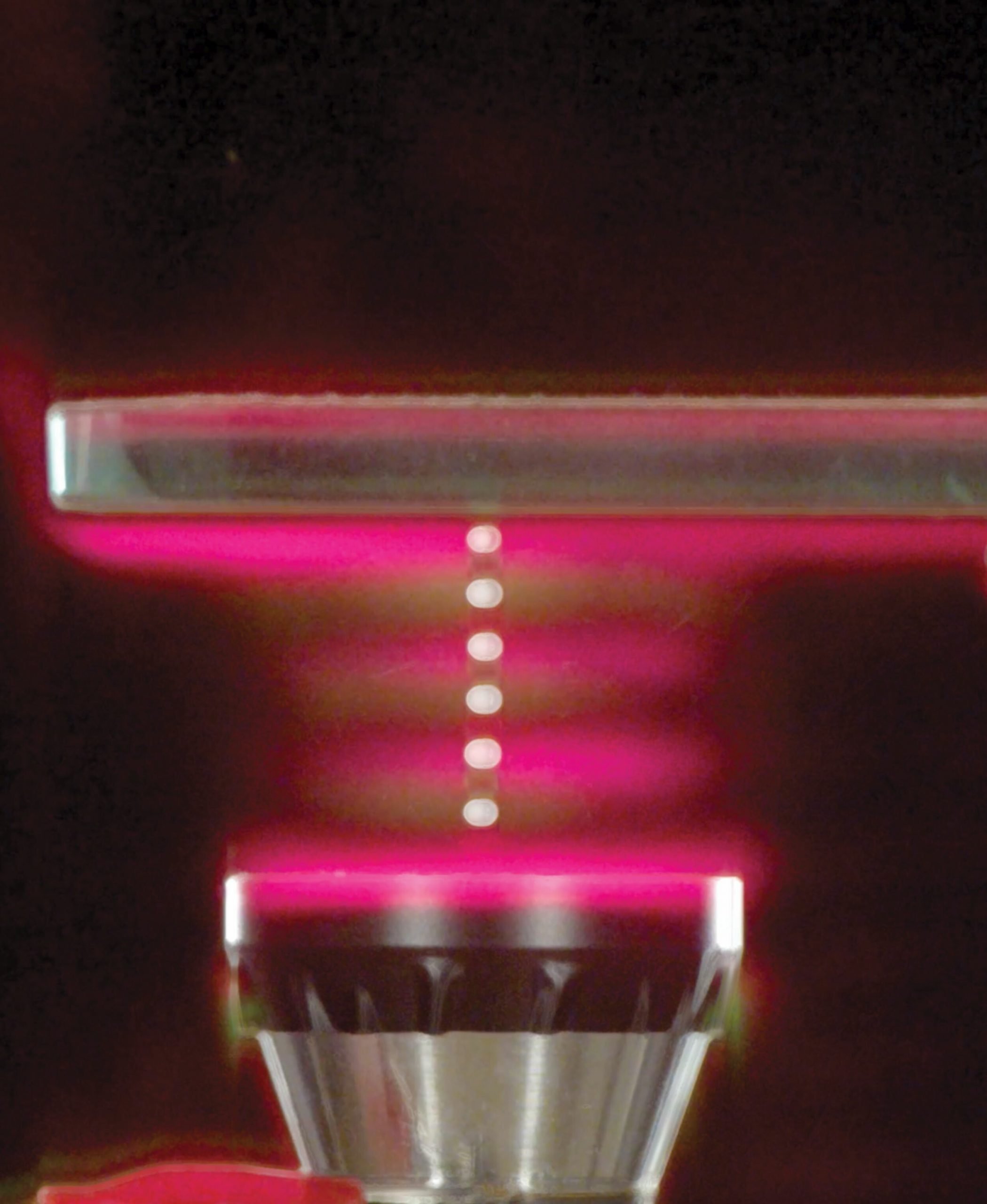
    Acoustic levitation is a fascinating phenomenon in which small objects, like the Styrofoam balls seen here, are levitated by a standing acoustic wave. In this image, a color schlieren system shows regions of increasing pressure with height (red) and decreasing pressure with height (green). The balls sit within the colored bands, indicating that they’re levitated near the standing wave’s pressure nodes.

    Interestingly, a basic (linear) analysis of the acoustics indicates that the balls should levitate at the pressure anti-nodes, but this clearly isn’t the case in reality. As the authors show, understanding acoustic levitation requires a nonlinear analysis, which reveals the acoustic radiation pressure as the force responsible for holding the balls in place near the nodes. Check out their paper for the full analysis! (Image and research credit: D. Jackson and M. Chang; via Physics Today)

  • How Frogs Block Unwanted Noise

    How Frogs Block Unwanted Noise

    In a crowded room, it can be hard to pick out the one conversation you want to hear. This so-called “cocktail party problem” is one animals have to contend with, too, when a noisy landscape can obscure the calls of potential mates. American green tree frogs have a clever solution to the problem: inflating their lungs to dampen out other frog species’ calls.

    This method works because frogs have a direct anatomical connection between their lungs and their eardrums. Researchers found that when these frogs inflate their lungs, there’s a pronounced drop in their sensitivity to sound in the 1.4 – 2.2 kHz frequency band. That frequency range falls between the green tree frog’s peak mating call frequencies, but it coincides with the frequencies of other frogs living in the same regions. So rather than using their lungs to make themselves louder, these clever amphibians use them to make other frogs quieter! (Image credit: B. Gratwicke; research credit: N. Lee et al.; via Physics Today)

  • How the Hummingbird Got Its Hum

    How the Hummingbird Got Its Hum

    Summer hikes in the Rocky Mountains are frequently pierced by a hum that can deepen to a bomber-like buzz as hummingbirds flit by. They’re so small and fast that they’re hard to see, but they’re never hard to hear. A new study pins down just where that telltale hum comes from.

    To determine the specific origin of the hummingbird’s sound, researchers observed hovering hummingbirds with an array of over 2,000 microphones and multiple high-speed cameras. With this set-up, they could create a 3D acoustic map of the bird’s sounds, correlated with its motions. They found that the bird’s sounds come primarily from aerodynamic forces generated during their distinctive wingstroke – not from vortices or the fluttering of their feathers.

    They also found that the hummingbird’s fast wingstroke — about 40 times per second — fed into sounds at 40 and 80 Hz, as well as higher frequency overtones. Since these sounds are well within human hearing range, they make up most of what we hear from the birds. (Image credit: P. Bonnar; research credit: B. Hightower; via The Guardian; submitted by Kam-Yung Soh)

  • The Sounds of Leidenfrost Stars

    The Sounds of Leidenfrost Stars

    On a hot surface, droplets can float on a layer of their own vapor and vibrate in star-like shapes. These so-called Leidenfrost stars also make noise, with distinct beats that match the oscillations of the vapor layer beneath them. Researchers found that the frequency of the sound shifts with droplet size, increasing as the drop size decreases. Physically, the droplets act much like a wind instrument! (Image and research credit: T. Singla and M. Rivera; via APS Physics)

  • Featured Video Play Icon

    Recreating Acoustics

    The cultural heritage of a site is made up of more than its appearance; its soundscape is vital, as well. Acousticians and historians work together to preserve and recreate the auditory landscape of important sites through acoustical measurements and digital reconstructions based on architecture and building materials. Thanks to projects like these, researchers can achieve feats like recreating a concert within the Notre Dame Cathedral as it was before the 2019 fire. To learn more about the technologies behind these feats, check out this Physics Today article. (Image and video credit: Ghost Orchestra; for more, see Physics Today)