Tag: acoustics

  • Dry Plants Warn Away Moths

    Dry Plants Warn Away Moths

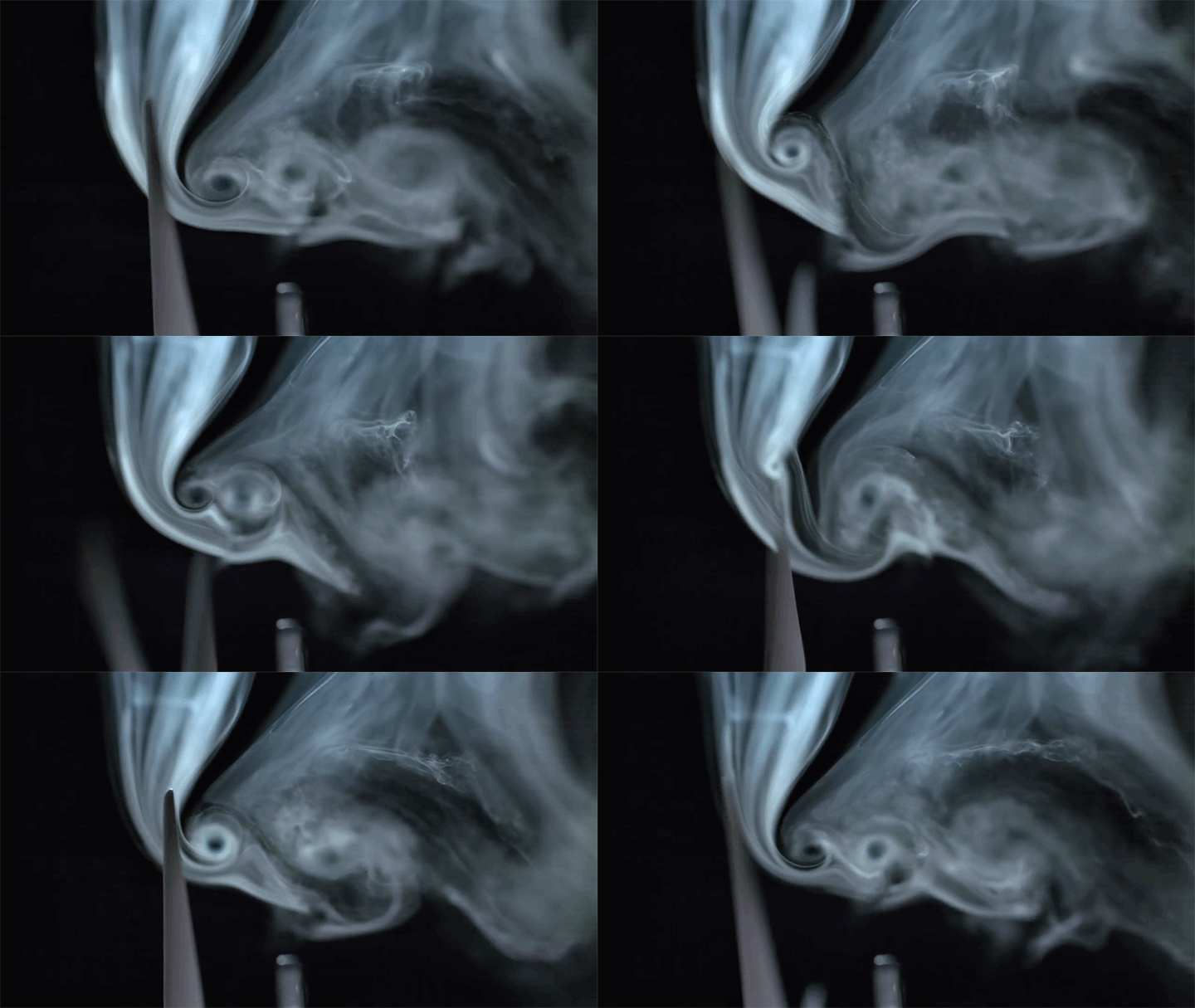
    Drought-stressed plants let out ultrasonic distress cries that moths use to avoid plants that can’t support their offspring. In ideal circumstances, a plant is constantly pulling water up from the soil, through its roots, and out its leaves through transpiration. This creates a strong negative pressure — varying from 2 to 17 atmospheres’ worth — inside the plant’s xylem. If there’s not enough water to keep the plant’s inner flow going, cavitation occurs — essentially a tiny vacuum bubble opens in the xylem. That cavitation isn’t silent; it creates a click at ultrasonic frequencies above human hearing. But just because we don’t hear it doesn’t mean that sound goes unheard.

    In fact, recent research suggests that, not only do moths hear the plant’s cavitation cries, female moths will avoid laying eggs on a healthy plant that sounds like it’s cavitating. Evolutionarily, this makes sense. Hatchlings rely on their birth plant for food and habitat; if an adult moth picks a dying, drought-stressed plant, its offspring won’t survive. It pays to be sensitive to the plant’s signs of distress. (Image credit: Khalil; research credit: R. Seltzer et al.; via NYTimes)

    Fediverse Reactions
  • Inside a Big Cat’s Roar

    Inside a Big Cat’s Roar

    The roars of big cats — tigers, lions, jaguars, and leopards — carry long distances. In part, this reflects the animals’ size: large lungs exhale lots of air through a large voice-box, whose vibrations resonate in a large throat. But size alone does not make the roar. Below are examples of two big cat voice-boxes. On the left is the nonroaring snow leopard; on the right is the voice-box of a roaring jaguar. The red boxes labeled “VF” mark each cat’s vocal folds. Nonroaring cats have triangular folds, while roaring ones have thick square or rectangular vocal folds. These rectangular folds are more aerodynamically efficient, allowing them to produce a wider range of output levels. They’re also more resilient to the intense forces of a roar, thanks to the cushioning effect of fat deposits inside them. If interested, you can learn more over at Physics Today. (Image credit: tiger – T. Myburgh, voice box – E. Walsh and J. McGee; research credit: E. Walsh and J. McGee)

    The vocal folds (VF) of nonroaring cats are triangular (left), whereas roaring cats have rectangular vocal folds (right).
    The vocal folds (VF) of nonroaring cats are triangular (left), whereas roaring cats have rectangular vocal folds (right).
  • Featured Video Play Icon

    “Echo”

    Daniel Kish is an echolocation pioneer, teaching fellow blind people to navigate the world independently. By clicking or tapping and listening to how the sound reflects back, Kish and his students are able to construct a mental map of the world around them. The technique is so effective that they’re able to ride bikes or, as shown with one student in the documentary, learn to skateboard. Check out the full video to see them in action and get a sense of how echolocation works. (Video and image credit: The New Yorker)

  • Sensing Sound Like Spiderwebs

    Sensing Sound Like Spiderwebs

    Most microphones — like our ears — work by sensing the tiny pressure changes caused by a sound wave‘s passing. But for microphones built this way, the smaller they get, the more sensitive they are to thermal noise. That’s one reason that the tiny microphones in a laptop or webcam just don’t sound as good as larger mics.

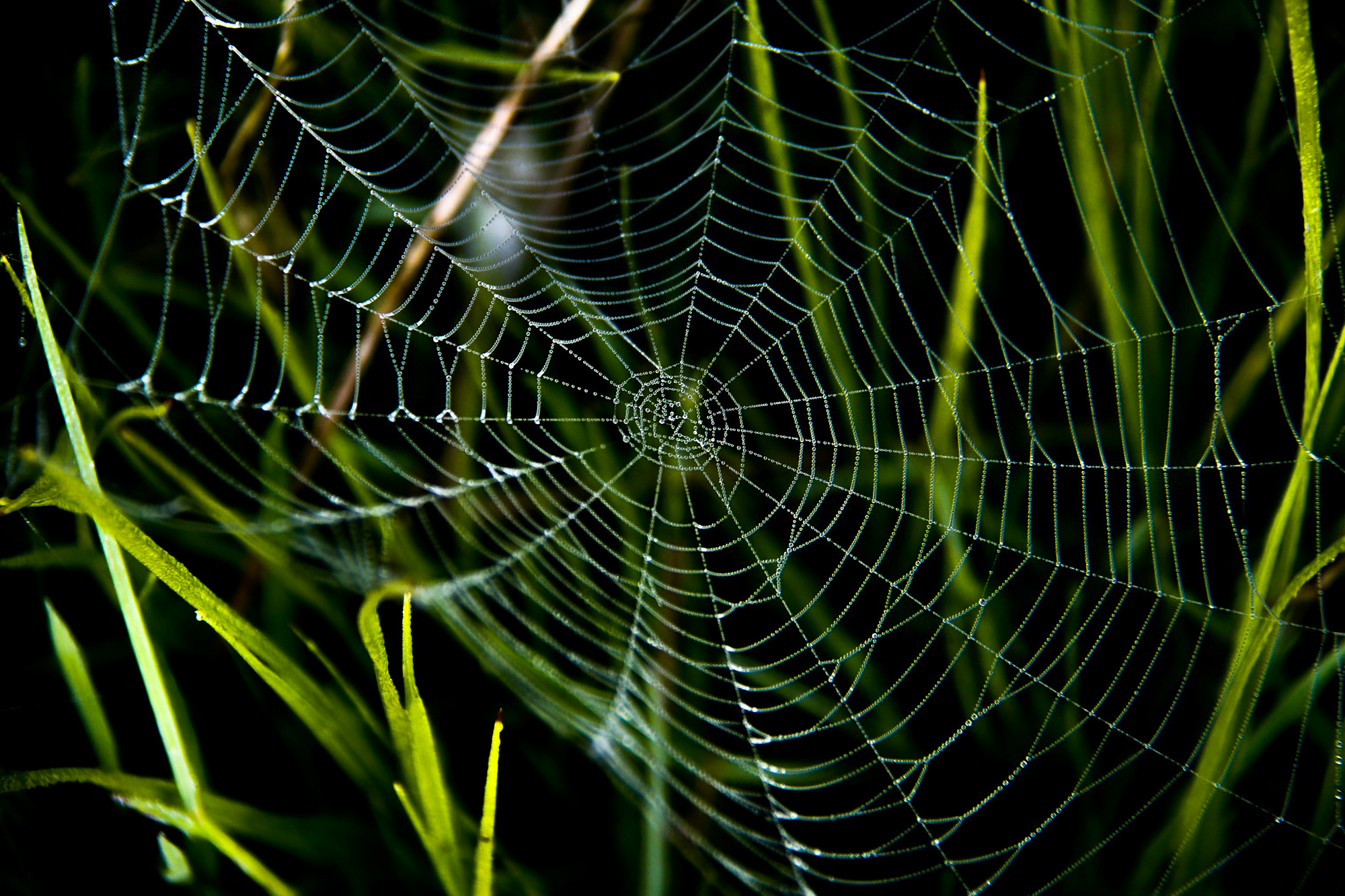
    Researchers turned to nature to look for alternative ways to measure sound and zeroed in on the mechanism spiders use. Spiders “listen” to their web’s vibrations; the tiny strands of silk quiver as air flow from a sound moves past. Instead of being pressure-based, this mechanism uses viscous drag to register a sound.

    The team fabricated an array of microbeams to test the concept of a viscosity-based microphone and found that tiny beams sensed sounds just as well as larger ones. That means these microphones can get smaller without sacrificing performance. For now, they’re not as sensitive as conventional microphones, but that’s not surprising, given that engineers have been improving pressure-based microphones for 150 years. It’s a promising start for a new technology, though. (Image credit: N. Fewings; research credit: J. Lai et al.; via APS Physics)

  • How Moths Confuse Bats

    How Moths Confuse Bats

    When your predators use echolocation to locate you, it pays to have an ultrasonic deterrence. So, many species of ermine moths have structures on their wings known as tymbals. These areas have a band of ridges, and, when the moth’s wing lifts or falls, the ridges buckle one-by-one. A nearby bald patch on the wing acts as an amplifier, making these ultrasonic snaps louder. Altogether, the mechanism deters prowling bats anytime the moth flaps its wings — without any additional effort on the moth’s part. Since the moths have no ears, they presumably don’t even know that they’re making the sound! (Image credit: Wikimedia/entomart; research credit: H. Mendoza Nava et al.; via APS Physics)

  • The Sound of Bubbles

    The Sound of Bubbles

    Every day I stand in front of my refrigerator and listen to the water dispenser pouring water into my glass. The skinny, fast-moving jet of water plunges into the pool, creating a flurry of bubbles. Those bubbles come from air the water jet pulls in with it, and the sound the water makes (minus the fridge’s noises) comes from those bubbles. A short, laminar jet will make fewer bubbles and, therefore, be quieter than a a jet that falls farther before hitting the water.

    The reason? That tall jet falls for long enough that its walls start to wobble or even break up completely into separate droplets. Compared to a smooth jet, these wobbly or broken-up jets pull in more air and create more bubbles. That makes them louder. Researchers even suggest that listening to these bubbles can give a noninvasive method for finding how much fresh oxygen is in the water. (Image credit: R. Piedra; research credit: M. Boudina et al.; via APS Physics)

  • A Better Ear Plug

    A Better Ear Plug

    Ear plugs can be wonderful at blocking outside noise, but they come with a downside: they typically amplify internal bodily sounds, like our heartbeat, breathing, and chewing. This effect, called occlusion, is distracting enough for some users to forego ear protection or hearing aids. But a new prototype offers a hope for an occlusion-free future without requiring active noise-cancelling.

    Most devices fit a short way inside our ear canals, which blocks outside sound well, but creates a little resonance chamber between the plug and our ear drums. It’s this gap that amplifies the low-frequency sounds within our bodies, making them seem much louder. To counter that, the team’s new plug contains foam sections arranged with hollow spaces between. By tuning the properties of the 3D-printed foam, they created a resonant structure inside the earbud that damps out those low-frequency body noises while still blocking outside sound.

    Illustration of the earbud's interior. The blue and green areas are foam-filled cavities.
    Illustration of the earbud’s interior. The blue and green areas are foam-filled cavities.

    So far the prototype has only been tested with an artificial ear designed for auditory tests; that’s enough to show that the concept works, but next they’ll redesign the bud to fit a human ear canal more comfortably. (Image and research credit: K. Carillo et al.; via APS Physics)

  • Bravo!

    Bravo!

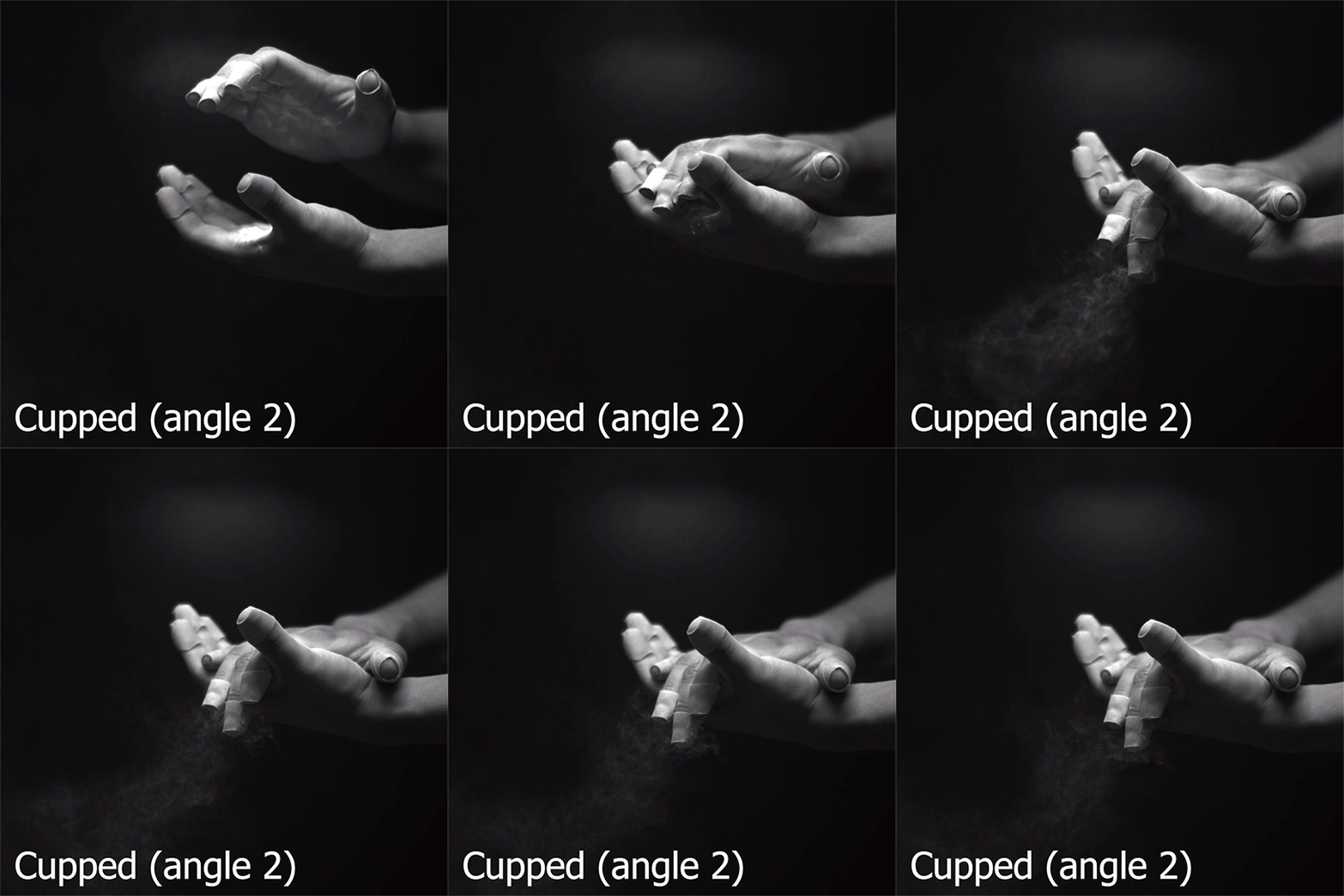
    Applauding is a familiar activity, but, as you stand for an encore in the concert hall, do you think about how you hold your hands and how that affects your clap? That question prompted two scientists to embark on an acoustical exploration of clapping. By testing 11 different ways to hold their hands during clapping, the duo found some interesting results.

    The loudest clap — achieving an average of 85 decibels — held the hands at 45 degrees to one another, with palms partially overlapping (A2 in the figure). But the clap that most pleased the ear was a little different (A1+). It kept the 45 degree orientation, but the palms overlapped fully with a domed shape between them. In that configuration, the palms form a little resonance chamber that makes the clap sound deeper and richer. (Image credits: top – G. Latorre, others – N. Papadakis and G. Stavroulakis; research credit: N. Papadakis and G. Stavroulakis; via Physics World)

    Scientists studied the sounds made from clapping in 11 different hand configurations.
    Scientists studied the sounds made from clapping in 11 different hand configurations.
  • Featured Video Play Icon

    The Physics of Vowels

    Blow across the top of a glass bottle, and you’ll get a whistle-like sound. Put some liquid in there and the pitch of the sound changes. Our vocal tracts are basically the same thing: a tube with a hole at the end. But as Joe Hanson shows in this Be Smart video, our ability to change the shape and resonance of our vocal tract by moving our tongues and lips enables us to make a wide range of vowel sounds. Enjoy this dive into the world of linguistic physics! (Video and image credit: Be Smart)

  • Shouting Into the Wind is Easier Than You Think

    Shouting Into the Wind is Easier Than You Think

    “Shouting into the wind” usually means a failure to communicate, but it turns out that shouting into the wind doesn’t work the way people usually think. In fact, it’s easy for people upstream to hear your shouting, thanks to an acoustical effect called convective amplification. You’ve likely experienced it firsthand as an ambulance approaches. With its sirens blaring, the ambulance sounds louder as it comes toward you and quieter after it’s past. (This is separate from the Doppler effect, which changes the pitch of the approaching and receding vehicle.)

    So why does shouting into the wind seem so hard? It’s because your ears are downstream of your mouth. Like the ambulance that’s already gone by, your voice comes from ahead of your ears and therefore sounds quieter to you than it does to your audience upstream. (Image credit: I. Huhtakallio; research credit: V. Pulkki et al.; via Science News; submitted by Kam-Yung Soh)