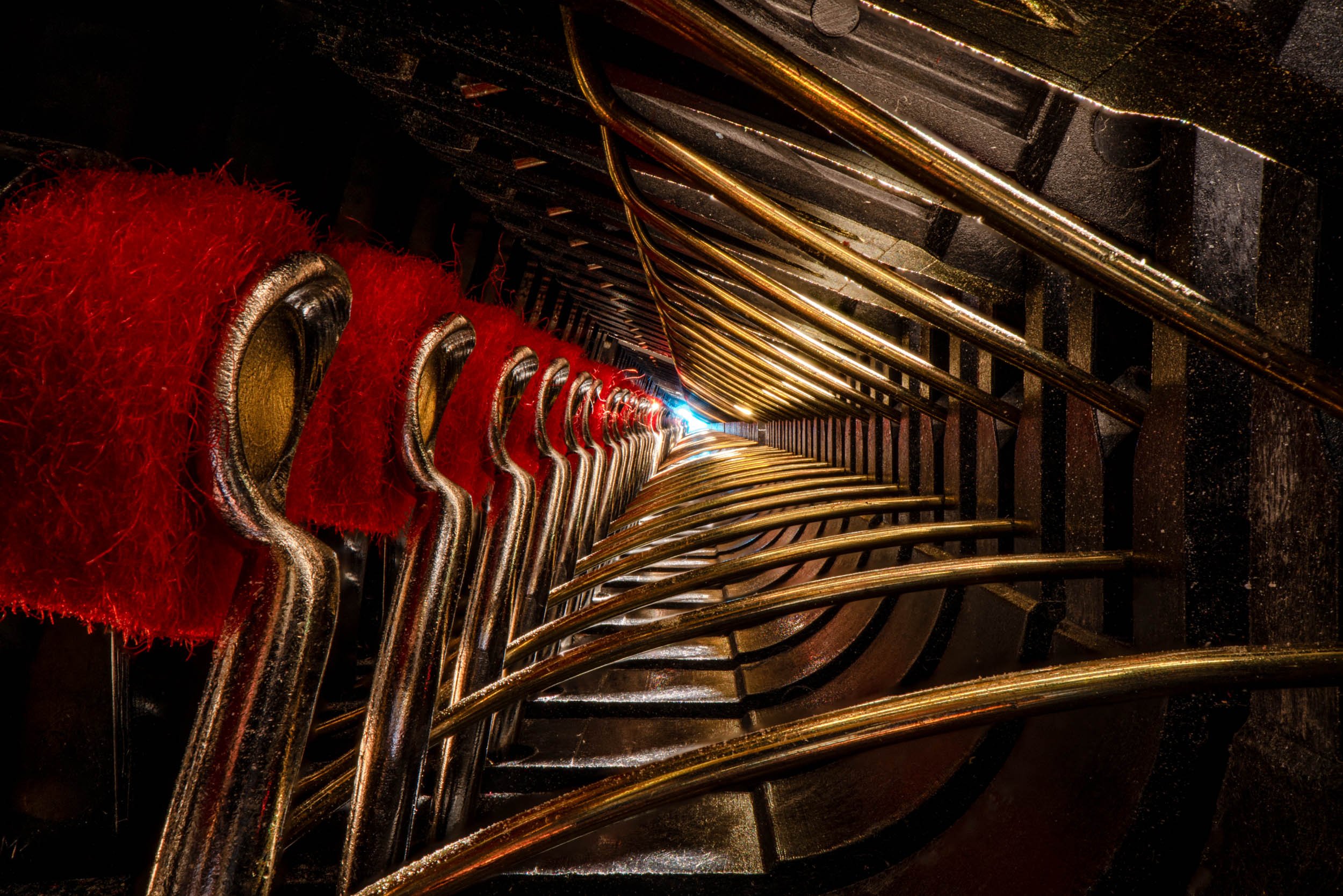
Photographer Charles Brooks offers a rare glimpse into the interiors of musical instruments in this series. Whether stringed, wind, or percussion, an instrument’s unseen interior structure creates the acoustic resonance needed for their music. Brooks makes these spaces feel like vast cathedrals of sound, which, to the pressure waves emanating from the instruments, they are. Which is your favorite? Personally, I love the graceful lines of the cello and the rough surface of the didgeridoo. (Image credit: C. Brooks; via Colossal)
Tag: acoustics

Acoustic Cameras
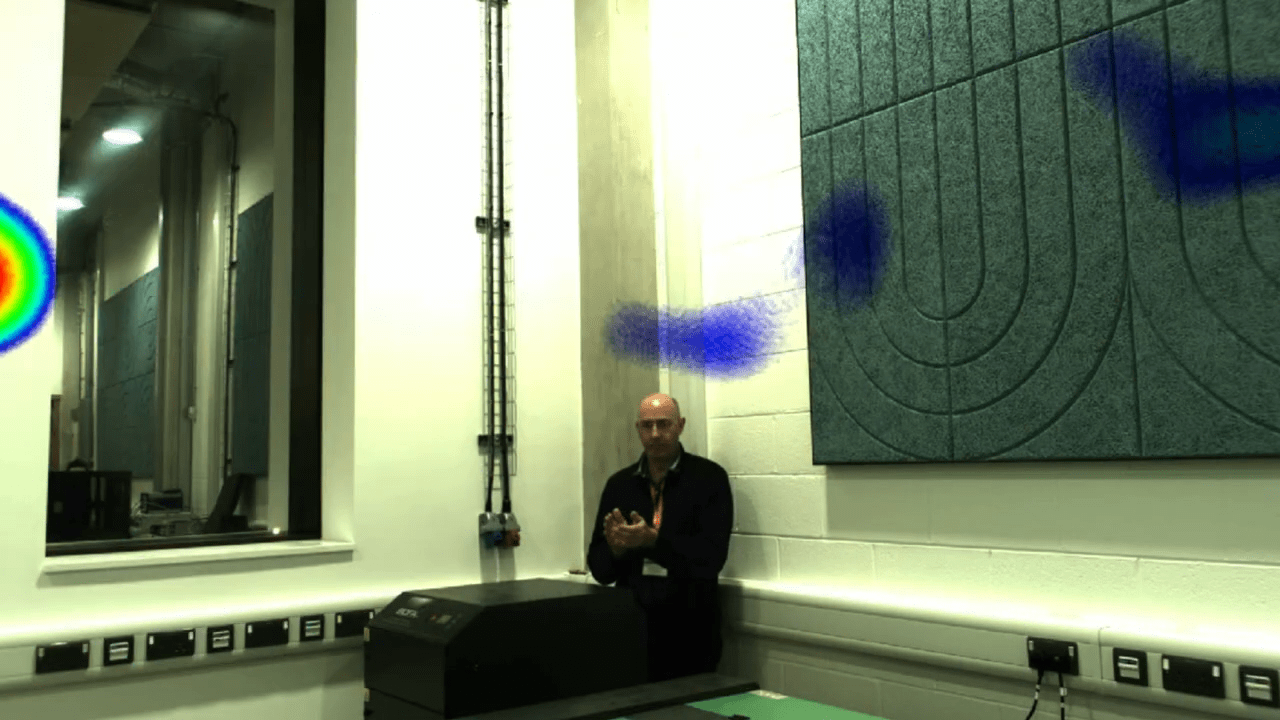
Acoustic cameras use arrays of microphones to isolate where sounds are coming from. As Steve Mould shows in this video, they have some incredibly cool properties. They can show engineers which part of a device is producing particular sound frequencies, which is handy, for example, when trying to quiet a vacuum cleaner or learn which wheels on a train need maintenance. They can also show how sound moves around a room; near the end of the video, you can see the echo from a clap flashing around a room. Check out the full video for more! (Video credit: S. Mould)

Listen to a Martian Dust Devil
A lucky encounter led the Perseverance rover to record the first-ever sound of a dust devil on Mars. The rover happened to have its microphone on (something that only happens a few minutes every month) just as a dust devil swept directly over the rover. Check out the video above to see and hear what Perseverance captured.
Using the rover’s instrumentation, researchers worked out that the dust devil was at least 118 meters tall and about 25 meters wide. The team was even able to determine the density of dust in the vortex from the sound of individual grain impacts captured in the acoustic signal! Serendipitous as the experience was, planetary scientists may now look to include microphones on more missions, since we now know how to get useful meteorological data from them. (Video credit: JPL-Caltech/NASA; image credit: LPL/NASA; research credit: N. Murdoch et al.; via AGU Eos; submitted by Kam-Yung Soh)

Recreating the Rings of Power Opening
Everyone loves a good title sequence, especially when they feature neat visuals. Many who watched “The Rings of Power” zeroed in immediately on their use of cymatics — visuals born from the vibrations of sound. In the video above, Steve Mould delves into the physics behind cymatics and recreates patterns similar to those in the show’s opening, which was a mixture of CGI and live action.
For Tolkien fans, the opening sequence holds additional layers of meaning; in Tolkien’s mythology, the universe is born from song, and many of the patterns shown in the opening — the two trees, Fëanor’s star, and the Silmarils themselves — are drawn directly from Tolkien’s myths. In a way, the opening sequence tells the story of the creation of Arda and the rise of Sauron’s predecessor, Melkor/Morgoth, and all the events that led to the show itself. It’s incredibly cool, both from a physics perspective and a literary one. (Image and video credit: S. Mould)

Absorbing Sound with Moth Wings
Manmade soundproofing tends to be porous and bulky or very limited in the range of frequencies it can handle. In contrast, moths are natural absorbers of ultrasound, having evolved to avoid reflecting those frequencies back to the bats hunting them. Researchers took the structures from a moth wing and applied them to an aluminum disk to see how the coating performed. They found that the moth wing’s structures reduced sound reflection by as much as 87% at the lowest frequency tested (20kHz, still beyond human hearing.) As researchers explore how the individual structures of the wing perform, they hope to adapt the moth’s prowess to soundproof within the human range of hearing. (Image and research credit: T. Neil et al.; via Physics World)

Aligning by Bubble Array
Assembling structures from small components is often difficult. Techniques like optical tweezers are limited to very small objects, and magnetic techniques only work with certain materials. Here, researchers use acoustical forces on bubbles to move and align centimeter-sized objects.
When a single bubble oscillates in an ultrasonic field, its changing size creates pressure variations around it. When an acoustic wave scatters off one bubble and impacts another, it sets up a small attractive force between the bubbles, known as the secondary Bjerknes force. For individual bubble pairs, this force is extremely small and unable to affect much. But using arrays of bubbles — one array on a fixed object and another on a floating object — researchers amplified the attraction and showed that the resulting forces could manipulate and align their components. (Image credit: top – J. Thomas, others – R. Goyal et al.; research credit: R. Goyal et al.; via APS Physics)

Perturbations
At first glance, today’s video appears to have little to do with fluid dynamics since it’s a demonstration of interactions between magnets. But for those who’ve delved into the mathematics of fluid dynamics — especially subjects like perturbation theory — there’s a lot to appreciate here. In the video, we see systems of magnets constructed and then manipulated, often by moving a single magnet and watching how the rest respond. Visually, this demonstrates how disturbances move in complex, interconnected damped systems. The auditory component — definitely turn the sound on for this video — is an extra layer of fluids-related goodness that also shows how reconfiguring a system changes its resonant frequencies. (Image and video credit: Magnetic Tricks and Magnetic Games; via Colossal)

Sonic Booms and Urban Canyons
In the days of the Concorde — thus far the world’s only supersonic passenger jet — noise complaints from residents kept the aircraft from faster-than-sound travel except over the open ocean. With many pursuing a new generation of civil supersonic aircraft, researchers are looking at how those sonic booms could interact with those of us on the ground.
In this study, researchers simulated the shock waves from aircraft interacting with single and multiple buildings on the ground. They found that the presence of a building increases the perceived sound level of the boom by about 7 dB at the most. But the most interesting results are what happens between multiple buildings.
If the street between buildings is wide enough, they each act independently, as if they were single buildings. But for narrower streets, the acoustics waves reflect and diffract between the buildings, creating a resonance that makes the acoustic echoes last longer. The effect is especially pronounced for a sonic boom traveling across a series of buildings, which mimics the layout of a dense city full of urban canyons. (Image credit: Concorde – M. Rochette, simulation – D. Dragna et al.; research credit: D. Dragna et al.)

Acoustic waves reflect and propagate through 2D urban canyons with widths of 10 meters (top), 20 meters (middle), and 30 meters (bottom). 
Whistle Physics
Ever wondered how whistles work? Depending on the type of whistle, there are a few different phenomena in play, but the most fundamental one is the oscillation of a fast-moving air stream. Any small deviation in the air stream can set up a situation where the flow shifts side-to-side, and most whistles use this oscillation to drive the sound they produce.
Many whistles direct the air flow onto a wedge-shape to strengthen the oscillation; then they have a cavity that amplifies the sound using resonance. Water whistles — which warble in a bird-like way — do the same thing, but the water inside them creates a shape-changing cavity, thereby changing the pitch to create an unsteady, warbling sound. You can see all these whistles and more deconstructed in Steve’s video. (Video and image credit: S. Mould)