Tag: acoustics

  • Avoiding Shear Thickening

    Avoiding Shear Thickening

    Many substances – like the cornstarch and water mixture above – exhibit a property called shear-thickening. In these fluids, deforming them quickly causes the viscosity to increase dramatically. That shear-thickening occurs when particles inside the fluid jam together, creating large chains able to resist the force being applied. That’s why the oobleck on this vibrating speaker can sustain these “cornstarch monsters”.

    Shear-thickening is useful in many contexts, but it’s problematic during manufacturing, when pumping these substances can become incredibly difficult due to the fluid’s innate resistance to flowing. A new study, though, finds that it’s possible to temporarily suppress shear-thickening using acoustic waves. The researchers used piezoelectric devices to generate acoustic waves at a frequency around 1 MHz while shearing the cornstarch mixture. The acoustic waves disrupt the formation of particle chains inside the mixture, keeping its viscosity 10 times lower than during regular shear-thickening. (Image credit: bendhoward, source; research credit: P. Sehgal et al.; submitted by Brian K.)

  • Seeing Sound

    Seeing Sound

    It’s not always easy to imagine how waves travel, but with this demonstration, you can see sound waves and how they reflect and defract. The set-up uses schlieren optics that show light and dark bands where strong changes in density take place. This, combined with a stroboscopic light, makes it possible to see the wave fronts from the acoustic transducer on the left side of the screen. Once the wave is apparent, introducing a reflective object lets us see exactly how sound waves bounce, reflect, and interfere. (Image and video credit: Harvard Natural Sciences Lecture Demonstrations)

  • Featured Video Play Icon

    Seeing with Sound

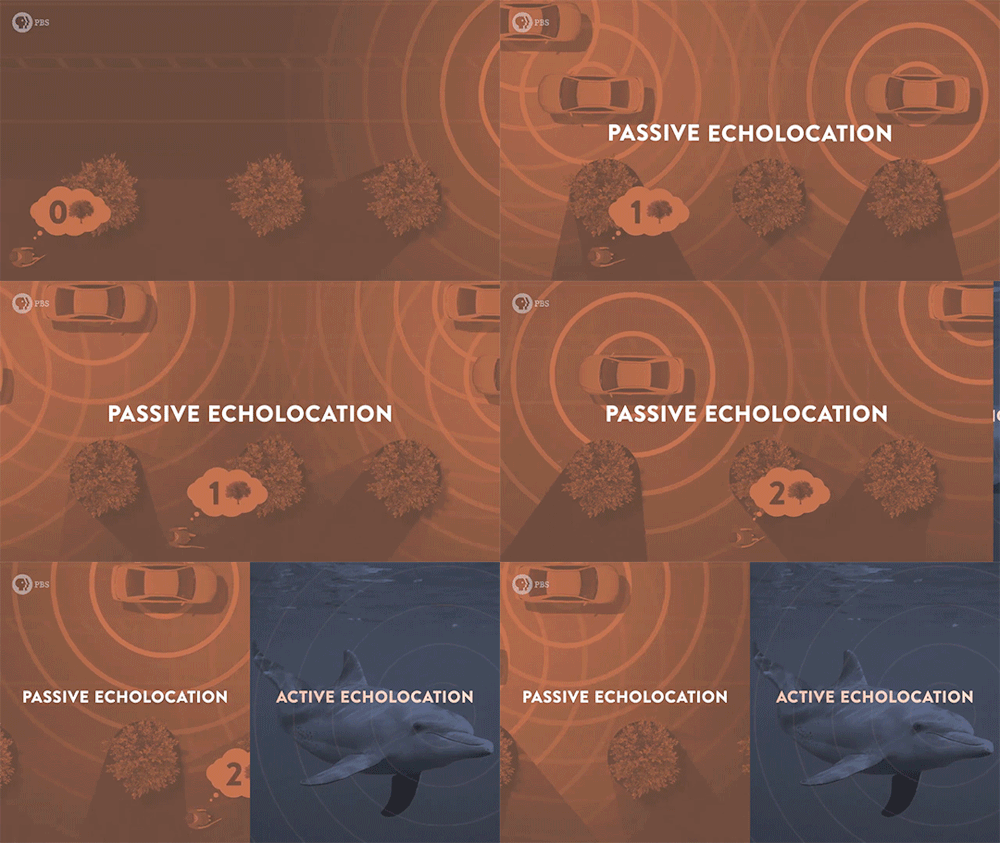
    Sound carries rich information about the environment through which it’s traveled. And while many sighted people never take the time to notice this, using sound to build a mental picture of the surrounding world is something many blind people do constantly, either by studying how sounds produced by others change (passive echolocation) or by using their own sounds to pinpoint what’s around them (active echolocation). 

    In the latest It’s Okay to Be Smart video, you have a chance to learn some of the basics of active echolocation and how you can train your brain to recognize and process this extra environmental information. 

    Personally, I am not very good at this. I can hear edges but it turns out I’m very bad at figuring out where they are. That said, having spent time recently in a few anechoic chambers – where sound reflection is almost completely damped out – I’ve come to realize that even as a sighted person, I rely on sound a lot more than I think I do! (Video and image credit: It’s Okay to Be Smart)

  • Seeing the Song

    Seeing the Song

    We can’t always see the flows around us, but that doesn’t mean they’re not there. Audobon Photography Award winner Kathrin Swaboda waited for a cold morning to catch this spectacular photo of a red-winged blackbird’s song. In the morning chill, moisture from the bird’s breath condensed inside the vortex rings it emitted, giving us a glimpse of its sound. (Image credit: K. Swaboda; via Gizmodo; submitted by Joseph S and Stuart H)

  • Featured Video Play Icon

    Experimenting with Speakers

    In her ongoing quest to explore natural resonance, Dianna has enlisted some very nice, very expensive speakers to find out just what happens when the bass drops. If you ever wondered what the natural frequency of your eyeballs is, then this one’s for you.

    If you’re more intrigued by the idea of putting out fires with sound (and/or explosions), I’ve got some posts on that including a sound-based fire extinguisher and a supersonic cannon capable of blowing out fires. (Video credit: Physics Girl)

  • Featured Video Play Icon

    Fighting Resonance

    Resonance is a funny creature, as Dianna discovered when she tried to sing a rising scale through a tube. At certain notes, everyone who attempted to do it had their voices crack. Tracking down the source of the mystery means digging into what exactly resonance is and what the differences are between driving a system just before, at, and after resonance. Check out the video for the full acoustic story. (Video credit: Physics Girl)

  • Noisy Jets

    Noisy Jets

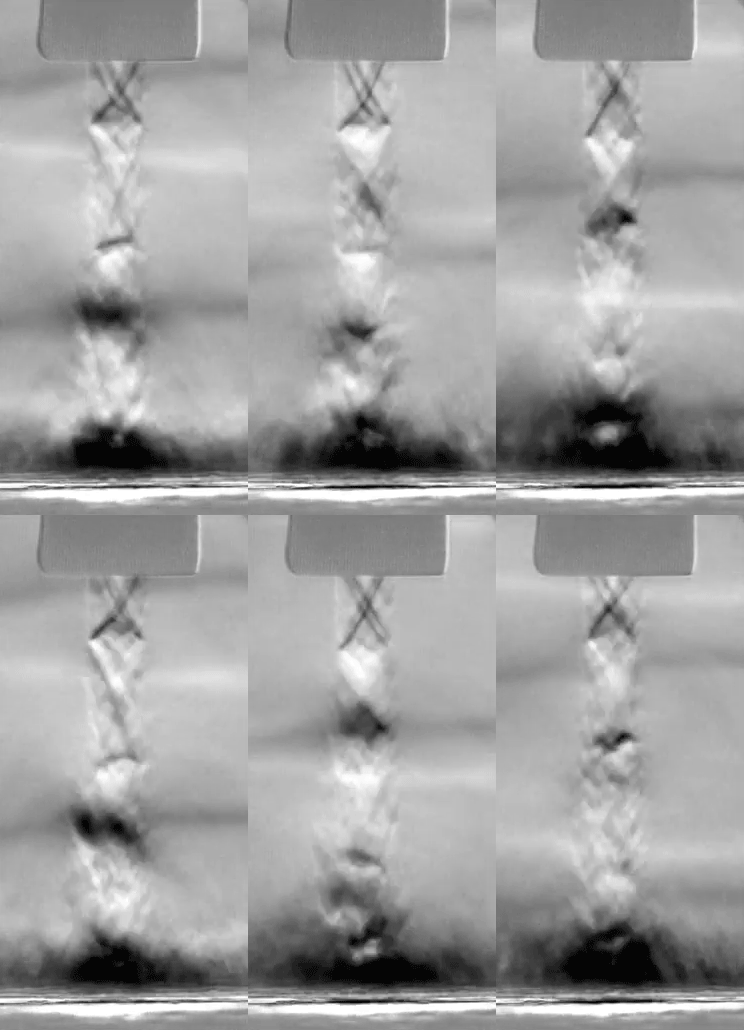
    One major problem that has plagued supersonic aircraft is their noise. The Concorde – thus far the only supersonic commercial airliner – was plagued with noise complaints that ultimately restricted its usability. Noise reduction is a major area of inquiry in aerospace, and the video below shows one experiment trying to understand the connections between supersonic flow and noise.

    Above you see a supersonic, Mach 1.5 microjet emanating from a nozzle at the top of the image. The jet is hitting a flat plate at the bottom of the image. Just beyond nozzle’s exit, you can see the X-shape of shock waves inside the jet. The position of that X is oscillating up and down.

    In the background, you can see horizontal light and dark lines traveling up and down. Those horizontal lines in the background are acoustic waves. When they hit the bottom plate, they reflect and travel upward until they hit another surface (outside the picture) and reflect back down. As they travel, they interact with the jet, causing those X-shaped shock waves to move up and down. This coupling between flow and acoustic waves makes the jet much louder – up to 140 dB – than it would be otherwise.

    Researchers hope that unraveling the physics of simpler systems like this one will help them quiet more complicated aircraft. (Image and video credit: F. Zigunov et al.)

  • Featured Video Play Icon

    Sonic Tractor Beam

    Acoustic levitation uses the radiation forces generated by sound waves to trap small, lightweight particles at the nodes of standing waves. We’ve seen this a number of times previously, both with solid objects and liquid droplets. What makes this example particularly impressive, though, is that these researchers use an array of speakers to manipulate multiple objects at once. Check out the video above for a whole series of clips from the research. (Video credit: Science; research credit: A. Marzo and B. Drinkwater)

  • Rattling Feathers for Attention

    Rattling Feathers for Attention

    Peacocks are known for their colorful mating displays, but it turns out there’s more to them than meets the eye. To help them gain a penhen’s attention, peacocks will sometimes rattle their train-feathers. The sound this makes is mostly below the range of human hearing, but the rustle creates subtle vortices in the air that cause the feathers atop a peahen’s head to vibrate. Playing back the sound at peahens from typical train-rattling distances also gets the females’ attention. Researchers found the playback makes peahens’ crests vibrate at a resonant frequency, suggesting that these feathers are for more than display; they’re used for communication as well! (Image and research credit: S. A. Kane et al.; video credit: Science)

  • Ricequakes

    Ricequakes

    Rockfill dams, sinkholes, ice shelves, and other geological features often consist of brittle, porous materials that are partially submerged. Over time, pressure and chemical reactions with the fluid around them can cause these structures to collapse, but it can take many, many years. 

    To study the physics behind this, researchers have turned to a new model: puffed rice cereal. Like their counterparts in nature, puffed rice grains contain micropores that slowly soften and get crushed after being wetted. Researchers filled their test container with puffed rice and put it under pressure to give the whole stack a constant stress. Then they injected milk in the bottom section of the container. After an immediate collapse in the wet material (lower left), the remaining grains collapsed slowly in a series of “ricequakes”. 

    As the micropores compacted, the cereal let out audible cracks that corresponded with the motion of a crushing wavefront (lower right). The time between ricequakes increased linearly and depended on pore size. The relationship was so consistent, researchers found, that they could predict how long the puffed rice stack had been wet simply by listening to the time between crackles! Experiments like these offer scientists an exciting chance to understand geological physics that would otherwise take up to millions of years to observe. (Image and research credit: I. Einav and F. Guillard; via Physics World; submitted by Kam-Yung Soh)