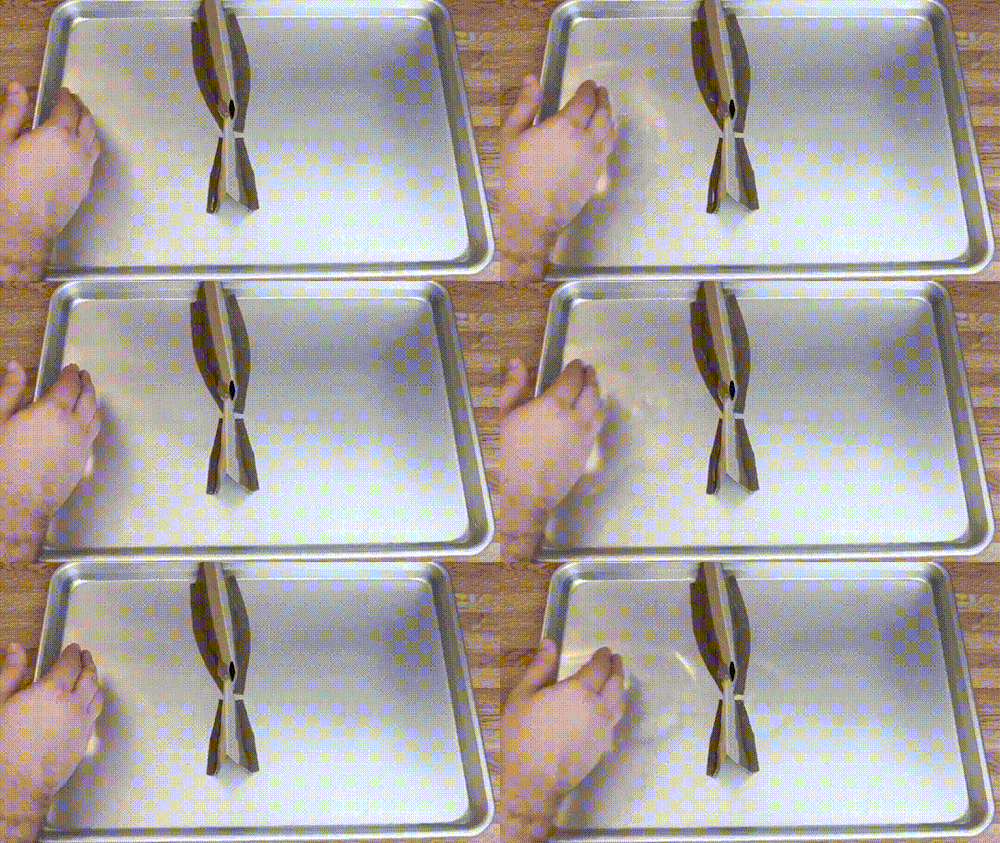
Wave phenomena can sometimes be a little difficult to wrap one’s head around. In this video, Mike from The Point Studios explains wave diffraction and why opening a window can help you spy on the conversation next door. Diffraction occurs when waves encounter an obstacle. If that obstacle is a slit in a wall, the slit becomes a point source, radiating waves outward spherically. The video focuses on acoustics, but diffraction matters in more than just sound – it’s key to water ripples, light and other electromagnetic waves, and, according to quantum theory, the fundamental building blocks of matter. (Video credit: The Point Studios)
A recent viral video features mesmerizing footage of a giant octopus kite flown at a kite festival in Singapore earlier this month. The kite’s arms twist and wave lazily in the breeze. Watching the video, I was struck by how realistic the kite’s motion looks. It really looks like an octopus is just cruising there in mid-air. And that resemblance might not be accidental.
In fluid dynamics, scientists often use a concept called dynamic similitude to test the physics of a scale model instead of the full-size original. The simplest version of this uses the Reynolds number to compare the model and the original. The Reynolds number is a dimensionless number that depends on the object’s size, the flow’s speed, and the density and viscosity of the fluid. If you match the scale model’s Reynolds number to the original’s Reynolds number, then the physics will be the same – even if you changed the fluid or the size of the object.
Returning to our kite, one thing the footage doesn’t entirely convey is just how enormous this kite really is. The Straits Times reports the kite is about the length of five buses and requires six people to get aloft. But the kite’s size helps compensate for the fact that it’s flying in air instead of swimming through viscous water like a real octopus. Although I’m left estimating the kite’s size and the wind’s speed, my quick calculations put the Reynolds numbers for the kite and the octopus on the order of 10,000. So, strange as it seems, this giant kite really is acting like a swimming octopus!
Our atmosphere is full of aerosols – extremely tiny particles and droplets of salt, dust, pollutants, and other substances. Wind’s effects alone cannot account for the sizes and quantities of aerosols we measure. Another potential source is the bursting of bubbles; more specifically, the bubbles that form at the oceans’ surface. Frothy, crashing waves often capture pockets of air. When these bubbles burst, the thin film of their surface ruptures into long filaments that break into tiny droplets. Such droplets can be small enough to get carried on the breeze, eventually evaporating and leaving the particulates that were once in the water to ride the winds. (Image credit: H. Lhuissier & E. Villermaux; see also: Y. Couder)
The blue-outlined dolphins you see above get their glow from microorganisms called dinoflagellates. They are a type of bioluminescent plankton, shown in the lower image, that can be found in oceans around the world. Their glow comes from combining two chemicals: luciferase and luciferin. The dinoflagellates suspended in the ocean do this when they are disturbed–specifically, when the water around them transmits a shear stress above a certain threshold. Typically, this is caused by something larger–a potential predator–moving past, although it can also be stimulated by breaking waves. The higher the shear stress, the more intense the glow, but the dinoflagellates only use their bioluminescence sparingly. If you apply shear stress and keep applying it, their glow fades away without reactivating. After all, they can only produce so much chemical fuel. (Image credit: BBC from Attenborough’s Life That Glows; h/t to Gizmodo; research credit: E. Maldonado and M. Latz)
Time for another look at some of the best fluids content out there. It’s the fluids round-up – with a special focus this week on oceans!
– Ryan Pernofski spent two years filming the ocean in slow motion with his iPhone to make the short film “Slowmocean” seen above. It’s a gorgeous ode to the beauty of breaking waves.
– Oceans with higher salinity than Earth’s could drive global circulation that would make exoplanets more hospitable to life.
– Wind and waves make harsh, erosive environments. This photo essay from SFGate shows how greatly the sands of Pacifica shift over time. (submitted by Richard)
– Ever listened to an orchestra made from ice? You should! Learn about Tim Linhart, who builds and maintains ice instruments. (submitted by ashketchumm)
– MIT has demonstrated a new 3D-printing technique that allows for printing liquid and solid parts simultaneously, allowing would-be creators to rapid-prototype hydraulically-driven robotics.
If you look online, the term “rogue wave” gets thrown around a lot – a whole lot. And most of the videos you see of “rogue waves”, “freak waves”, and “monster waves” are just, in fact, big waves. What makes a deep-water ocean wave a rogue, scientifically speaking, is that it is extreme compared to its surroundings. One definition requires that a rogue wave be more than twice as tall as the height of average large waves in the area – like the rogue that takes out the Lego boat above. Outside the lab, this is a rare event – fortunately – because a true rogue wave has tremendous destructive power and seems to appear out of the blue.
This seemingly unpredictable behavior is thought to arise from nonlinear interactions between waves. Essentially, under the right conditions, a rogue wave grows monstrously large by sucking energy out of other surrounding waves. One way to try and predict rogue waves is to measure all the waves nearby and simulate their potential nonlinear interactions computationally – but this is time-consuming and requires a lot of computing power.
Instead, researchers have developed an alternative method, illustrated in the time series above. Instead of considering the rogue potential for all waves, they identify waves with characteristics that make them more likely to go rogue and focus on simulating those waves. In the animation, the wave packets are colored from green to red based on their increasing likelihood of turning into rogue waves. The algorithm is simple enough to run quickly on a laptop and can provide a couple minutes of warning to a ship’s crew – enough time to batten down before the wave hits. (Image credits: simulation – T. Sapsis et al., source; experiment: N. Ahkmediev et al., source; via The Economist and MIT News; submitted by 1307phaezr)
Sand, winds, and waves can interact to form remarkable and complex patterns. These sand ripples from the tidal flats of Cape Cod are a testament to such interactions. When a fluid like air or water flows over a flat bed of sand, it can shear and lift grains of sand, moving them to a new location. Very quickly, turbulence within the flow disturbs the initially smooth surface and begins to form the wavelike crests we see. Because the change in surface shape alters the nearby air or water flow, there is a trend toward self-organization and persistence. In other words, once the ripples form, they’re reinforced by their effect on the wind or water that formed them. Once rippled, the surface does not tend to smooth back out. (Image credit: N. Sharp; research credit: F. Sotiropoulos and A. Khosronejad)
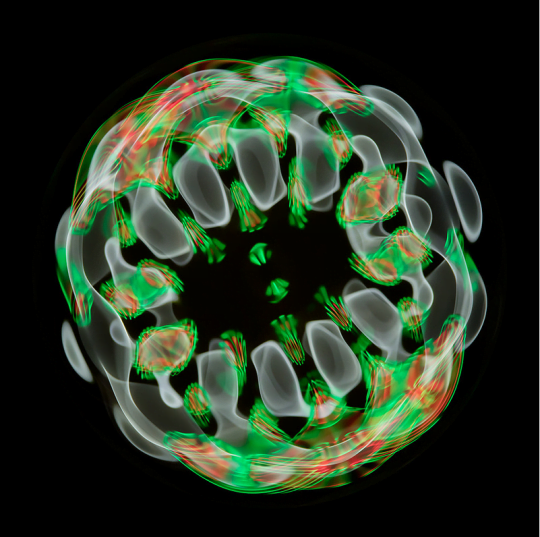
Cymatics are the visualization of vibration and sound. Here photographer Linden Gledhill has taken a simple speaker vibrating a dish of water and turned it into some incredible art. When you vibrate liquids like water up and down, it disturbs the usually flat air-water interface and creates waves on the surface. These Faraday waves are a standing wave pattern that differs depending on which sound is being played. By combining the wave patterns with LED lighting and strobe effects, Gledhill creates some remarkable images that combine sound, light, and fluid dynamics all in one. If you watch the video (make sure to hit the HD button!), you’ll see the patterns in motion and hear the sounds used to generate them. In the last clip (around 0:19), he’s added glitter to the set-up, which highlights the circulation within the vibrating fluid. As you can see, there are strong recirculating regions in each lobe of the pattern, but other areas, like the center region are almost entirely stationary. You can see more photos from the project in his Flickr feed. Special thanks to Linden for letting me post the video of his work, too! (Video and image cred
Not all fluids are, well, fluid. Traffic, flocks of birds, ants, and even sheep can behave like fluids. This video shows an aerial perspective on sheep being herded, and despite the four-legged nature of these particles, they have a lot of fluid-like characteristics. You can watch ripples and waves travel through the herd and see how disturbances propagate. The herd is actually a brilliant example of compressible flow; notice how the sheep slow down and bunch up as they near the gate then speed up and spread out once they pass the constriction. This is exactly how supersonic fluids behave! (Video credit: T. Whittaker; submitted by Simon H and John B)
If you’re in the DC area, I’ll be speaking at the Annals of Improbable ResearchShow at the AAAS meeting Saturday evening. Our session is open to the public, but it’s likely to be crowded, so you may want to arrive early!
I’m not a winter person, but there’s something almost magical about the way water freezes. From instant snow to snow rollers and weird ice formations to slushy waves, winter brings all kinds of bizarre and unexpected sights. The video above is an artistic look at one of my favorites – freezing soap bubbles. Normally, the thin film of a soap bubble is in wild motion, convecting due to gravity, surface tension differences, and the surrounding air. Such a thin layer of liquid loses its heat quickly, though, and, as ice crystals form, the bubble’s convection and rotation slow dramatically, often breaking the thin membrane. Happily photographer Paweł Załuska had the patience to capture the beautiful ones that didn’t break! (Video credit: P. Załuska; via Gizmodo)
If you enjoy FYFD and want to help support it, please consider becoming a patron!