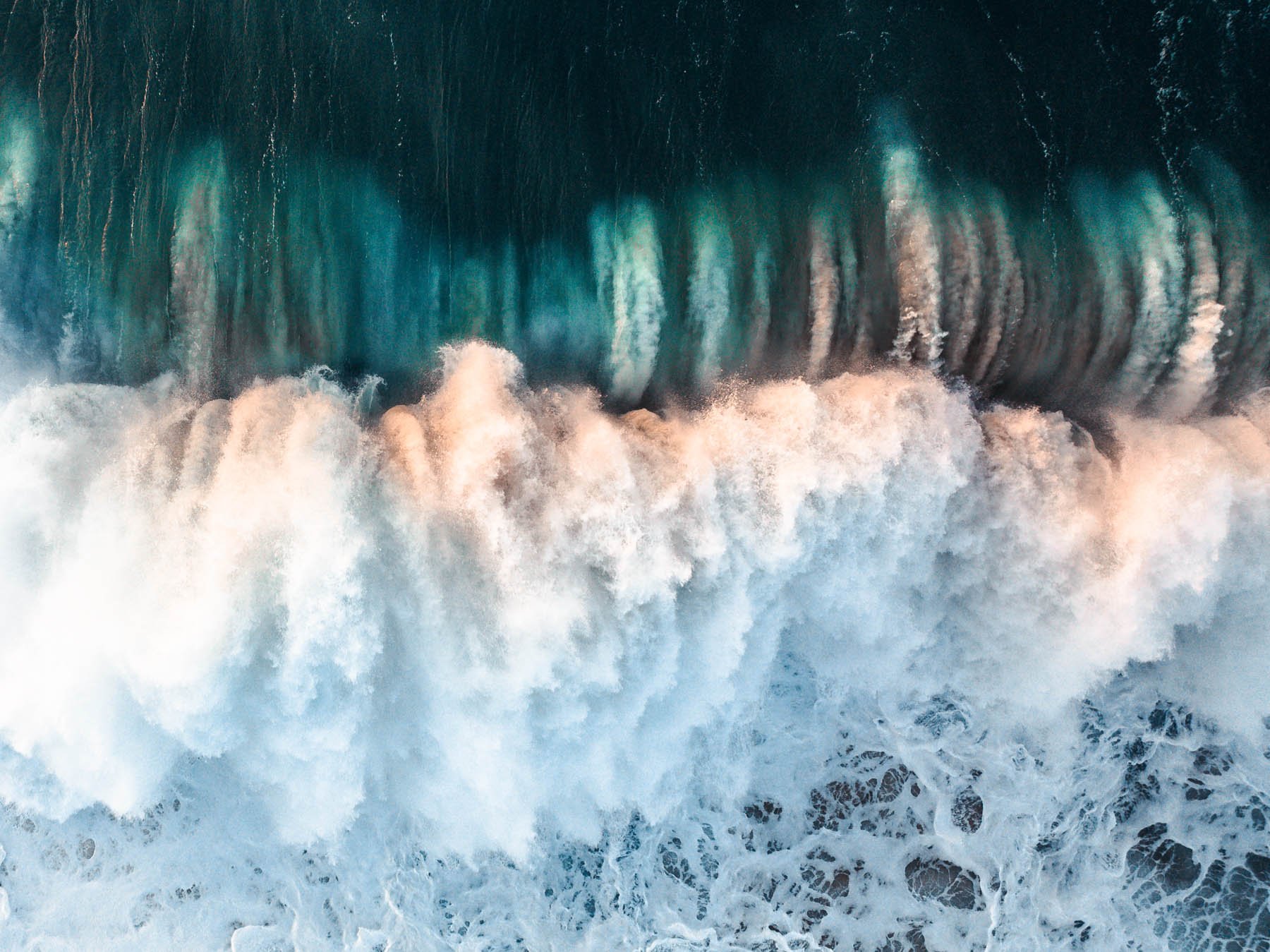
On the north shore of O’ahu, Hawaii, Banzai Pipeline is known for some of the most thrilling and deadly surfing in the world. The area’s barrel rolls are triggered when incoming waves break over the shallow reef. Photographer Kevin Krautgartner captures the waves from above, showcasing the incredible energy inherent in the ocean. The motion and texture of the water is mesmerizing. I feel like I could stare at these all day long! (Image credit: K. Krautgartner; via Colossal)
Mussels live in rough conditions, constantly pummeled by waves and turbulent currents. They hold themselves fast in the flow using dozens of byssel threads (commonly called a mussel’s beard) that anchor them to rocks and other mussels. The threads get built within the mussel’s foot, the tongue-like protrusion mussels use to drag themselves. The threads are similar to our ligaments: strong and stretchy. Each one is cemented securely using an adhesive that hardens in water. If engineers could replicate that adhesive, it would be fantastic for use in medicine. (Video and image credit: Deep Look)
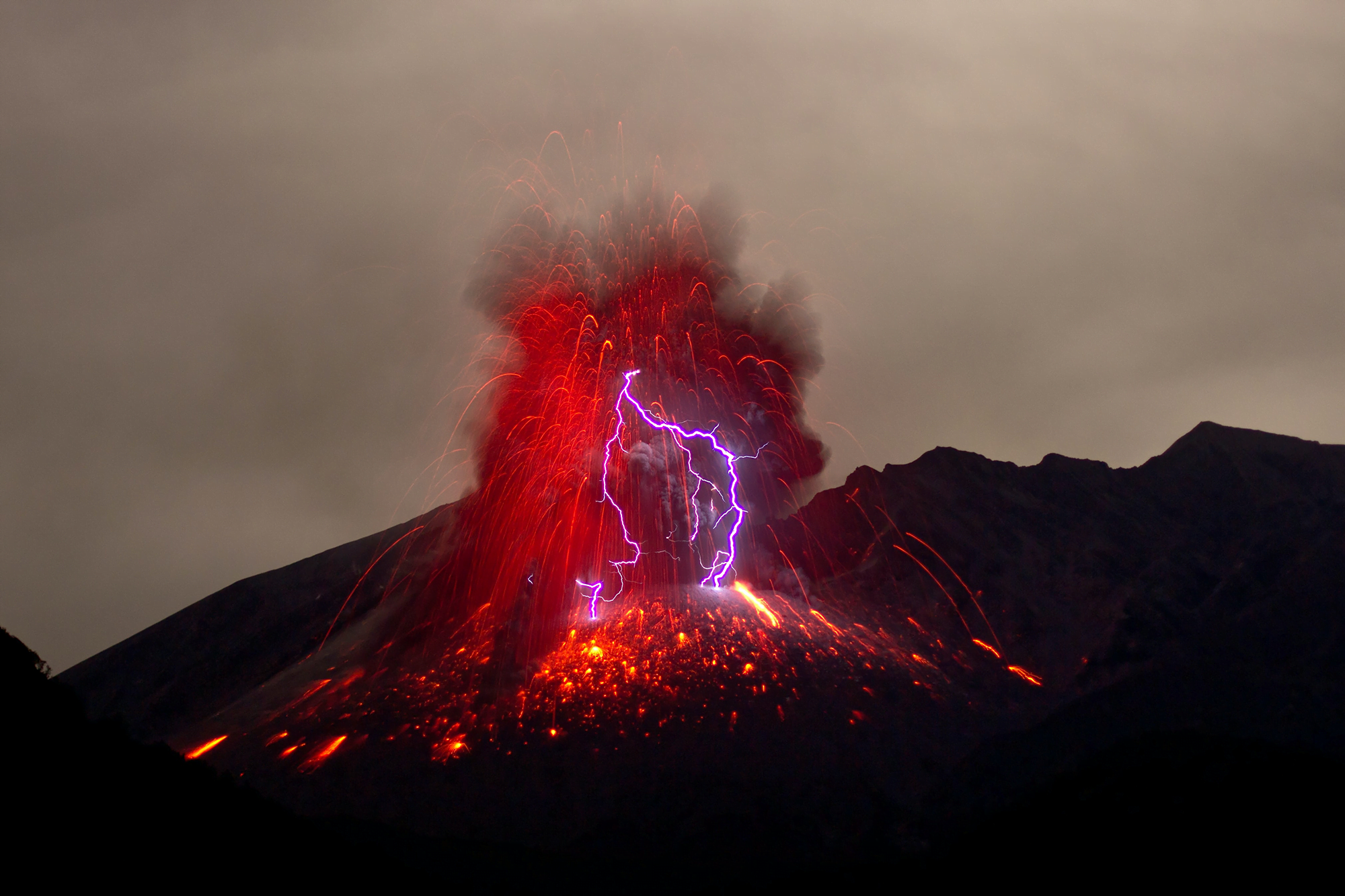
The ancient Greeks first recognized static electricity, but the mechanisms behind it remain somewhat mysterious. In particular, it’s unclear how two pieces of the same material can build a charge between them simply by touching. Yet we regularly see examples of this when volcanic ash creates enough charge to discharge lightning. A new study sheds light on the question by studying the impact of a single grain of silica on a silica disk.
The researchers used acoustic levitation to hold their silica particle in place. By turning the acoustic waves off, they could bounce the grain off the disk, then catch the particle again with the acoustic field. After a bounce, they swept an electrical field across the particle and observed its oscillations to determine how much charge the particle held. When necessary, they could also discharge the particle.
This animation demonstrates the three phases of an experiment. In the first (left), the acoustic field is shut off, allowing the silica grain to fall and strike the disk. Then the field is turned back on to “catch” the particle. In the second phase (middle), the researchers use a sweeping electrical field to determine the charge built up on the grain. In the third phase (right), they periodically discharge the built-up charge on the particle.
What they found was that charge on the particle grew with the number of impacts. They also saw that they could reverse the polarity of the charge with careful cleaning and baking of their objects. Their conclusion is that adsorption of water from the surrounding air is what enables the build-up of static charge on identical materials. (Image credit: volcano – M. Szeglat, experiment – G. Grosjean and S. Waitukaitis; research credit: G. Grosjean and S. Waitukaitis; via APS Physics)
Stingrays swim over rippled sands in this award-winning image from photographer Gregory Sherman. Above this peaceful vista, waves break and a dramatic skyscape looms. It’s the regular back-and-forth of the waves that shapes the ripples of sand. The rays can also use the sand for cover; note the remnants of sand atop a few of these rays, and then see how they hide themselves. See more winners from the Underwater Photographer of the Year awards in this gallery. (Image credit: G. Sherman/UPY 2023; via Colossal)
A group of excited atoms can collectively emit more photons than they could individually in a phenomenon known as superradiance. Now researchers have shown that vibrating fluids can produce superradiance as well.
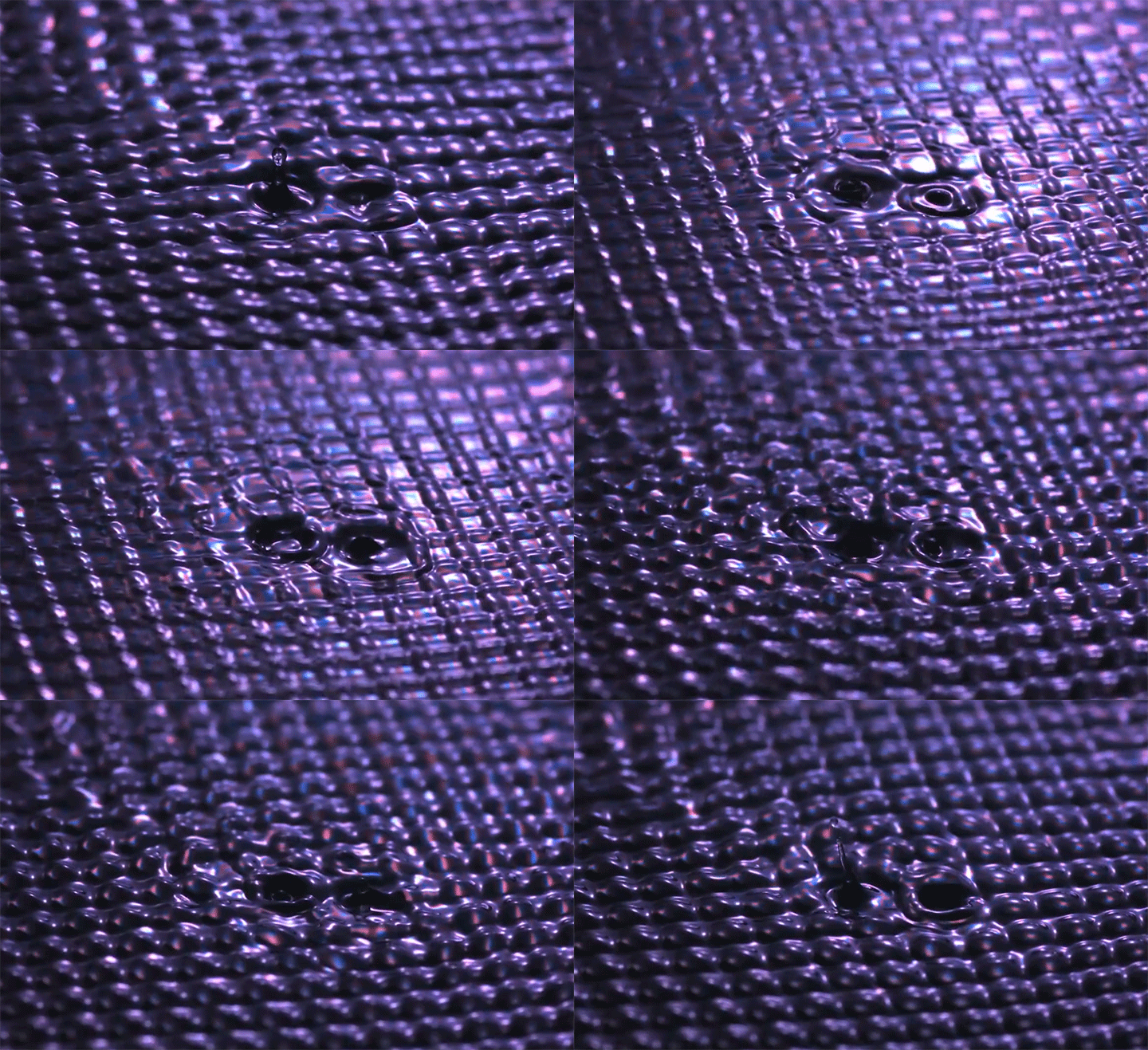
Two different wave fields used in the experiment, each with a different distance between the circular cavities.
Similar to other hydrodynamic quantum analogs, the researchers vertically vibrated a pool of liquid at a frequency that produced Faraday waves. Beneath the pool, they placed two circular wells, varying the distance between them to observe how their wave fields interacted. With a large enough vibration, the two circular wells emitted droplets (top image), and the number of droplets they produced was higher than expected for two independent wells, indicating superradiance. The results suggest that it may be possible to build even more hydrodynamic analogs of quantum systems than previously thought! (Image and research credit: V. Frumkin et al.; via APS Physics)
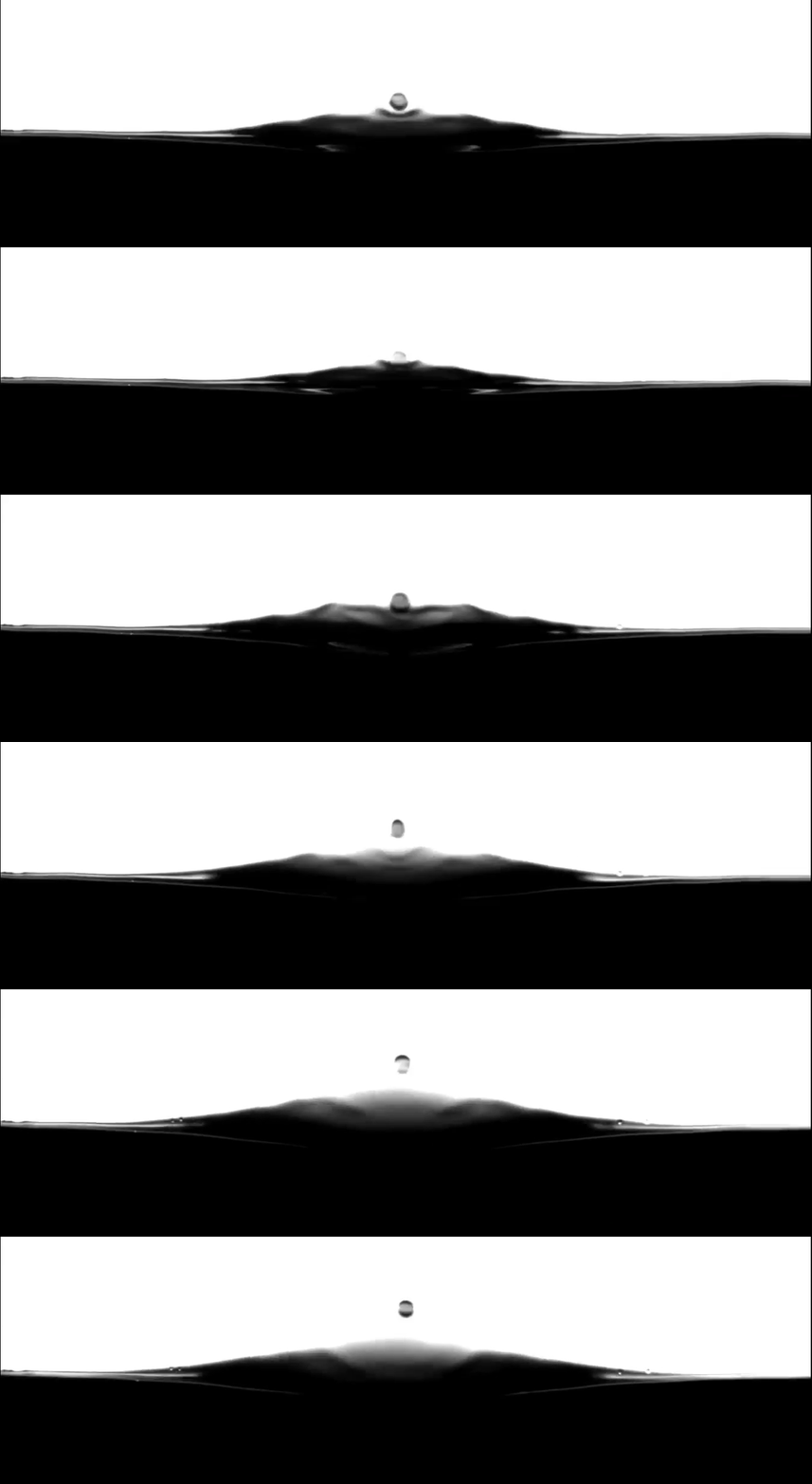
Over the past few years, we’ve seen lots of droplets bouncing and walking on waves. But today’s example is a little different. In this set-up, the wave is a large standing wave that sloshes from side-to-side in a narrow container. As it does, the wave catches and tosses a large ~3mm water droplet. The system is surprisingly stable, with this game of catch lasting for tens of thousands of cycles and up to 90 minutes before the droplet coalesces. The researchers found that, if the droplet tries to wander from its spot, the oscillating surface wave corrects it, guiding the droplet back to the optimal position. (Image and research credit: C. Sandivari et al.; via APS Physics; submitted by Kam-Yung Soh)
We live in a world of fluids. We breathe them, move through them, and have them move in us. “FLOW” is a celebration of that pervasive motion, animated from hand-drawn artwork. It features fluid dynamics from our daily lives — a candle’s flame, breaking waves, pedestrian traffic — all the way to astronomical scales far beyond typical human experience — the rotation and collision of galaxies. It’s a beautiful reminder that flows are always surrounding us, linking our lives from the small to the unbelievably large. (Video credit: MIT LineStorm Animation Consortium; submitted by Pell O.)
Lab experiments and numerical simulations can only take us so far; sometimes there’s no substitute for getting out into the field. That’s why a beach in San Diego turned pink this January and February, as researchers released a safe, non-toxic dye into an estuary. The goal is to understand how small freshwater sources mix with colder, saltier ocean waters when they meet in the surf zone. Differences in temperature and salinity both affect the waters’ density and, therefore, how they’ll combine, especially in the face of the turbulent surf. Using drones, distributed sensors, and a specially-outfitted jet ski, the researchers collect data about how the dye (and therefore the estuary’s water) spreads over the 24 hours following each dye release. Check out their experiment’s site to learn more. (Image credits: E. Jepsen/A. Simpson/UC San Diego; via SFGate; submitted by Emily R.)
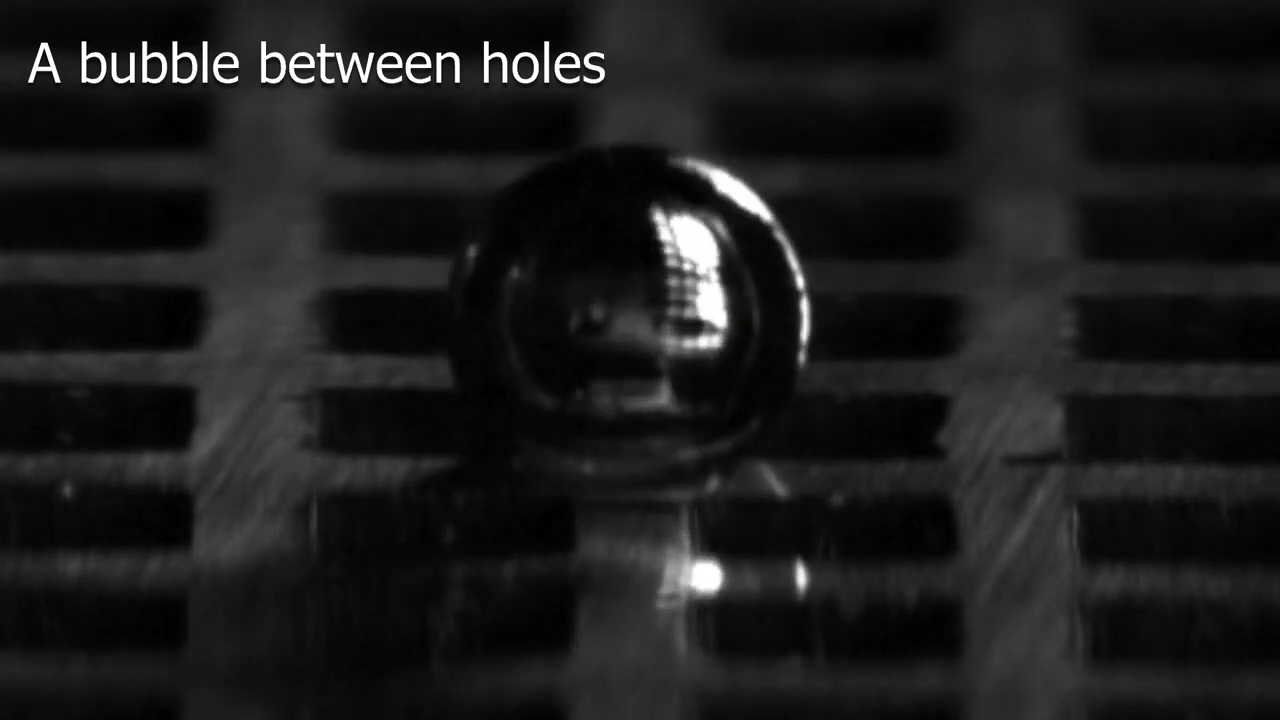
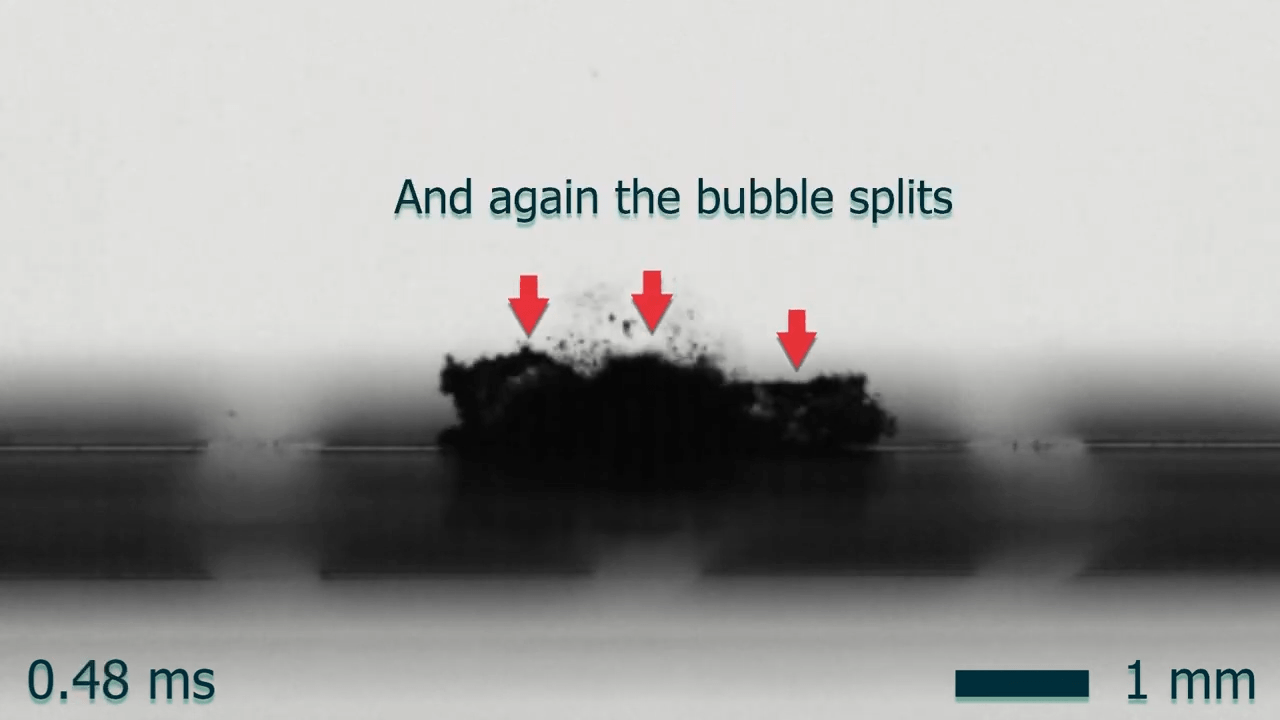
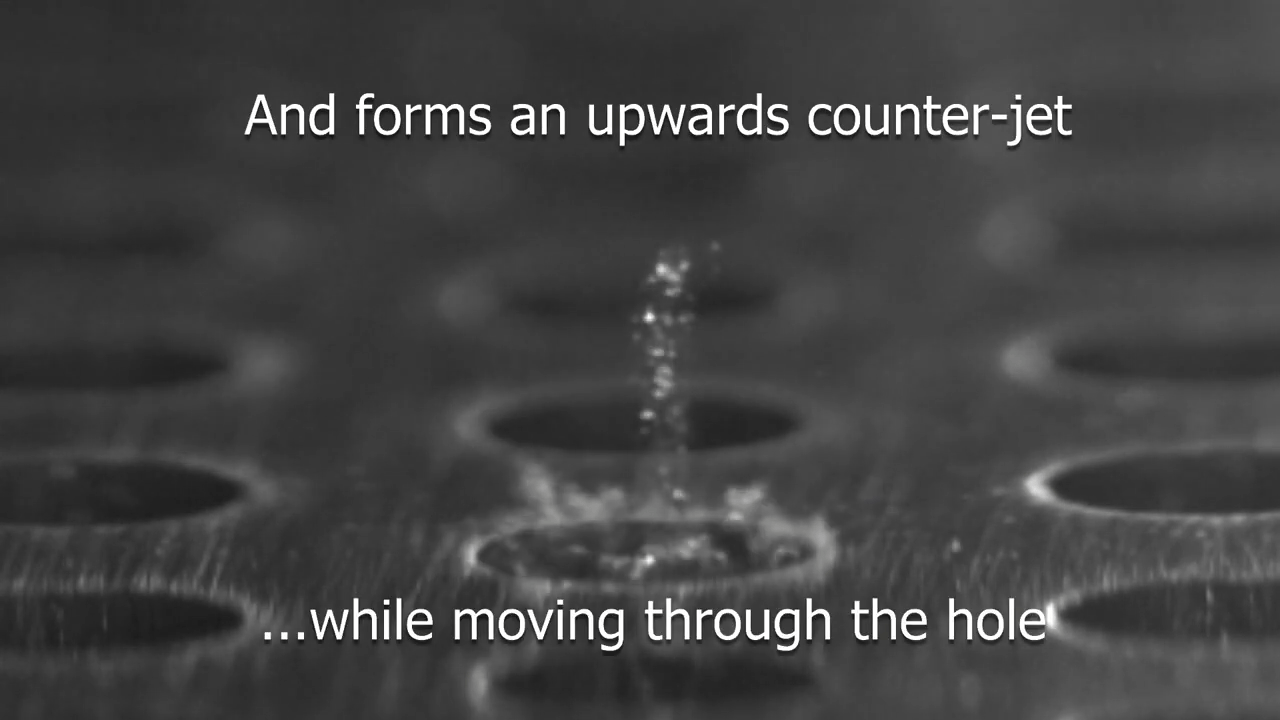
Cavitation bubbles live short, violent lives. Triggered here with a laser, these bubbles rapidly expand and then collapse, sending out shock waves. In this video, researchers explore how bubbles collapse when they’re near a plate with holes in it. For bubbles sitting between holes, collapse becomes asymmetric, eventually splitting the bubble into two as it falls in on itself. Bubbles centered over a hole perform a disappearing act, sucking themselves down into the hole during collapse. (Image and video credit: E. Andrews et al.)
Though we rarely notice it, our sky is always aglow. Washed in solar radiation, the oxygen and nitrogen molecules at high altitude get broken apart during the daytime and recombine at night, producing a luminescent glow that forms a uniform backdrop against the sky. In this image, the airglow forms a bull’s-eye-like set of rings, thanks to atmospheric gravity waves left behind by a thunderstorm. (Image credit: J. Dai; via APOD)