In one of their most Mythbusters-like videos ever, the Slow Mo Guys ask: can an explosion deflect a bullet? To find out, they built out a system to trigger a C4 explosive using a 9mm bullet, all while watching with a series of high-speed cameras. As you’d expect, there are lots of blast waves and neat flame propagation to watch. As for the fundamental question, well, you’ll have to watch to find out! (Video and image credit: The Slow Mo Guys)
Self-propelled objects can form fascinating patterns. Here, researchers investigate how small plastic “surfers” move on a vibrating fluid. Each surfer is heavier in its stern than its bow. When the fluid vibrates, the surfer creates waves that are asymmetric — deeper in the stern than at the bow. For single surfers, this imbalance propels the surfer in the direction of its bow. But with more than one surfer, other patterns form.
The video demonstrates five of the seven patterns pairs of surfers exhibit.
The team looked at groups of surfers all the way up to eight members. Among pairs, the researchers found seven distinctive patterns, including orbiting groups, tailgaters, and promenading pairs. Larger groups, they found, had similar collective behaviors. They hope their surfers will be an easily accessible platform for exploring active matter. (Image and research credit: I. Ho et al.; via APS Physics)
Vibration is one method for breaking a drop into smaller droplets, a process known as atomization. Here, researchers simulate this break-up process for a drop in microgravity. Waves crisscrossing the surface create localized craters and jets, making the drop resemble the Greek mythological figure of Medusa. With enough vibrational amplitude, the jets stretch to point of breaking, releasing daughter droplets. (Image and research credit: D. Panda et al.)
Watching a rocket engine start up in slow motion is always fun. This Slow Mo Guys video shows a test fire of one of Firefly’s engines, which is capable of 45,000 pounds of thrust. Gav walks us through the process of preparing to film the test as well as what his footage shows.
Green flames mark ignition of the initial fuel, and bursts of flame jerk back and forth as shock waves pass through the engine. That’s a necessary part of establishing supersonic flow through the bell-shaped diffuser at the end of the engine. Once the exhaust reaches supersonic speeds, expelling it creates a diamond-like pattern of standing shock waves and expansion fans that ultimately equalize the exhaust jet’s pressure to that of the surrounding atmosphere. (Video and image credit: The Slow Mo Guys)
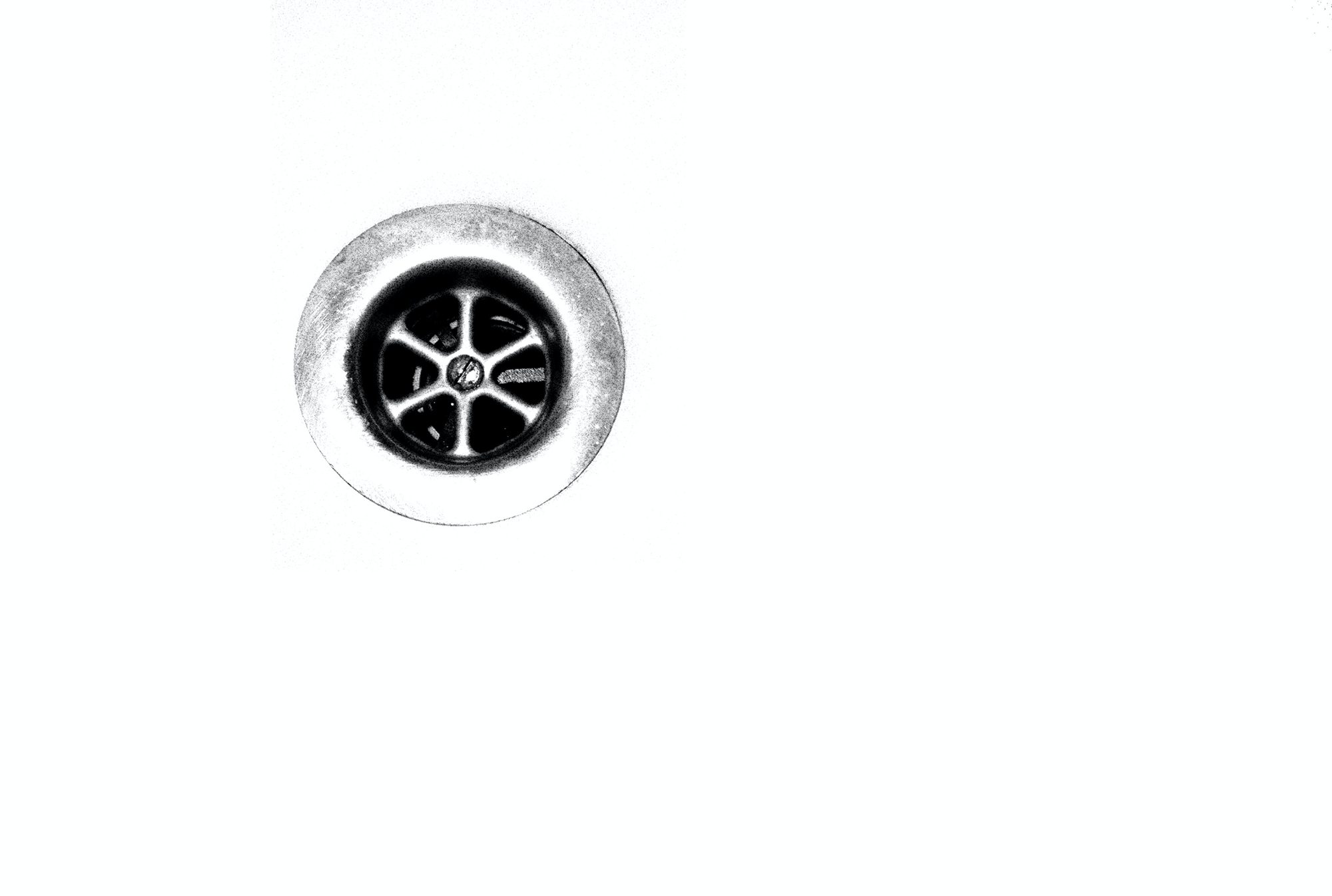
Turn on your kitchen sink, and the falling jet may form a circle of shallow flow where it strikes the sink. This fast-moving region of flow, surrounded by a wall of water, is a hydraulic jump. A recent study delves into a previously-missed phenomenon of this flow: intermittent disruption and reappearance.
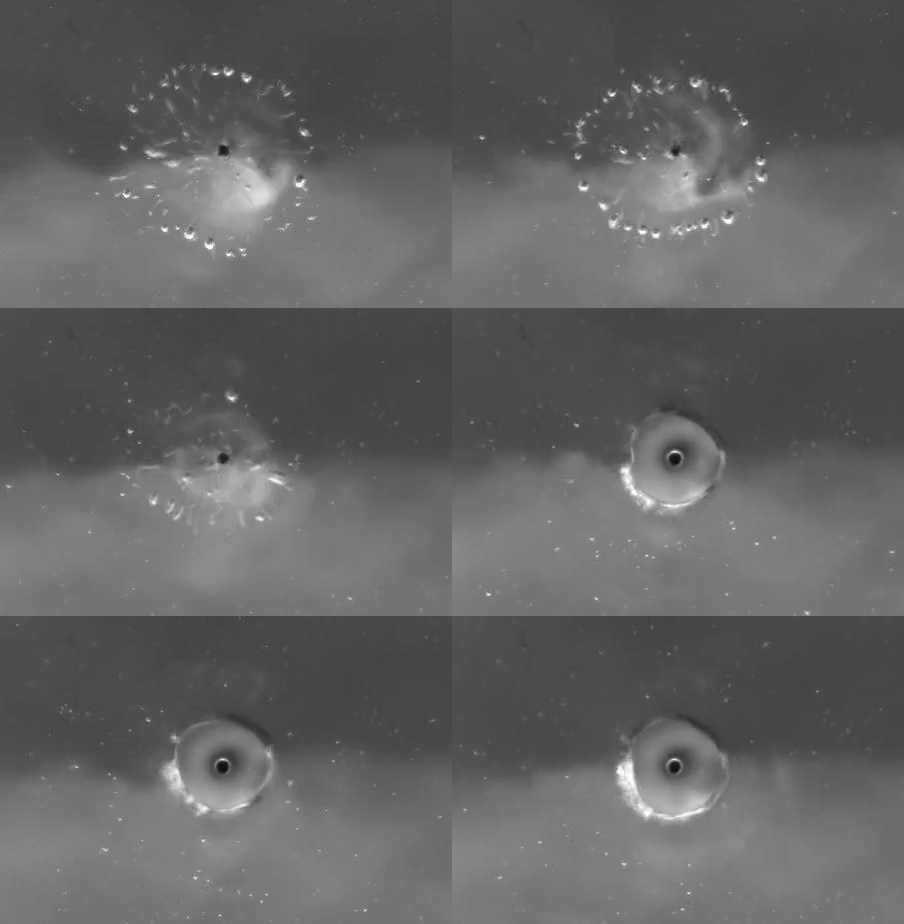
An oscillating hydraulic jump, viewed from below.
The team found that, within a narrow range of jet and surface sizes, a hydraulic jump will periodically appear and disappear. The effect comes from the hydraulic jump itself; waves from the jump propagate outward, hit the edge of the circular plate, and reflect inward. When the incoming and outgoing waves interfere, it floods the jump zone, making it disappear briefly. (Image credit: sink – Nik, jump – A. Goerlinger et al.; research credit: A. Goerlinger et al.; via APS Physics)
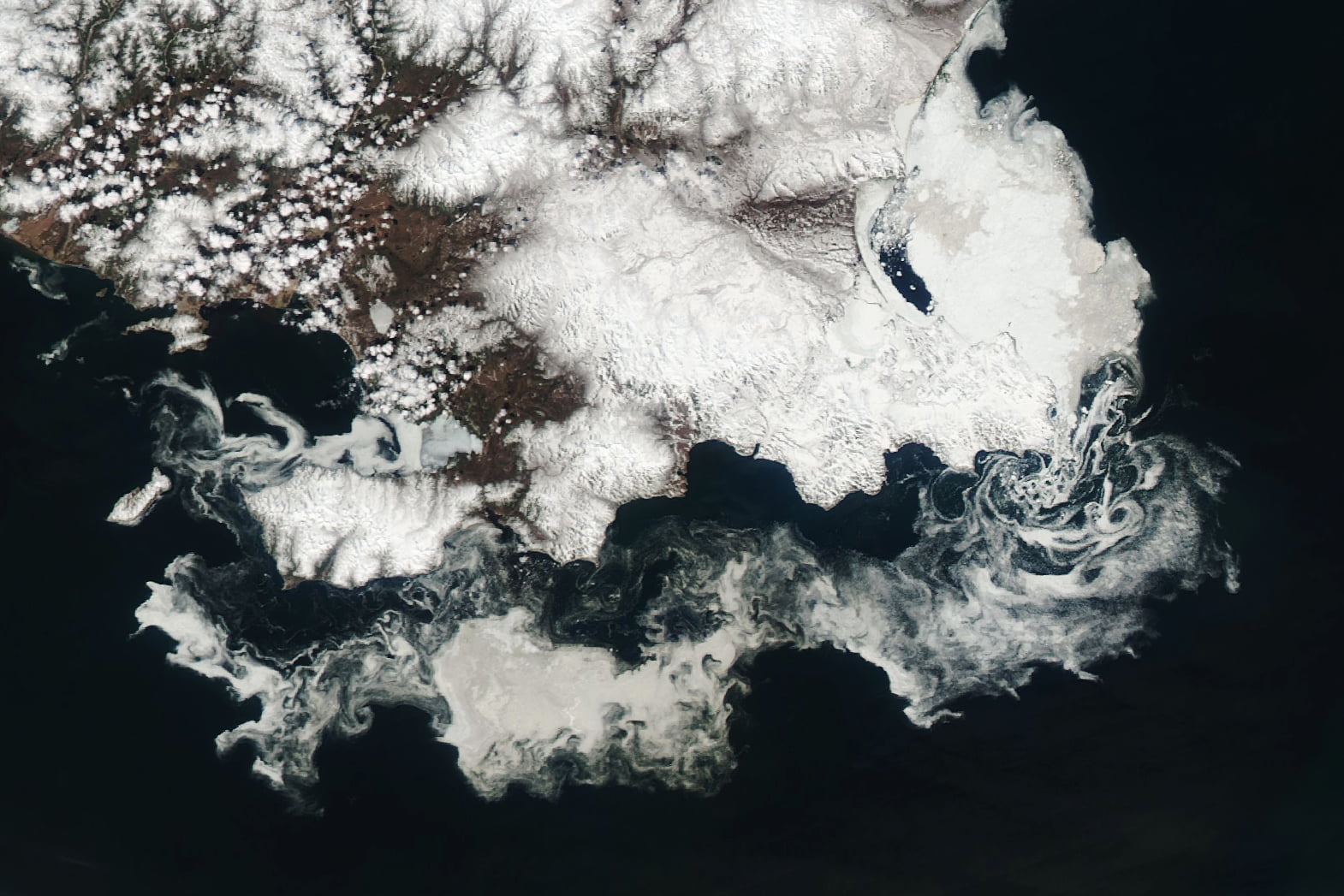
The Sea of Okhotsk is the northern hemisphere’s southernmost sea that seasonally freezes. Caught between the Siberian coast and the Kamchatka Peninsula, cold air from Siberia helps freeze water kept at lower salinity due to freshwater run-off. This image, taken in May 2023, shows free-floating sea ice forming spirals driven by wind and waves. Small islands off the eastern coast (right side in image) are likely responsible for the swirling eddies seen there. Like phytoplankton blooms and sediment swirls in warmer seasons, the sea ice acts as a tracer to reveal flow. (Image credit: W. Liang; via NASA Earth Observatory)
Extreme weather events like floods, hurricanes, atmospheric rivers, heat waves, and droughts are increasingly discussed in terms of the effects of climate change. Because complex systems have complex causes, it’s difficult to draw exact lines of causality between human-made climate change and a given weather event. But scientists have built an array of tools that help address two key questions: 1) how much more extreme was this weather due to climate change, and 2) how much more likely was this extreme event due to climate change?
Comparing (a) the actual flooding from Hurricane Harvey with (b) the estimated flood that would have occurred without climate change. The depth of actual flood waters was about 1m greater due to climate change.
To answer the first question, scientists often use hindcasts. In these studies, scientists first build a simulation that mirrors the actual event, like Hurricane Harvey’s stall over Houston, Texas. Once their simulated storm reflects the actual one, they tweak the initial conditions to reflect a world without climate change and see how the storm differs. By comparing the actual and simulated floods (image above), scientists can estimate just how much worse climate change made things. In Harvey’s case, they found that human activity increased the overall precipitation by 19% and that 32% of the flooded homes in Harris county would not have flooded in a world without climate change. Detailed results from that particular study can be explored in the web portal here. (Image credits: Flooded street – J. Gade, Harvey flooding – M. Wehner; research credit: M. Wehner in Physics Today)
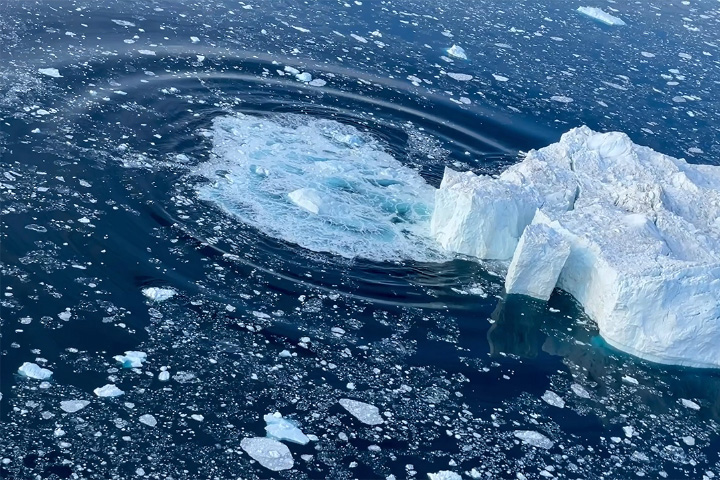
In summer, the fjords of Greenland are littered with ice, but in August 2023, satellites caught an odd interloper. See the thin white arc spanning the fjord in the photo above? Scientists suspect this ephemeral feature was a wave caused by a large iceberg calving off the glacier on the right. When large chunks of ice fall into the water, they can cause distinctive waves that travel out from the point of impact.
Another possible mechanism is an underwater plume. In Greenland’s fjords, such plumes are sometimes formed from freshwater melting below the glacier. When that water rises to the surface, it can push ice. (Image credit: W. Liang; via NASA Earth Observatory)
It takes a lot of power to lift a giant rocket‘s payload all the way to orbit, and in the first moments of a rocket launch, all that energy is directed downward at a concrete pad. How do engineers design and protect launch pads? In this Practical Engineering video, Grady tackles just that question through a comparison of SpaceX’s Stage Zero and NASA’s Launch Pad 39A.
SpaceX notoriously chose to build Stage Zero without a trench or water sprayer system like the ones NASA use. Trenches deflect the rocket exhaust to reduce the impact on infrastructure beneath the engines. And water sprayers reduce the temperatures the pad experiences and disrupt shock waves that otherwise hammer the pad. Without those precautions, even special heavy-duty concretes have a hard time holding together against a launch. (Video and image credit: Practical Engineering)
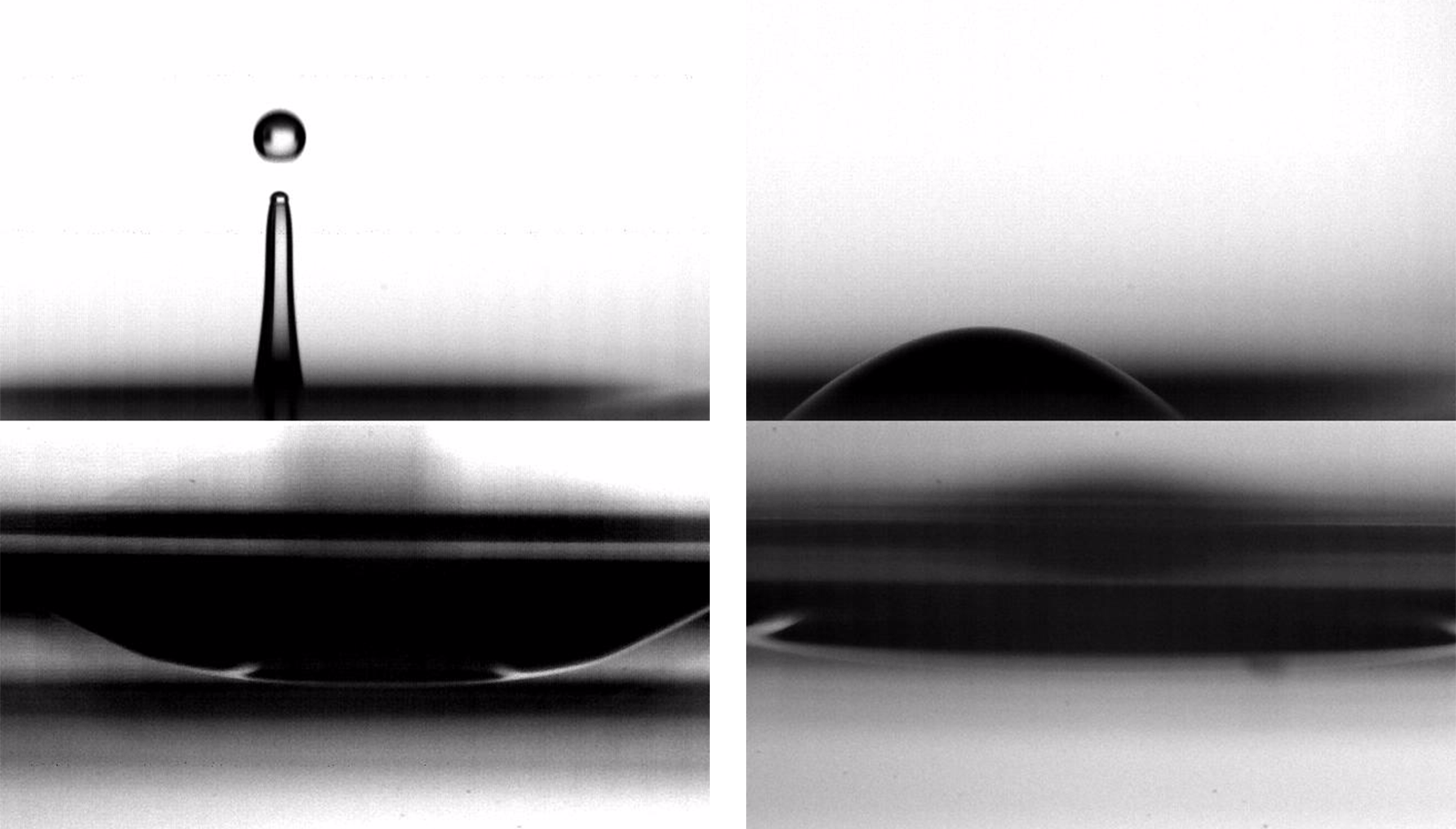
A bubble released in pure water pops at the surface, creating a rebounding jet and a daughter droplet.
In clean water, a bubble’s burst generates a rebounding jet that shoots off one or more daughter droplets, as seen in the animation above. But when researchers added proteins that modify only the water’s surface, they found something very different. As seen below, the bursting bubble no longer generated a jet, and, instead of forming droplets, it made a single, tiny daughter bubble. The difference, they found, comes from the added viscoelasticity of the surface. The long protein molecules resist getting stretched, which damps out the tiny waves that surface tension usually produces on the collapsing bubble cavity. (Image and research credit: B. Ji et al.; submission by Jie F.)
When the surface of water is viscoelastic, a bursting bubble creates no jet and a daughter bubble instead of a drop.