Search results for: “surface tension”

  • Soapy Solutions

    Soapy Solutions

    When a drop of soap falls into a pool of water, its surface-loving molecules spread out on the water’s surface. Exactly how the soap spreads depends on the local concentration of its surfactant molecules, which create areas with different surface tensions that cause flow. All in all, it’s a tough process to predict because it varies in time at every point on the pool. But a recent paper offers a new class of exact solutions for the problem.

    The paper considers a surfactant-laden droplet spreading over a (relatively speaking) deep pool. Other researchers showed recently that this situation can be described with a complex version of the Burgers’s equation, which was originally developed to describe turbulent flows. The authors solved the equation for a variety of initial conditions and found that the time-dependent spread of the surfactants was sensitive to the initial surface distribution. The higher the initial surface concentration, the faster the surfactants spread. (Image credit: T. Despeyroux; research credit: T. Bickel and F. Detcheverry; via APS Physics; submitted by Kam-Yung Soh)

  • Featured Video Play Icon

    A Fractal Raft From a Spinning Top

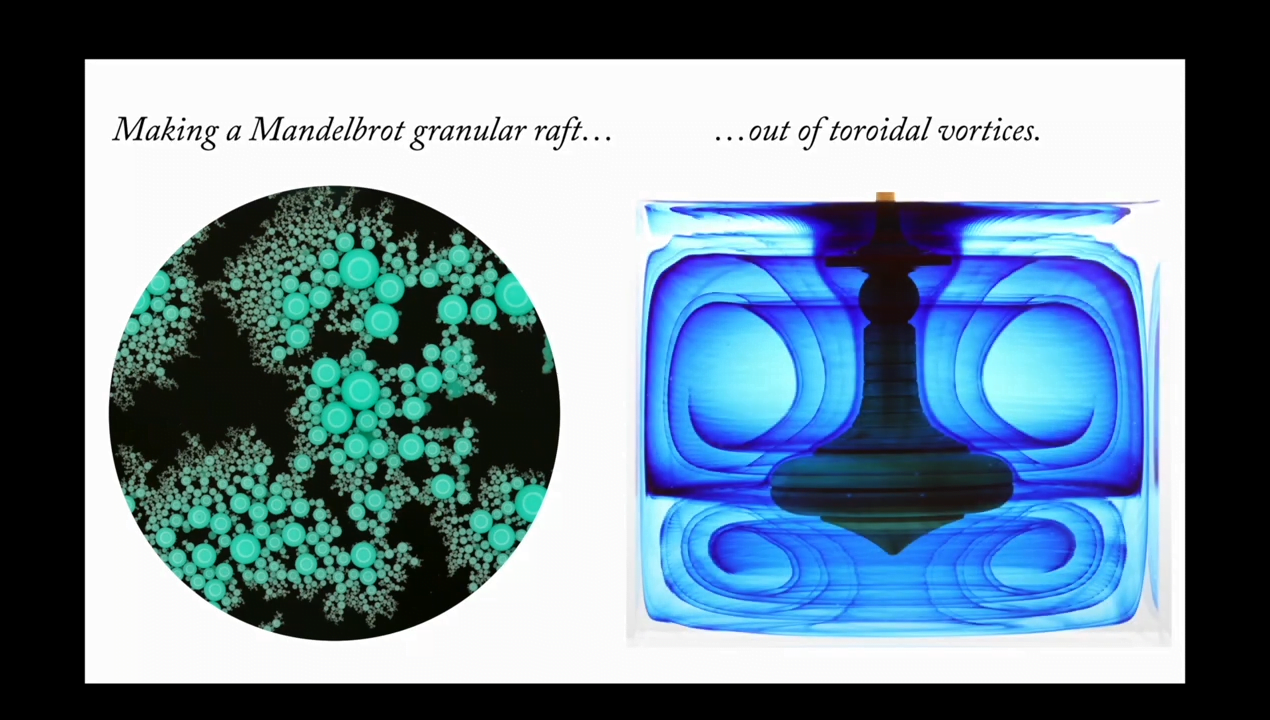
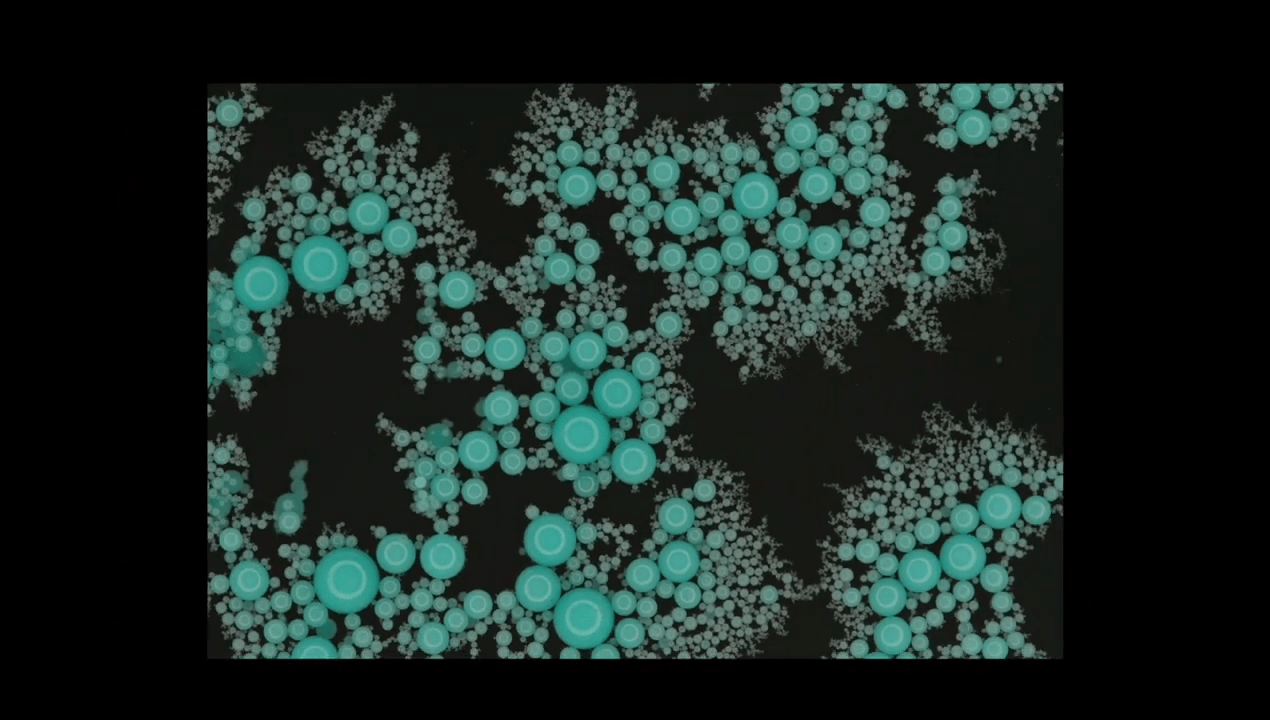
    File this one under Cool Things I Would Have Never Thought Of. In this video, researchers play around with the flow around a spinning top and end up creating a fractal, granular raft. By immersing a top in dyed fluid, they show the toroidal vortices that form around the spinning toy. Then, instead of dye, they add a stretchy elastomer compound that cures over time. The elastomer stretches into thin ligaments in the swirling flow around the top. Eventually, it breaks apart into spherical drops of all different sizes.

    Once the top is removed, the elastomer drops slowly float to the surface. Surface tension and the Cheerios effect draw the drops together, and because of their many sizes, the rafts that form are fractal. (Image and video credit: B. Keshavarz and M. Geri)

  • Bubbles in Turbulence

    Bubbles in Turbulence

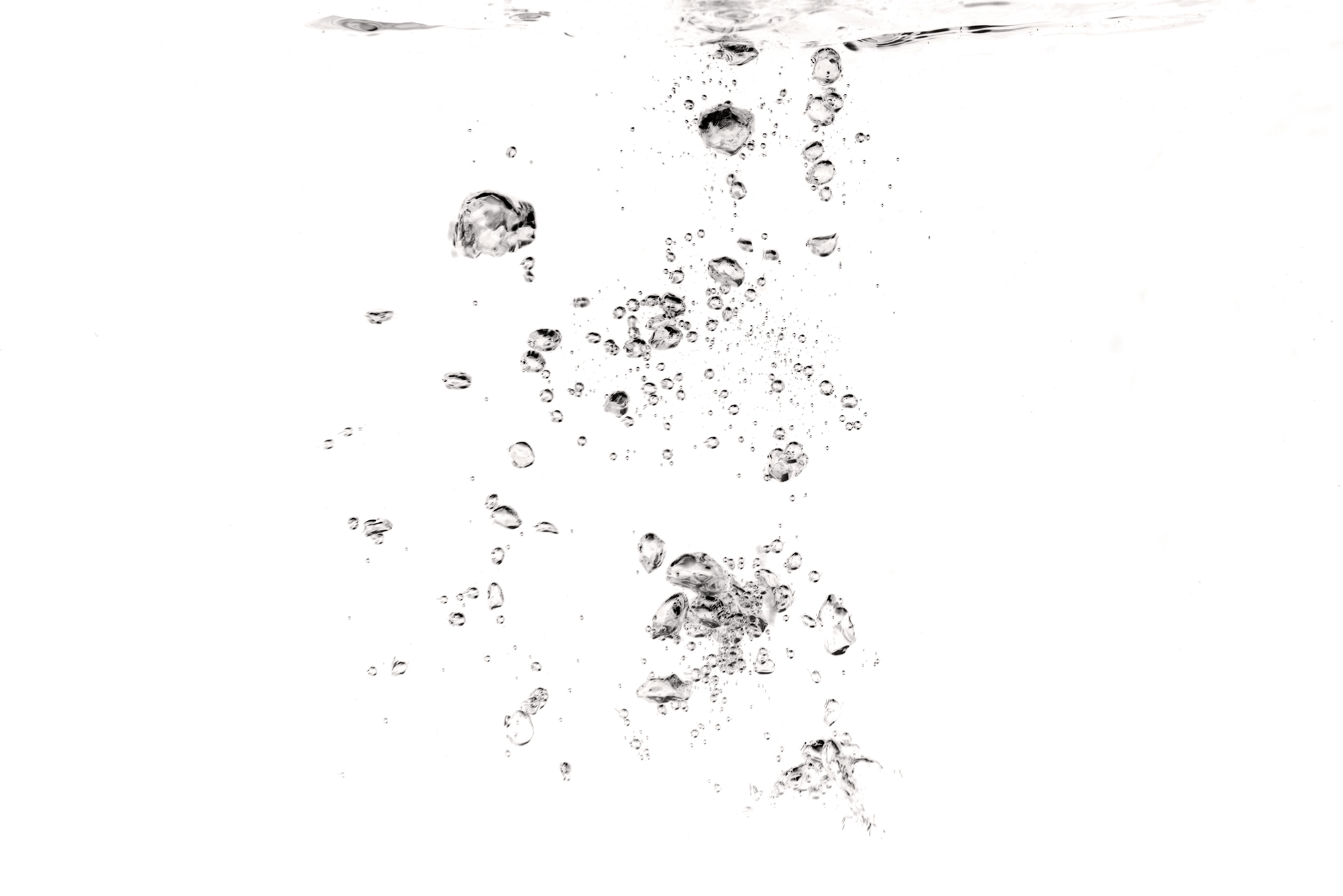
    In nature and industry, swarms of bubbles* often encounter turbulence in their surrounding fluid. To study this situation, researchers used numerical simulation to observe bubbles across a range of density, viscosity, and surface tension values relative to their surroundings. They found that density differences between the two fluids made negligible changes to the way bubbles broke or coalesced.

    In contrast, viscosity played a much larger role. More viscous bubbles were less likely to deform and break, thanks to their increased rigidity. When looking at small deformations along the bubble interface, both density and viscosity had noticeable effects. With increasing bubble density, they observed more dimples on the interface; increasing the viscosity had the opposite effect, making the bubbles smoother. (Image credit: Z. Borojevic; research credit: F. Mangani et al.)

    *We usually think of bubbles as air or another gas contained within a liquid. But this study’s authors use the term “bubble” more broadly to mean any coherent bits of fluid in a different surrounding fluid. Colloquially, this means their results apply to both bubbles and drops.

  • When Seeing a Flow Changes It

    When Seeing a Flow Changes It

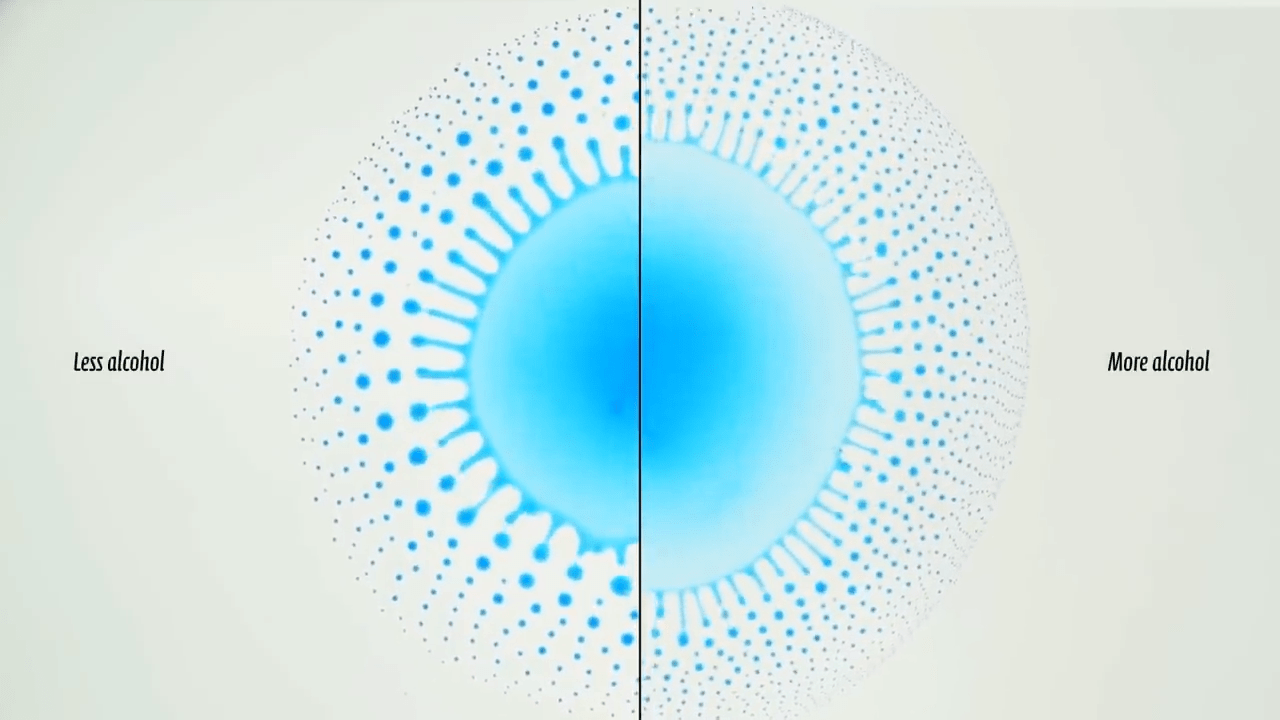
    Adding dye to a flow is a common technique for visualization. After all, many flows in fluids like air and water are invisible to our bare eyes. But for some classes of flows — especially those driven by variations in surface tension — adding dye can have unforeseen effects. A recent study shows how true this is for bursting Marangoni droplets, where evaporation and alcohol concentration can pull a water-alcohol droplet apart.

    Composite series of photos showing the effect of increased dye concentration on Marangoni bursting.
    As more dye is added to the experiment, the daughter droplets grow larger and more ligaments form. In the first three images, a dashed black line has been added to show the location of the droplet rim.

    Without dye, it’s nearly impossible to see the phenomenon since the refractive indices of the two component liquids are so close. But the researchers found that, as they added more methyl blue dye, it did more than increase the contrast in the flow. It changed the flow, making the droplets larger and creating ligaments between them. They believe that the dye’s own surface tension creates local gradients that alter the flow. It’s a reminder that experimentalists have to be careful to consider how our efforts to measure and observe a flow can change it. (Image credit: top – The Lutetium Project, bottom – C. Seyfert and A. Marin with modification; research credit: C. Seyfert and A. Marin)

  • Featured Video Play Icon

    Contactless Bending

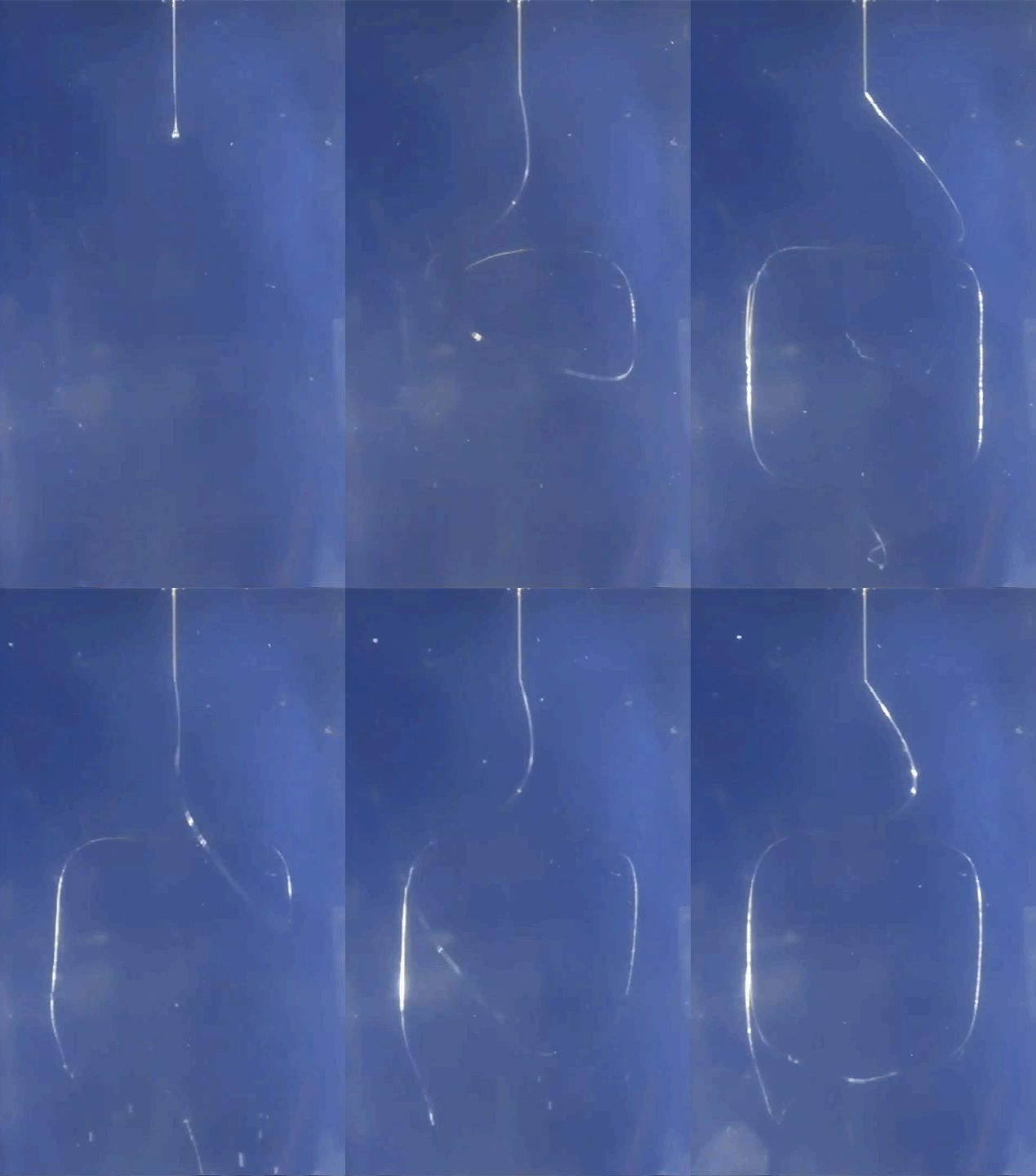
    Using electromagnetism, researchers are bending and shaping soft liquid wires even against gravity. The team used galinstan — an alloy of gallium, indium, and tin that remains liquid at room temperature. On its own, galinstan has a high surface tension and forms droplets. But with a voltage applied, that surface tension is suppressed, making the liquid form a long, thin, still-liquid wire. Adding a magnetic field allowed the researchers to manipulate the falling stream of liquid, even levitating loops of the metal against the force of gravity! (Image, video, and research credit: Y. He et al.; via Cosmos; submitted by Kam-Yung Soh)

  • Mimicking Asteroids

    Mimicking Asteroids

    In nature, objects like asteroids, black holes, and atomic nuclei can get distorted when spinning rapidly. Researchers are exploring these objects using a new model platform: particle rafts levitated by sound. The individual particles are less than a millimeter wide and tend to clump together due to the scattering of sound waves off neighboring particles. This effect provides a cohesive force — similar to surface tension or the effects of gravity — that draws the particles together. With the right frequency, the sound waves can also make the granular rafts spin, setting up a tug-of-war between cohesion and centrifugal force.

    Using sound waves for levitation, particles slowly rise and clump together. Particles are approximately 190 micrometers each, and the video is drastically slowed down from real-time.

    As the rafts spin, they distort, pull apart, and come back together. Interestingly, the cohesive force a raft experiences increases with the raft’s size. That makes the attractive force unlike surface tension (which is the same whether you have a bucket of water or a lake) and more like gravity (which is stronger with more material.) Because of this size dependence, the team hopes their granular rafts could be a new way to study the formation of rubble-pile asteroids and similarly granular systems.

    As the raft’s rotation increases, it’s pulled apart by centrifugal forces, but the pieces later reconnect. Video is slowed down by a factor of 60.

    (Video, image, and research credit: M. Lim et al.; via APS Physics)

  • Coalescence Symmetry

    Coalescence Symmetry

    When droplets coalesce, they perform a wiggly dance, gyrating as the capillary waves on their surface interfere. When the droplets have matching surface tensions, like the two water droplets in the animation on the lower left, the coalescence dance is symmetric. But for differing droplets, like the water and ethanol droplets merging on the lower right, coalescence is decidedly asymmetric.

    The asymmetry arises from the droplets’ different surface tensions. The size and speed of the capillary waves that form on a droplet depend on surface tension, so droplets of different liquids have inherently different capillary waves. During merger, the interference of these capillary waves causes the asymmetry we see. (Image credit: top – enfantnocta, coalescence – M. Hack et al.; research credit: M. Hack et al.)

  • Ant Bridge

    Ant Bridge

    As red ants scout their way to food, the terrain can sometimes get in the way. Here a leading scout has made their body into a bridge that their fellows can use to cross the watery gap. Take a close look at the water’s surface and you’ll see that the meniscus curves up to meet the rocks. That’s a clue that this image is really very small! For water on Earth, that curvature only occurs at lengths below a couple of millimeters, where surface tension has the power to overcome gravity’s efforts to flatten the surface. The ants’ bridge is only possible because the red ant is small enough and light enough for surface tension to support it. Learn more about the amazing interactions of ants and water in some of my previous posts. (Image credit: Chin Leong Teo; via Colossal)

  • Featured Video Play Icon

    Fast Fractal Fingers

    With the right balance of viscosity and surface tension, many fluid combinations can form fractal or dendritic patterns. Here, researchers use a drop of food coloring atop a mixture of water and xanthan gum. Depending on the concentration of gum (and the age of the viscous fluid) different fractal patterns spread quickly across the surface. (Image and video credit: R. Camassa et al.)

  • Featured Video Play Icon

    When Bubbles Don’t Die

    In a pure liquid, most bubbles pop almost immediately. But with a simple ingredient — a little heat — bubbles can live almost indefinitely. The mechanism is revealed in this video when the researchers use an infrared camera to watch a bubble on a heated pool. The top of the bubble is cooler than the rest of the liquid, forming colder, denser droplets that slide down. But the cooler liquid also has a higher surface tension, which draws warm liquid up the bubble, replenishing it. The result is a stable bubble that simply carries on. (Image and video credit: S. Nath et al.)