Search results for: “surface tension”

  • Featured Video Play Icon

    Really, Really Slow Mo Fluids

    Fluid dynamics is a perfect subject for high-speed video. So much goes on at speeds that are far too quick for our eyes and brains to perceive. But there is such a thing as too slow – a concept explored in this Slow Mo Guys video, which takes everyday activities like turning on a faucet or splashing into a pool and slows them down a speed where one second lasts an hour. The video I’ve embedded here isn’t nearly that long; it speeds up and slows down. But if you really want to, you can watch Gav fall into a pool for a full hour. (Image and video credit: The Slow Mo Guys)

  • Why Creases Don’t Disappear

    Why Creases Don’t Disappear

    Flex your fingers and you’ll see your skin fold into well-defined creases. Many soft solids (including old apples) fold this way, and like your skin, the creases never fully disappear, even when the stress is removed. A recent study finds that surface tension and contact-line-pinning are critical to the irreversibility of these creases.

    The authors studied sticky polymer gel layers under a confocal microscope as the gel folded. In doing so, they found that surface tension dictates the microscopic geometry of a fold, causing the two sides of a surface to touch. They also found that completely unfolding a creased surface requires more energy than folding it in the first place did because the folded surfaces adhere to one another.

    When unfolded, the crease behaves somewhat like a droplet on a rough surface. Such droplets move in fits; their contact line stays pinned to the rough microscopic peaks of the surface until there’s enough energy to overcome that attachment and the contact line jumps to another position. Similarly, a creased surface cannot simply unfold smoothly. Adhesion ensures that part of the crease remains, serving as a starting point for the next fold-unfold cycle. (Image credit: C. Rainer; research credit: M. van Limbeek et al.; via APS Physics; submitted by Kam-Yung Soh)

  • Microjets and Needle-Free Injection

    Microjets and Needle-Free Injection

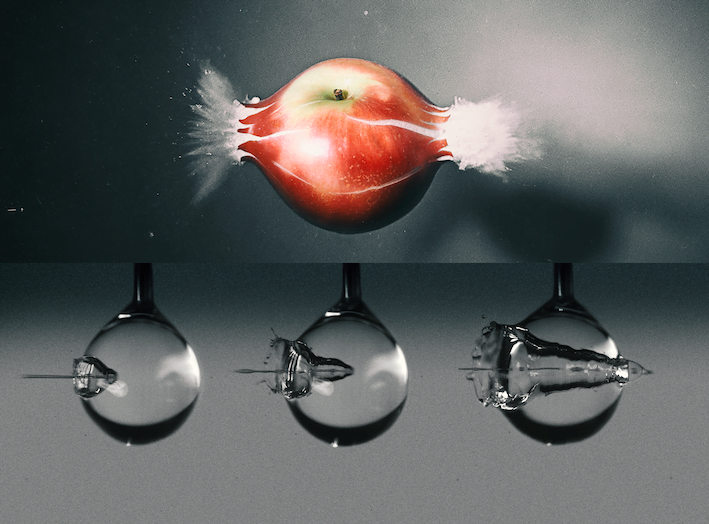
    Some people don’t mind needles, and others absolutely detest them. But to replace needles with needle-free injections, we have to understand how high-speed microjets pass through skin. Given skin’s opacity, that’s tough, so researchers are instead using droplets as a model. If we can understand the dynamics of a microjet passing through different kinds of droplets, getting jets of medicine into arms becomes easier.

    Researchers found that jets passed completely through a droplet if they impacted above a critical velocity. For Newtonian droplets, the jet creates a cavity and shoots straight through because the inertia of the impact outweighs the countering force of surface tension. But with viscoelastic drops, the jet goes through, slows down, and gets sucked back into the droplet. In this case, the combination of surface tension and viscoelasticity can, eventually, overpower the jet’s inertia. (Image, research, and submission credit: M. Quetzeri-Santiago et al.)

  • Featured Video Play Icon

    Fun From the Beach

    Here’s a neat bit of fluid dynamics derived from a day at the beach! Our experiment begins with well-mixed (and likely compacted) sand grains and sea water in a bottle. When flipped, the sand layer sits at the top of the bottle with the water layer beneath.

    Very quickly new layers establish themselves in the bottle. The lower half of the bottle turns into a turbulent churn of water and sand, topped by a thin air bubble, then the thick sand layer, and finally, a layer of filtered water. That air bubble beneath the sand means that the sand layer is compacted enough that surface tension keeps the air from being able to squeeze through the grains. On the other hand, water is able to filter through, eventually making it into that upper region. The compact layer of sand is supported in the bottle by force chains running through the largest grains, which is why only fine sediment settles down through the turbulent layer at this point.

    Eventually, the top sand layer erodes enough that it can no longer support its weight, and the sand collapses. As the grains settle out, we end up with fine sediment on the bottom (as previously discussed), followed by a layer of coarse sand from the erosion and collapse of the sand layer, topped with a layer of very fine grains that — due to their light weight — are the very last to settle out of the water. I love that such a simple seaside experiment contains such scientific depth! (Video and submission credit: M. Schich; special thanks to Nathalie V. for helpful input)

  • Tiny Symmetric Swimmers

    Tiny Symmetric Swimmers

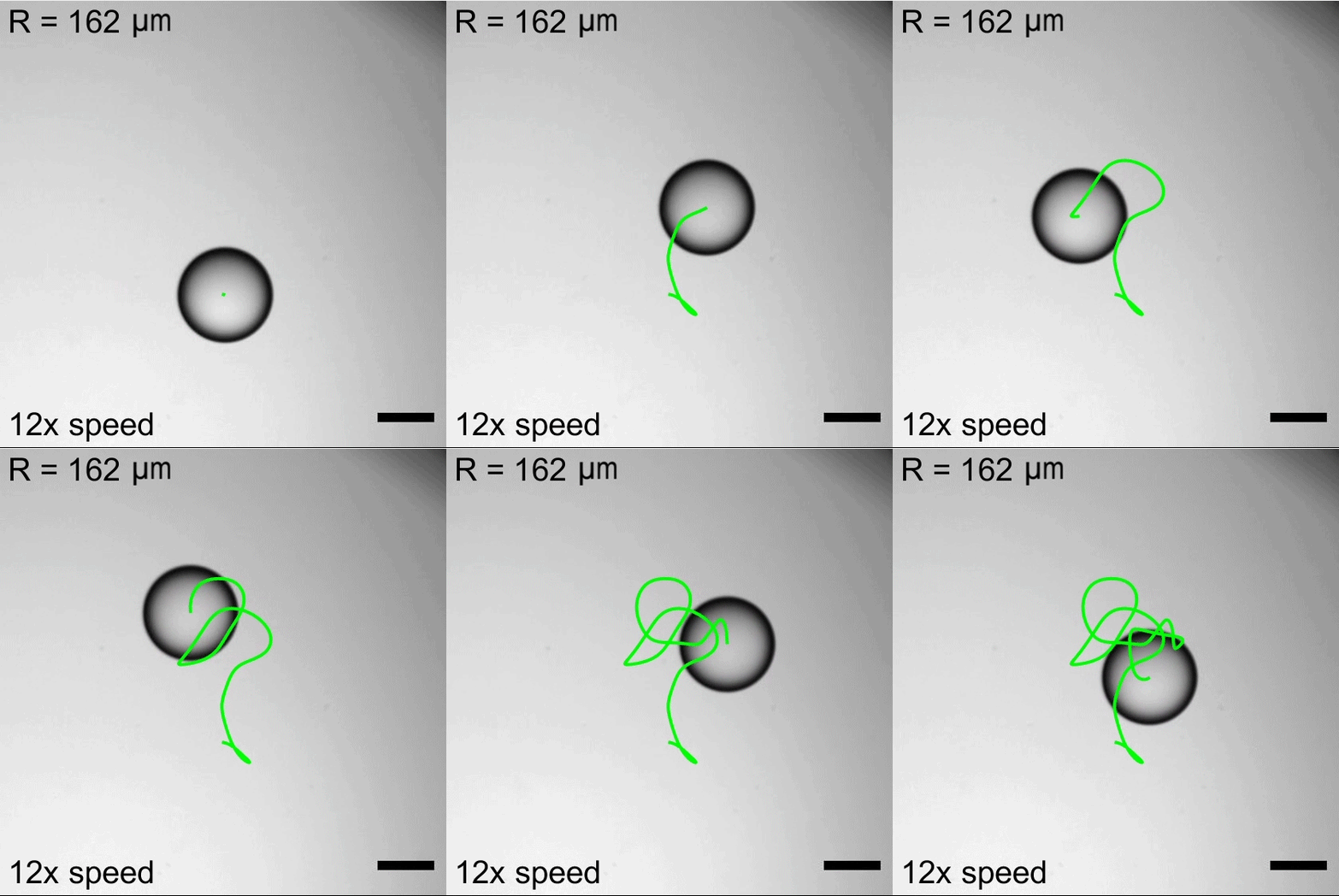
    Microswimmers live in a world dominated by viscosity, and in viscous fluids, symmetric motion provides no propulsion. That’s why bacteria and other tiny organisms use cilia, corkscrew flagella, and other asymmetric means to swim. But a new study decouples the symmetry of a swimmer’s motion from the motion of the fluid, thereby creating a tiny symmetrically-driven swimmer that does swim.

    Their microswimmer consists of two beads, which attract one another via surface tension and are repelled using external magnetic fields. This effectively creates a spring-like connection between the two beads, making them move in and out symmetrically in time. But since one bead is larger than the other, its greater inertia makes it slower to start moving and slower to coast to a stop. This inertial imbalance between the two is significant enough for the beads to swim. The key here is that though the beads’ motion relative to one another is symmetric, their motion relative to the fluid is not! (Image and research credit: M. Hubert et al.; via Science; submitted by Kam-Yung Soh)

  • Falling Beads

    Falling Beads

    Liquids flowing down a fiber can form bead-like droplets that may sit symmetrically (a) or asymmetrically (b) on the fiber. In general, the asymmetric droplets appear as surface tension increases or as the fiber diameter increases. The pattern of the droplets changes with flow rate. Within each subfigure, the flow rate increases from left to right. At low flow rates, we see only one or two large droplets migrating down the fiber. At moderate flow rates, a regular pattern of drops emerges. And at high flow rates, droplets coalesce on the fiber to form drops large enough that they fall and sweep up the downstream droplets. (Image and research credit: C. Gabbard and J. Bostwick)

  • Featured Video Play Icon

    Metallic Magma

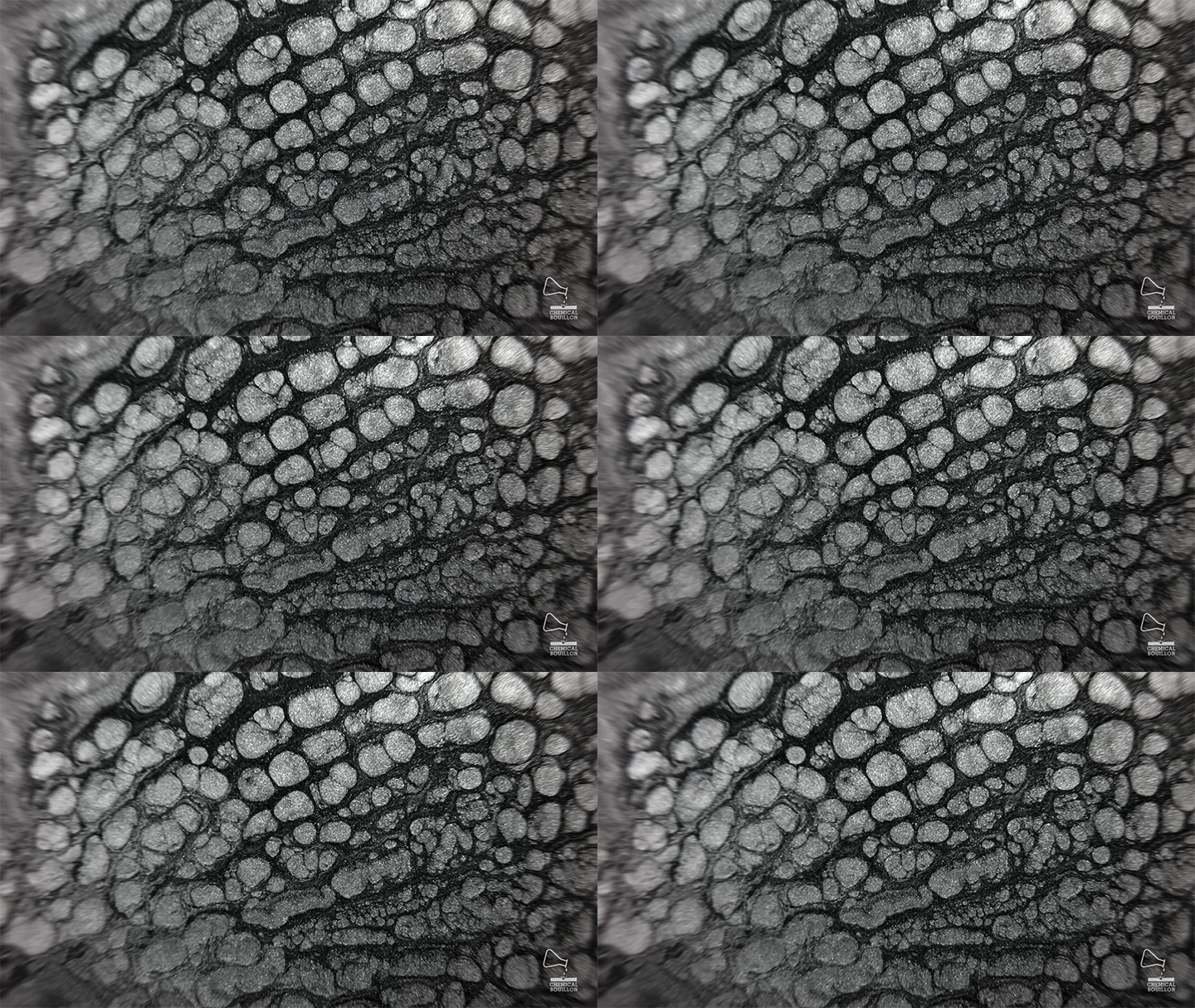
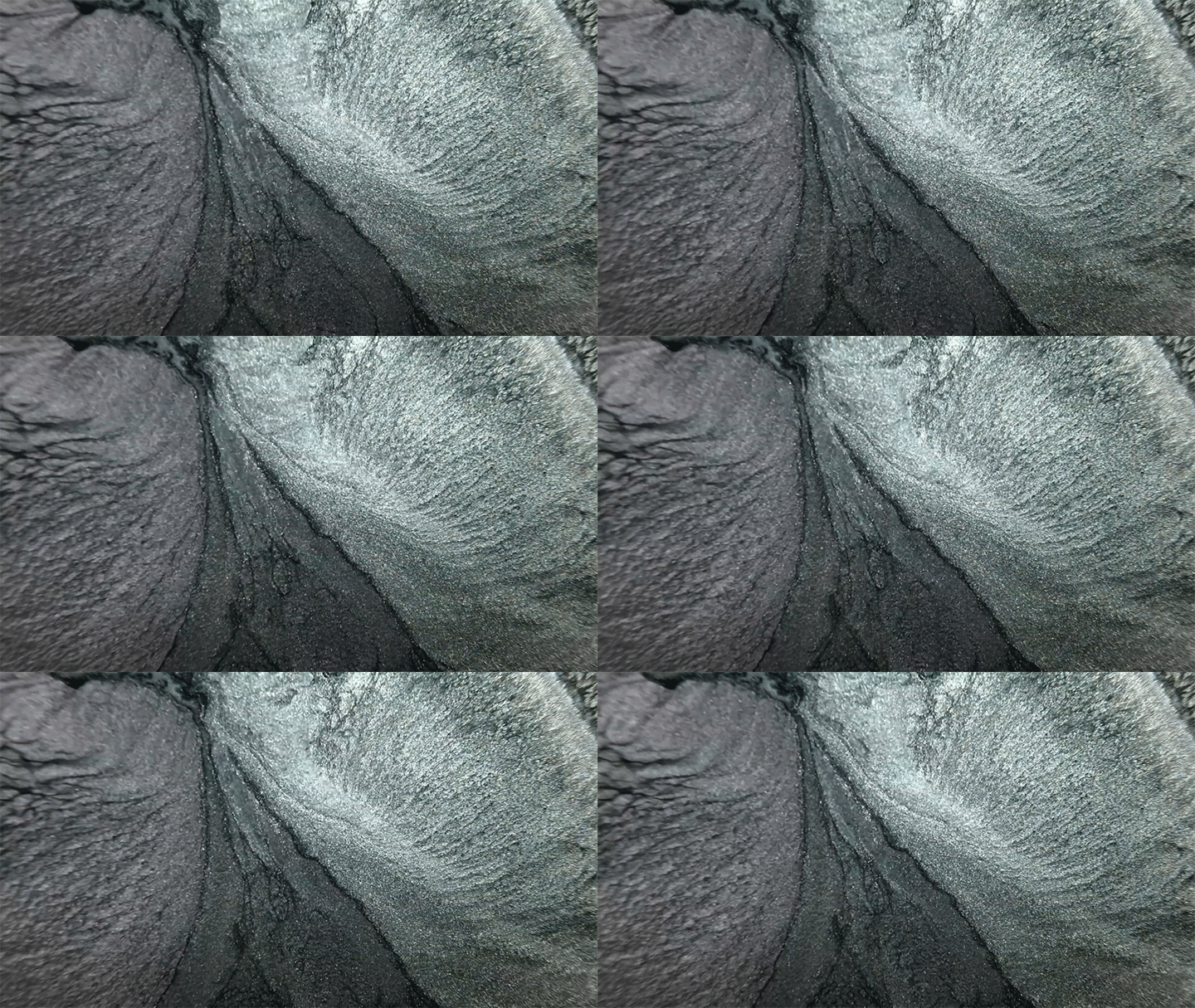
    Metallic paint flows like silver lava in this macro video from Chemical Bouillon. The paint has been mixed with an unknown fluid (my guess is alcohol) to produce the flows we see here. My suspicion is that we’re seeing solutal convection where variations in surface tension create convective flow within the liquid. What do you think? (Video and image credit: Chemical Bouillon)

  • Decelerating Jets

    Decelerating Jets

    For more than a century, scientists have been fascinated by the jet that forms after a drop impacts a liquid. In this study, researchers tracked fluorescent particles in the fluid to understand the velocity and acceleration of flow inside the jet. They found that, within the first 10ms after the jet appears, it decelerates at up to 20 times the gravitational acceleration. That’s much too fast for gravity to cause, pointing instead to the critical importance of surface tension in dictating the behavior of these fast-moving jets. (Image and research credit: C. van Rijn et al.; via APS Physics; submitted by Kam-Yung Soh)

  • Featured Video Play Icon

    Fluid Chains

    In this video, Steve Mould tackles a question many of us have likely wondered: just why does falling water make this chain-like shape? When pouring from a slit-like orifice, water jets take on this undulating pattern. While I have no issue with Steve’s explanation of surface tension oscillations driving the shape, I’ll quibble a little bit with the idea that this hasn’t been studied. Personally, I’d connect it to the fishbone instability, which classically occurs when two jets collide. At low flow rates, though, the colliding jets form a pattern very much like this one. And if you look just past the initial conditions at the container opening, all of these flows have thicker jet-like rims colliding. I think the flows in these videos are just a slightly messier version of the low-flow-rate fishbone. What do you think? (Video and image credit: S. Mould)

  • Featured Video Play Icon

    The Unsinkable Pygmy Gecko

    The Brazilian pygmy gecko is a tiny inhabitant of the Amazon rainforest, growing to no longer than 24 mm. But these tiny lizards have some incredible superpowers when it comes to surviving the rainforest’s deluges. The gecko’s surface is superhydrophobic — water repellent — thanks to millions of tiny hairs that create air pockets between water and the gecko’s skin. This superhydrophobic surface, combined with the gecko’s tiny stature, allow it to sit atop water, supported entirely by surface tension. (Image and video credit: BBC Earth)