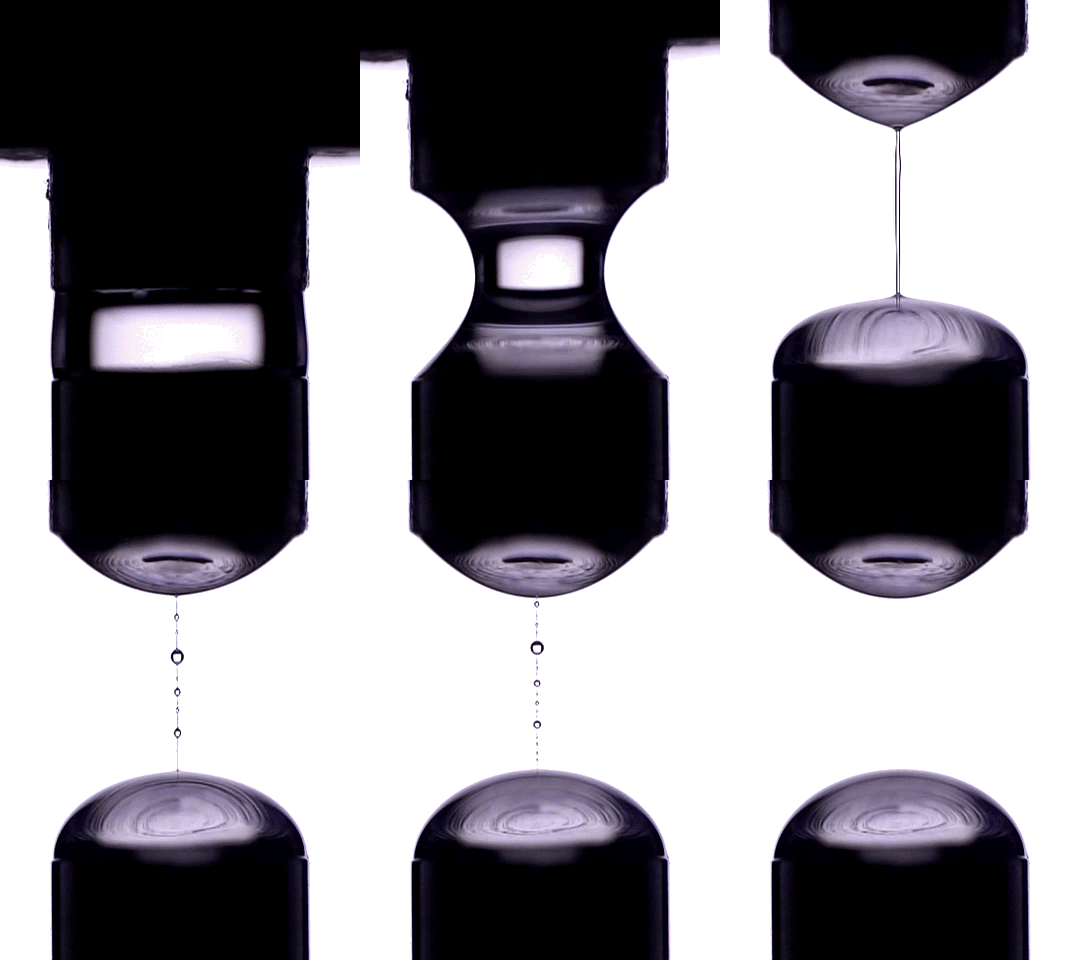
When still drops evaporate from a surface, they do so in several phases, as illustrated in the video above. Initially, the drop forms a spherical cap. At this point the velocity within the droplet is so small that it is difficult to resolve, but particles within the drop move outward toward the contact line. As the drop evaporates, they form a circle of sediment – the familiar coffee ring. As the drop flattens, radial velocity increases, drawing more and more particles to the coffee ring. Eventually the drop pulls away from the ring, leaving surface tension and evaporation to compete in driving the internal flow. During this phase, some parts of the contact line try to re-establish the flow pattern that made the first ring; this leaves behind circular segments broken up by the increasing instabilities in the contact line. In the final stage, surface tension smooths some of the irregularities and drives an inward velocity that leaves behind radial sediment segments. (Video credit: G. Hernandez-Cruz et al.)
Search results for: “surface tension”

Vibrating Droplets
When still, water drops sitting on a surface are roughly hemispherical, drawn into that shape by surface tension. But on a vibrating surface, the same water drop displays many different shapes, like those in the video above. Researchers have observed more than 30 different mode shapes by varying the driving frequency. The metal mesh placed beneath the glass on which the drops sit helps the researchers determine the drop’s shape. As the drop deforms, the mesh appears to distort due to the refraction of light through the changing shape of the drop’s water-air interface. The distortion allows observers to visualize (and in some experiments even reconstruct) the shape of the drop’s surface. Understanding this kind of droplet behavior is valuable for many applications, including ink-jet printing and microfluidic devices. (Video credit: C. Chang et al.; via Science)
Navigating the Interface
Walking on water may be the stuff of legend at human scales, but it’s a fact of everyday life for many smaller species. Waxy, hydrophobic coatings typically make such insects’ points of contact (feet, legs, etc.) water-repellent, and their light weight can be supported by surface tension. Navigating the interface between air and water is more complicated, though, and these creatures have evolved several mechanisms to help. Some, like water striders, use appendages they insert below the surface for propulsion. At 0:49 in the montage above, you can see flow visualization of the vortices generated by a stroke. Other insects release a chemical in their wake that lowers the local surface tension and drives them away via the Marangoni effect. For more, see here and especially this Physics Today article. (Video credit: D. Hu and J. Bush)
Contaminants Flowing Uphill
Here’s an example of some baffling fluid dynamics. Researchers have found that, when pouring a fluid from one container into a lower one containing a fluid with floating particulates, it’s possible for the floating particles to travel upstream against gravity and the flow. The phenomenon is driven by surface tension. The particulates floating in the lower container decrease the fluid’s surface tension relative to the pure fluid pouring in from above. This creates a gradient in surface tension that, via the Marangoni effect, drives a small flow upstream, in the direction of the greater surface tension. In the video above, this flow takes the form of two recirculating vortices in the pouring channel, oriented such that their upstream velocities run along the outside of the channel. Occasionally this flow draws particulates up the waterfall and into the recirculating zones, creating upstream contamination. We reported this previously, but the researchers have now released videos demonstrating the effect, including in pipettes and a water flume. Usually it’s taken for granted that matter cannot move upstream, so this could be a game-changer, especially at small scales where surface tension already dominates. For more, see their paper. (Video credit: S. Bianchini et al.)

Bouncing in Lockstep
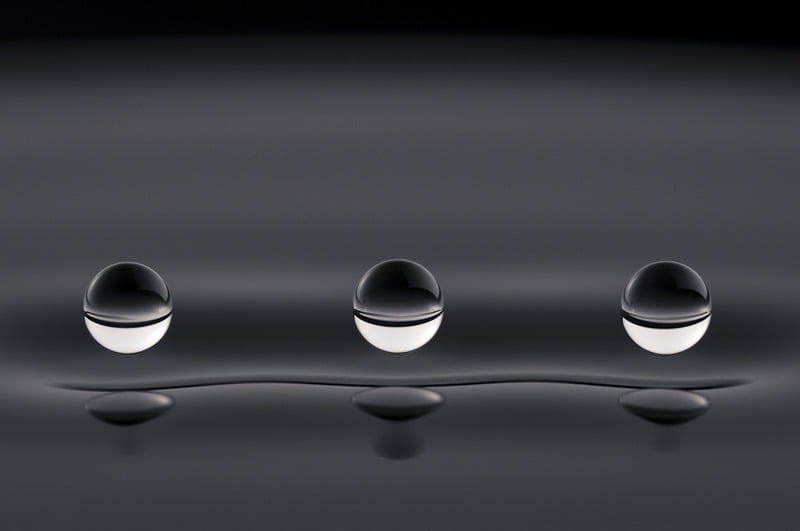
Droplets of silicone oil bounce on a pool of the same thanks to the vibration provided by a loudspeaker. Each droplet’s bounce causes ripples in the pool and the interference between these ripples fixes the droplets in lockstep with one another. As long as the vibration continues to feed the thin layer of air that separates the droplets from the pool during each bounce and no impurities break the surface tension at the interface, the droplets will bounce indefinitely on their liquid trampoline. Such systems can be used to observe quantum-mechanical behavior like wave-particle duality on a macro-scale. (Photo credit: A. Labuda and J. Belina)
Bursting Bubble
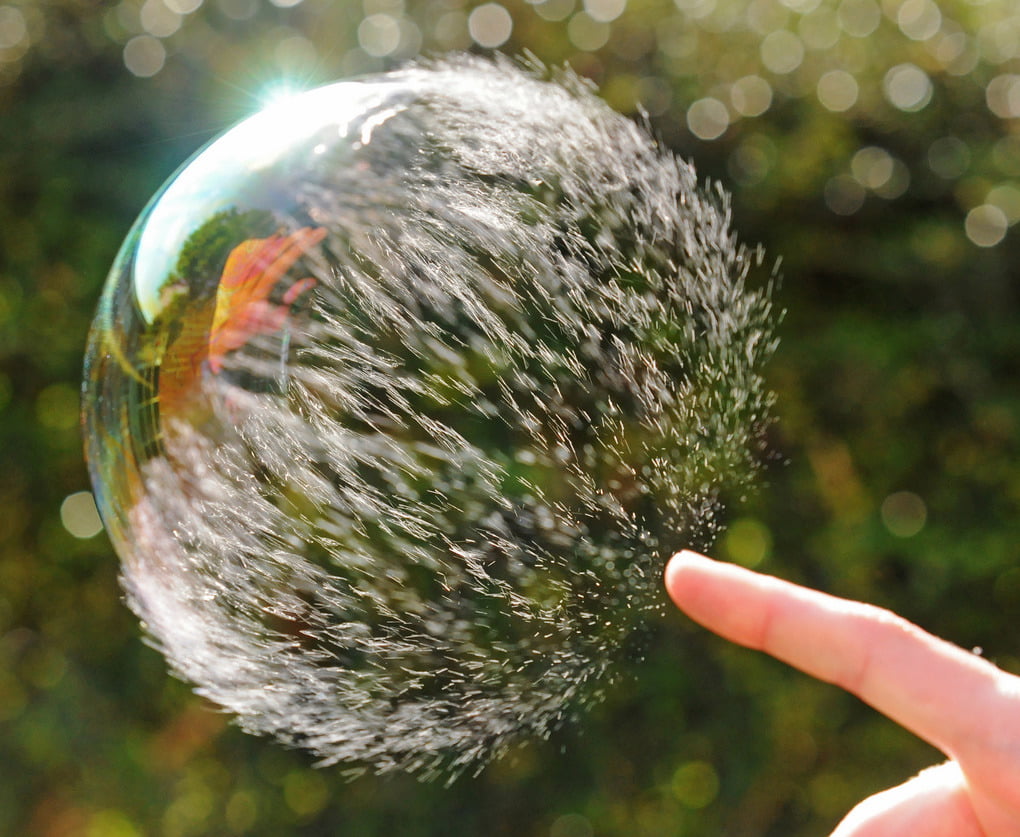
Originally posted: 24 Aug 2011 That soap bubbles burst in the blink of an eye is a pity considering how fascinating their disappearing act is. This photo set from photographer Richard Heeks captures the bubbles mid-burst. Once the bubble’s film is breached, surface tension rips the smooth film back like a broken balloon, causing the liquid that used to be part of the bubble to erupt into droplets. (Photo credit: Richard Heeks)
Reminder: Many thanks to those who have filled out the survey! There are some great responses so far. If you haven’t done so, won’t you please fill out our reader survey?

Beads on a String

Adding just a small amount of polymers to a liquid can drastically change its behavior. The polymers make the liquid viscoelastic, meaning that, under deformation, the liquid shows behaviors that are both viscous (like all fluids) and elastic (i.e. able to resume its original shape, like a rubber band). These properties are particularly identifiable under extensional loading, like in the animation above. Under these loads, the polymers in the fluid stretch and rearrange, creating an internal compressive stress that acts opposite the imposed tensile stress. It’s this balance of forces, along with ever-present surface tension that creates the beads-on-a-string effect seen above. (Image credit: B. Keshavarz)
ETA: As usual, Tumblr gave me issues with an animated GIF. It should be fixed now. Sorry!

Hanging Liquids
A horizontal filament of viscous liquid hanging between two plates stretches under gravity. The photo above is a composite showing the stretching of a single thread over several time steps. The fluid forms a catenary, the same shape as a hanging chain or cable when supported only at its ends. This behavior is confined to viscous filaments of sufficient length and diameter. Short and thin filaments instead form a U-shape with a thin horizontal filament joined to two thicker vertical threads. This difference in shape occurs due to the drainage of the liquid along the filament’s length. If the viscous thread begins to fall before surface tension drains the fluid from the center toward the ends, then a catenary of essentially uniform diameter forms. If instead the liquid drains before falling, the non-uniform U-shape is observed. (Photo credit: M. Le Merrer et al.)

The Colors of Soap
The brilliant and beautiful colors of a bubble are directly related the the thickness of the soap film surrounding it. When light shines on the soap film, some rays are reflected from the upper surface of the film, while others are refracted through the film and reflect off its lower surface. These reflected rays have different phase shifts and their interference is what causes the colors we observe. The color patterns themselves reveal the interior flow of the soap film, in which gravity tries to thin the film and surface tension tries to distribute the film evenly. (Photo credit: R. Kelly, A. Fish, D. Schwichtenberg, N. Travers, G. Seese)
Stretching to Break
Have you ever wondered what happens inside a jet of fluid as it breaks into droplets? Such events are not commonly or readily measured. This video uses a double emulsion–in which immiscible fluids are encapsulated into a multi-layer droplet–to demonstrate interior fluid flow during the Plateau-Rayleigh instability. The innermost drops and the fluid encapsulating them have a low surface tension between them, thanks to the addition of a surfactant to the inner drops. As a result, the inner drops are easily deformed by motion in the fluid surrounding them. Flow on the left side of the jet is clearly parabolic, similar to pipe flow. Closer to the pinch-off, the inner droplets shift to vertical lines, indicating that the interior flow’s velocity is constant across the jet. After pinch-off, the inner droplets return to a spherical shape because they are no longer being deformed by fluid movement around them. The coiling of the inner drops inside the bigger one is due to the electrical charges in the surfactant used. (Video credit: L. L. A. Adams and D. A. Weitz)