Search results for: “surface tension”

  • Bubble Dynamics Govern Faster Pouring

    Bubble Dynamics Govern Faster Pouring

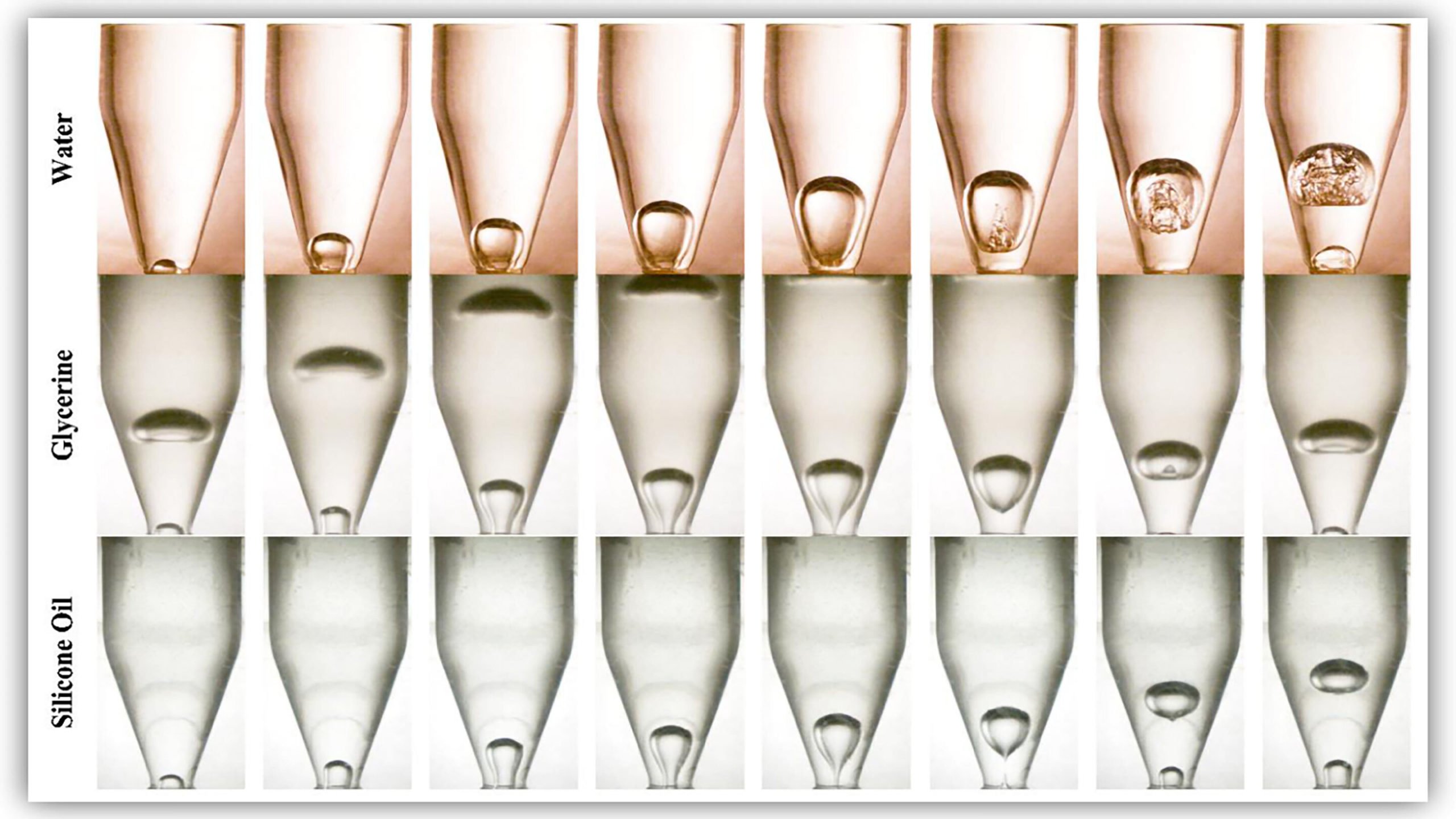
    We’re all familiar with the problem of pouring a liquid from a narrow-necked bottle. To a certain extent, tilting the bottle further will reduce the time it takes to empty, but if you tilt too far, your smooth pour becomes violent glugging as bubbles forming at the bottle’s mouth block liquid from exiting.

    Researchers find that the time it takes to empty a bottle depends both on the qualities of the liquid — its viscosity and surface tension — and on the geometry of the bottle. In particular, they found that the shape of the bottle influences how quickly bubbles grow at the bottle’s mouth when tilted to the critical angle. Their findings suggest that higher tilt angles and faster pours can be achieved by optimizing bottle geometry. (Image and research credit: L. Rohilla and A. Das; via phys.org)

  • Featured Video Play Icon

    Growing Metal Fingers

    Eutectic gallium-indium alloy is a room-temperature liquid metal with an extremely high surface tension. Normally, that high surface tension would keep it from spreading easily. But once the metal oxidizes, the surface tension drops. When that oxidation is combined with an electric field, the metal spreads into fingers. The higher the voltage, the more complex the fingering patterns. (Image and video credit: K. Hillaire et al.)

  • Capsule Impact and Bursting

    Capsule Impact and Bursting

    Nature and industry are full of elastic membranes filled with a fluid, from red blood cells to water balloons. A new study looks at how these capsules deform — and sometimes burst — on impact. The researchers created custom elastic shells that they filled with various fluids like water, glycerol, and honey, then used the impacts to build a model of capsule deformation.

    They found that there’s significant overlap between droplet impacts and capsule impacts, with a few key differences; instead of surface tension, capsules resist deformation through their elastic shell’s surface modulus — a combination of its elasticity and thickness. Capsules, unlike droplets, can also burst. To study this, the researchers used water balloons, which they were able to pre-stretch more easily than their custom shells. They found that their model could accurately predict the conditions under which the balloons burst.

    The authors hope the model will be helpful both in designing capsules intended to burst — like a fire-fighting projectile — and in creating safety measures to prevent capsule burst — like car-crash standards that protect from organ damage. (Image and research credit: E. Jambon-Puillet et al.; via Physics World; submitted by Kam-Yung Soh)

  • Featured Video Play Icon

    Expanding Water Beads

    In this timelapse, we see hydrogel beads expanding as they absorb water. There are some interesting subtleties to the physics here. Notice how, in the Petri dish segments, the beads shift from a single crystalline structure to several smaller structures. I suspect those shifts are driven by the dropping water level, which changes how surface tension interacts with the beads’ shape to create attractive forces between beads.

    Another interesting point comes as the beads expand through and out of the glass of water. Initially, the water level doesn’t change in the glass. This is because the water beads are taking up the same volume as the water that they’ve absorbed. But once the beads emerge past the water’s initial height, the water level drops dramatically. That’s because the beads are still absorbing what little water is left and continuing to expand in volume. (Image and video credit: Temponaut)

  • Featured Video Play Icon

    Mixing Leidenfrost Drops

    When placed on a very hot, patterned surface, droplets will self-propel on a layer of their own vapor. Here, researchers use this to drive droplets to coalesce so that they can observe how well they mix. After their head-on collision, the merged droplets have two major forces fighting in them: surface tension, which tries to minimize the overall surface area; and gravity, which tries to flatten the large droplet. Together, these forces drive the large oscillations we see in the merged drop, and those oscillations help mix the liquid from the two original drops together. (Image, video, and research credit: Y. Chiu and C. Sun)

  • Breaking Up Granular Rafts

    Breaking Up Granular Rafts

    Particles at a fluid interface will often gather into a collection known as a granular raft. The geometry of the interface where it meets individual particles, combined with the surface tension, creates the capillary forces that attract these particles to one another. Colloquially, this is called the Cheerio’s effect; it’s the same physics that draws those cereal chunks together in your bowl.

    Once together, these granular rafts can be surprisingly difficult to break up. That’s the focus of a new study on erosion in granular rafts. As seen in the top image, the raft has to be moving quite quickly before individual beads get pulled away. The experimental set-up here is pretty neat, and it’s not apparent from the video, so I’ll take a moment to explain it. The particles you see are gathered at an interface between water and oil. To generate the movement we see, researchers take the metal cylinder seen at the left of the image and pull it downward. That curves the oil-water interface, effectively creating a hill for the raft to accelerate down.

    To focus in on the forces necessary to separate individual particles, the researchers also looked at a pair of particles (bottom image). With this set-up, they could more easily track the geometry of the contact line where the oil, water, and bead meet. What they found is that the attractive forces generated between the beads are two orders of magnitude larger than predicted by classical theory. To correctly capture the effect, they needed a far more precise description of the contact line geometry around a sphere than is typically used. (Image and research credit: A. Lagarde and S. Protière)

  • Featured Video Play Icon

    “Focus, Vol. 1”

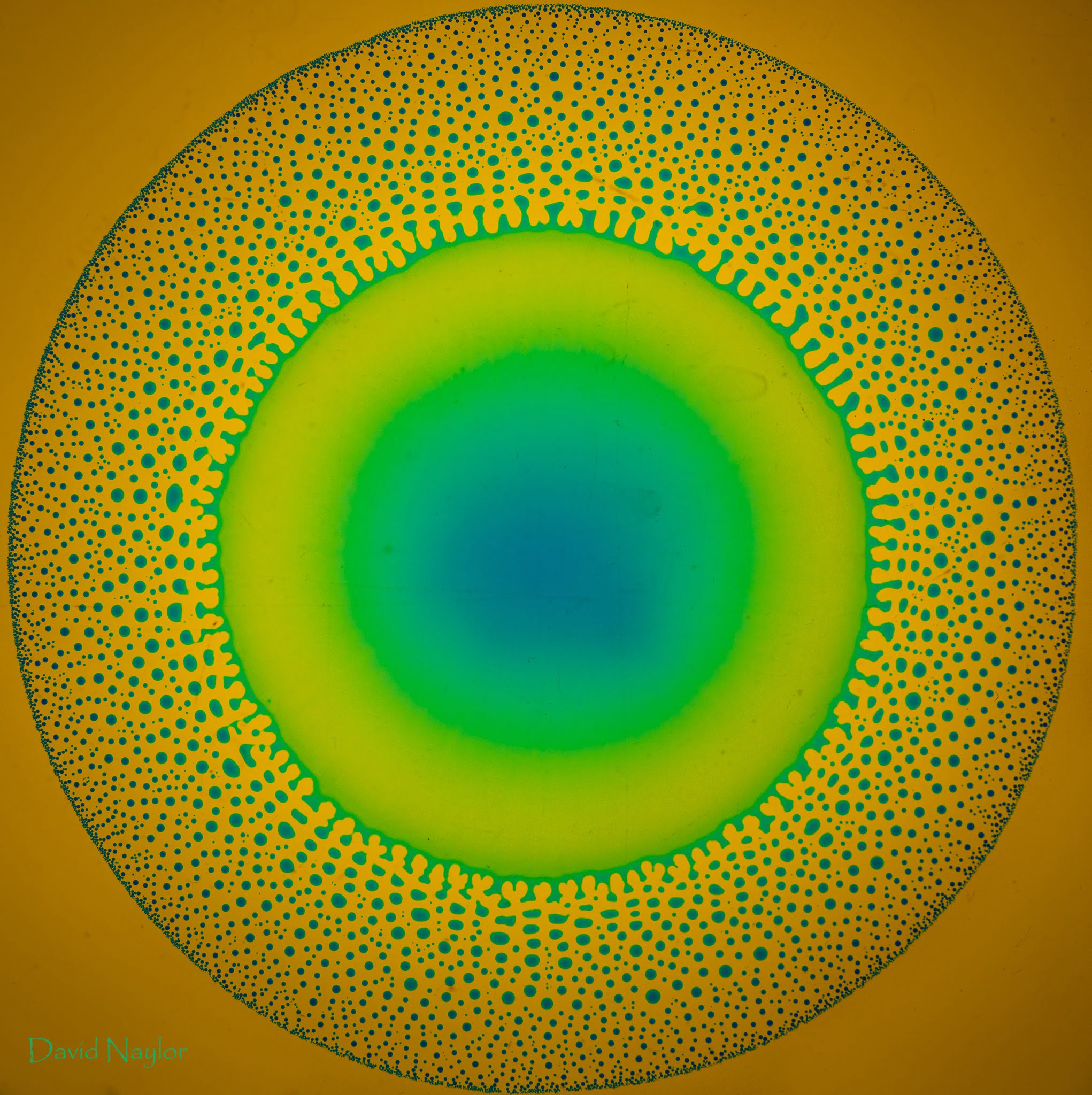
    In “Focus, Vol. 1,” photographer Roman De Giuli follows colorful droplets as they roll along, chase one another, and burst. You may notice that many of the drops seem attracted to one another. This is actually a surface tension effect caused by the dimples the droplets create on the surface; it’s the same effect responsible for Cheerios clumping together in your milk. Interestingly, though, the oil coating the drops doesn’t seem to drain quickly enough for the clumping drops to actually coalesce. (Image and video credit: R. De Giuli)

  • Featured Video Play Icon

    Why Animals Shake Themselves Dry

    For many animals, letting themselves air-dry is not an option. They would become hypothermic before their wet fur dried completely. This is why dogs and many other furry mammals shake themselves dry. It’s a remarkably efficient process, too, removing the majority of water from fur in a matter of seconds.

    The key is to shake at a frequency such that the centrifugal force of the shake overcomes surface tension’s ability to keep the water attached to fur. The looseness of a dog’s skin (compared to humans!) is a bonus for them; the extra translation as they shake increases the centrifugal force, allowing them to shed more water more quickly. (Image and video credit: BBC Earth; research credit: A. Dickerson et al.)

  • Featured Video Play Icon

    The Birth of a Liquor

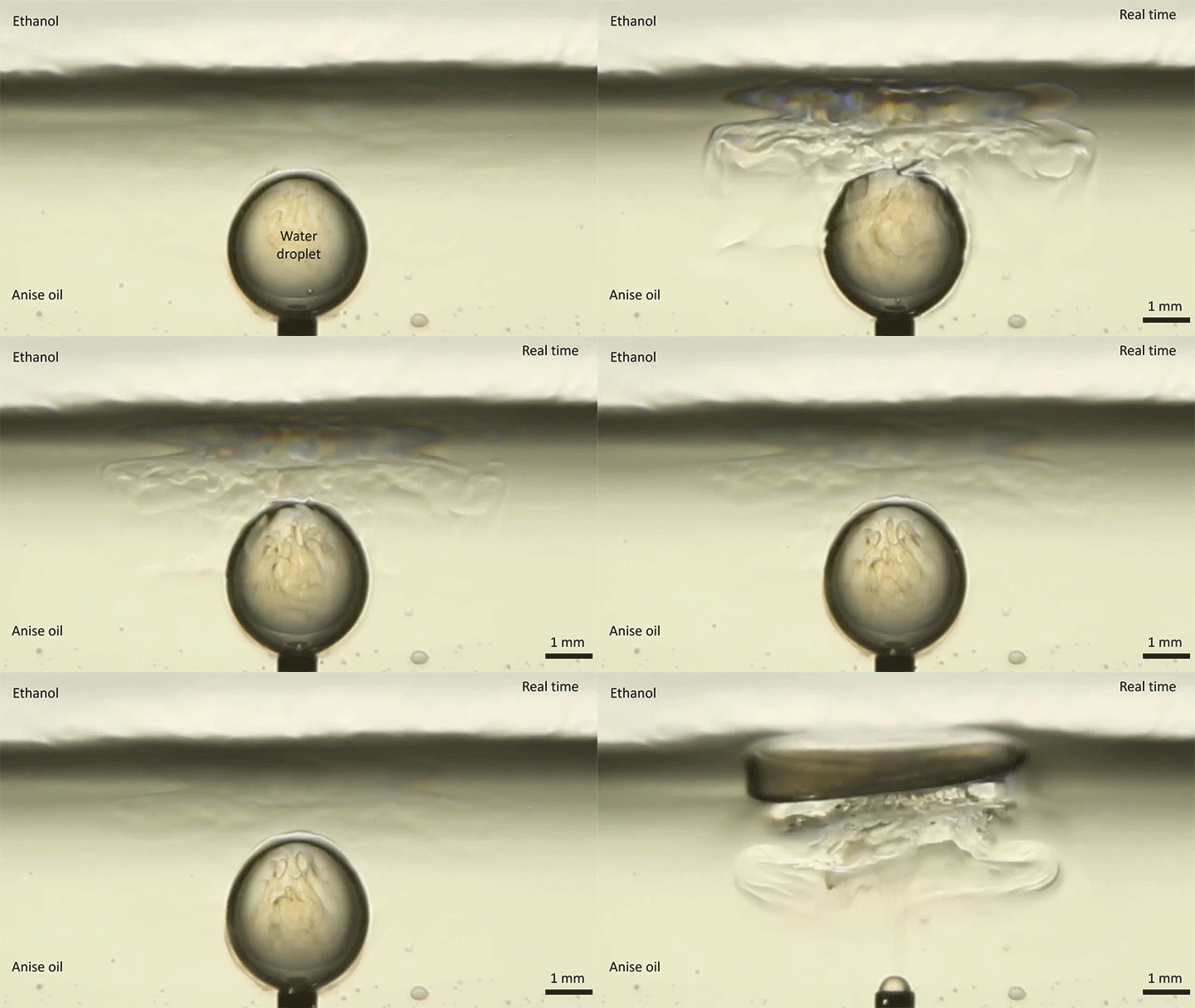
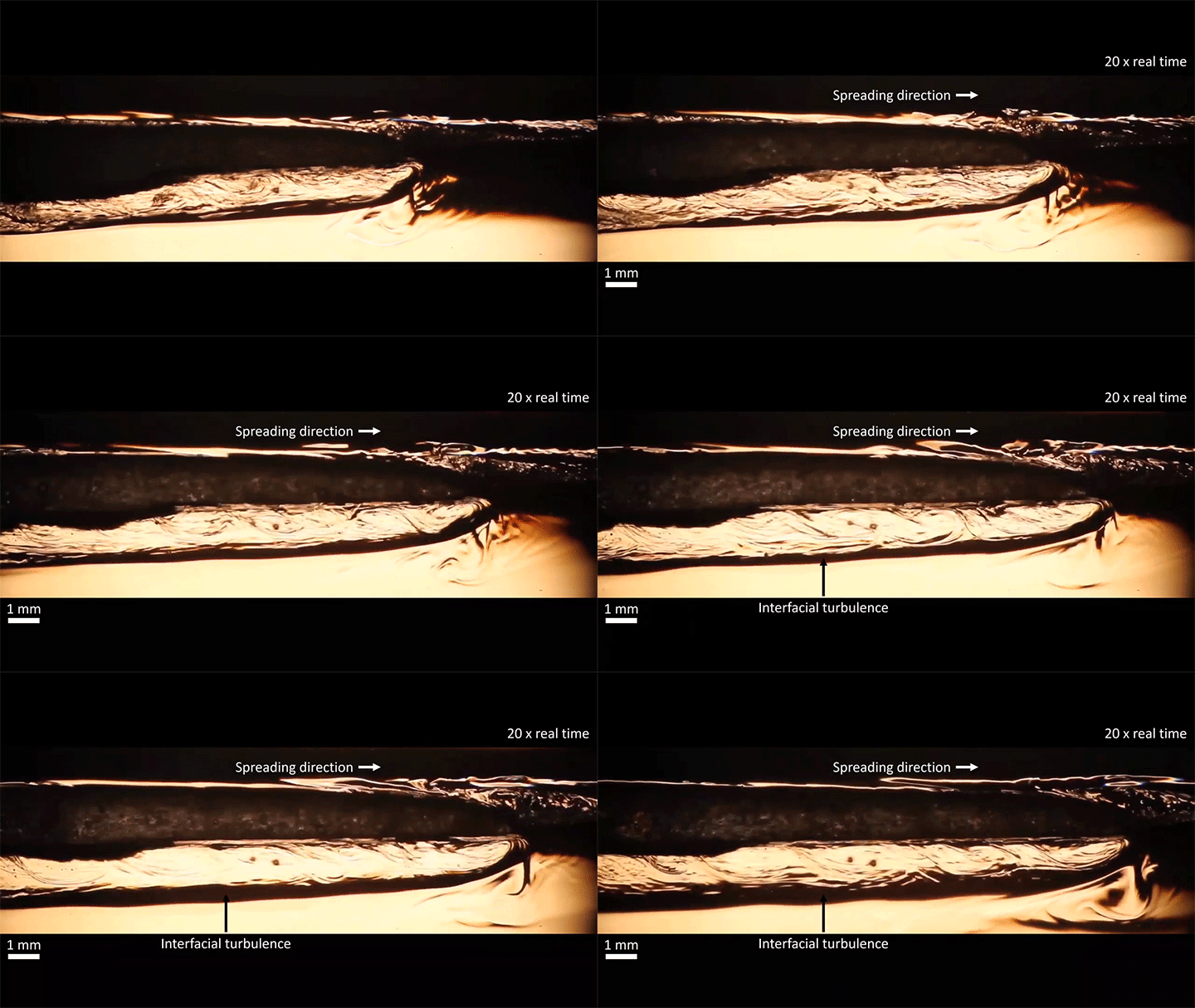
    A water droplet immersed in a mixture of anise oil and ethanol displays some pretty complicated dynamics. Its behavior is driven, in part, by the variable miscibility of the three liquids. Water and ethanol are fully miscible, anise oil and ethanol are only partially miscible, and anise oil and water are completely immiscible. These varying levels of miscibility set up a lot of variations in surface tension along and around the droplet, which drives its stretching and eventual jump.

    Once detached, the droplet takes on a flattened, lens-like shape that continues to spread. That spreading is driven by the mixing of ethanol and water, which generates heat and, thus, convection around the drop. This not only spreads the droplet, it causes turbulent behavior along the drop’s interface. (Image and video credit: S. Yamanidouzisorkhabi et al.)

  • Featured Video Play Icon

    “Dendrite Fractals”

    In this short film from the Chemical Bouillon team, dark ink drops spread in dendritic fractal patterns after being deposited on an unknown transparent liquid. Although the patterns look similar to those of the Saffman-Taylor instability, I suspect what we see here is actually driven by surface tension and not viscosity.

    The authors describe the ink they used as a “special old” “tree ink,” which — putting on my fountain pen aficionado hat — probably means some variety of iron gall ink. These inks draw on chemicals extracted from trees and other plants to create a permanent, waterproof ink. They tend to be highly acidic, which could play a role in the pattern formation seen here. (Video and image credit: Chemical Bouillon)