In an ongoing tradition, let’s take another look at some Star Wars-inspired aerodynamics. This year it’s the TIE fighter’s turn. Here, researchers simulate the spacecraft trying to escape Yavin 4’s atmosphere at Mach 1.15. The research poster’s blue contours show pressure contours, with darker colors connoting higher pressures. The bright low pressure region immediately behind the craft suggests a difficult, high-drag ascent and a turbulent, subsonic wake despite the craft’s supersonic velocity. (Image credit: A. Martinez-Sanchez et al.)
Tag: star wars

Millennium Falcon’s Glide
In what seems to be a tradition now, a group at MIT imagined how the Millennium Falcon would perform if it lost its engines during atmospheric flight. Their hypothetical scenario took place in the Battle of Endor, with the Falcon flying at an altitude of 2 kilometers.* Could Han Solo and Chewbecca safely glide the craft down?
Using computational fluid dynamics, the group found the Millennium Falcon has a glide ratio of only 1.8, meaning it travels forward 1.8 kilometers in the time it takes to lose one kilometer of altitude. Its namesake bird, on the other hand, has a glide ratio of 10. The Corellian freighter might not be the best glider out there, but the team estimated that it could safely manage its 3.6 kilometer glide down. (Image credit: S. Costa et al.; see also X-Wing Re-entry and AT-AT Flow)
*I’m definitely overthinking this, but now I’m really wondering what atmospheric characteristics they used for Endor. And what’s Endor’s gravity like?
Flow Over an AT-AT
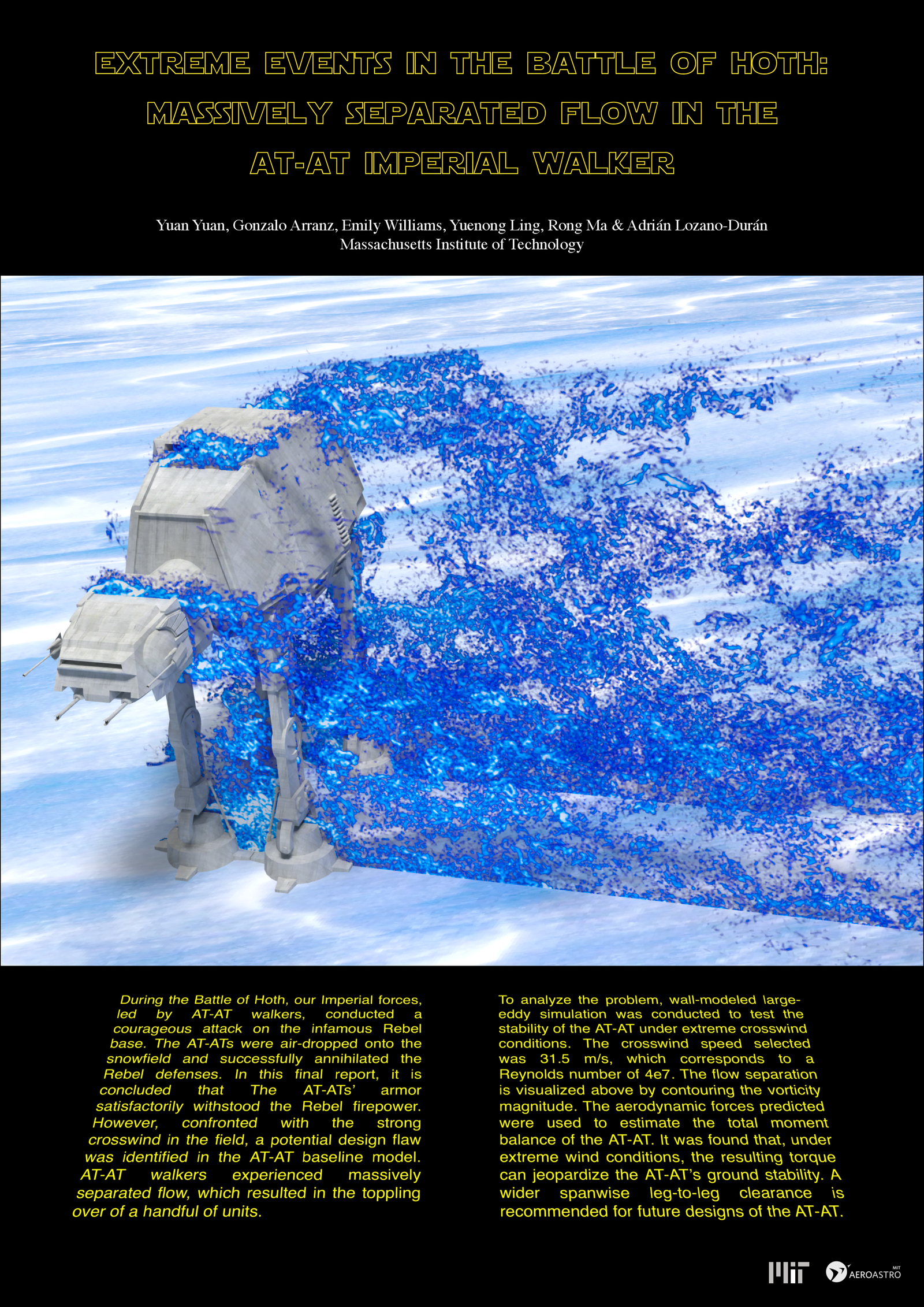
Having previously examined the re-entry characteristics of an X-Wing, a group of engineers are back to look at Imperial vehicle physics. In this poster, they look at what happens to the AT-AT walker when strong crosswinds, like those seen in the Battle of Hoth, blow across the vehicle’s path. Given its boxy body and gangly legs, it will come as no surprise that the AT-AT is not at all streamlined and instead causes lots of separated flow. Those flow separations come with strong side forces that can tip the walkers.
Be sure to take a closer look at the text on the poster. It’s written from the perspective of Imperial engineers, complete with recommendations for the next generation of AT-AT. (I don’t think those got built, at least not by the Empire!) May the 4th be with you! (Image credit: Y. Yuan et al.)
Re-Entry For X-Wings
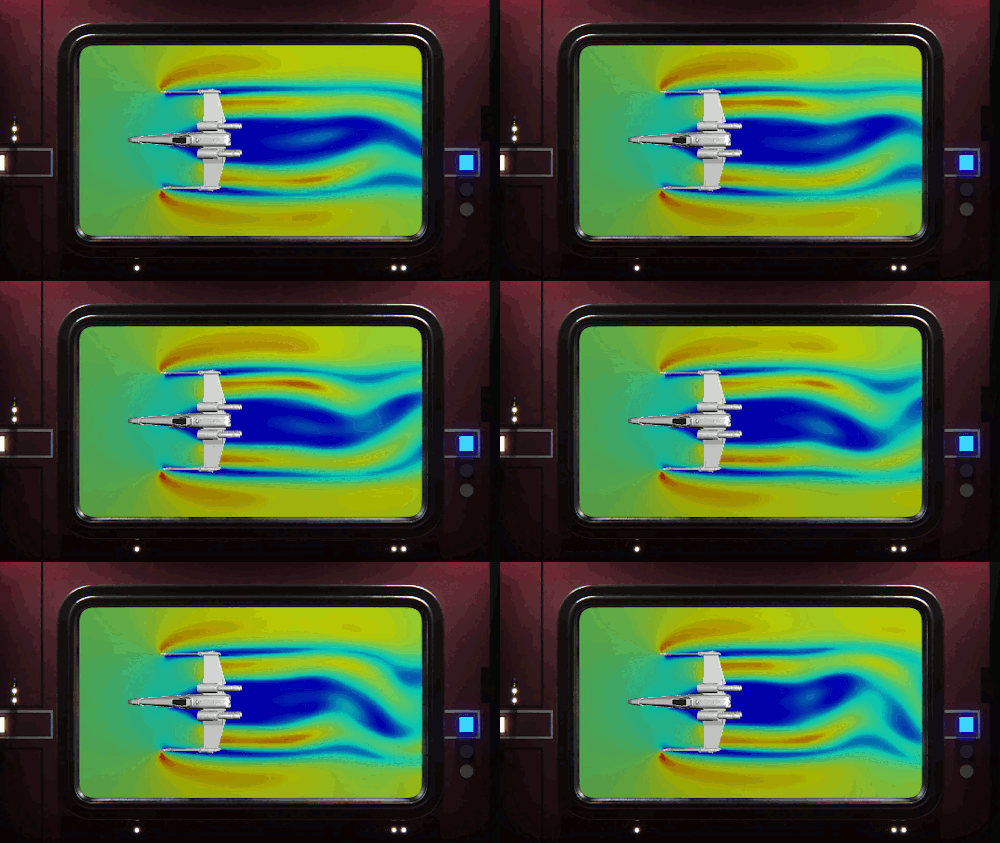
Fans of sci-fi and fantasy have a long-standing tradition of exploring the physics and/or practicality of creations in their fandom, and Star Wars fans are no exception. Here engineers ask whether Luke Skywalker’s X-wing fighter could survive the descent through Dagobah’s atmosphere as he searched for Master Yoda. Their results are based on a numerical simulation, with some assumptions about the spacecraft’s descent path and design as well as the planet’s atmosphere. Fans of the Jedi will be glad to hear that the X-wing can survive its supersonic descent intact, delivering the last Jedi safely to his mentor. (Image credit: Y. Ling et al.)

Creating Star Wars-Like Volumetric Displays


Despite their ubiquity in science fiction, volumetric displays — three-dimensional displays visible from any angle — have been tough to create in real life. But a team from the University of Sussex has made impressive strides using a system based on acoustic levitation.
Here’s how it works: an array of ultrasonic speakers levitates and moves small plastic beads at up to 9 m/s. Simultaneously, LED lights project colors onto the sphere. Thanks to the human brain’s ability to create persistent images from the motion, we’re able to see simple displays like the figure-8 and smiley face above with the naked eye. To form something more complicated, like the spinning globe seen in the final image, the bead must be filmed using a camera with a slow shutter speed. But with that, the display looks incredible.
There’s obviously a ways to go before your R2 unit can project holographic messages for you, but all the basic ingredients for that technology are here. Check out the coverage on Scientific American and the original research paper for more. (Image credit: Star Wars – Lucasfilm; others – E. Jankauskis; research credit: R. Hirayama et al.; via SciAm)

Star Wars Aerodynamics
Science fiction is not always known for hewing to scientific fact, so it will probably come as little surprise that Star Wars’ ships have terrible aerodynamics. But it’s nevertheless fun to see EC Henry’s analysis of drag coefficients of various Rebel and Imperial ships and just how poorly they fare against our own designs.
Drag coefficients really only give a tiny piece of the story, though. We don’t know what speed Henry is testing the ships at, and we get no information about properties like lift or lift-to-drag ratio, which can be even more important than just the drag when it comes to evaluating an aircraft.
There are some intriguing hints about other aerodynamic properties in the clips of flow around an X-wing and TIE fighter, though. Notice that the wake of both ships meanders back and forth. This is an indication of vortex shedding, and it means that both spacecraft would tend to be buffeted from side-to-side when flying in an atmosphere. Either the ships would need some kind of active control to counter those forces, or pilots would need iron constitutions to operate under those conditions! (Video and image credit: EC Henry)
[original video no longer available]