Search results for: “liquid jet”

  • Daily Fluids, Part 4

    Daily Fluids, Part 4

    Inside or outside, we encounter a lot of fluid dynamics every day. Here are some examples you might have noticed, especially on a rainy day:

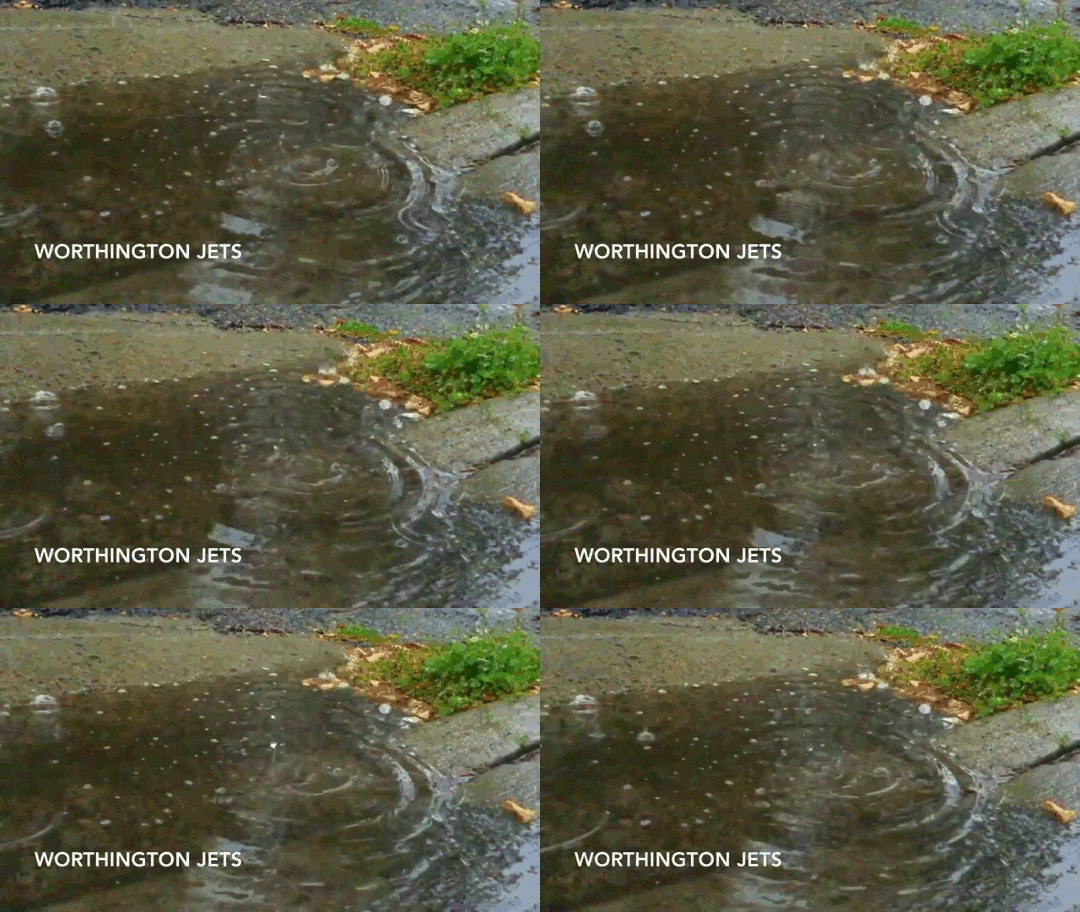
    Worthington Jets
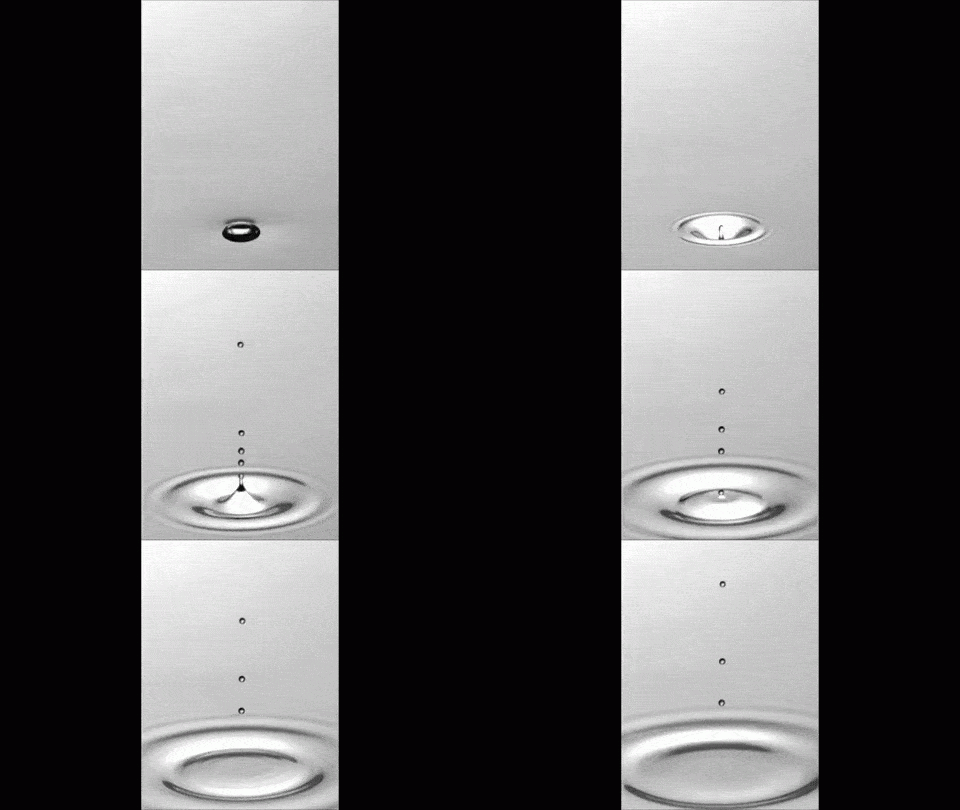
    After a drop falls into a pool, there’s a column-like jet that pops up after it and sometimes ejects another small drop. This is known to fluid dynamicists as a Worthington jet, but really it’s something we all see regularly, especially if you watch rain falling onto puddles or look really closely at your carbonated drink.

    Crown Splash
    Like the Worthington jet, crown splashes often follow a drop’s impact into another liquid. But they can also show up when slicing or stomping through puddles!

    Free Surface Dynamics
    Anytime you have a body of water in contact with a body of air, fluid dynamicists call that a free surface. How the interface between the two fluids shifts and transforms is fascinating and complicated. Waterfalls are a great example of this, but so are ocean waves or even the ripples from tossing a rock into a pond.

    Hydrophobic Surfaces
    Water-repellent surfaces are called hydrophobic. Water will bead up on the surface and roll off easily. While many manmade surfaces are hydrophobic, like the teflon in your skillet, so are many natural surfaces. Many leaves are hydrophobic because plants want that water to fall to the ground where their roots can soak it up. Keep an eye out as you wash different vegetables and fruits and see which ones are hydrophobic!

    Check out all of this week’s posts more examples of fluid dynamics in daily life. (Image credit: S. Reckinger et al., source)

  • Daily Fluids, Part 1

    Daily Fluids, Part 1

    Just getting cleaned up and ready for the day involves a lot of fluid physics. Here are a few of the phenomena you may see daily without realizing:

    Plateau-Rayleigh Instability
    This behavior is responsible for the dripping of your faucet. More specifically, it’s the reason that a falling jet breaks up into droplets. It works on rain, too!

    Forced Convection
    Everyone is familiar with a winter wind making them colder or hot air from a dryer getting the moisture off their hands. These are examples of forced convection – heat transfer by driving a fluid past a solid. Another common example? The fans in your computer!

    Liquid Atomization
    This is the process of breaking a liquid into lots of tiny droplets. Aside from any aerosol can ever, this phenomenon is also key to your daily shower and internal combustion in your car.

    Archimedes Principle
    This might be one of my favorite bits of the whole video because it hearkens back to some of my own earliest fluid dynamics exposure. Archimedes Principle says that buoyancy is equal to the weight of the fluid a body displaces. My mom (a science teacher) taught me about this one in the bathtub! It’s key to everything that ever floated, including us!

    Tune in all week for more examples of fluid dynamics in daily life. (Image credit: S. Reckinger et al., source)

  • Blowing Through a Straw

    Blowing Through a Straw

    As kids, most of us got in trouble at some point for blowing through a straw into our nearly-empty drinks. What you see here is a consequence of such misbehavior, though in this case the fluid is silicone oil and the straw is a metal needle (not shown) through which helium is continuously injected beneath the liquid surface. Depending on the angle of the straw, different behaviors are observed, as seen in this video. The photo above shows an intermediate regime, in which tiny jets form at the surface and eject a stream of drops. Each drop sails in a little parabolic arc and briefly bounces on the surface, like the drops on the right, before coalescing into the pool. (Image credit: J. Bird and H. Stone; video)

  • Electric Coiling

    Electric Coiling

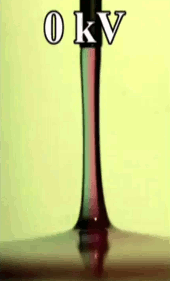
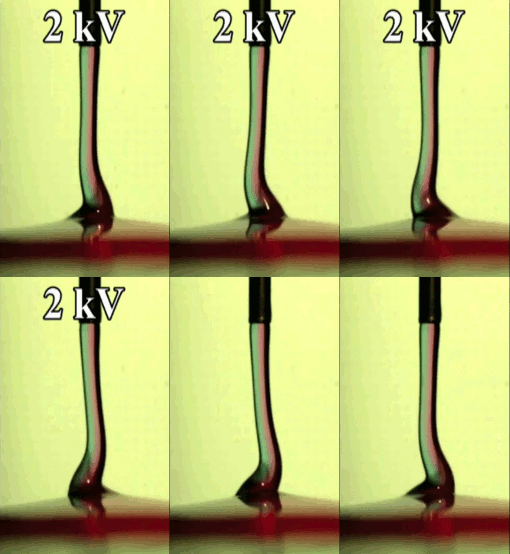
    A falling jet of viscous fluid–like honey or syrup–will often coil. This happens when the jet falls quickly enough that it gets skinnier and buckles near the impact point. Triggering this coiling typically requires a jet to drop many centimeters before it will buckle. In many manufacturing situations, though, one might want a fluid to coil after a shorter drop, and that’s possible if one applies an electric field! Charging the fluid and applying an electric field accelerates the falling jet and induces coiling in a controllable manner. 

    An especially neat application for this technique is mixing two viscous fluids. If you’ve ever tried to mix, say, food coloring into corn syrup, you’ve probably discovered how tough it is to mix viscous substances. But by feeding two viscous fluids through a nozzle and coiling the resulting jet, researchers found that they could create a pool with concentric rings of the two liquids (see Figure C above). If you make the jet coil a lot, the space between rings becomes very small, meaning that very little molecular motion is necessary to finish mixing the fluids. (Image credits: T. Kong et al., source; via KeSimpulan)

  • Miniature Bursting Bubbles

    Miniature Bursting Bubbles

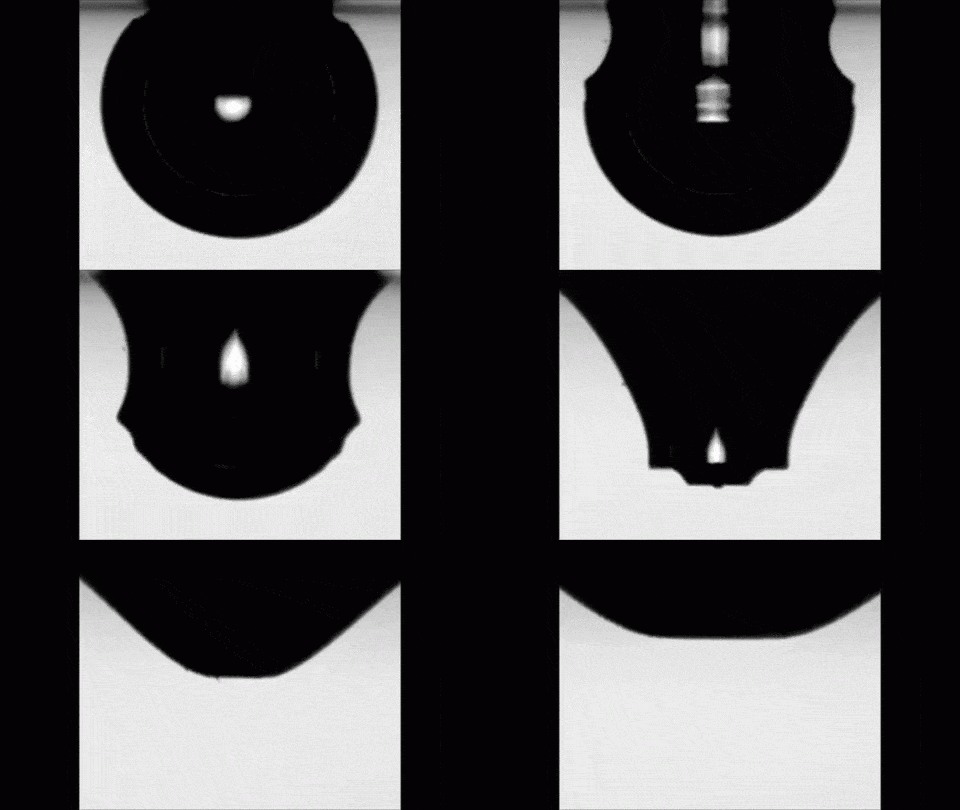
    Fizzy drinks like soda or champagne contain dissolved carbon dioxide which forms bubbles when the pressure inside its container is released. The tiny bubbles rise to the surface where the liquid film covering them can rupture, creating a small cavity at the surface. The cavity collapses in a matter of milliseconds (bottom animation). Above the surface, the cavity reverses its curvature to create a liquid jet (top animation) which can expel multiple tiny droplets. These droplets can tickle a drinker who hovers too close, but they also carry and distribute the aroma molecules that are part of the experience of a drink like champagne. (Image credit: E. Ghabache et al., source)

    (Today’s topic brought to you by my impending nuptials to my favorite physicist/spacecraft engineer.)

  • Alligators Water Dancing

    Alligators Water Dancing

    Amorous alligators call to mates with a behavior known as water dancing. Their audible bellows are accompanied by infrasonic soundvibrations below the 20 Hz limit of human hearing. These vibrations from their lungs excite Faraday waves in the water near the alligator’s back and make the surface explode in a dance of jets and atomized droplets. I’ve seen similar results in other instances of vibration, but this may be the only example of this I’ve seen in the wild. Researchers studying the phenomenon noted that the frequency of sound the alligators emit corresponds to a wavelength equal to the spacing of the raised scales, or scutes, on the alligators’ backs. They hypothesize that the shape of the scutes helps males create the display.  (Image credit: N. Marven, source; research credit: P. Moriarty and R. Holt; h/t to io9)

    ——————

    Don’t forget about our FYFD survey! I’ve teamed up with researcher Paige Brown Jarreau to create a survey of FYFD readers. By participating, you’ll be helping me improve FYFD and contributing to novel academic research on the readers of science blogs. It should only take 10-15 minutes to complete. You can find the survey here. Please take a few minutes to participate and share!

  • The Dance of the Droplets

    The Dance of the Droplets

    Milk and juice vibrating on a speaker can put on a veritable fireworks display of fluid dynamics. Vibrating a fluid can cause small standing waves, called Faraday waves, on the surface of the fluid. Add more energy and the instabilities grow nonlinearly, quickly leading to tiny ligaments and jets of liquid shooting upward. With sufficiently high energy, the jets shoot beyond the point where surface tension can hold the liquid together, resulting in a spray of droplets. (Image credit: vurt runner, source video; h/t to @jchawner)

  • Featured Video Play Icon

    Fire-Breathing

    In this high-speed video, the Slow Mo Guys demonstrate fire-breathing. Rather than using a liquid fuel like kerosene, they utilize cornstarch, which is both easily flammable and non-volatile thanks to its powdered form. Blowing out the cornstarch creates a turbulent jet of cornstarch and air. Combine that with a combustion source, and the cornstarch quickly deflagrates, meaning that the flame propagates via heat transfer. When neighboring regions of cornstarch become hot enough, they ignite and the flame front expands. You can observe this in the flame growth shown in the video; just after ignition the cornstarch jet is much wider than the fire and it takes some time for the flames to catch up with the jet. Although a liquid-fueled fireball operates by the same principles, it can look rather different. For comparison, check out this high-speed video of a WD-40 fireball. And, hopefully it goes without saying, but don’t try this stuff at home. (Video credit: The Slow Mo Guys)

  • Cavitation

    [original media no longer available]

    Cavitation–the formation and collapse of vapor-filled cavities within a liquid–occurs in a variety of natural and manmade applications. It can shatter bottles, wreak havoc with boat impellers, is used as a hunting mechanism by several shrimp species, and can even generate light and sound. It is the collapse of the cavitation bubble that can be so damaging, and this video shows how. In the experiment, researchers generate a cavitation bubble near the free surface–or, in other words, near the air-water interface. Pressure in the bubble is much lower than the pressure of the surrounding liquid, so the bubble collapses after the momentum from its initial generation is spent. Interaction with the surface generates a jet that projects downward and pierces the cavitation bubble as it collapses. As seen from 0:54 onward, the bubble’s collapse generates a shock wave that propagates outward from the bubble site. It’s this shock wave that so effectively damages materials and stuns underwater prey. (Video credit: O. Supponen et al.)

  • Beverage Bubbles Bursting

    Beverage Bubbles Bursting

    Fizzy drinks like soda and champagne have many bubbles which rise to the surface before bursting. When the film separating the bubble and the air drains and bursts, it leaves a millimeter-sized cavity that collapses on itself. That collapse creates an upward jet of fluid which can break into tiny aerosol droplets that disperse the aroma and flavor of the drink. Similar bubble-bursting events occur in sea spray and industrial applications, too. Researchers find that droplet ejection depends on bubble geometry and fluid properties such as viscosity. More viscous liquids, for example, generate smaller and faster droplets. Learn more and see videos of bubble-bursts at Newswise. (Image credit: E. Ghabache et al.)